 EN
EN
Meta title: Why a Zinc Glycinate COA May Not Prove Chelation
Meta description: A 20% zinc assay can look perfect while failing to prove zinc bisglycinate identity. Learn what importers should verify before approving a bulk order.
The COA says 20.4% zinc. The specification says “zinc glycinate chelate.” The price says premium.
None of those facts proves that you received the chelate you paid for.
An elemental zinc assay answers one question: how much zinc is present. It does not automatically establish what zinc compound is present, whether two glycine ligands are coordinated to each zinc ion, how much unreacted glycine remains, or whether inexpensive zinc oxide was blended into the batch.
That gap is one of the most expensive blind spots in mineral sourcing. A drum can pass a zinc assay and still fail the commercial story printed on your customer’s label.
Total zinc and chelate identity are different claims
AAS or ICP can quantify elemental zinc accurately. These are valuable release tools, but they destroy or atomize the sample during measurement. The result generally does not preserve information about the original molecular structure.
If zinc oxide, zinc sulfate and zinc bisglycinate were adjusted to the same elemental zinc concentration, a total-zinc result alone would not tell the buyer which source created the number.
Ask the supplier to separate four specifications:
- elemental zinc content;
- chemical identity;
- ligand-to-metal relationship;
- free or unreacted starting materials.
Download our zinc glycinate specification checklist before comparing quotations.
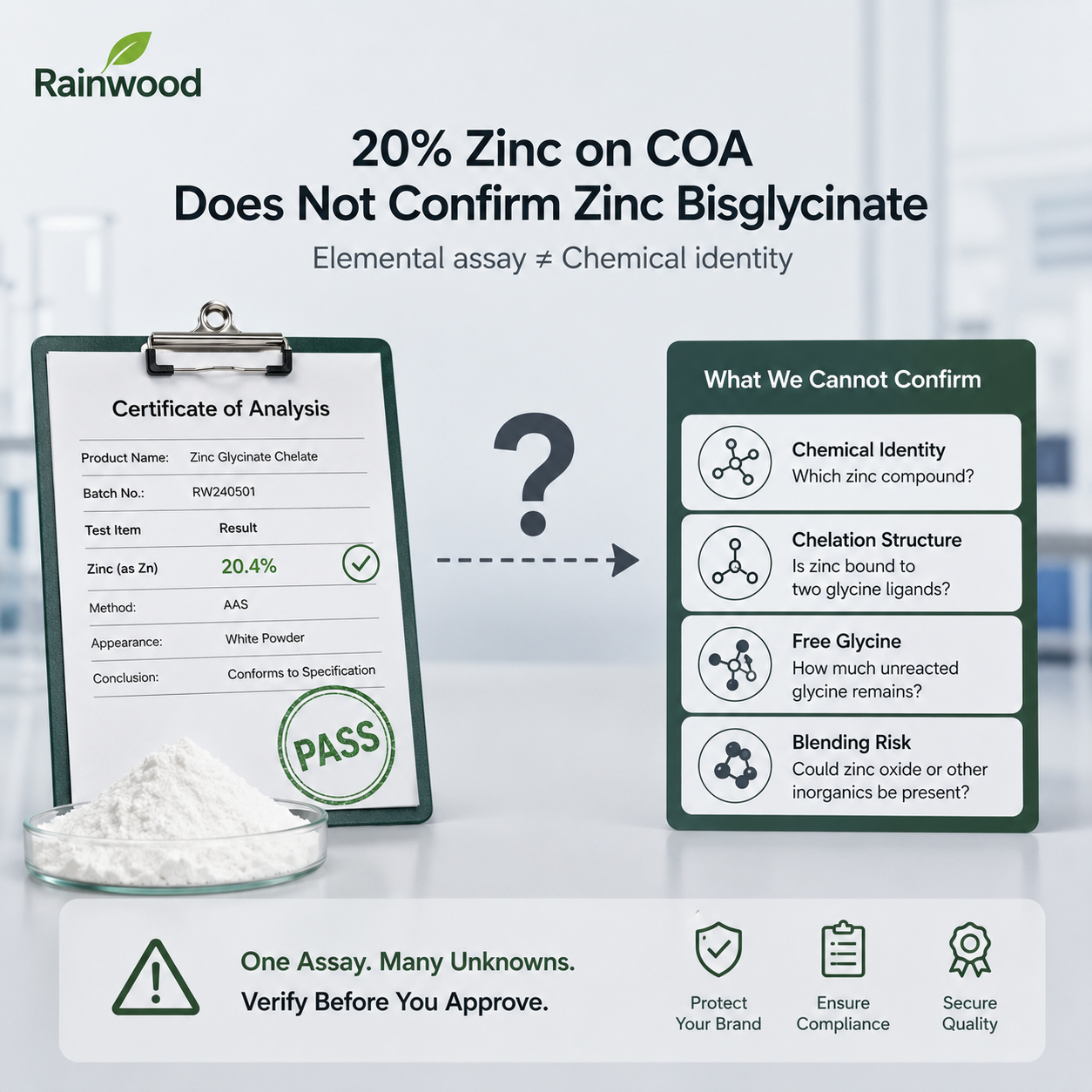
Red flag 1: the method column says only “AAS”
AAS can support the zinc-content claim. It cannot, by itself, prove bisglycinate structure.
Your document pack should explain how identity is established. Depending on the material and justified method, the evidence may include a combination of infrared spectroscopy, X-ray diffraction, comparison with a qualified reference material, chromatographic or ligand analysis, reaction-process records and mass-balance information.
No single fashionable instrument should be treated as magic. The method must discriminate the purchased material from plausible substitutes and physical mixtures.
If the supplier answers “our zinc result passes, so the chelate is confirmed,” stop the approval process.
Red flag 2: “chelation rate” appears without a definition
Some quotations advertise 90%, 95% or even 100% chelation. Ask what the percentage means.
Is it:
- percentage of total zinc considered chelated;
- percentage of glycine that reacted;
- percentage of finished powder represented by a named complex;
- a calculation based on input quantities; or
- a proprietary color or solubility test?
A percentage without a defined measurand, validated method, calculation and acceptance criterion is decoration—not evidence.
The supplier should be able to provide the method principle, reference material, specificity, recovery, precision and treatment of free zinc or free glycine. If it cannot, do not build “fully reacted” or “true chelate” claims on the number.
Red flag 3: the elemental percentage does not match the material story
Pure anhydrous zinc bisglycinate has a theoretical zinc proportion based on its molecular formula. Commercial materials may differ because of water, carriers, processing aids or a standardized concentration. That is not automatically a defect, but it must be declared.
A 20% material and a 30% material can both be legitimate commercial ingredients with different specifications. They are not interchangeable kilogram for kilogram.
Ask for:
- exact chemical name and CAS information;
- molecular or compositional basis;
- hydration state where relevant;
- carrier identity and percentage;
- zinc specification on an as-is or dry basis;
- glycine specification;
- moisture or loss on drying; and
- calculation used for formulation.
Otherwise, a buyer may formulate with 100 mg of powder believing it supplies 30 mg of elemental zinc when it actually supplies 20 mg.
Read our elemental-zinc calculation guide.
Red flag 4: the quotation and COA use different names
“Zinc glycinate,” “zinc bisglycinate,” “zinc amino acid chelate” and “glycine zinc complex” are often used loosely in commercial documents. Some may refer to the same intended compound; others may describe broader or materially different preparations.
Reconcile the name across:
- quotation;
- purchase specification;
- manufacturer declaration;
- COA;
- SDS;
- invoice and customs documents;
- finished-product formula; and
- consumer label.
One approved identity should follow the material from manufacturer to finished bottle. A sales representative’s statement that the names are “basically the same” is not a change-control system.
Red flag 5: the laboratory tests a convenient composite
A composite sample can produce an acceptable average while hiding pockets of unreacted raw material or poor blend uniformity. This matters if the final product is a standardized preparation rather than a single well-characterized crystalline substance.
For new suppliers or high-risk batches, agree on sampling across containers and locations. Retain samples and define what happens when identity evidence conflicts with elemental assay.
The right question is not “does one scoop pass?” It is “does the commercial lot consistently match the approved material?”
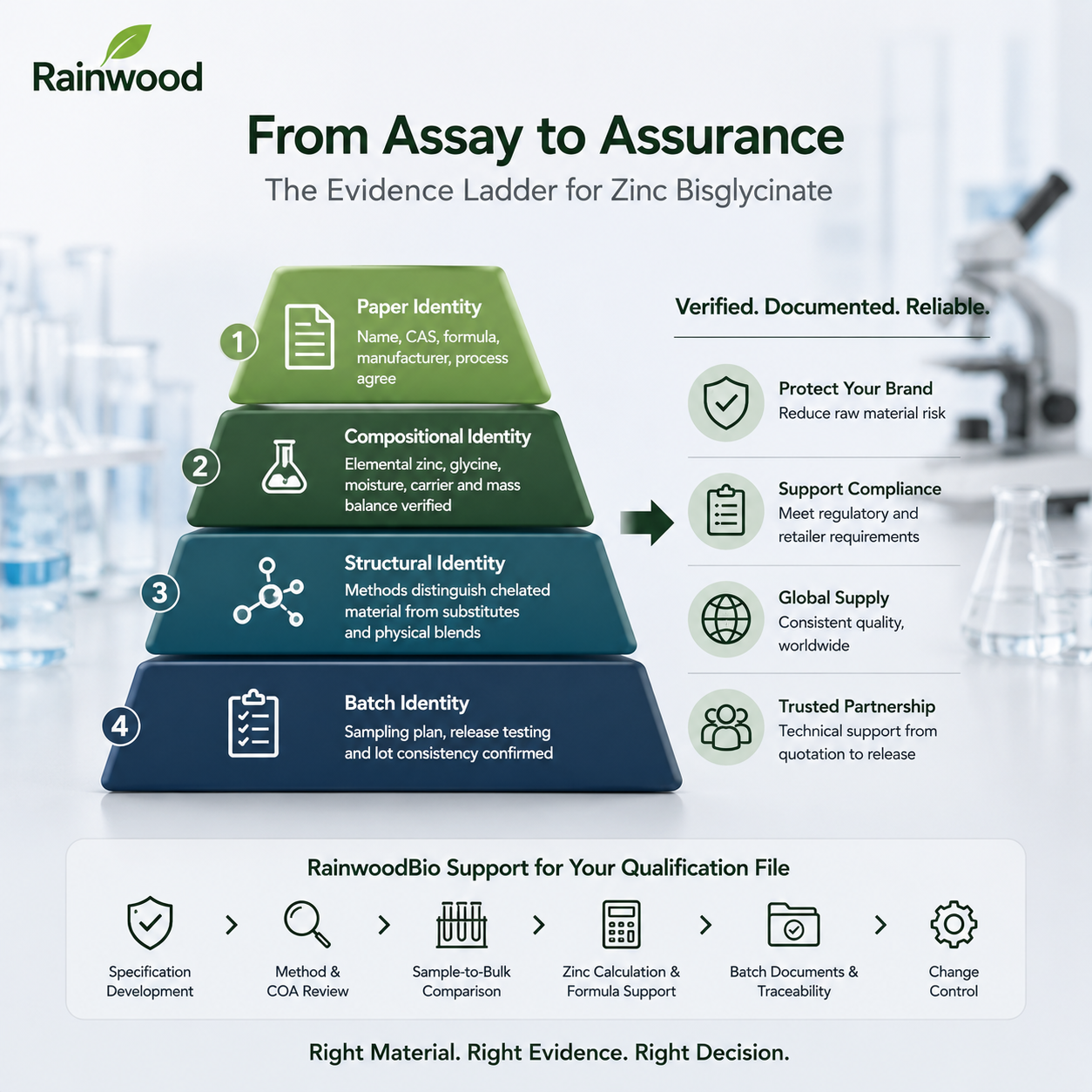
Build a raw-material evidence ladder
Use four levels:
1. Paper identity: name, CAS, formula, manufacturer and process description agree.
2. Compositional identity: elemental zinc, glycine, moisture and carrier data close the mass balance.
3. Structural identity: a justified method distinguishes chelated material from relevant substitutes or physical blends.
4. Batch identity: the methods are applied through an agreed sampling and release plan.
This ladder prevents a common procurement mistake: demanding more certificates while never asking whether the certificates answer the right question.
Explore RainwoodBio’s quality-control and testing workflow.
How RainwoodBio can support the qualification file
RainwoodBio’s website states that the company was established in 2006 and works across mineral ingredients and private-label supplements. It also publishes laboratory capabilities including AAS, HPLC, GC, UV and other analytical equipment.
For zinc glycinate, the useful approach is to assign each tool to a defined question. AAS may support elemental zinc. Supplier documents and suitable identity methods must address form and chelation. Finished-product testing must confirm the declared dose in the actual matrix.
RainwoodBio can organize the project around:
- an approved raw-material specification;
- manufacturer and source traceability;
- method and COA review;
- sample-to-bulk comparison;
- finished-product zinc calculation;
- batch documents; and
- change control.
The exact test package should be agreed for the purchased grade and target market before the order—not invented after a marketplace asks for proof.
The importer’s release gate
Do not release the lot until you can answer:
- What exact material did we order?
- What does the zinc percentage mean?
- What method proves elemental content?
- What evidence supports the chemical form?
- Are free glycine, free zinc salts or carriers controlled?
- Does the batch match the approved sample?
- Can the evidence support our finished-product label?
If one answer is missing, the low-risk decision is not blind rejection. It is a targeted investigation.
Request a zinc glycinate document and sample review. Send RainwoodBio the quotation, specification and COA. We will help identify which claims are supported, which tests are missing and what should be locked before shipment.
Frequently asked questions
1.Does a 20% zinc assay prove zinc bisglycinate?
No. It supports elemental zinc content. Chemical-form or chelation claims require additional, fit-for-purpose evidence.
2.Is zinc glycinate the same as zinc bisglycinate?
The terms are sometimes used as synonyms, but buyers should not assume equivalence. Lock the exact identity, composition and method in the purchase specification.
3.Is FTIR alone enough?
Not automatically. It can contribute useful structural evidence, but suitability depends on specificity, reference comparison and the substitutes the method must distinguish.
4.Should every batch receive every advanced identity test?
Not necessarily. Build a risk-based qualification and release programme, but do not reduce routine testing until the source and process are properly qualified.
References
- U.S. Patent US20060292698A1, *Spectroscopic Methods for Detecting and Identifying Chelates*: https://patents.google.com/patent/US20060292698A1/en
- U.S. Patent WO2006034195A2, *Quantitative and Qualitative Chelation Measuring Methods and Materials*: https://patents.google.com/patent/WO2006034195A2/en
- USP, Dietary Supplement Monographs Prioritized for Development: https://www.usp.org/sites/default/files/usp/document/get-involved/monograph-modernization/ds-prioritized-list-monographs-for-development.pdf
- RainwoodBio official website: https://www.rainwoodbio.com/
*This article is for B2B procurement and educational purposes. Analytical and regulatory requirements should be confirmed for the exact ingredient, finished product and destination market.*