 EN
EN
Meta title: Why Zinc Glycinate Gummies Fail Before Launch
Meta description: Zinc glycinate gummies can fail through metallic aftertaste, mineral interactions, moisture changes and elemental-dose errors. Learn what to test before mass production.
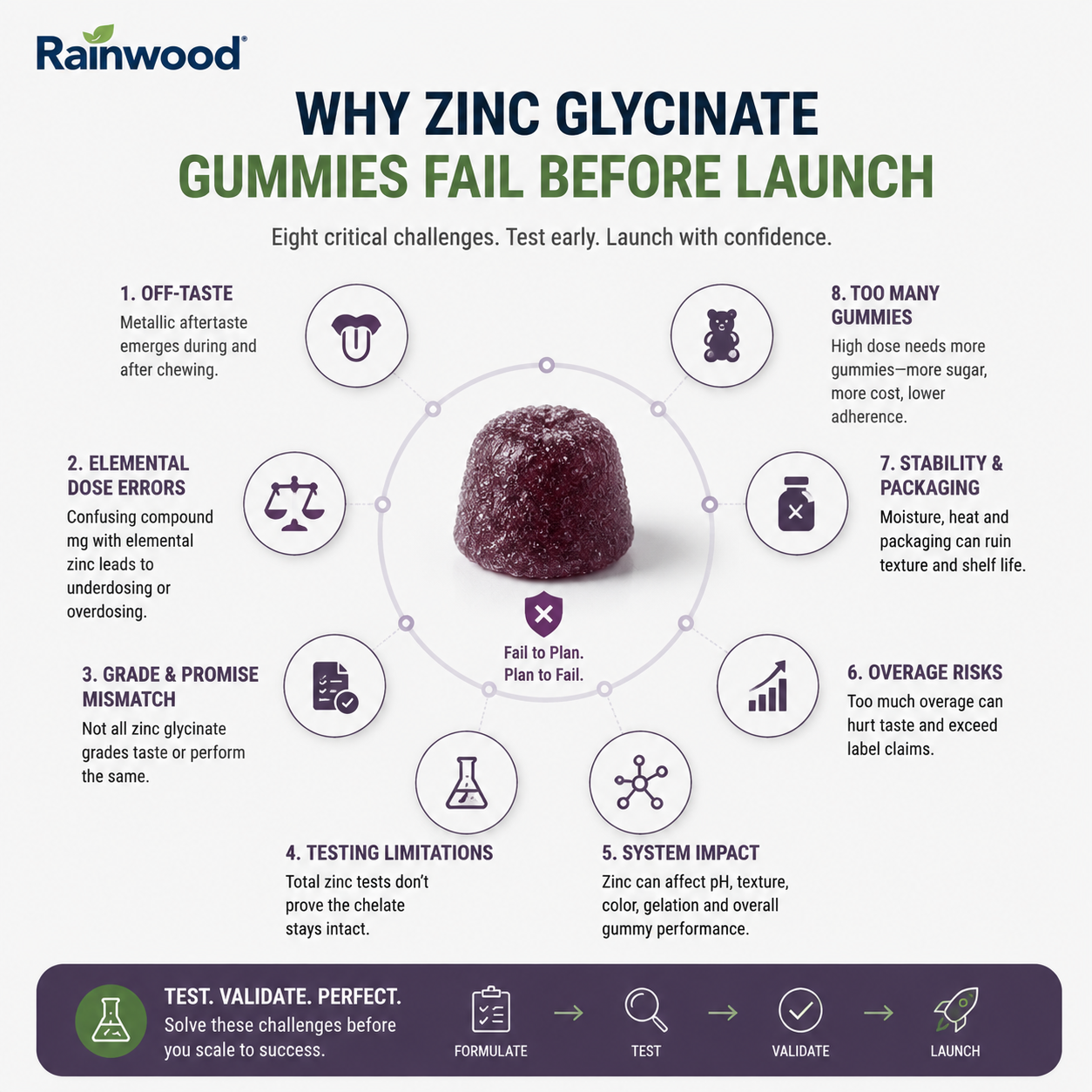
The first gummy tastes like berry. The fourth tastes like a coin.
The sample is soft and glossy. Eight weeks later it is sticky, dull and sweating inside the bottle.
The label says 25 mg zinc glycinate. Nobody can explain whether that means the compound or elemental zinc.
This is how an attractive gummy concept becomes a return problem.
Zinc glycinate may support a premium mineral story, but a gummy exposes the ingredient to taste, moisture, acids, heat, colors and other reactive components. You cannot solve those variables with a stronger fruit flavor and a perfect mockup.
Failure 1: the flavor masks the first bite only
Metallic and astringent notes can emerge during chewing and remain after swallowing. Strong acids may sharpen fruit flavor while changing the perception or behavior of the mineral system.
Evaluate sensory performance at:
- first bite;
- complete chew;
- 30 seconds after swallowing;
- several minutes later;
- repeated daily use; and
- multiple stability time points.
Use trained internal assessment and representative consumer testing. A founder saying “I can live with it” is not a sensory programme.
Request our zinc gummy feasibility checklist.
Failure 2: the team formulates compound milligrams
If the raw material contains 20% elemental zinc, delivering 15 mg elemental zinc requires 75 mg of that powder before accounting for the approved formulation approach. A developer who adds only 15 mg of raw material delivers about 3 mg elemental zinc.
The reverse mistake can create excessive input and unexpected taste.
Lock:
- elemental zinc per gummy;
- gummies per serving;
- raw-material elemental specification;
- input per gummy;
- overage policy;
- assay target; and
- Supplement Facts declaration.
Read **30 mg zinc glycinate versus 30 mg elemental zinc** **[INTERNAL LINK -> Elemental Zinc Label Math Article]**.
Failure 3: “chelates taste better” becomes a guarantee
A chelated mineral may offer sensory advantages in some systems, but taste depends on the exact grade, dose and gummy matrix. Carriers, residual starting materials, particle size and free ions can change the result.
Compare at least two qualified grades at equivalent elemental zinc, not equal powder weight. Blind-code the samples so price and supplier reputation do not influence the panel.
If a supplier promises “completely tasteless,” request the test matrix, dose and shelf-life evidence.
Failure 4: zinc is tested before the gummy is digested
Total zinc testing can confirm the amount in the finished gummy when the method is suitable. It does not automatically prove the raw material remained in its original complexed form through a hot, acidic process.
If the chelated form is central to your marketing, assess whether the manufacturing conditions and available evidence support that story. At minimum, control raw-material identity, processing conditions and finished elemental content. Do not casually claim that the finished gummy contains an unchanged molecular species without appropriate evidence.
Review why total zinc does not prove chelation.
Failure 5: the mineral changes the gummy system
Minerals can affect pH, gelation, color, flavor, water activity and texture. The impact depends on pectin or gelatin system, acids, sweeteners, cooking sequence and other actives.
Monitor:
- depositing behavior;
- set time;
- weight uniformity;
- sticking and oiling;
- water activity;
- texture;
- color drift;
- odor;
- assay uniformity; and
- package interaction.
A stable placebo gummy proves almost nothing about the mineral formula.
Failure 6: overage is used without a degradation story
An overage should be justified by manufacturing and stability data, target label claim and regulatory requirements. It should not be a default percentage borrowed from another vitamin.
Excess zinc can intensify taste and create an above-specification product. FDA has cited a manufacturer where finished-product zinc exceeded its established specification and master manufacturing records lacked required controls.
Define who approves the overage, how it is calculated and what finished result triggers investigation.
Failure 7: the bottle becomes a microclimate
Warm shipping, humidity, repeated opening and incompatible packaging can change gummy texture and surface condition. A desiccant may help some systems and harm others by making gummies too firm.
Run stability in the final bottle, closure and count. Include relevant accelerated and real-time conditions, but do not treat acceleration as a perfect prediction of long-term behavior.
Simulate parcel shipping and customer opening. A gummy that survives a sealed stability chamber may still fail after 20 humid openings.
Failure 8: the dose requires too many gummies
More gummies create more flavor exposure, calories, sweeteners, bottle volume and monthly cost. They also increase the chance that customers treat the product like candy and exceed directions.
Calculate the complete customer month:
- gummies per day;
- total gummies per bottle;
- bottle size;
- shipping weight;
- cost per 30 days;
- sugar or sweetener load; and
- maximum expected use.
Sometimes a capsule is the more customer-friendly premium format.
Compare capsule, tablet, gummy and lozenge formats.
The pilot batch that can save the launch
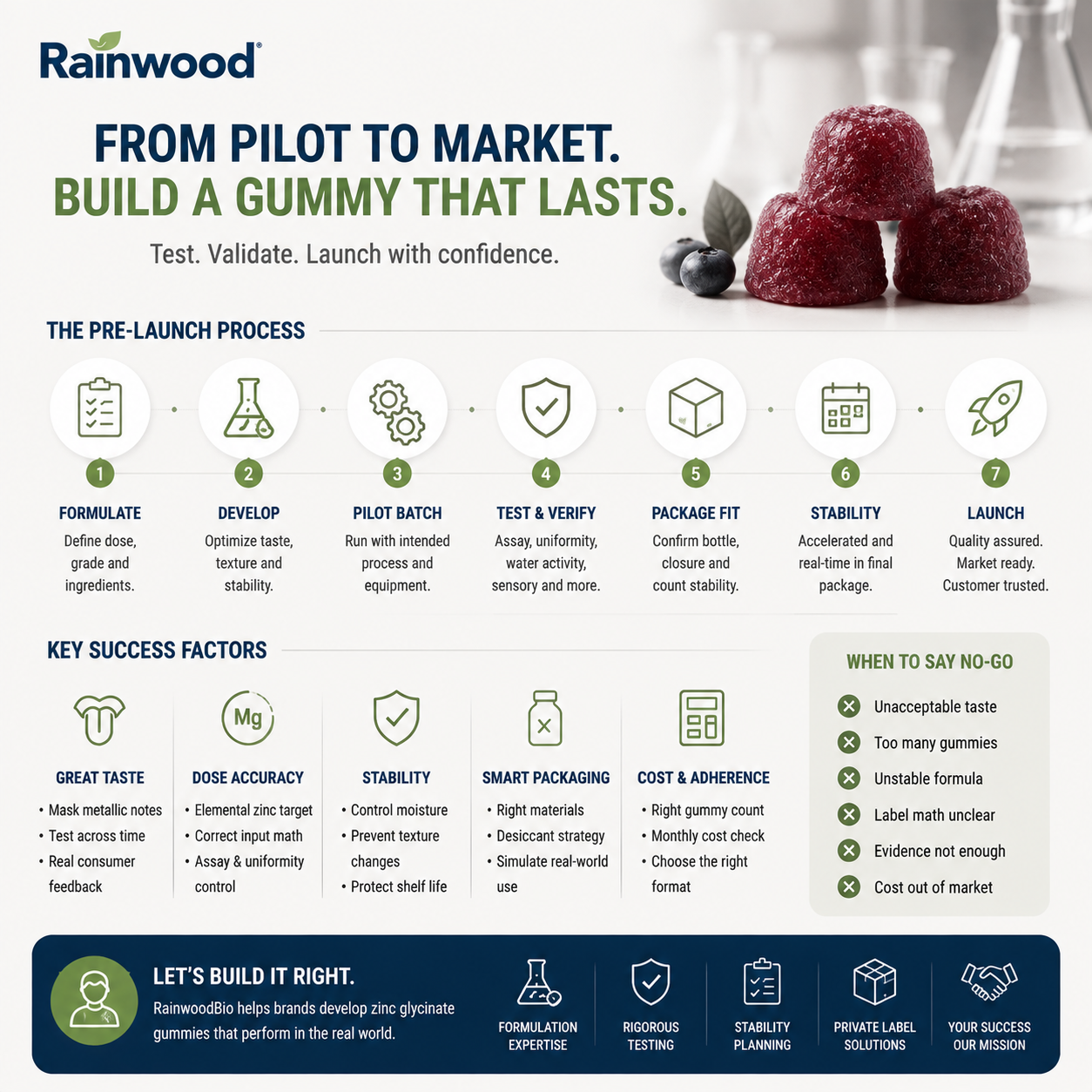
Do not jump from hand sample to commercial volume. Run a representative pilot with the intended equipment, ingredient sequence and packaging.
Approve only after reviewing:
- process record;
- actual yield;
- unit weight;
- zinc assay and uniformity;
- sensory profile;
- water activity;
- initial microbiology where relevant;
- packaging fit; and
- planned stability programme.
Retain enough samples to investigate later complaints.
How RainwoodBio can develop the real gummy
RainwoodBio publishes custom gummy capability and describes pre-production validation, formulation development and private-label packaging. Its broader website lists mineral-supplement experience and laboratory equipment including AAS.
For a zinc glycinate gummy, RainwoodBio can organize:
- grade comparison at equal elemental dose;
- flavor and acid screening;
- pilot processing;
- unit-weight and serving calculations;
- finished zinc testing;
- packaging selection;
- stability planning; and
- label-data alignment.
The exact formula, MOQ, claims and test package need project-specific confirmation. A general gummy capability does not guarantee every zinc dose can be made pleasant and stable.
The no-go criteria
Stop the project or change format when:
- the intended elemental dose cannot be masked acceptably;
- the required gummy count destroys adherence;
- the formula is unstable in the proposed package;
- the label math is unresolved;
- the chelate claim exceeds available evidence; or
- the monthly landed cost misses the market.
Changing format before launch is cheaper than defending a bad gummy after reviews arrive.
Request a zinc glycinate gummy sample and stability feasibility review. RainwoodBio can compare dose scenarios and tell you which compromises must be tested before commercial tooling or packaging.
Frequently asked questions
1.Can zinc glycinate be made into gummies?
Potentially, yes. Success depends on dose, grade, sensory system, processing, packaging and stability.
2.Does a gummy need finished-product zinc testing?
The finished product should have an appropriate release plan. Raw-material results alone do not confirm the dose in each commercial serving.
3.Can flavor completely eliminate metallic taste?
Avoid guarantees. Flavor can manage perception, but the result must be tested at the intended dose and through shelf life.
4.How many gummies should one serving contain?
There is no universal answer. Balance elemental dose, sensory quality, unit capacity, directions, safety and monthly economics.
References
- NIH ODS, Zinc Fact Sheet for Health Professionals: https://ods.od.nih.gov/factsheets/Zinc-HealthProfessional/
- FDA Warning Letter to Sun Ten Laboratories: https://www.fda.gov/inspections-compliance-enforcement-and-criminal-investigations/warning-letters/stpca-inc-dba-sun-ten-laboratories-645336-04072023
- Kupiec et al., comparison of zinc supplement bioaccessibility: https://pubmed.ncbi.nlm.nih.gov/37375717/
- RainwoodBio Private Label Supplements: https://www.rainwoodbio.com/private-label-supplements
*This article is for B2B product-development education. Finished-product safety, stability and regulatory requirements must be assessed for the exact formula and market.*