 EN
EN
Meta title: The Trademarked Zinc Chelate Bait-and-Switch
Meta description: A supplier can sample a branded zinc chelate and ship a generic bulk substitute. Learn how OEM buyers can lock source, claims, documents and batch identity.
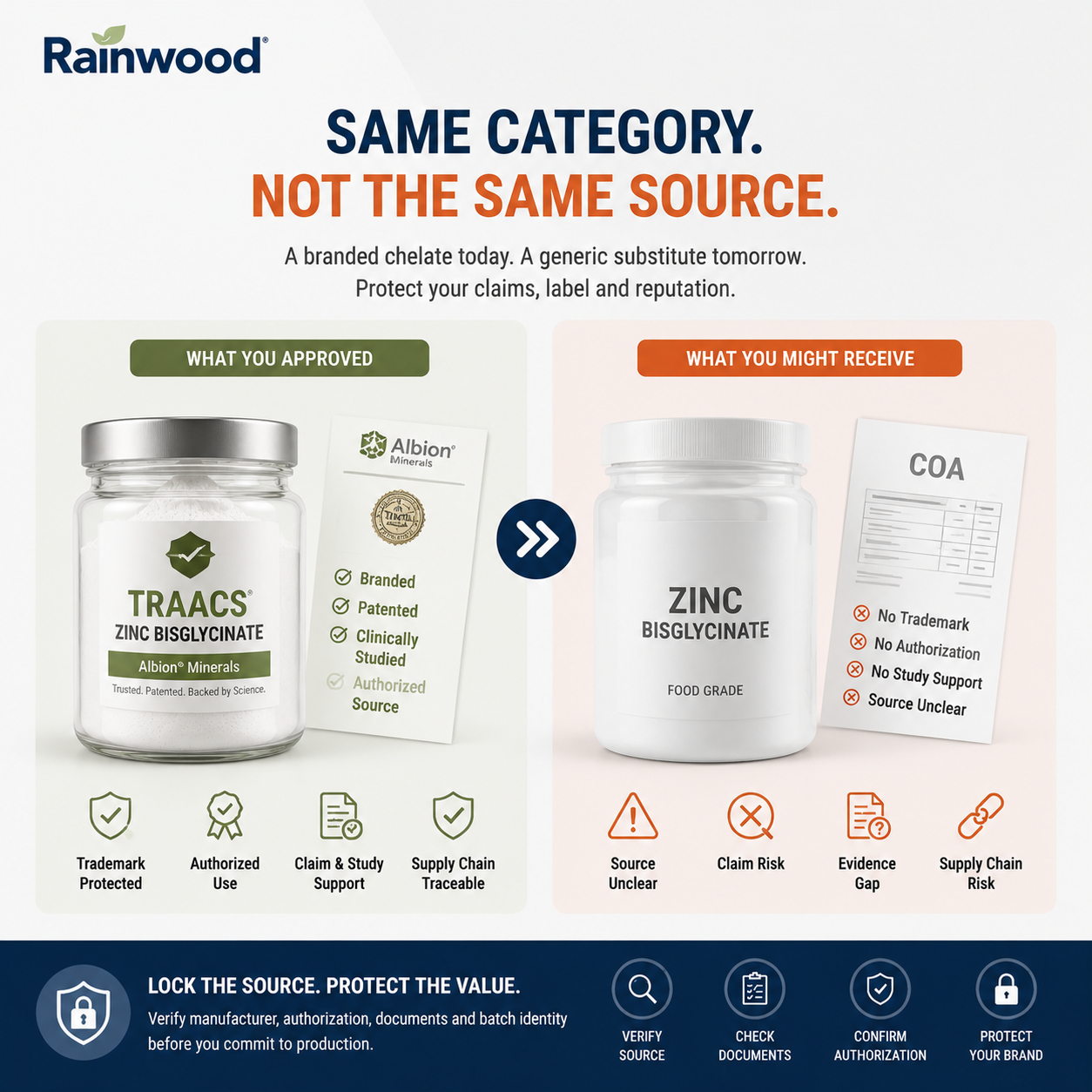
The sample arrives with a famous chelate brochure. The sales deck shows a trademark. The product page says “patented.” Your team approves the taste, label and price.
Then the bulk batch arrives under a generic ingredient name.
The elemental zinc still passes. The factory insists the material is equivalent. The trademark quietly disappears from the invoice, COA or manufacturer declaration.
That is not a paperwork cleanup. It may be a source substitution that breaks your claim, packaging and evidence strategy.
A trademark is not a chemical name
Zinc bisglycinate is a category or chemical-form description. A trademark identifies a particular commercial ingredient, supplier system or brand asset subject to its owner’s terms.
Two materials may share a general chemical description while differing in:
- manufacturer;
- process;
- grade;
- elemental standardization;
- carrier;
- particle size;
- supporting evidence;
- quality documentation; and
- trademark authorization.
If your label or advertising names a trademarked ingredient, generic chemical similarity does not automatically preserve the right to use the mark.
Use our branded-ingredient approval checklist before artwork begins.
Bait-and-switch signal 1: the brochure is branded but the COA is not
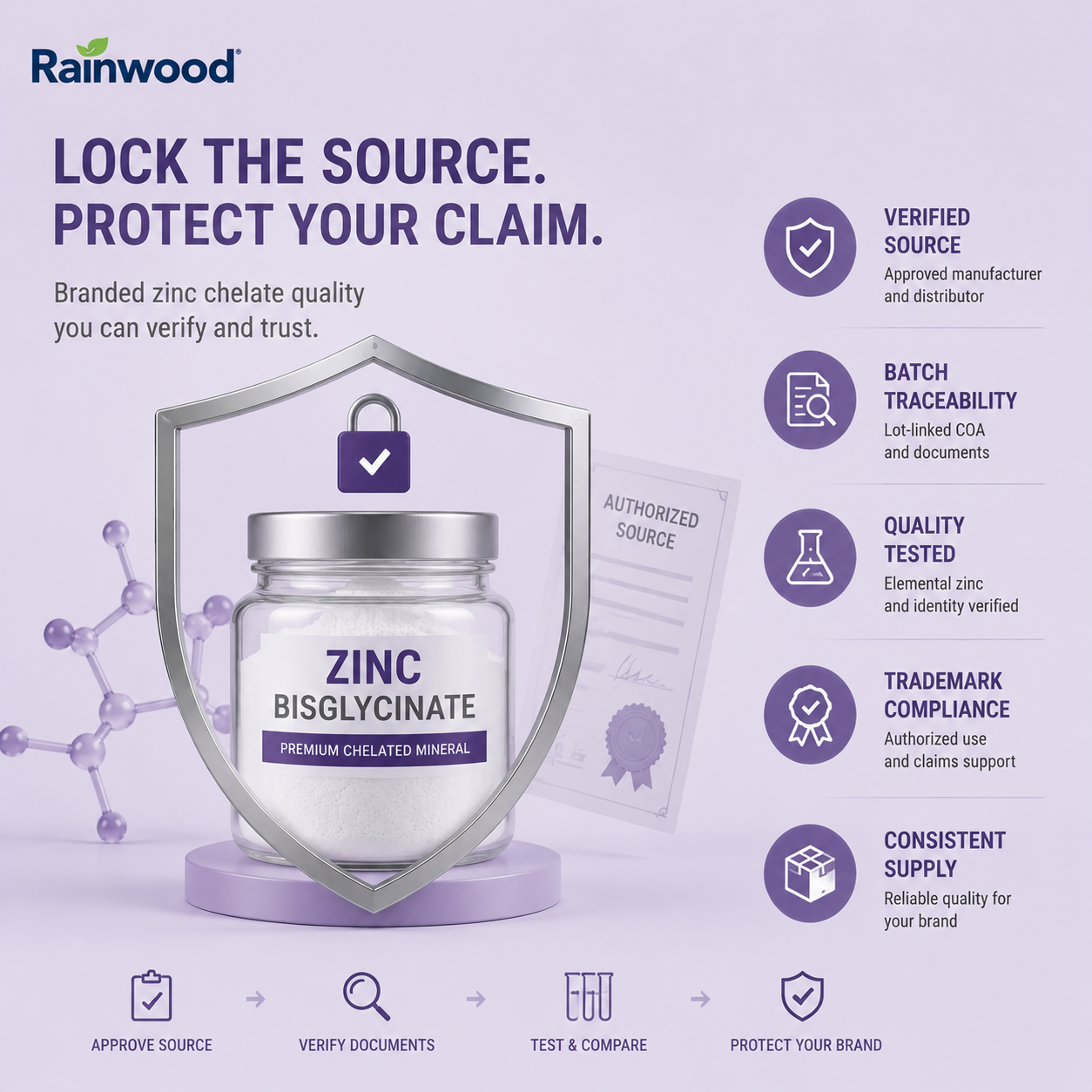
A distributor may attach a well-known manufacturer’s brochure to a generic quotation. Ask the seller to connect every document through:
- manufacturer legal name;
- manufacturing site;
- product code;
- lot number;
- authorized distributor evidence;
- original COA;
- packaging photographs; and
- traceable invoice chain.
A brochure proves that an ingredient exists. It does not prove that the quoted lot contains it.
Bait-and-switch signal 2: “same formula” replaces authorization
Trademark use is controlled by the owner. A supplier saying “our formula is the same” does not grant your brand permission to print another company’s mark.
Before use, confirm:
- current trademark status;
- correct spelling and symbol;
- approved claim language;
- market and product-category permission;
- minimum inclusion or other programme requirements;
- artwork approval; and
- supply-chain documentation.
Do this directly with the rights holder or through a documented authorized route.
Bait-and-switch signal 3: the sample container has no lot traceability
A sample in a plain silver bag can be anything. Ask for a sample COA, manufacturer lot, sampling date, repacking record and seal identification.
When bulk arrives, compare:
- appearance;
- odor and taste;
- solubility behavior;
- particle characteristics;
- elemental zinc;
- identity evidence;
- carrier and moisture; and
- packaging/lot coding.
Read **how a physical zinc-and-glycine blend can pass weak tests** **[INTERNAL LINK -> Zinc Oxide Plus Glycine Article]**.
Bait-and-switch signal 4: price drops but nothing technical changes
A significant price reduction deserves a technical explanation. It may come from volume, freight, contract timing or margin. It may also come from a different manufacturer, lower elemental grade, undeclared carrier, reduced testing or a generic substitute.
Require the revised quotation to identify what changed. “Special support” is not enough when the saving exceeds a normal commercial adjustment.
Compare cost per gram of delivered elemental zinc—not only cost per kilogram of powder. Then include testing, serving impact, trademark value and evidence continuity.
Bait-and-switch signal 5: procurement approves “equivalent” by email
Equivalence is a cross-functional decision. Purchasing cannot approve it alone because the change can affect:
- raw-material identity;
- formula input;
- finished-product specifications;
- label source declaration;
- website claims;
- clinical citations;
- taste and processing;
- stability;
- regulatory file; and
- distributor commitments.
Use a formal change request with technical, quality, regulatory and brand approval.
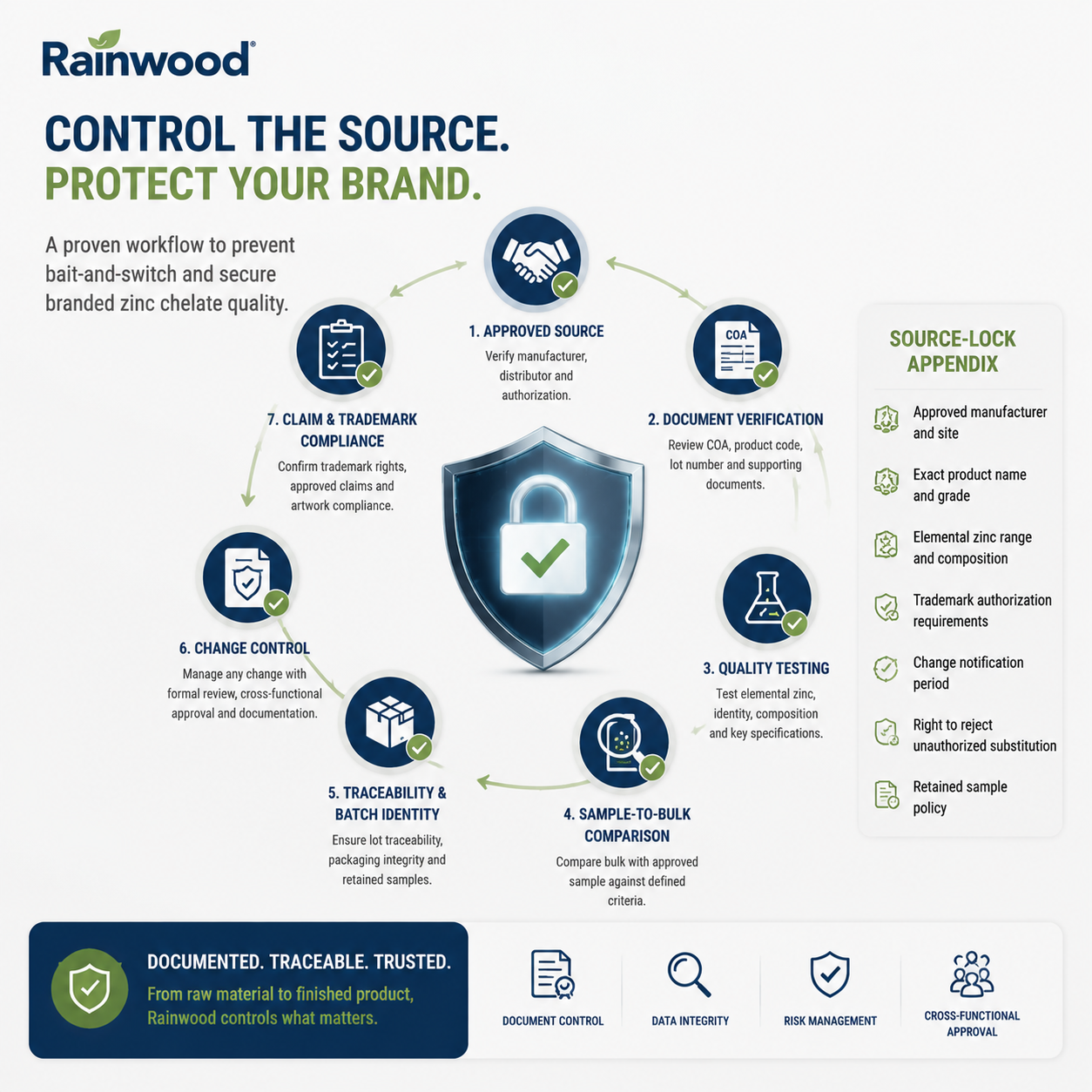
Build a source-lock appendix
Attach a one-page appendix to the purchase agreement containing:
- approved manufacturer and site;
- exact commercial product name;
- product code and grade;
- elemental zinc range;
- full composition disclosure;
- identity and release methods;
- trademark authorization requirements;
- approved packaging;
- change-notification period;
- right to reject unauthorized substitution; and
- retained-sample policy.
This document is more useful than ten emails saying “same as sample.”
Explore our supplier qualification workflow.
Run a blind sample-to-bulk comparison
When commercial stock arrives, have the technical team compare coded samples without being told which one is the premium lot. This reduces the tendency to explain away visible differences after procurement has already committed.
The comparison should be linked to predefined acceptance criteria. Sensory or physical differences do not prove substitution, but they trigger investigation before production.
For critical claims, consider confirming the batch with the branded-ingredient owner or authorized analytical programme where available.
Separate three claims buyers often merge
Your product may claim:
1. it contains zinc bisglycinate;
2. it contains a particular branded zinc bisglycinate; and
3. it delivers benefits supported by studies on that branded material.
Each claim needs its own evidence. Proving number one does not automatically prove numbers two and three.
That distinction protects both honest generic ingredients and legitimate branded ingredients from lazy equivalence claims.
How RainwoodBio can control the approved source
RainwoodBio’s published workflow covers supplier management, sample validation, production, testing, documentation and traceability across mineral and private-label products.
For a branded or tightly specified zinc ingredient, RainwoodBio can build controls around:
- approved manufacturer and distributor;
- incoming-lot documents;
- elemental-zinc testing;
- identity-evidence review;
- sample-to-bulk comparison;
- formula version;
- packaging claim approval; and
- written change control.
RainwoodBio should not treat its AAS capability as proof of trademark identity; elemental testing answers a different question. The strength lies in connecting the analytical result to source documents and finished-product records.
Review RainwoodBio’s private-label supplement capabilities.
The approval test
Ask your OEM one direct question:
“Can you prove that the material in this commercial lot is supplied by the manufacturer named in our approved branded-ingredient file?”
The answer should produce documents—not adjectives.
If the supplier cannot connect sample, source, batch and permission, remove the trademark from the product or stop the order until the chain is restored.
Send RainwoodBio the sample COA and proposed artwork for a source-lock and trademark-risk review. This can expose a substitution before it becomes printed inventory.
Frequently asked questions
1.Is every generic zinc bisglycinate inferior?
No. Generic materials should be evaluated on their own specifications and evidence. The problem is unauthorized substitution or borrowing claims from another ingredient.
2.Can a factory use a trademark if it bought the material from a trader?
That depends on the rights holder’s authorization and traceability requirements. Confirm through documented channels.
3.Does an identical elemental zinc result prove equivalence?
No. It does not establish manufacturer, chemical form, carrier, process, trademark rights or evidence continuity.
4.Should the source be locked forever?
Not necessarily. Changes can be managed, but they should be assessed and approved before implementation.
References
- Balchem/Albion Minerals, TRAACS product list: https://balchem.com/human-nutrition-health/wp-content/uploads/sites/2/2024/03/TRAACS_Product-list_Albion-Minerals.pdf
- USP, Zinc Glycinate listed among prioritized dietary supplement monographs: https://www.usp.org/sites/default/files/usp/document/get-involved/monograph-modernization/ds-prioritized-list-monographs-for-development.pdf
- U.S. Patent US20060292698A1, chelate identification methods: https://patents.google.com/patent/US20060292698A1/en
- RainwoodBio official website: https://www.rainwoodbio.com/
*This article is educational. Trademark rights, ingredient authorization and analytical equivalence should be confirmed with qualified professionals and the relevant rights holder.*