 EN
EN
Executive Summary
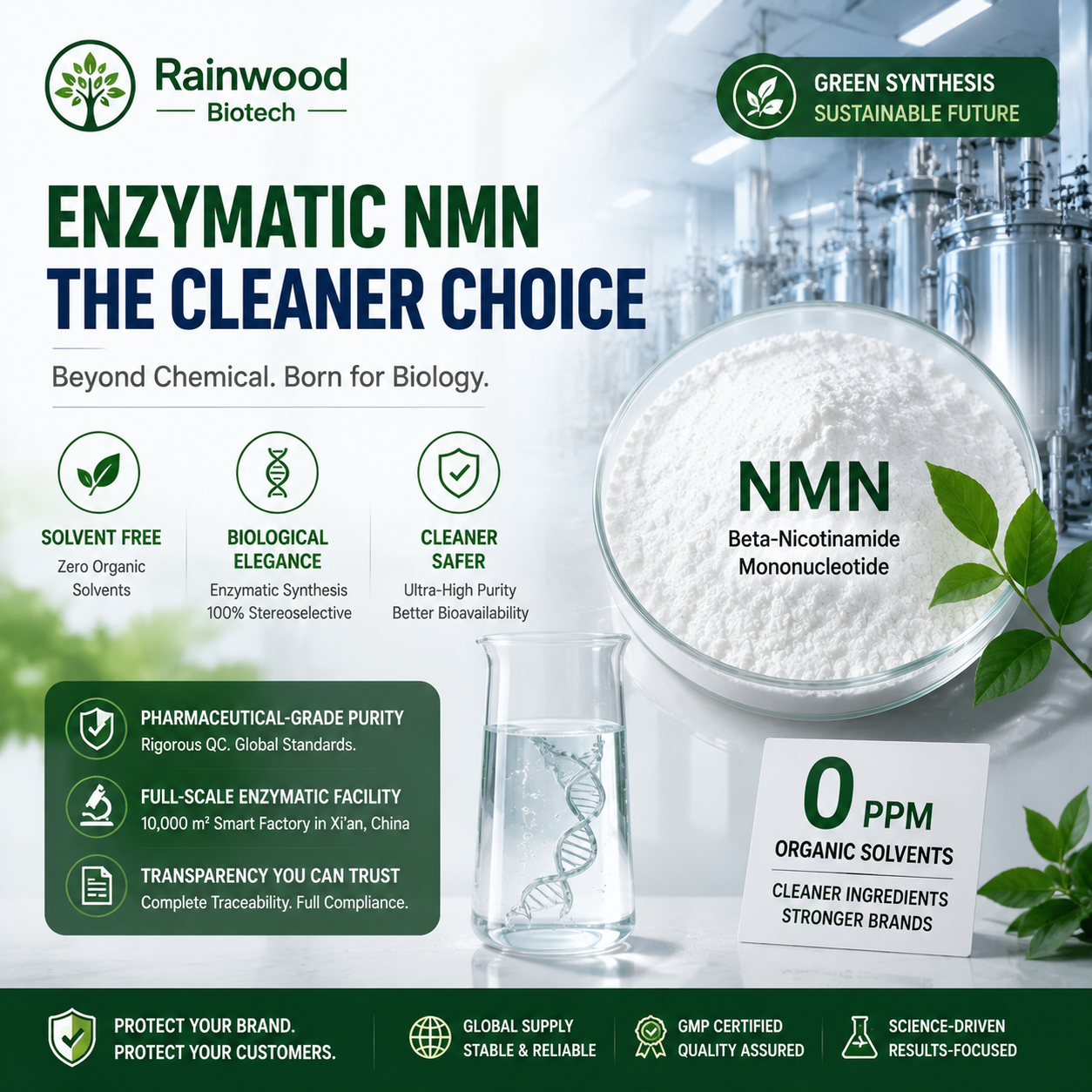
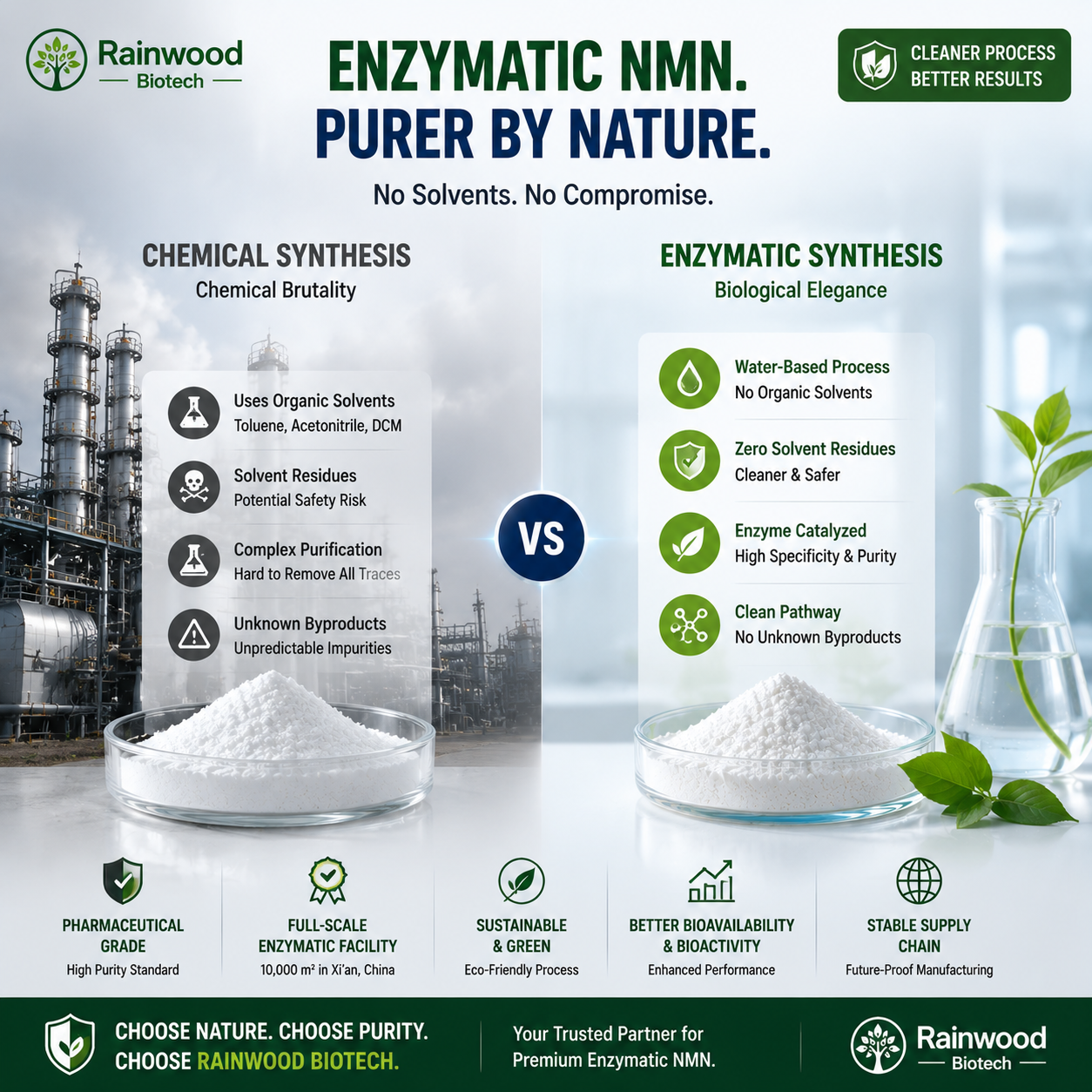
In the 2026 wellness market, 'purity' is no longer the final goal—it is the baseline. High-end brands are now pivoting away from chemically synthesized NMN due to concerns over solvent residues and biological activity. This report compares the 'Chemical Brutality' of old-school manufacturing with the 'Biological Elegance' of Rainwood Biotech's full-scale enzymatic process.
The 'Solvent Scar': The Hidden Cost of Chemical NMN
For a brand founder, the choice of raw materials is a choice of legacy. When you source bulk Beta-Nicotinamide Mononucleotide, you aren't just buying a powder; you are buying the chemical history of that powder. Traditional chemical synthesis is a process of 'brute force.' It uses high temperatures, high pressures, and a cocktail of aggressive organic solvents like toluene, dichloromethane, and acetonitrile to force the molecules together.
The problem isn't that chemical synthesis doesn't work—it does. The problem is the 'scars' it leaves behind. No matter how many times a product is washed, trace amounts of these solvents can remain trapped within the crystalline structure. In the competitive 2026 market, where 'Clean Label' is the gold standard, having even 50ppm of toluene on your record is a marketing liability that can sink a premium brand.
Rainwood Biotech has moved past this 'Chemical Brutality.' We recognize that the longevity consumer is the most health-conscious demographic in history. They don't want a product that was born in a vat of industrial solvents.
Enzymatic Synthesis: Mimicking the Biological Masterpiece
Your body doesn't use toluene to create NMN. It uses enzymes—highly specific biocatalysts that operate in a gentle, aqueous environment. At Rainwood Biotech, we have scaled this 'Biological Elegance' to a 10,000 sqm industrial facility. Our process for creating Beta-Nicotinamide Mononucleotide involves a multi-stage enzymatic cascade that mimics the body’s natural salvage pathway.
By using proprietary enzymes to catalyze the reaction between Nicotinamide and Ribose, we achieve 100% stereoselectivity. This means we don't just create a molecule; we create the *right* molecule. There are no 'Bad Twin' isomers (Alpha-NMN) and, more importantly, zero organic solvents involved in the primary synthesis. The reaction happens in pure, deionized water.
This 'Green Synthesis' is why our NMN has a cleaner sensory profile and a superior safety record. When you tell your customers that your NMN is enzymatic, you are telling them it was built for the human body, by a process that respects human biology.
The Solvent Trap: Why COAs Can Be Deceptive
Many procurement managers look at a COA and see 'Solvent Residuals: Not Detected' and assume they are safe. But in the world of B2B auditing, 'Not Detected' is only as good as the detection limit (LOD) of the lab. Many commodity factories set their LODs high to avoid flagging their own product. They are essentially hiding the chemical scars of their old-school synthesis behind a wall of poor data.
Furthermore, chemical synthesis often leads to the formation of unknown byproducts—molecules that weren't intended to be there and aren't even listed on a standard HPLC audit. These 'Unknown Impurities' are the true danger for a brand. They are the ticking time bombs that could lead to unforeseen side effects or regulatory recalls as testing technology advances.
Sourcing enzymatic Beta-Nicotinamide Mononucleotide from Rainwood Biotech eliminates this risk. Because our reaction is biocatalyzed, the pathways are clean and predictable. We don't have to 'clean up' a mess because we don't make one in the first place.
Bioactivity and the 'Energy Gap'
There is a growing debate in the R&D community about the 'Energy State' of synthetic vs. enzymatic molecules. While the chemical formula ($C_{11}H_{15}N_2O_8P$) is the same, the crystalline lattice and the biological 'intent' are different. Enzymatic NMN, born in an aqueous environment similar to our own cytoplasm, often demonstrates better solubility and a more rapid uptake in sublingual applications.
Chemical synthesis often results in a more 'braggish' crystal that is harder for the body to break down. This might seem like a minor detail, but for a brand selling a 'Premium' product, these details are everything. If your customers don't *feel* the difference, they won't reorder. Our partners consistently report higher 'efficacy-feedback' from consumers when they switch to our enzymatic Beta-Nicotinamide Mononucleotide.
It’s not just about passing a test; it's about delivering a result. And results are driven by biological compatibility, not chemical force.
Environmental and Strategic Sovereignty
In 2026, the global regulatory landscape for chemical manufacturing is tightening. Factories that rely on heavy solvent use are facing frequent 'Environmental Audits' that lead to sudden shutdowns and supply chain disruptions. If your supplier is a chemical factory in a high-pollution zone, your supply chain is fragile.
Rainwood Biotech's green enzymatic facility is the future of sustainable sourcing. Because our byproduct is primarily water and biodegradable salts, we are immune to the environmental crackdowns that plague our competitors. Choosing our enzymatic Beta-Nicotinamide Mononucleotide is not just a quality decision; it is a strategic one to ensure your production line never goes dark due to a supplier's regulatory failure.
We provide the stability, the safety, and the story that premium brands need to dominate the longevity market.
The Audit Checklist: Sourcing Enzymatic NMN in 2026
How do you verify if the NMN you are buying is truly enzymatic? Here are the (sharp) audit questions for your supplier:
1. **Full Solvent Profile**: Ask for a GC-MS report covering at least 20 common organic solvents, with a detection limit below 1ppm. If they struggle to provide this, they are hiding chemical residues.
2. **The Water Test**: Dissolve 5g in 50ml of water. Enzymatic NMN should produce a crystal-clear solution with zero 'chemical' or 'burnt' odor. Any yellow tint or acrid smell is a sign of chemical synthesis byproducts.
3. **Synthesis Flow Chart**: Ask for the raw material input list. If you see 'Triethylamine' or 'Acetonitrile' as reaction reagents, it’s not enzymatic—it’s a chemical shortcut.
Protect your brand. Protect your customers. Move beyond the 'Chemical Liability' and join the enzymatic revolution with Rainwood Biotech.
About Rainwood Biotech
Rainwood Biotech is a global leader in high-end longevity ingredient manufacturing. With a specialized focus on Beta-Nicotinamide Mononucleotide, we leverage full-scale enzymatic synthesis to deliver pharmaceutical-grade purity. Our 10,000 sqm facility and PhD-led R&D team ensure that every batch meets the most rigorous safety and bioactivity standards in the industry.
Table of Contents
- Executive Summary
- The 'Solvent Scar': The Hidden Cost of Chemical NMN
- Enzymatic Synthesis: Mimicking the Biological Masterpiece
- The Solvent Trap: Why COAs Can Be Deceptive
- Bioactivity and the 'Energy Gap'
- Environmental and Strategic Sovereignty
- The Audit Checklist: Sourcing Enzymatic NMN in 2026
- About Rainwood Biotech