 EN
EN
Executive Summary
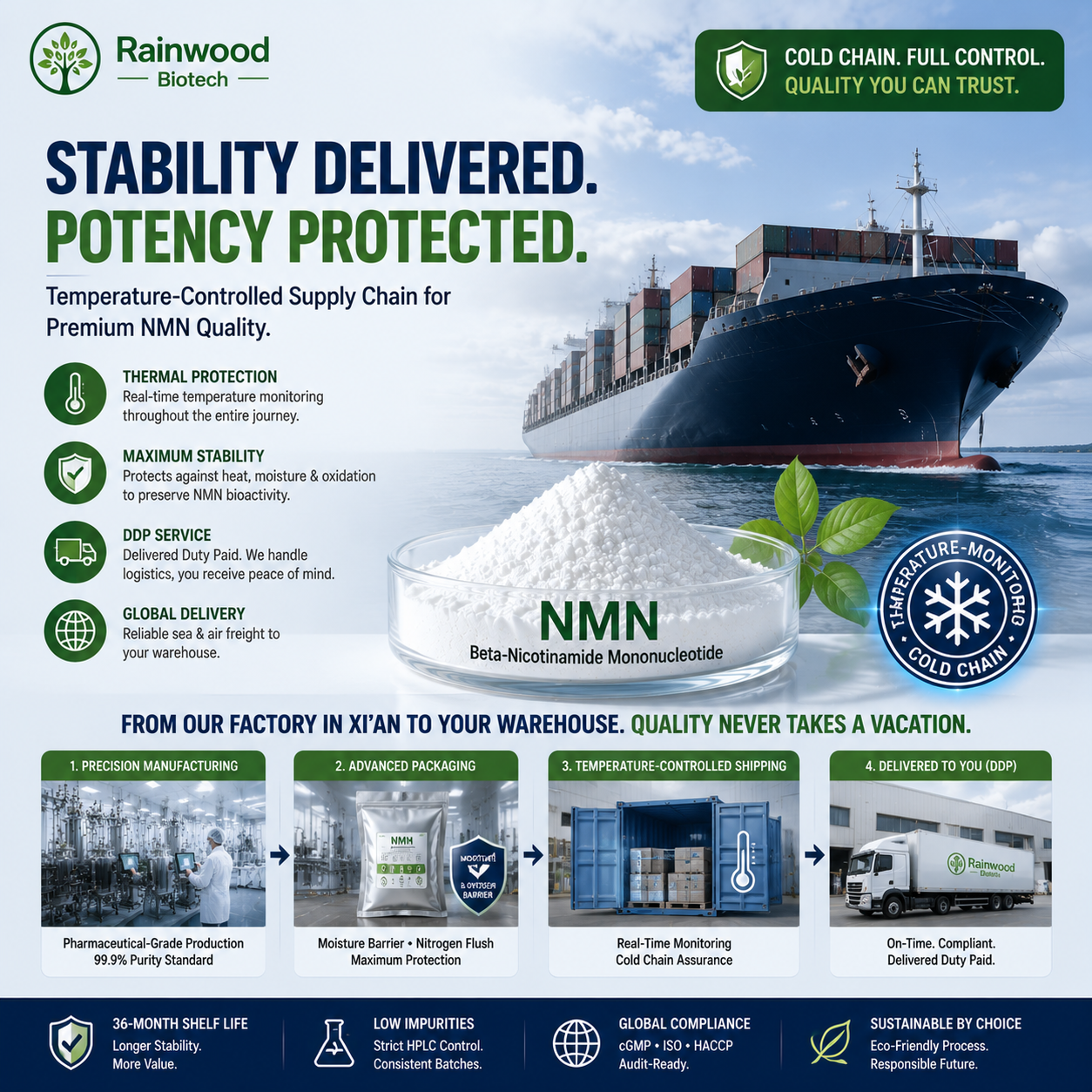
In the global landscape of longevity supplements, '99.9% Purity' is often treated as the ultimate metric of quality. However, for a molecule as sensitive as Beta-Nicotinamide Mononucleotide, a factory-gate analysis is merely the beginning of the story. In 2026, the most significant threat to brand integrity isn't the synthesis process itself, but the 'Thermal Gauntlet' of global logistics. This report explores the chemical kinetics of NMN degradation, the 'Container Oven' effect of maritime shipping, and why Rainwood Biotech’s temperature-monitored DDP (Delivered Duty Paid) infrastructure is the only way to ensure that what was promised in the lab is what arrives at your warehouse.
1. The 'COA Paradox': Why Purity at Origin Doesn't Guarantee Potency at Destination
Procurement teams often celebrate when a batch of Beta-Nicotinamide Mononucleotide passes its final HPLC audit at the manufacturing site. The Certificate of Analysis (COA) is signed, stamped, and filed. But for the buyer in the United States, Europe, or Australia, that document is a record of the past. It does not account for the 45 days the product will spend in a metal box crossing the ocean.
The paradox of NMN is that its biological power—its ability to rapidly elevate NAD+ levels—is directly tied to its molecular instability. The N-glycosidic bond that connects the nicotinamide group to the ribose-5-phosphate is the 'engine' of the molecule, but it is also its Achilles' heel. If the thermal energy in the environment exceeds the activation energy of the degradation reaction, the 'engine' breaks down before it ever reaches the consumer.
Many suppliers rely on the fact that NMN 'looks' stable. Unlike some oils that turn rancid or proteins that denature visibly, NMN can lose significant potency while still appearing to be a white powder. By the time a brand realizes their product is under-dosed, the shipment has already been encapsulated and sold.
2. The Chemistry of Decay: Hydrolysis, De-amidation, and the 'Browning' Effect
To understand why heat is so dangerous to NMN, we must look at the molecular level. NMN degrades primarily through two chemical pathways when exposed to heat and moisture:
• Hydrolysis: This is the cleavage of the glycosidic bond. When heat increases molecular vibration, any residual moisture in the crystal lattice or ambient humidity that penetrates the packaging can trigger this reaction. The NMN molecule splits into Nicotinamide (Vitamin B3) and Ribose-5-phosphate. While Nicotinamide is a safe vitamin, it lacks the specific SIRT1-activating properties of NMN.
• De-amidation: At extreme temperatures, the amide group on the nicotinamide ring can be lost, further degrading the molecule into Nicotinic Acid Mononucleotide (NaMN).
• Oxidative Discoloration: While not always a loss of primary potency, the 'Yellowing Effect' is a sensory disaster for premium longevity brands. Heat accelerates the oxidation of trace impurities, turning a snowy-white powder into a yellow or ivory mess. For a consumer paying $100 for a bottle of anti-aging pills, a yellow tint is an immediate signal of 'expired' or 'low-quality' product.
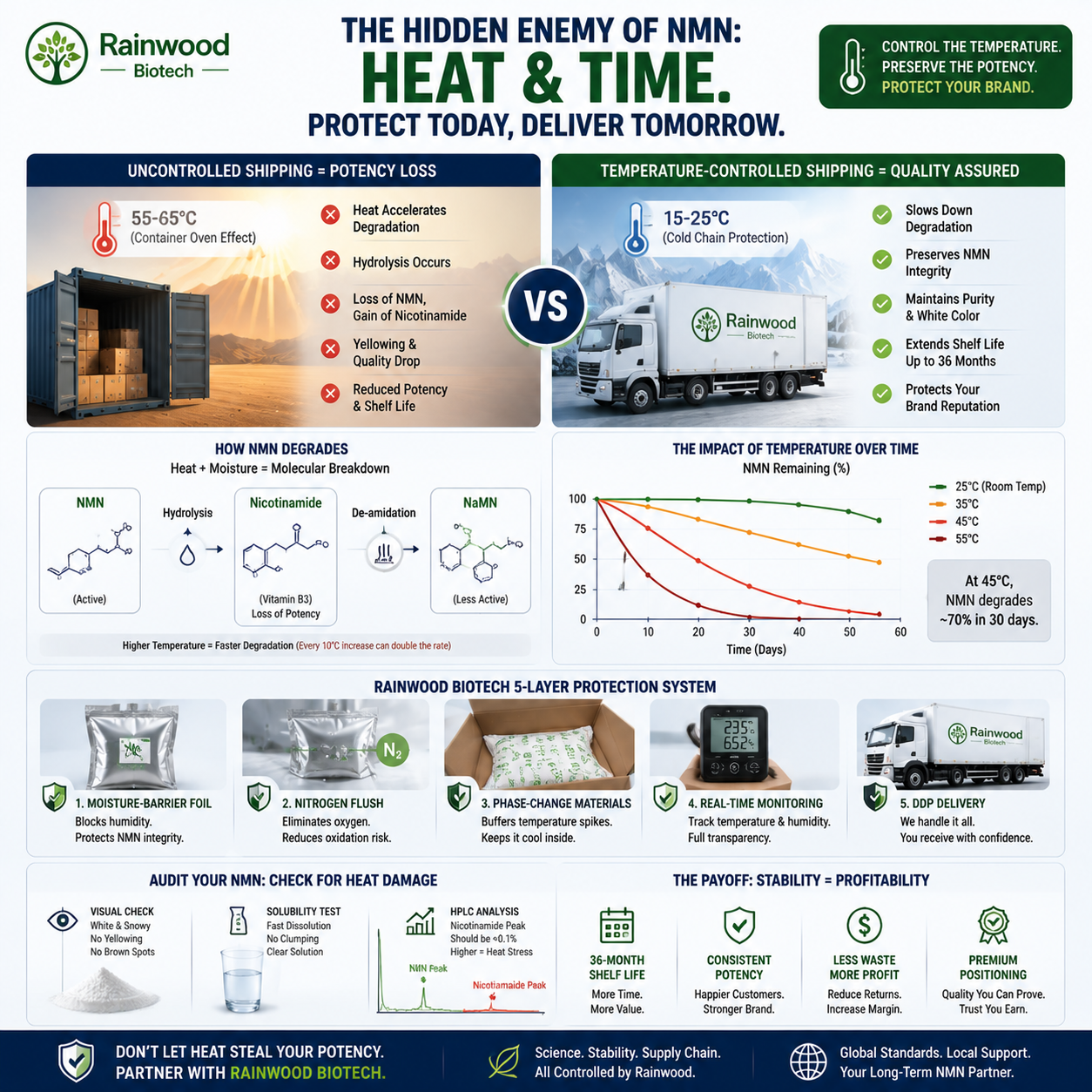
At Rainwood Biotech, our stability studies show that while NMN is stable at room temperature (25°C), every 10°C increase in temperature can double the rate of degradation. A batch that is stable for 24 months at 25°C may only remain within spec for 3 months if stored at 45°C. This exponential decay is why 'room temperature' storage in a warehouse is not the same as 'uncontrolled' storage in a shipping container.
3. The 'Container Oven' Effect: The Realities of Maritime Shipping
Most brokers and traders will tell you that NMN is 'stable for shipping.' They are referring to a 3-day air-freight journey. But for bulk procurement, maritime shipping is the standard. A standard shipping container is essentially a giant solar collector. During a trans-Pacific or trans-Indian Ocean voyage, the sun’s radiation hits the metal roof for 12 hours a day. In a non-refrigerated (dry) container, internal air temperatures frequently reach 55°C (131°F) to 65°C (149°F).
If the vessel is delayed at a port in the Middle East or Southern California during the summer, these temperatures can be sustained for weeks. This is what we call the 'Heat Soak.' Even if the product is in the center of the pallet, the thermal mass eventually equilibrates with the container air. If your Beta-Nicotinamide Mononucleotide is sitting in a 60°C box for 30 days, it is being 'cooked.' The product that leaves the ship is not the same product that left our Xi'an facility. The molecular 'engine' has been idling in a furnace for a month.
4. The Customs 'Black Hole': The Silent Danger of Port Delays
One of the most dangerous phases of the supply chain is the time spent in a customs warehouse. These facilities are often tin-roofed, non-insulated buildings where temperatures can spike even higher than inside a container. A shipment can sit for 7 to 14 days awaiting clearance.
Most suppliers use FOB (Free on Board) or CIF (Cost, Insurance, and Freight) terms. This means their responsibility ends when the goods arrive at the port. If the cargo is heat-damaged while sitting in a customs warehouse, the buyer carries the loss. This is why Rainwood Biotech has invested heavily in our DDP (Delivered Duty Paid) infrastructure. We don't just ship product; we manage the 'Thermal Biography' of the batch.
5. Case Study: The 'August Meltdown' of 2025
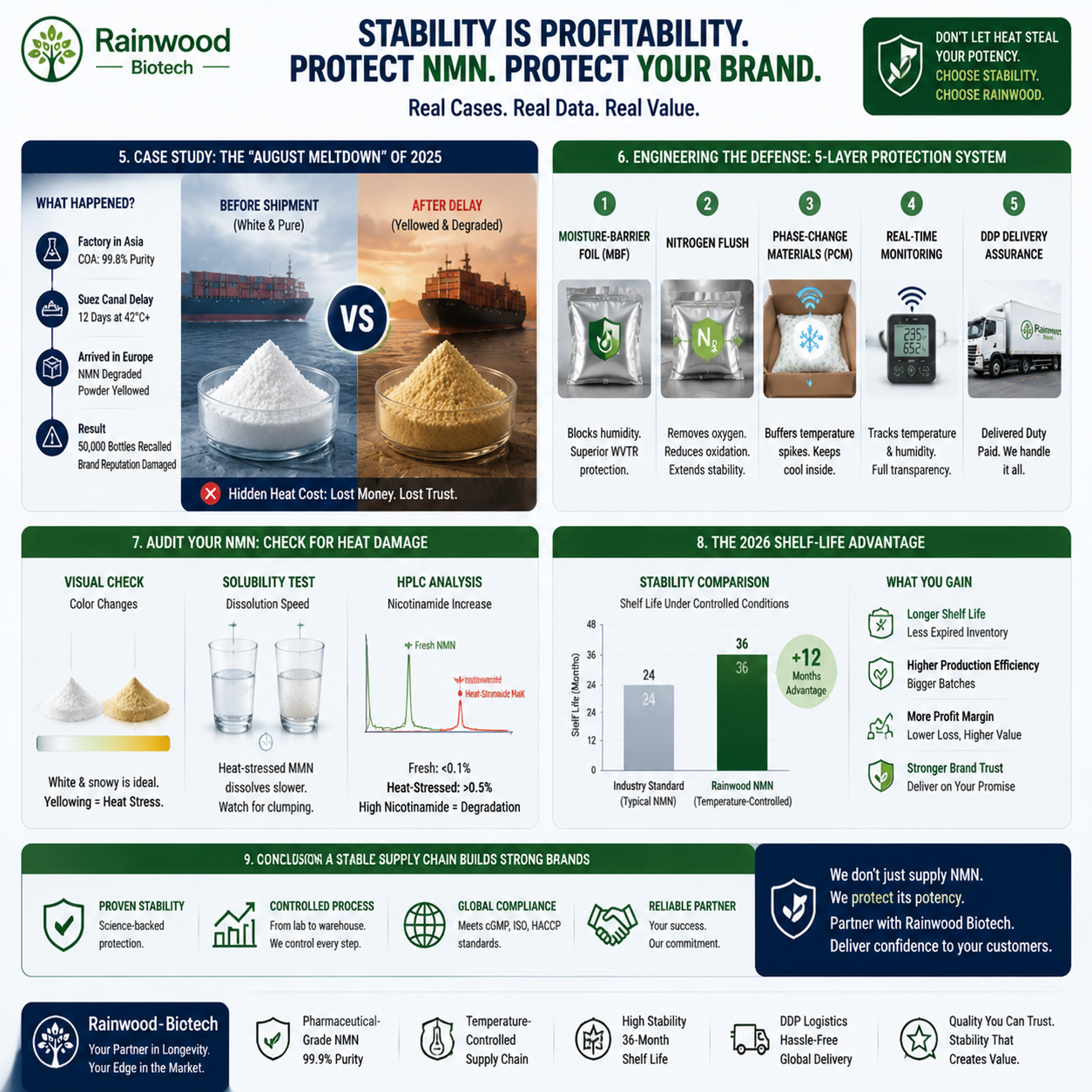
In August 2025, a major European longevity brand faced a recall of 50,000 bottles of NMN. Their COA showed 99.8% purity at the factory in Asia. However, the shipment was delayed at the Suez Canal for 12 days in 42°C ambient temperatures. By the time the product was encapsulated in Germany, the NMN had degraded by 6%, and the powder had developed a distinct yellowish hue.
The cost of the recall, the damage to the brand's reputation, and the loss of consumer trust far outweighed the 'savings' they made by using a cheaper FOB supplier without temperature monitoring. This is a cautionary tale for any brand owner: The cheapest price often carries the highest risk. At Rainwood Biotech, we see this scenario play out every summer with brands that prioritize upfront cost over landed quality.
6. Engineering the Defense: Beyond Standard Packaging
At Rainwood Biotech, we don't believe that a standard poly-bag is enough for a molecule as sensitive as NMN. We have engineered a multi-layered defense system:
1. Moisture-Barrier Foil (MBF): We use a proprietary quad-layer foil with a Water Vapor Transmission Rate (WVTR) that is 90% lower than standard PE bags.
2. Vacuum-Sealing with Nitrogen Flush: By removing oxygen and moisture and replacing it with inert nitrogen, we drastically slow down the oxidative pathways of degradation.
3. Phase-Change Materials (Optional): For ultra-premium orders or extreme summer routes, we offer integrated Phase-Change Materials (PCMs) inside the outer carton to buffer against temperature spikes. This technology ensures that the internal temperature of the box stays below 25°C even if the outside hits 40°C for several hours.
7. Procurement Audit: How to Identify 'Heat-Stressed' NMN
If you are currently sourcing from a supplier who does not provide temperature monitoring, your QA team must be vigilant. Here is how to audit your incoming Beta-Nicotinamide Mononucleotide for thermal damage:
• The 'Yellowing' Gradient: Compare the powder against a 'Primary White' reference. Any shift towards ivory or a slight tan color is a red flag.
• The Solubility Lag: Heat-stressed NMN often exhibits 'Clumping' at the microscopic level, leading to a slower dissolution rate in water compared to fresh material.
• HPLC Impurity Mapping: Look for a rise in the 'Nicotinamide' peak. In fresh Rainwood Biotech material, this peak is typically <0.1%. If your incoming material shows >0.5%, it has likely seen excessive heat during transit or storage.
8. The 2026 Shelf-Life Advantage
By using Rainwood Biotech's high-density, low-moisture, and temperature-controlled NMN, brands can confidently offer a 36-month shelf life instead of the industry-standard 24 months. This extra 12 months of 'retail window' is pure profit for the brand owner, as it reduces the risk of expired inventory and allows for larger, more cost-effective production runs. This stability is not a coincidence; it is a direct result of controlling the thermal history of the molecule.
9. Conclusion: The Strategic Value of a Stable Supply Chain
In the longevity market of 2026, transparency is the new currency. Brands that can prove their NMN has been kept in a stable 'Cold Chain' from synthesis to shelf will command a significant premium. Don't let your brand's reputation evaporate in a shipping container. At Rainwood Biotech, we treat the supply chain as an extension of our laboratory. We provide the technical authority and the logistics infrastructure to ensure that your promise to the consumer is never compromised by the heat of the journey.
Table of Contents
- 1. The 'COA Paradox': Why Purity at Origin Doesn't Guarantee Potency at Destination
- 2. The Chemistry of Decay: Hydrolysis, De-amidation, and the 'Browning' Effect
- 3. The 'Container Oven' Effect: The Realities of Maritime Shipping
- 4. The Customs 'Black Hole': The Silent Danger of Port Delays
- 5. Case Study: The 'August Meltdown' of 2025
- 6. Engineering the Defense: Beyond Standard Packaging
- 7. Procurement Audit: How to Identify 'Heat-Stressed' NMN
- 8. The 2026 Shelf-Life Advantage
- 9. Conclusion: The Strategic Value of a Stable Supply Chain