 EN
EN

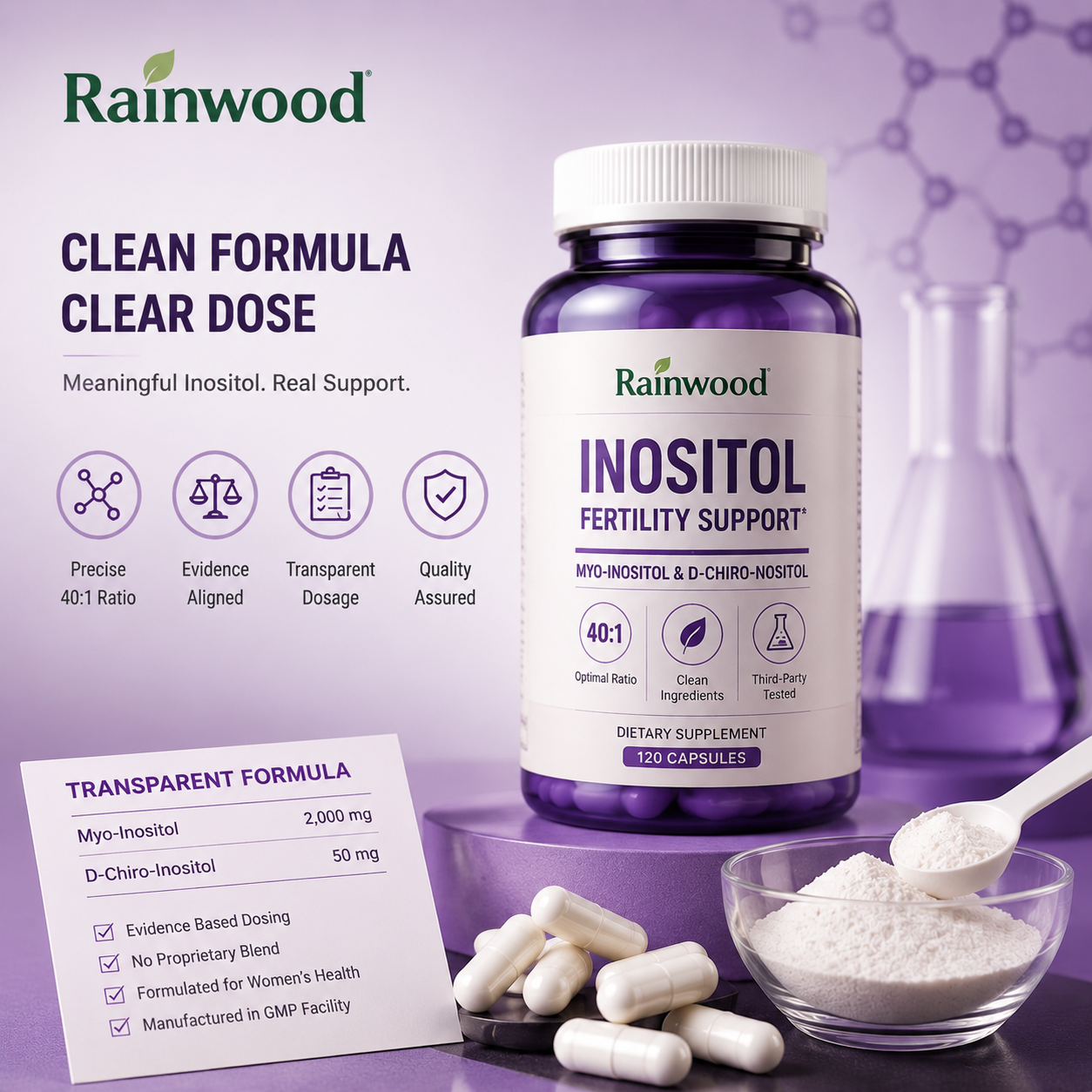
Meta title: The Fairy-Dusted Inositol Fertility Formula Trap
Meta description: A long fertility blend can hide tiny inositol amounts, proprietary doses and weak evidence. Learn how brands spot formula decoration before launch.
Twelve ingredients. Eight benefit icons. One enormous proprietary blend.
No individual inositol amount.
This is the fairy-dusted fertility formula: a label designed to look comprehensive while keeping every meaningful comparison impossible.
The brand gets more keywords. The supplier gets a lower ingredient cost. The customer gets a premium bottle with no clear answer to the simplest question:
How much Myo-Inositol and D-Chiro-Inositol am I actually taking?
Why formula decoration sells
Each added ingredient creates:
- another search term;
- another icon;
- another benefit story;
- another competitor comparison;
- another reason to charge more.
But the physical serving does not grow. If a gram-level inositol concept is forced into two capsules with folate, NAC, CoQ10, vitamin D, botanicals and minerals, something must give.
Usually, it is the dose.
Start with our transparent inositol formula-development guide.
Trick 1: the proprietary blend hides every weak amount
A blend may disclose only the combined total. Ingredients are listed in descending weight, but individual quantities remain unknown.
The label can mention Myo-Inositol and DCI without allowing the customer to verify:
- daily milligrams;
- 40:1 ratio;
- evidence relevance;
- cost per active amount; or
- whether one ingredient is merely decorative.
If transparency is part of the brand promise, disclose what matters.
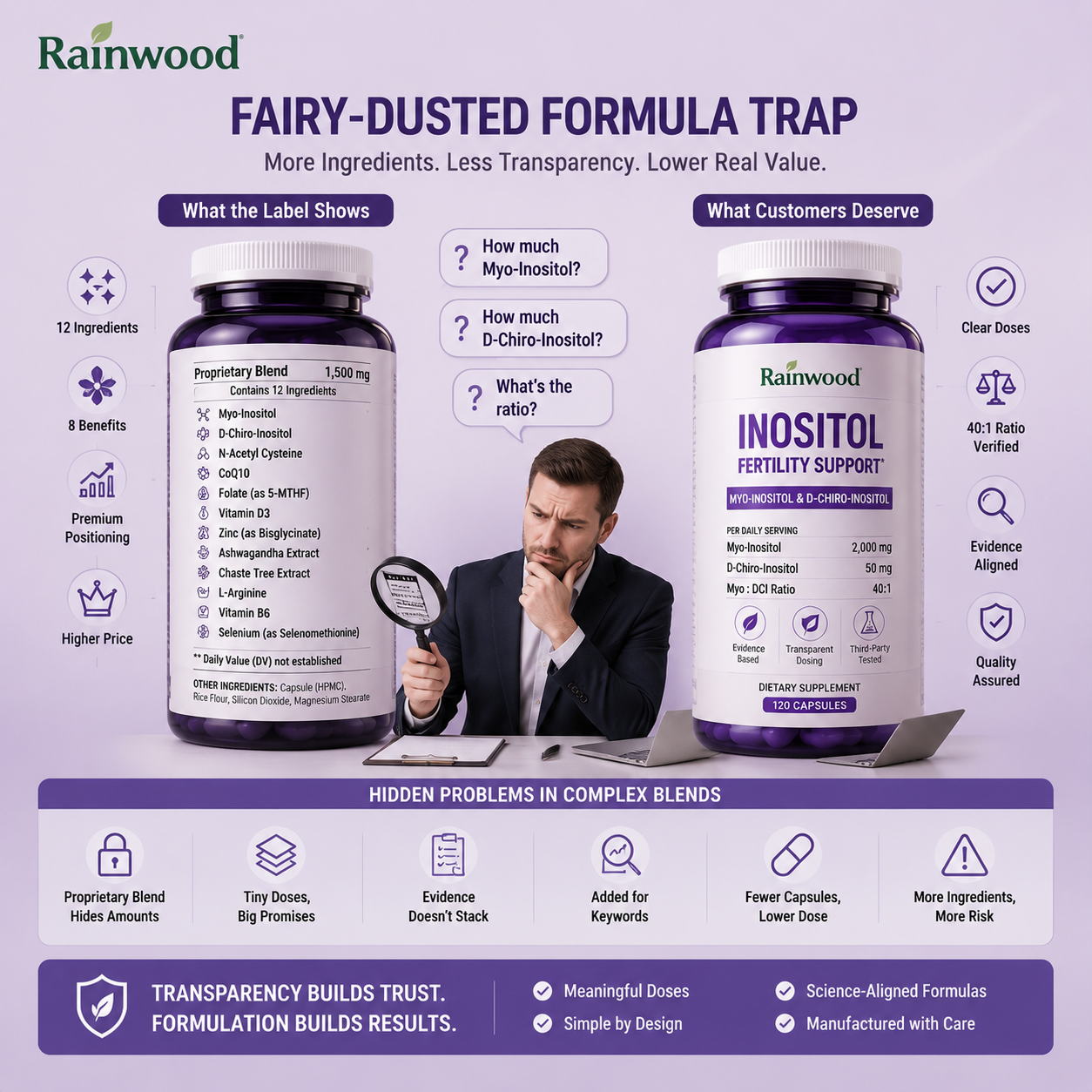
Trick 2: the ratio headline survives while the dose disappears
A formula can maintain 40:1 at almost any scale.
Forty milligrams plus one milligram is mathematically perfect and commercially tiny compared with 2,000 mg plus 50 mg.
The ratio should never be printed more prominently than the amounts that create it.
Trick 3: every ingredient borrows evidence from another formula
The sales page may cite:
- a Myo-Inositol study;
- a DCI study;
- a folate study;
- a vitamin D review;
- a botanical mechanism; and
- a combination trial with a different formula.
The page then implies that this exact twelve-ingredient product delivers all outcomes.
Evidence does not stack like logos. The finished formula needs a coherent rationale, and claims must match the actual product.
Trick 4: low-dose ingredients are included for the search algorithm
Ask of every ingredient:
1. Is it present for function or keyword coverage?
2. Is the daily amount disclosed?
3. Is the amount consistent with the story?
4. Can it be manufactured and tested?
5. Does it create a warning?
6. Does it add real differentiation?
If the supplier cannot answer, the ingredient is packaging decoration.
Trick 5: capsule count is reduced by reducing the formula
Brands fear four- or eight-capsule routines, so suppliers promise a two-capsule complex.
There are legitimate lower-dose positions. The problem is pretending that a convenience formula is equivalent to a higher-dose formula used in research or leading products.
Compare:
- exact dose;
- daily units;
- bottle days;
- customer cost;
- intended claim; and
- evidence.
Do not let convenience erase honesty.
Trick 6: more ingredients create hidden manufacturing risk
Complex blends increase questions around:
- low-level uniformity;
- particle-size differences;
- segregation;
- moisture;
- taste;
- colour;
- stability;
- analytical interference;
- sourcing;
- allergens; and
- market access.
Every added ingredient needs a specification, supplier, test or risk justification, batch record and change control.
The formula subtraction test
Remove one ingredient at a time and ask:
- Does the core product promise weaken?
- Does the evidence become clearer?
- Does the serving become easier?
- Does cost fall materially?
- Does testing become more reliable?
- Does the label become easier to understand?
If removing six ingredients improves the product, the original formula was designed for appearance.
The “clinically dosed” collage
Some labels place “clinically studied ingredients” beside a formula that does not disclose or match the studied quantities.
Audit every ingredient with:
| Ingredient | Commercial daily amount | Studied amount/form | Match? | Claim used |
|---|---:|---:|---|---|
If the formula contains one-tenth of the cited amount, the presence of the ingredient does not make the finished product clinically dosed.
Also check whether the citation studied:
- the ingredient alone;
- a branded source;
- another chemical form;
- a different population;
- a different duration; or
- a combination where individual contribution is unknown.
The “everything for everyone” customer trap
A formula positioned for cycle support, fertility, mood, sleep, glucose, beauty and prenatal nutrition has no clear primary buyer.
That creates:
- scattered keywords;
- contradictory messaging;
- more warnings;
- confused customer service;
- weak professional credibility; and
- low memorability.
Choose one hero problem and allow companion ingredients to support that story.
The margin trap inside tiny actives
Decorative actives may be inexpensive per bottle, but each one adds:
- supplier qualification;
- MOQ;
- incoming control;
- batch documentation;
- inventory;
- expiry risk;
- label review;
- test complexity; and
- shortage exposure.
The raw-material cost can be tiny while the operational cost is large.
How RainwoodBio can build a formula with a reason
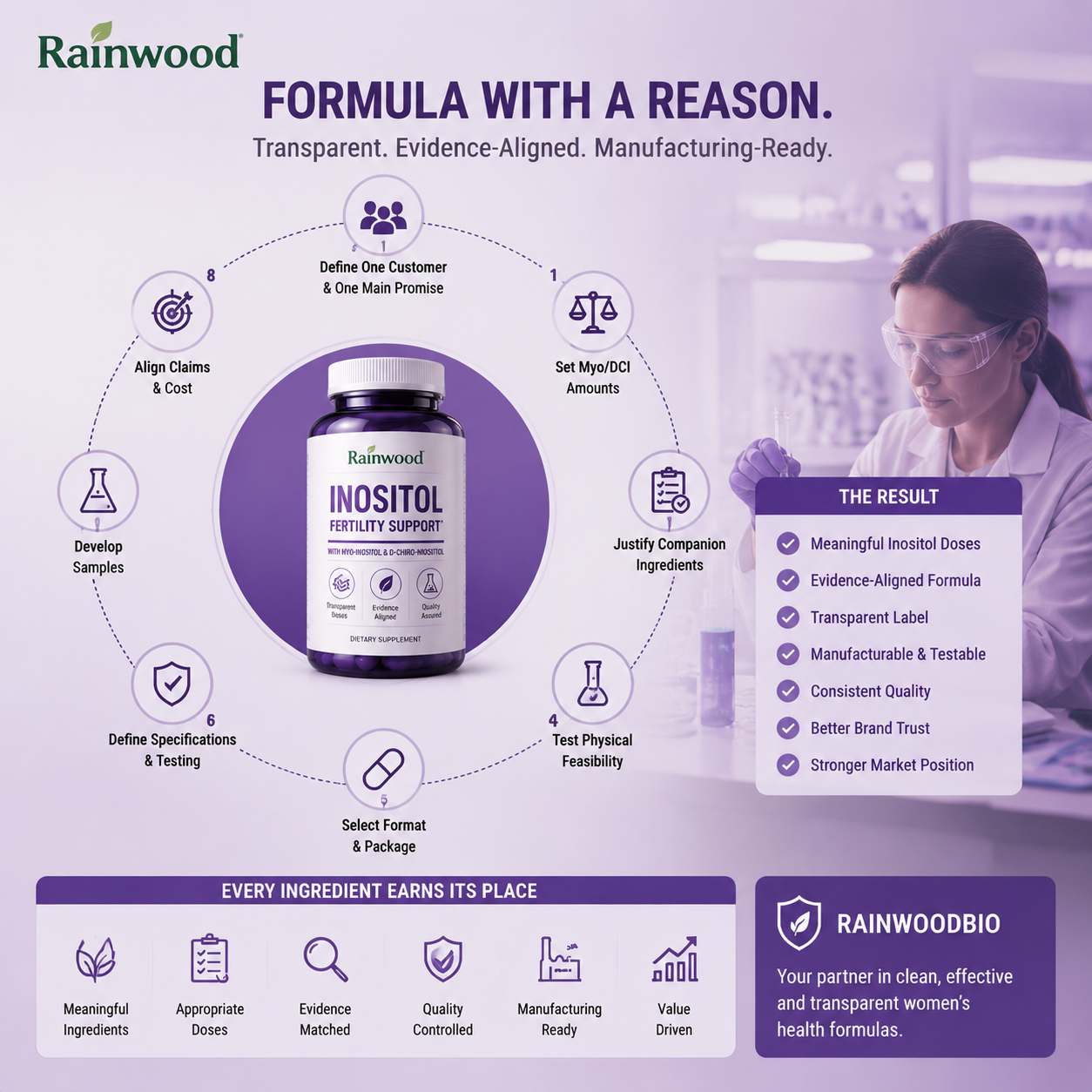
RainwoodBio publishes R&D, custom formulation and multiple dosage-form capabilities. For a complex inositol concept, the useful process is not “add every trending ingredient.” It is:
1. define one customer and one main promise;
2. set Myo/DCI amounts;
3. justify companion ingredients;
4. test physical feasibility;
5. select format and package;
6. define specifications and testing;
7. develop samples; and
8. align claims and cost.
Explore RainwoodBio’s custom women’s-health formulation service.
Learn more about RainwoodBio’s R&D and manufacturing capabilities.
The label transparency score
Give one point for each:
- Myo amount disclosed
- DCI amount disclosed
- Ratio calculable
- Daily serving clear
- Bottle days clear
- Other active amounts disclosed
- Ingredient forms specified
- Quality evidence available
- Claims matched to formula
- No decorative proprietary blend
A score below six means the premium story may be hiding a discount formula.
Frequently asked questions
1.Are proprietary blends always bad?
No. They can protect formulation know-how, but they reduce public dose transparency and require a strong confidential technical file.
2.Is a longer ingredient list more effective?
Not automatically. Formula effectiveness and marketability depend on identity, amount, evidence, interaction, format and customer fit.
3.Can RainwoodBio simplify an existing formula?
RainwoodBio can review the product brief, target market, serving and manufacturing feasibility to develop sample options.
Make every ingredient earn its place
Send RainwoodBio your current formula, daily serving, capsule target, market and price.
Request an inositol formula de-cluttering and feasibility review.
References
- NIH Dietary Supplement Label Database, *Inositol proprietary-blend and combination labels*.
- Fitz et al., *Inositol for Polycystic Ovary Syndrome: A Systematic Review and Meta-analysis* (2024).
- US Federal Trade Commission, *Health Products Compliance Guidance*.
*This article provides general formulation and marketing information and is not medical advice.*