 EN
EN

Meta title: Build an Inositol Dossier Practitioners Trust
Meta description: Professional inositol brands need more than a premium label. Build a dossier covering identity, dose, evidence, testing, stability and traceability.
Practitioners do not need another bottle that says “hormone harmony.”
They need answers.
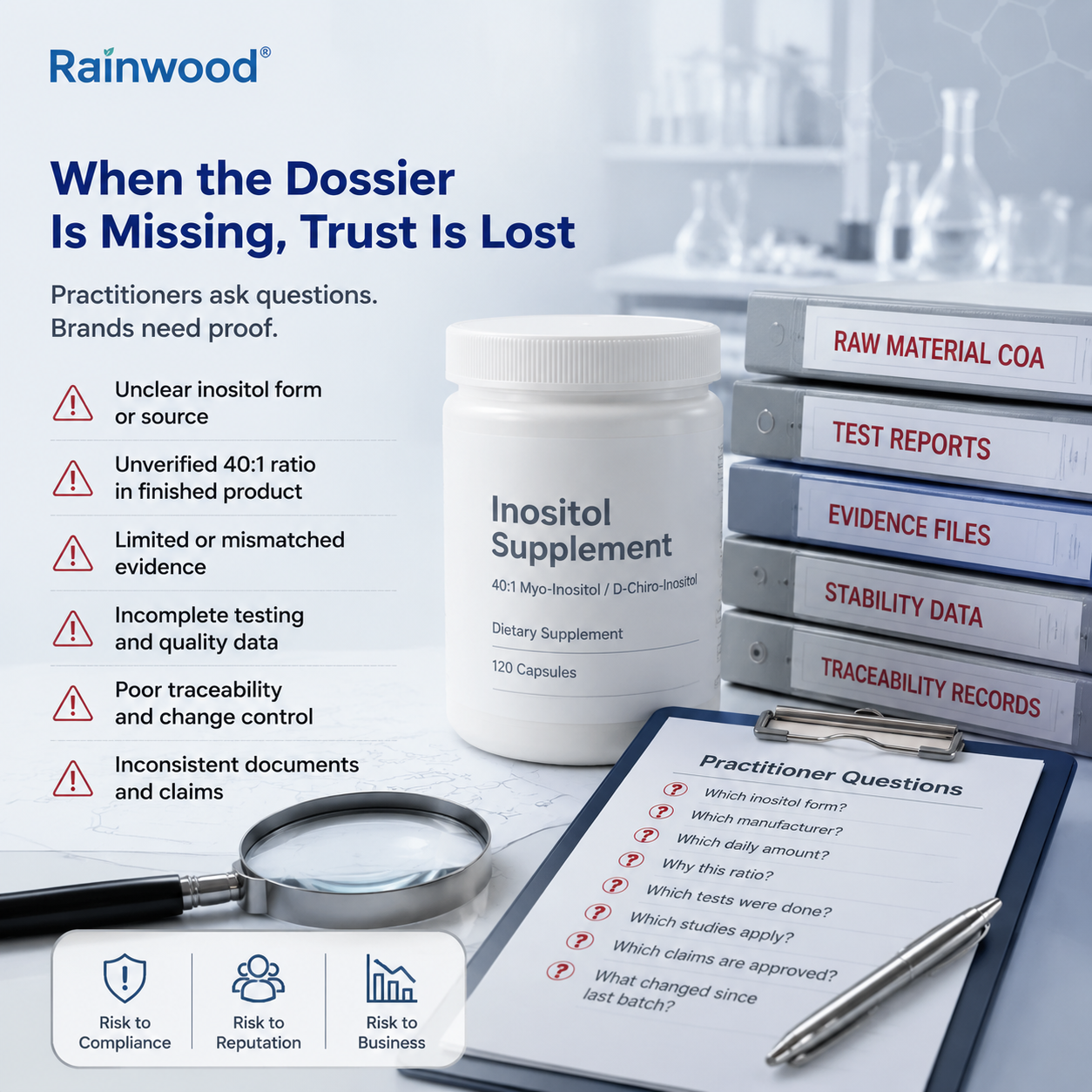
What form of inositol is used? Why this dose? Is the 40:1 ratio a real finished-product attribute? Which studies match the formula? What was tested? What happens if the source changes?
A brand that cannot answer these questions is not professional-grade. It is consumer marketing wearing a white coat.
Dossier section 1: exact product identity
Include:
- Myo-Inositol, DCI or other defined form;
- original manufacturer;
- manufacturing site;
- source/process overview;
- specification;
- identity and assay methods;
- lot COA;
- relevant impurity controls; and
- change-notification terms.
Do not write “Inositol Complex” where a professional expects chemistry.
Start with our inositol technical-document checklist.
Dossier section 2: formula logic
Show:
- amount per unit;
- amount per serving;
- servings per day;
- daily amount;
- Myo/DCI ratio;
- companion ingredients;
- rationale for each;
- dosage-form constraints; and
- intended customer routine.
If four capsules are required, say four. Hiding the routine until the back panel destroys trust.
Dossier section 3: evidence bridge
Create a table mapping:
| Commercial feature | Study material | Dose | Population | Outcome | Relevance | Limitation |
|---|---|---:|---|---|---|---|
Include contradictory or inconclusive evidence. The 2024 guideline-linked systematic review concluded that evidence was limited and inconclusive overall, despite possible benefits in some outcomes.
Professional credibility grows when the dossier can survive difficult questions.
Read Clinically Proven Inositol - Or Just a Selected Headline?.
Dossier section 4: manufacturing control
Document:
- approved suppliers;
- incoming verification;
- dispensing;
- preblending;
- mixing parameters;
- in-process checks;
- yield;
- finished specifications;
- deviation handling; and
- change control.
For a Myo/DCI blend, explain how the lower-level component is distributed and sampled.
Dossier section 5: finished-product proof
Depending on format and risk, include:
- identity/composition;
- dosage-unit or net-content control;
- microbiology;
- heavy metals;
- disintegration where applicable;
- packaging integrity;
- organoleptic attributes;
- stability;
- lot coding; and
- retention samples.
A raw-material COA is not a finished-product quality dossier.
Explore our inositol quality-control framework.
Dossier section 6: claims and education
Separate:
- scientific background;
- permitted label claims;
- practitioner education;
- consumer advertising;
- disease claims;
- testimonials; and
- medical questions requiring clinician judgment.
Train sales and customer-service teams to avoid turning a cautious evidence summary into a treatment promise.
Dossier section 7: precautions and market fit
The product file should identify:
- intended population;
- excluded populations where applicable;
- pregnancy or nursing considerations;
- medication and medical-condition warnings;
- allergens;
- serving instructions;
- market-specific label requirements; and
- complaint or adverse-event process.
Do not copy warnings from a competitor without reviewing the actual formula.
Dossier section 8: supply continuity
Professionals build routines around products. Silent changes can damage that trust.
Maintain:
- approved source list;
- forecast and lead time;
- safety stock;
- source-change assessment;
- formula and label impact;
- updated evidence review; and
- communication plan.
Dossier section 9: version control
A professional dossier loses credibility when the formula, label and COA describe different revisions.
Control:
- document number;
- revision;
- effective date;
- author and approver;
- change history;
- linked formula;
- linked label;
- linked specification; and
- obsolete-document withdrawal.
When a practitioner asks about the current product, the technical team should not send last year’s formulation by mistake.
Dossier section 10: questions the dossier does not answer
Include an honest limitations page:
- outcomes not established;
- populations not studied;
- formula differences;
- evidence uncertainty;
- unresolved stability questions;
- market-specific claim restrictions; and
- questions requiring medical judgment.
This page is not weakness. It prevents sales teams from inventing answers.
Convert the dossier into sales assets
The full file can create:
- practitioner one-page summary;
- product training;
- ingredient comparison;
- batch-quality explainer;
- transparent FAQ;
- sales-team objection handling; and
- responsible research Blog content.
One controlled technical source can power aggressive marketing without allowing every channel to improvise.
How RainwoodBio can support the professional file
RainwoodBio’s website describes an internal R&D team, laboratory equipment, supplier management, production control, batch testing, compliance documentation and traceability.
These capabilities can be organised around one product-specific dossier rather than scattered certificates:
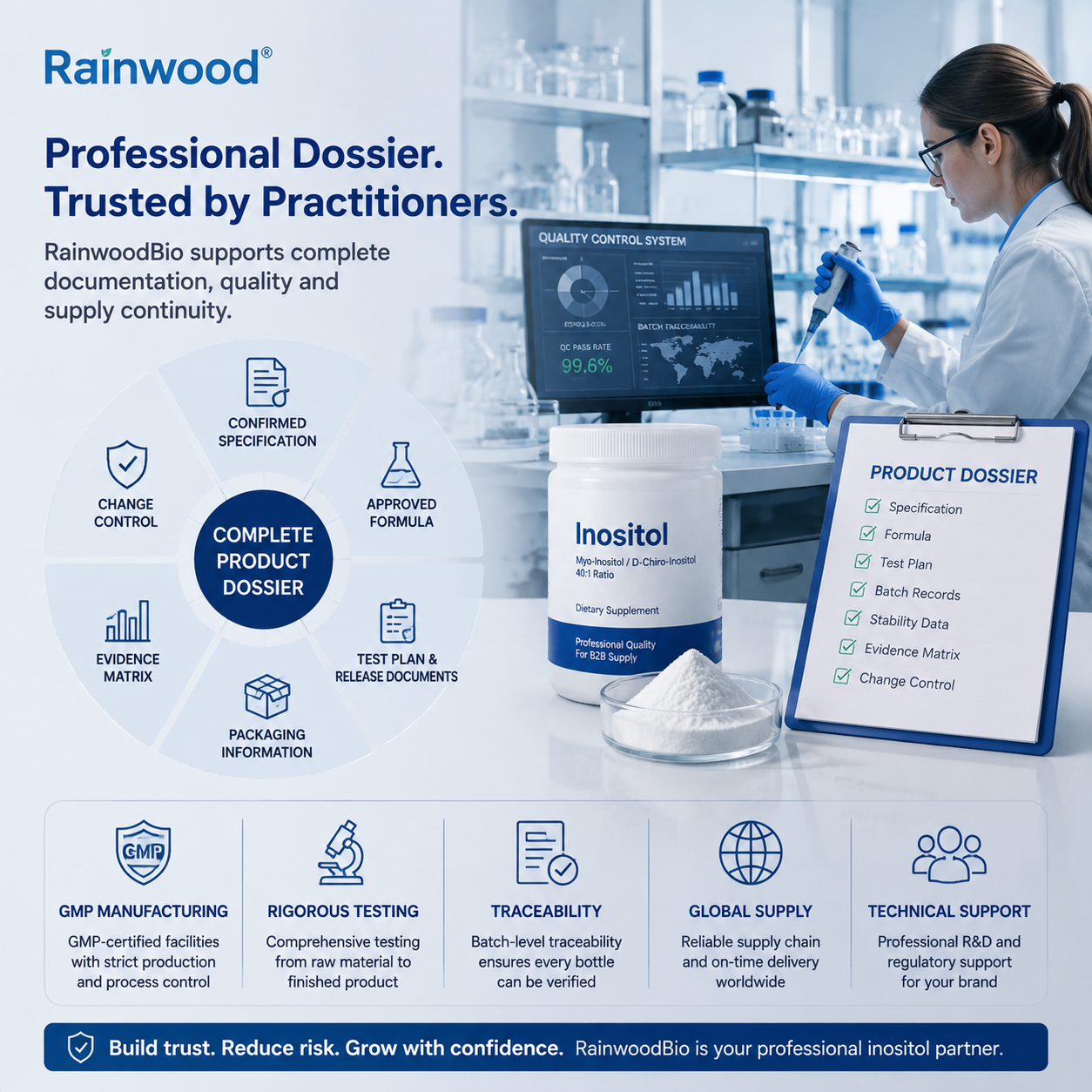
1. confirmed specification;
2. approved formula;
3. sample and production records;
4. test plan and release documents;
5. packaging information;
6. evidence matrix; and
7. change-control file.
Learn more about RainwoodBio’s R&D and quality capabilities.
The practitioner credibility test
Can your technical team answer these questions in one business day?
- Which inositol form?
- Which manufacturer?
- Which daily amount?
- Why this ratio?
- Which finished tests?
- Which studies apply?
- Which claims are approved?
- What changed since the last batch?
If not, the dossier is not ready.
Create a batch-level answer sheet
Practitioners may ask about a specific bottle, not the general product.
For every released lot, keep a concise record showing:
- finished lot number;
- ingredient lots;
- manufacture and expiry dates;
- specification revision;
- key release results;
- deviations;
- authorised disposition; and
- contact for technical questions.
This does not need to expose confidential manufacturing detail. It should prove that the brand can trace the bottle being discussed.
Train the sales team with red-line language
Give commercial staff three lists:
- statements they may use;
- statements requiring technical review; and
- disease or absolute claims they must not use.
Add approved answers for the 40:1 ratio, daily amount, clinical evidence, source and testing.
Without training, the most enthusiastic salesperson can destroy the credibility the dossier was built to create.
Give practitioners a controlled update path
A dossier becomes dangerous when old copies remain in clinics after the formula, source, label or evidence has changed. Put a document number, version, effective date and replacement notice on every professional pack. Maintain a distribution list so important updates can reach the people who received earlier versions.
Separate stable educational content from batch-specific documents. The formulation rationale may change rarely; a COA, allergen statement or market document can be lot- or time-dependent. This prevents sales teams from attaching an old certificate to a new batch simply because the file name looked familiar.
The update path should also tell practitioners where to send technical questions and how quickly they can expect a response. Credibility is not created only by having documents. It is created when the company can retrieve the correct version, explain its scope and correct an error without improvisation.
Frequently asked questions
1.Does every professional product need a published clinical trial?
Not necessarily, but claims and positioning need appropriate substantiation, and the relationship between ingredient research and the finished product should be clear.
2.Can proprietary information be protected?
Yes. Retailers or practitioners may receive confidential technical summaries or controlled documents without public disclosure of every detail.
3.How often should the dossier be updated?
Review after source, formula, method, packaging, regulation or evidence changes, and on a defined periodic schedule.
Give professionals something competitors cannot fake with packaging
Send RainwoodBio your formula, target market, channel and current technical documents.
Request a professional inositol dossier gap checklist.
References
- Fitz et al., *Inositol for Polycystic Ovary Syndrome: A Systematic Review and Meta-analysis* (2024).
- US Food and Drug Administration, *Current Good Manufacturing Practice for Dietary Supplements*.
- US Federal Trade Commission, *Health Products Compliance Guidance*.
- RainwoodBio, *About Us and published quality workflow*.
*This article provides general product-development information and does not replace medical, legal or regulatory review.*