 EN
EN

Meta title: Why 4 Grams of Inositol Cannot Fit in Two Capsules
Meta description: A 4 g inositol formula cannot be forced into two ordinary capsules. Learn how dose, density, shell size and label tricks affect feasibility.
Four grams of powder do not become smaller because your marketing team wants “two capsules daily.”
Yet suppliers keep approving impossible concepts on paper:
- 4 g active formula;
- two capsules;
- no excipients;
- small bottle;
- low price;
- easy swallowing.
Physics eventually sends the corrected quotation.
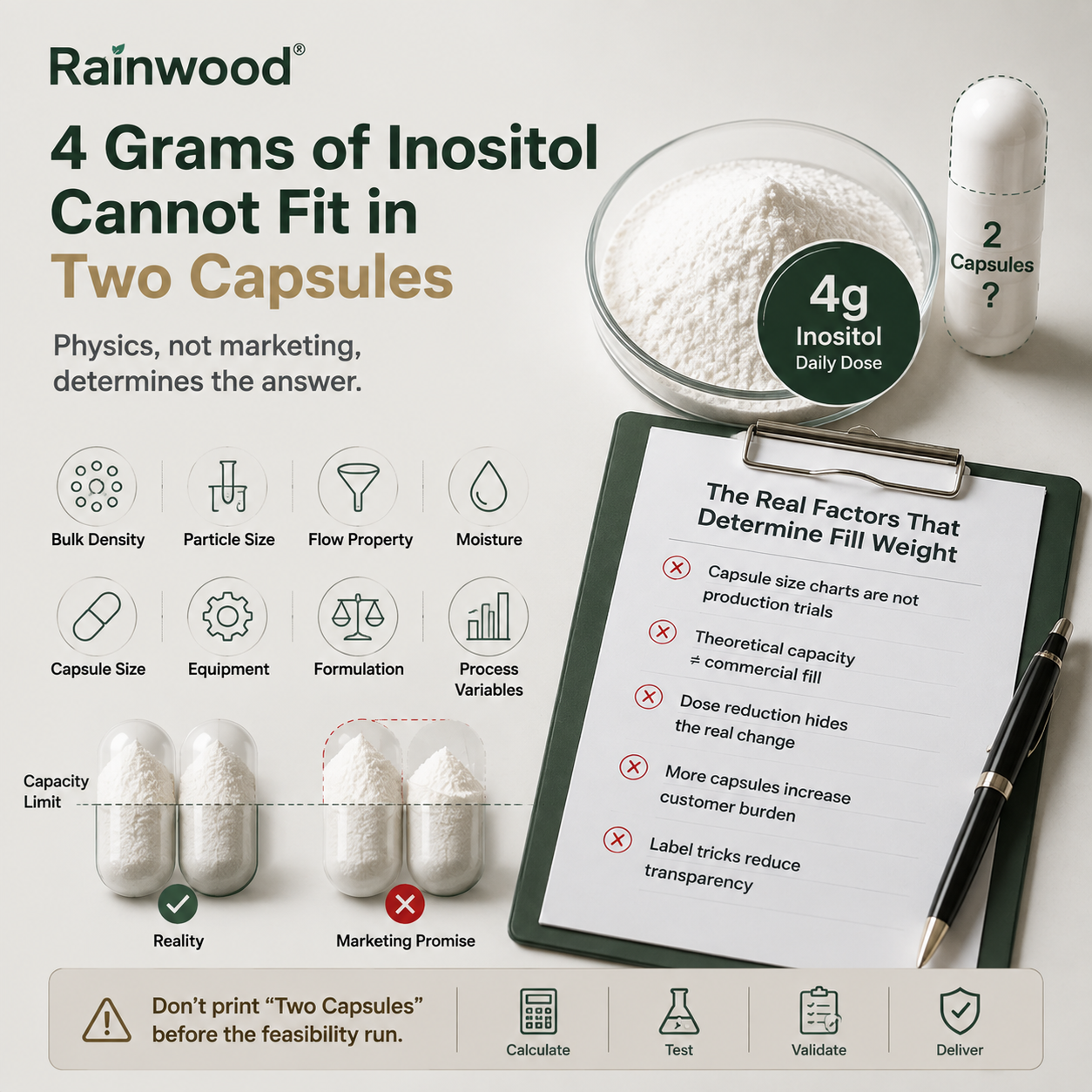
Capsule size charts are not production trials
Capsules hold volume. Fill weight depends on:
- bulk density;
- tapped density;
- particle size;
- flow;
- compaction;
- moisture;
- other ingredients;
- capsule shell; and
- filling equipment.
A theoretical chart cannot prove the actual commercial fill.
Use our inositol capsule-fill feasibility service.
The three ways suppliers make the concept “fit”
1. Reduce the dose
The formula quietly changes from grams to hundreds of milligrams.
2. Increase the capsule count
Two capsules become four, six or eight.
3. Change the format
The product moves to powder, stick packs or another delivery system.
These are legitimate design decisions when disclosed. They become a trap when the brand learns after artwork approval.
The 40:1 badge can survive dose reduction
A supplier can reduce 2,000 mg plus 50 mg to 400 mg plus 10 mg and keep the same ratio.
The label still says 40:1. The capsule count looks better. The formula is no longer the same product.
Read The 40:1 Inositol Trap.
Large capsules create customer costs
Increasing capsule size or count may affect:
- swallowing;
- daily adherence;
- shell cost;
- filling time;
- bottle size;
- shipping;
- FBA fees;
- perceived value; and
- review sentiment.
Ask representative customers to test the actual routine—not an empty sample capsule.
The bottle-day illusion
A bottle of 120 capsules can last:
- 120 days at one per day;
- 60 days at two;
- 30 days at four;
- 20 days at six; or
- 15 days at eight.
Show the daily serving and bottle days prominently.
Customers punish brands that make them calculate the truth after purchase.
Powder is not the automatic winner
Powder carries grams efficiently but introduces:
- scoop variability;
- flavour;
- dissolution;
- clumping;
- moisture;
- jar headspace;
- travel inconvenience; and
- customer education.
Stick packs improve portion control but add film, printing, packing and component MOQ.
The right choice depends on customer and economics.
What a proper feasibility run records
- exact raw-material lots;
- formula;
- capsule size and shell;
- target fill;
- actual average and variation;
- flow aids;
- machine settings;
- rejects;
- yield;
- daily capsule count;
- bottle fit; and
- package dimensions.
Do not print “two capsules” before this exists.
Do the mass-balance calculation
Before sampling, calculate:
1. active amount per day;
2. other active ingredients;
3. excipients;
4. total blend per day;
5. proposed capsule count;
6. target fill per capsule; and
7. theoretical volume using measured bulk density.
Then add realistic manufacturing variation.
If the target requires a fill beyond the demonstrated capability of the capsule and equipment, the concept is already broken.
Beware the “equivalent amount” wording
A label may use:
- blend equivalent;
- source equivalent;
- per-day amount while serving shows per-capsule;
- front-panel total while facts panel uses a smaller serving; or
- powder amount across several daily doses.
Make sure every large number is tied to a clearly defined serving. Customers should not need a calculator to discover that the headline requires eight capsules.
Test the finished routine
Give samples to representative users and observe:
- swallowing;
- timing;
- forgotten doses;
- bottle handling;
- travel;
- aftertaste;
- stomach comfort;
- instructions understood; and
- willingness to repeat for 30 days.
The technical team can create a product customers physically can take. Only user testing shows whether they will.
Calculate the promise customers actually receive
Do not approve the front label until the serving architecture passes four calculations:
1. grams of active ingredients per daily use;
2. number of units or scoops needed to deliver them;
3. genuine days of supply in one retail pack; and
4. landed cost per compliant customer month.
This exposes a common commercial illusion. A two-capsule serving may look elegant, but if it delivers only a fraction of the formula used in the brand’s supporting evidence, the package is selling convenience by quietly changing the product. Increasing the serving to eight or ten capsules may restore the amount while destroying adherence and margin.
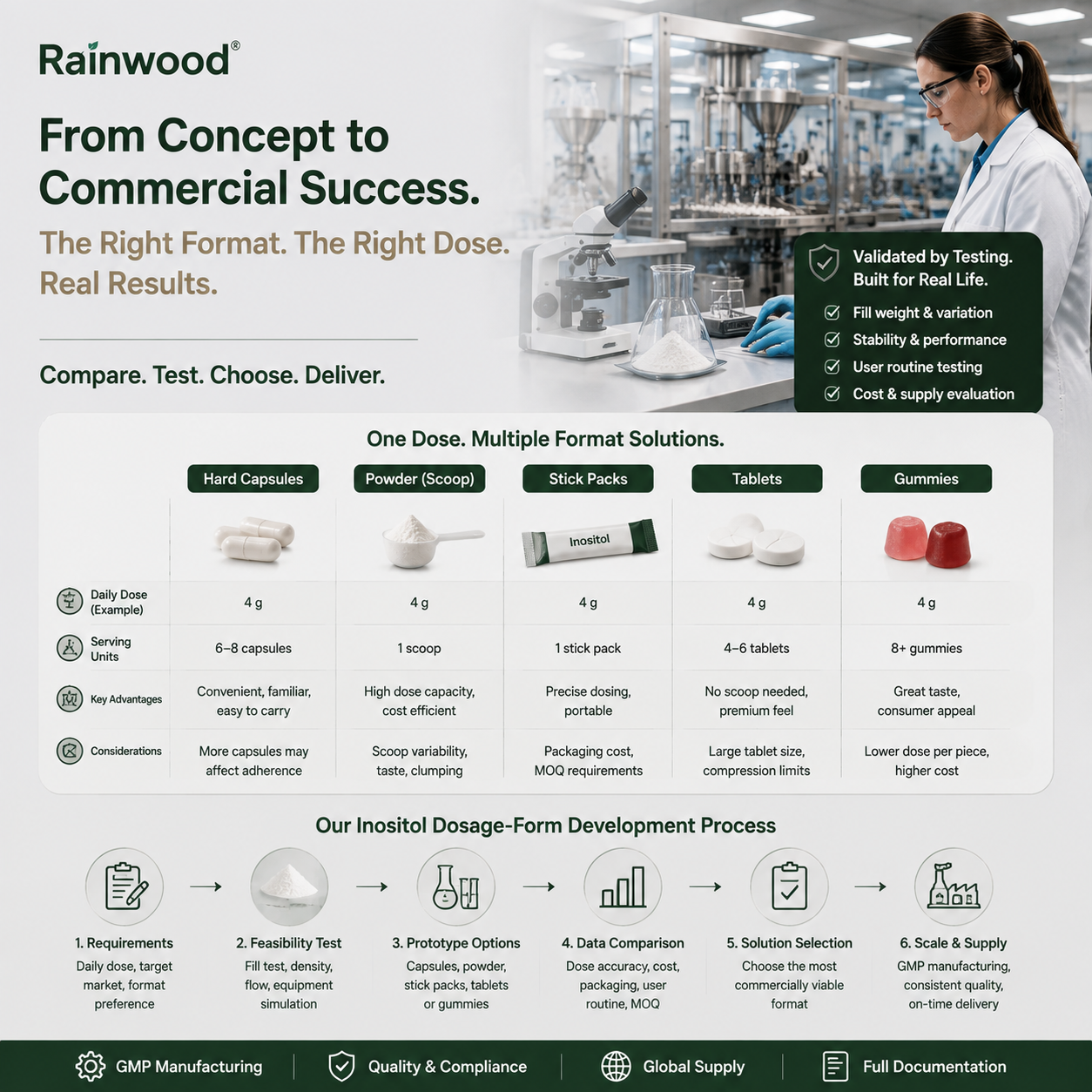
Build three honest prototypes instead: a full-dose powder, a divided-dose stick pack and the most practical capsule configuration. Quote each as a complete 30-day routine, not as a bottle. Then compare freight, packaging, testing, fulfilment fees, return risk and the number of daily actions demanded from the customer.
The winning format is not the one that looks cheapest on the first quotation. It is the one that can deliver the declared formula repeatedly without making the customer hate the routine.
That is the difference between attractive packaging and a commercially sustainable product.
How RainwoodBio can test the concept before it becomes a problem
RainwoodBio publishes capabilities across hard capsules, powders and sachets, tablets, gummies and private-label packaging.
That allows the same inositol dose to be compared across:
- capsule count;
- powder serving;
- sachet weight;
- packaging;
- MOQ;
- cost; and
- customer routine.
Explore RainwoodBio’s inositol dosage-form development service.
Learn more about RainwoodBio’s automated production capabilities.
The supplier challenge
Ask:
1. What bulk density was used?
2. Was the material production-representative?
3. Was the capsule machine-tested?
4. What excipients are included?
5. What is the actual fill variation?
6. How many units per day?
7. Which bottle fits the finished count?
If the supplier answers with only a capsule chart, the concept is not validated.
Frequently asked questions
1.How many capsules does 4 g require?
It depends on density, capsule size, formula and equipment. A commercial feasibility fill is required.
2.Can compression fit more powder?
Some materials can pack differently, but compaction can affect flow, processing and product performance. It is not a universal solution.
3Are .tablets better for high doses?
They may increase capacity but can become large and require suitable compression and disintegration controls.
Let the powder tell you the truth
Send RainwoodBio your daily amount, formula, preferred capsule size, bottle count and order quantity.
Request a real inositol fill and format assessment.
References
- NIH Dietary Supplement Label Database, *Myo-Inositol serving-size examples*.
- US Food and Drug Administration, *Current Good Manufacturing Practice for Dietary Supplements*.
- RainwoodBio, *OEM dosage-form capabilities*.
*This article provides general formulation information. Final dosage-form feasibility requires testing with the commercial formula and equipment.*