 EN
EN
Meta title: Why a 99% Inositol COA May Prove Almost Nothing
Meta description: Learn why a 99% assay may not prove Myo-Inositol, D-Chiro-Inositol or D-Pinitol identity—and what importers should test before buying.
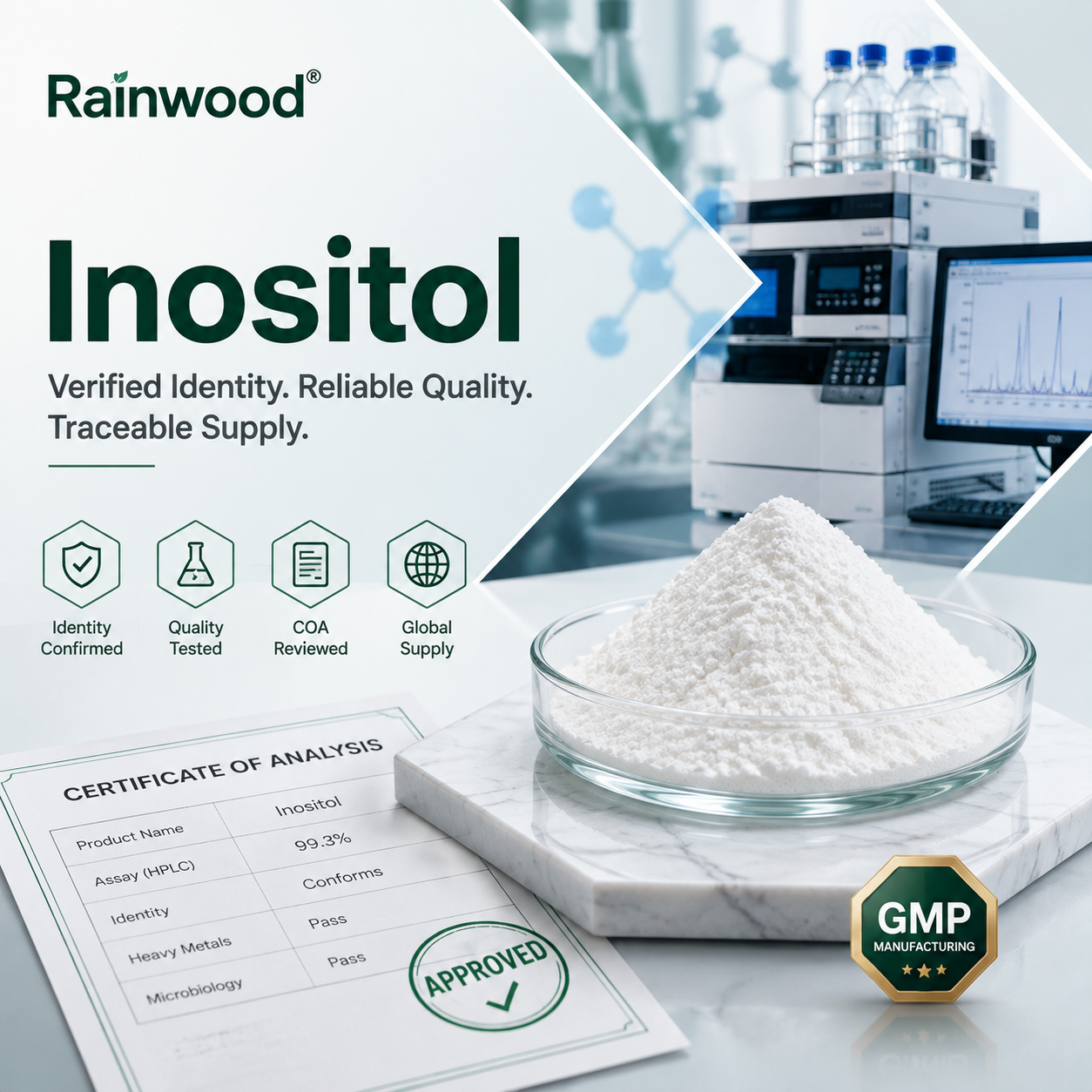
The COA looks perfect.
White powder: conforms.
Assay: 99.3%.
Heavy metals: pass.
Microbiology: pass.
There is only one problem: the document may still fail to prove which inositol is inside the drum.
Myo-Inositol, D-Chiro-Inositol and D-Pinitol can be reduced to familiar marketing language, but they are not interchangeable purchase specifications. If the identity method is weak or the COA was assembled from a generic template, “99%” can create confidence without answering the most important question.
Assay and identity are not the same test
An assay measures the amount of something defined by the method. Identity establishes what the material is.
A result can be precise and still answer the wrong question.
For example, a broad chemical or non-specific chromatographic method may quantify a compound class or main peak without demonstrating the intended stereochemical form. Total content does not automatically distinguish Myo-Inositol from another isomer.
Require the laboratory to explain:
- analytical principle;
- reference standard;
- specificity;
- sample preparation;
- calculation basis;
- system suitability;
- acceptance criteria; and
- whether the method can distinguish related compounds.
Use our inositol identity and specification checklist.
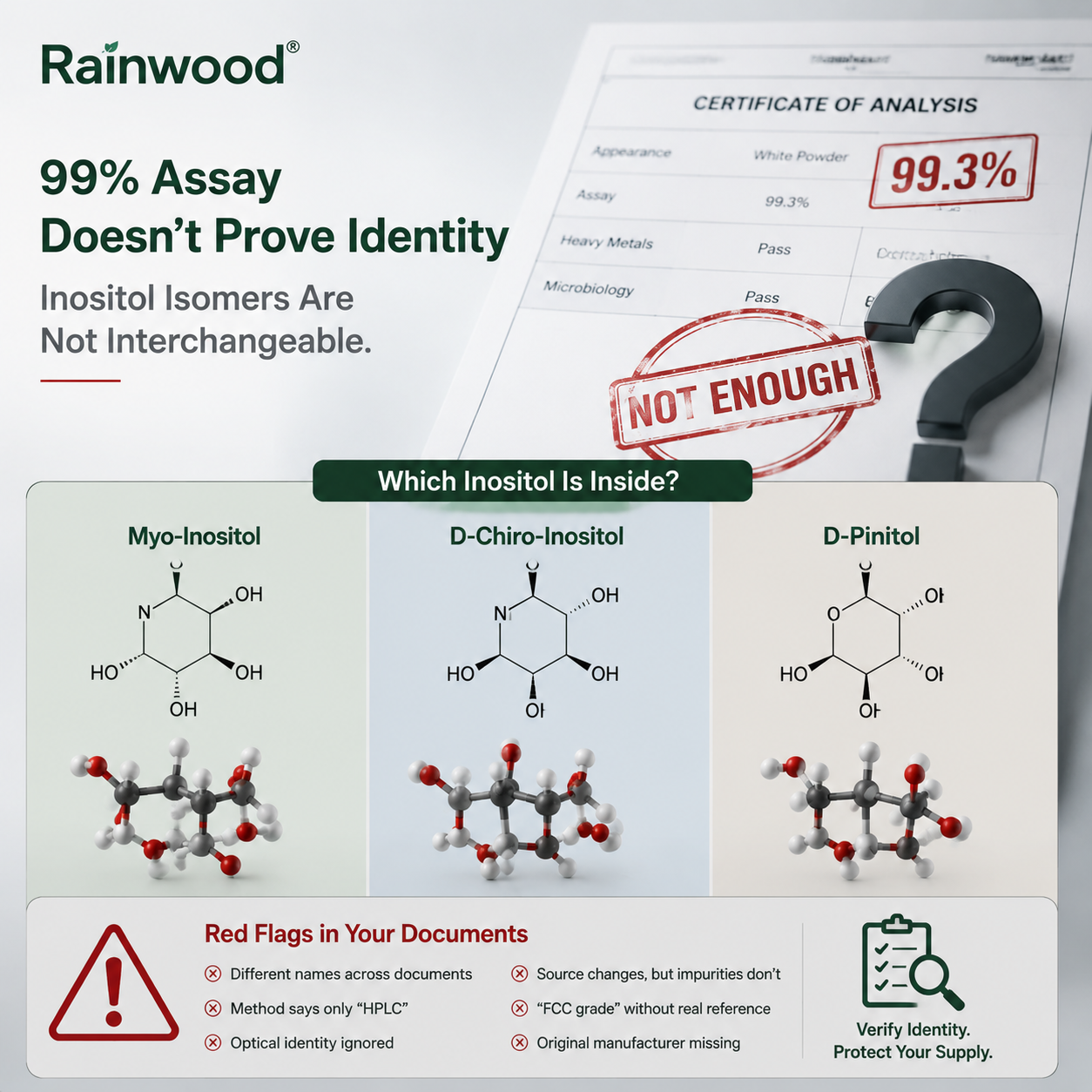
Red flag 1: three names appear across three documents
Compare the quotation, specification and COA.
If you find:
- “Myo D-Chiro Inositol” on the web page;
- “Chiro-Inositol” on the specification; and
- “D-Pinitol” in the description,
you do not have a spelling issue. You have an identity investigation.
The final purchase file should reconcile:
- exact chemical name;
- CAS number;
- molecular formula;
- manufacturer product code;
- source/process description;
- reference standard; and
- label name.
Do not let the commercial team explain away a technical contradiction with “they are basically the same.”
Red flag 2: the method column says only “HPLC”
HPLC is an instrument family, not a complete method.
Ask whether the procedure:
- separates the target from related inositols;
- uses a target-specific reference standard;
- has demonstrated specificity;
- reports related substances;
- is validated or verified for the matrix; and
- is applied to the raw material, finished product or both.
A colourful chromatogram is not enough if every unresolved compound sits under one peak.
Red flag 3: optical identity is ignored
Stereochemistry matters when purchasing a defined inositol isomer. Depending on the material and justified specification, optical rotation or another orthogonal technique may add useful identity evidence.
No single test solves every case. A stronger identity package may combine:
- infrared spectroscopy;
- suitable chromatography;
- optical or stereochemical evidence;
- chemical characteristics;
- comparison with a qualified reference standard; and
- manufacturer/process traceability.
The appropriate combination should be selected by a competent laboratory for the exact ingredient.
Red flag 4: the source story changes but the impurity plan does not
Myo-Inositol may be produced through routes involving plant phytate or fermentation. D-Pinitol may be associated with botanical sources such as carob or soy. Different routes can create different questions around:
- residual solvents;
- process aids;
- fermentation residues;
- microbial controls;
- pesticides;
- allergens;
- GMO statements;
- related carbohydrates;
- inorganic residues; and
- traceability.
A generic panel containing only lead, arsenic, cadmium, mercury and total plate count may miss process-relevant risks.
Ask the supplier to connect the manufacturing flow to the impurity specification.
Red flag 5: “FCC grade” or “USP method” appears without the actual reference
Compendial language carries authority, so it is often used loosely.
Ask:
- Is there an applicable monograph for the exact article?
- Which edition and monograph?
- Is the method reproduced exactly or modified?
- Has the modified method been validated?
- Does “meets FCC” cover identity, assay and all relevant purity criteria?
- Is the certificate claim supported by the laboratory record?
Do not accept a famous acronym as a substitute for a method.
Red flag 6: the original manufacturer is missing
A distributor COA can be legitimate. It should still preserve traceability.
Request:
- original manufacturer name;
- manufacturing site;
- original product code;
- original lot number;
- distributor lot linkage;
- specification revision;
- repacking record where applicable;
- storage conditions; and
- change-notification route.
If every document is recreated on a trader’s template and the original source is “confidential,” your ability to investigate a failure is also confidential.
Read Fermented, Corn-Derived, Carob-Derived or Simply Re-Labeled?.
Red flag 7: the finished blend is never checked
Raw-material COAs do not prove:
- the correct materials were dispensed;
- the correct ratio was achieved;
- the low-level DCI component was distributed;
- the capsule or sachet meets composition;
- the label amount is supported; or
- the product remains suitable through shelf life.
The finished-product plan should be driven by formula risk and claim importance. A 40:1 product needs more than two supplier COAs stapled to a batch record.
A three-level verification strategy
Level 1: document reconciliation
Confirm identity, source, specification, methods, lot traceability and market requirements.
Level 2: independent raw-material verification
Perform suitable identity and risk-based compositional or contaminant testing through a competent laboratory.
Level 3: finished-product verification
Confirm that the manufactured product meets its defined formula and release specification, using appropriate sampling and methods.
Testing should not become an expensive list copied from another ingredient. It should answer the risks created by this material, source, formula and market.
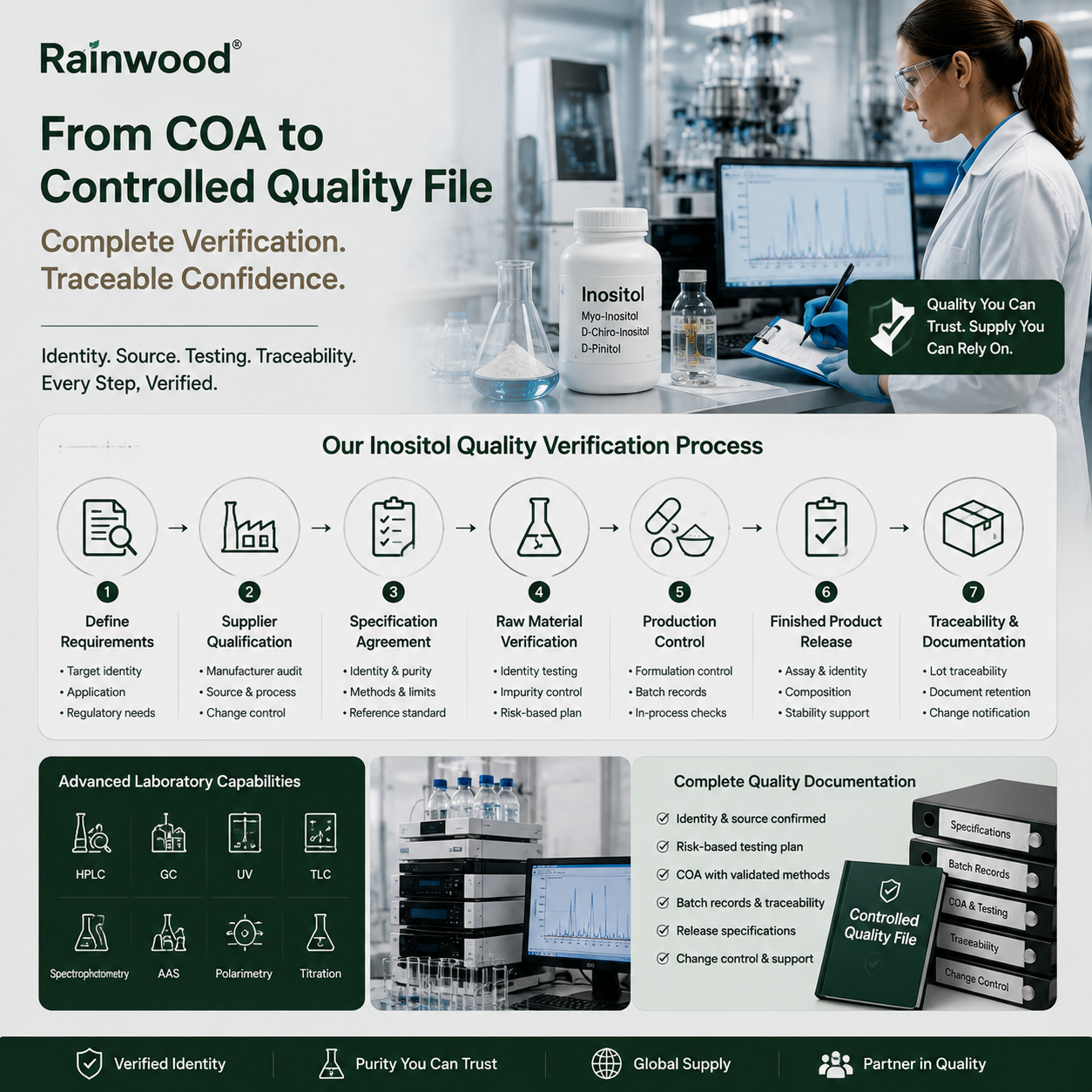
How RainwoodBio can turn a COA into a controlled file
RainwoodBio’s website lists laboratory capabilities including HPLC, GC, UV, TLC, spectrophotometry, AAS, polarimetry and automatic titration, alongside supplier management, production control and batch release.
Owning equipment does not automatically prove every method. The useful advantage is the ability to connect the project requirement to a defined specification and testing plan.
For an inositol order, RainwoodBio can organise:
- target identity and source;
- supplier and lot documents;
- agreed raw-material specification;
- risk-based verification;
- formulation and batch records;
- finished-product release requirements; and
- retained traceability.
Learn more about RainwoodBio’s quality-control and testing capabilities.
The COA challenge
Circle these fields on your current certificate:
1. exact ingredient name;
2. original manufacturer;
3. lot number;
4. identity method;
5. reference standard;
6. assay method;
7. source-related impurity controls;
8. specification revision; and
9. authorised signature/date.
If more than three are missing or vague, the document is a sales attachment—not a complete qualification file.
Frequently asked questions
1.Does 99% purity mean the material is high quality?
Not by itself. Quality also depends on correct identity, relevant impurities, methods, source, handling, traceability and suitability for the intended product.
2.Can total inositol testing distinguish Myo-Inositol and D-Chiro-Inositol?
Only if the selected method demonstrates the required specificity. Ask the laboratory directly.
3.Is an in-house COA acceptable?
It can be part of the file. Buyers should apply risk-based supplier qualification and independent verification rather than assuming that internal or external automatically means reliable.
4.Should every batch receive every possible test?
Not necessarily. Define release, periodic and qualification tests through a documented risk assessment and applicable requirements.
Send the COA before you send the deposit
RainwoodBio can review the structure of your current inositol specification and COA against the product you intend to buy or manufacture.
We will identify the questions the document does not answer and the evidence you should request before approving the source.
Send your 99% inositol COA for a specification gap review.
References
- US National Library of Medicine, PubChem, *Myo-Inositol*.
- US National Library of Medicine, PubChem, *D-Pinitol*.
- FAO/WHO JECFA, *Combined Compendium of Food Additive Specifications and analytical methods*.
- US Food and Drug Administration, *Current Good Manufacturing Practice for Dietary Supplements*.
- USP, *Dietary Supplements Compendium*.
*This article provides general quality and sourcing information. Analytical methods and specifications should be selected and approved by qualified professionals for the exact material and product.*