 EN
EN

Meta title: The Neotame Dose That Will Not Blend Itself
Meta description: Neotame’s tiny use level can create over-dosing, under-dosing, and sampling risk. Learn how OEM buyers control dilution, mixing, uniformity, and release.
The formula needs 0.002% neotame. The operator adds it directly to a 500 kg batch and records “mixed thoroughly.” The finished samples taste different from one another.
That is not a theoretical problem. At extremely low addition levels, the mixing process can become more important than the raw material’s headline purity.
Neotame’s potency allows manufacturers to reduce the mass of sweetener in a formula. It also reduces the margin for a weighment or distribution error. A small absolute error can become a large relative error in the active dose, especially when the sweetener is added as pure powder or a poorly controlled premix.
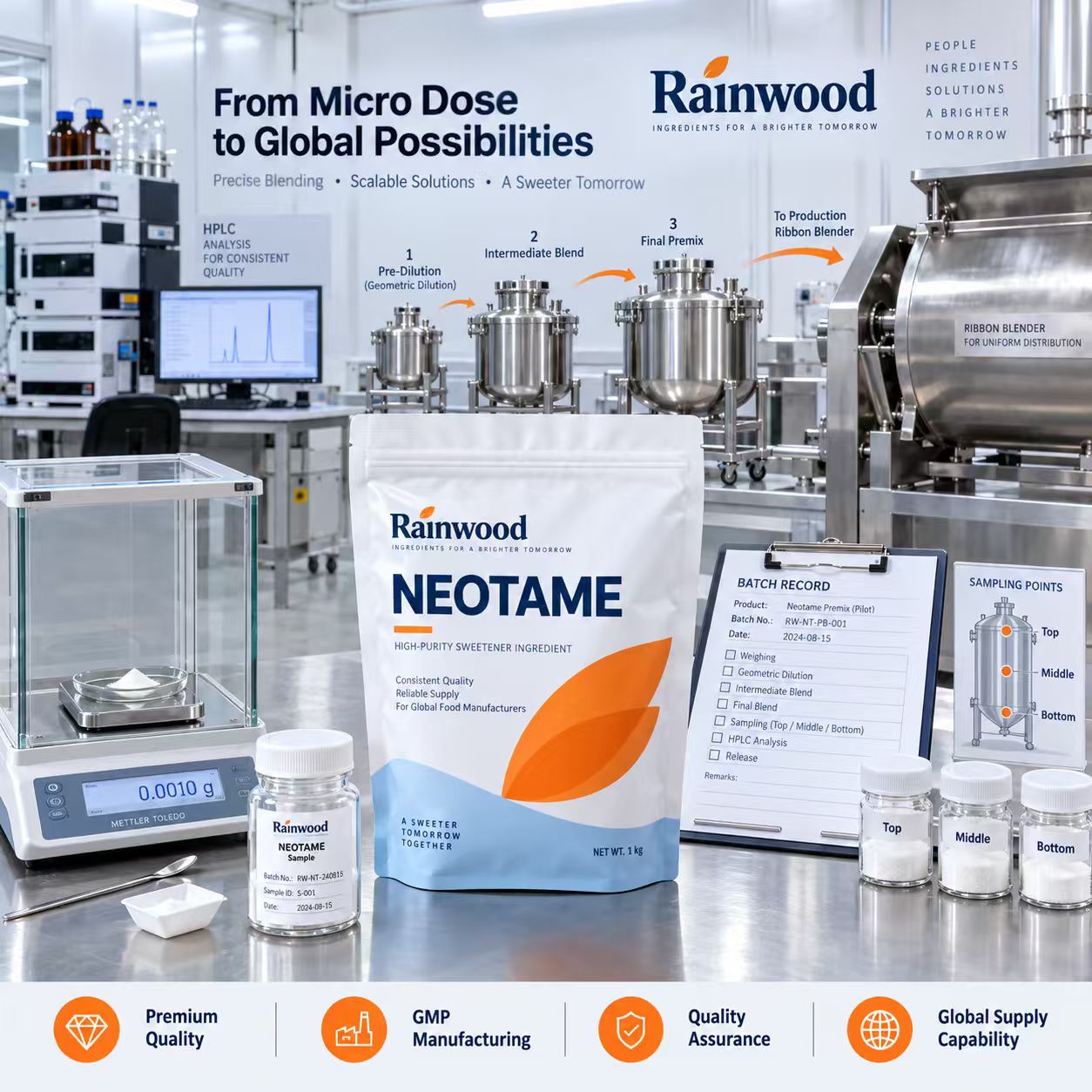
Use the RainwoodBio neotame powder context as a starting point, then qualify the dose and mixing system with the actual batch size and equipment.
Why direct addition can fail
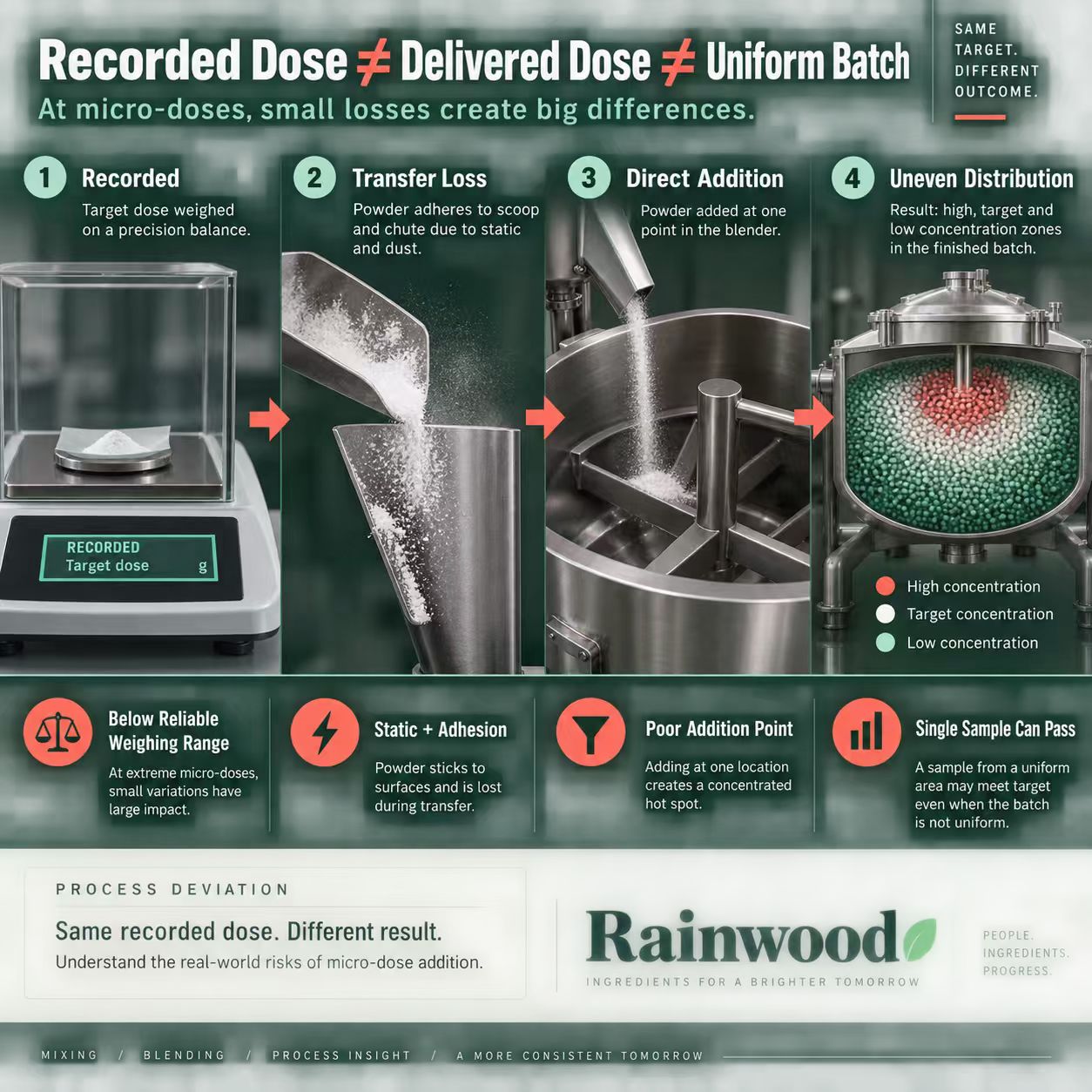
The risk grows when the required mass is below the reliable operating range of the balance or the active is not dispersed evenly through the carrier. Powder can stick to a scoop, transfer chute, bag wall, or blender lid. Electrostatic charge can make a small amount difficult to recover.
The operator may record the target weight, but the batch receives less than the recorded amount. A second operator may scrape the remaining powder into the next batch, creating an overage. Both events can happen without intentional misconduct.
The correct response is a controlled addition strategy, not a stronger promise that the team “mixes carefully.”
Read the pure powder versus premix guide before approving direct addition for a high-volume product.
A validated dilution train
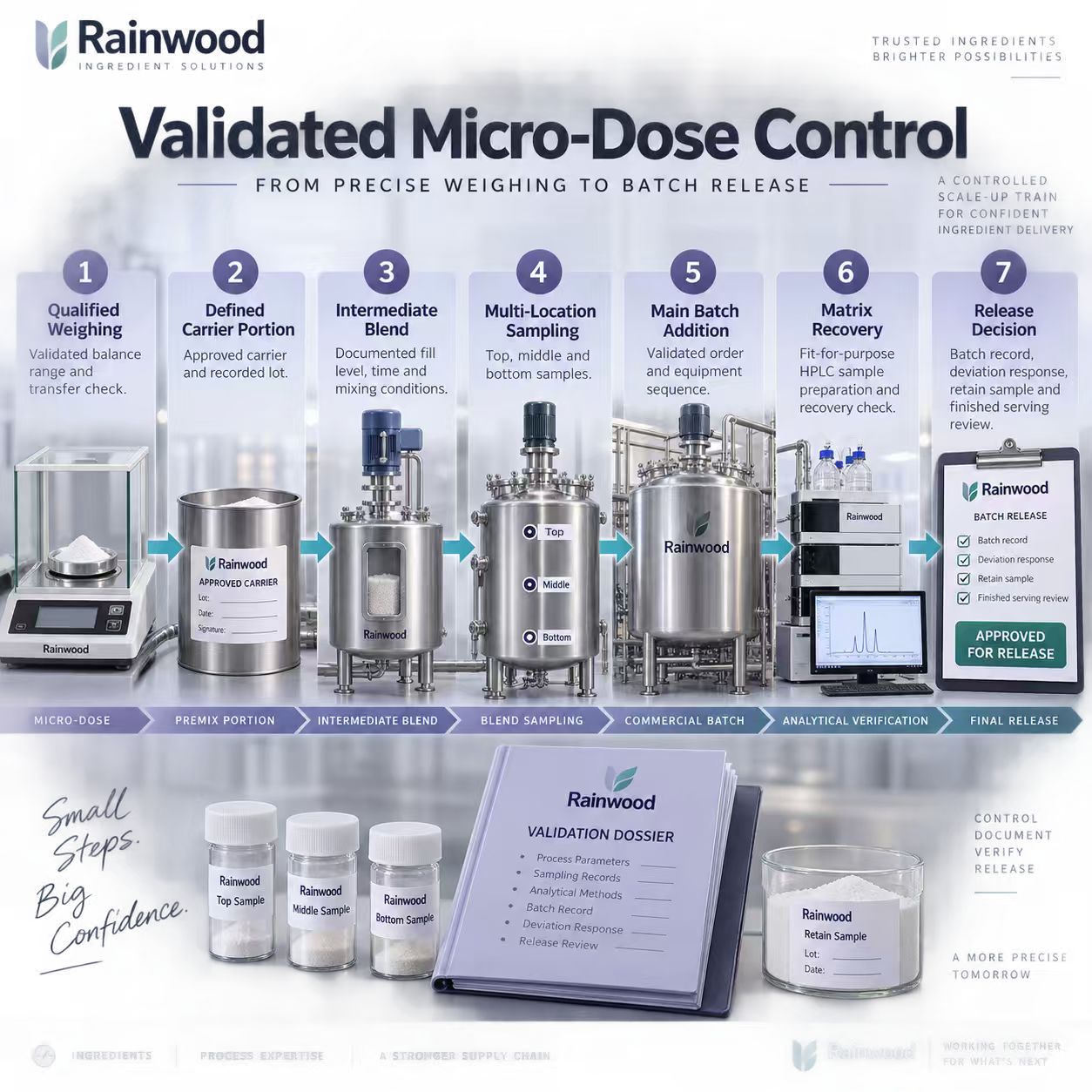
For a tiny dose, a staged dilution can create a more controllable intermediate:
1. Weigh neotame on a qualified balance within its validated range.
2. Add it to a defined carrier portion.
3. Blend the intermediate at a documented fill level and time.
4. Sample the intermediate at multiple locations.
5. Add the accepted intermediate to the main batch.
6. Blend the main batch using the validated sequence.
7. Sample the finished mix according to the release plan.
The carrier must be compatible with the formula and the target market. It can be sugar, polyol, soluble fiber, maltodextrin, or another approved ingredient, but each choice affects label, calories, texture, and segregation.
Use the neotame active-dose calculation worksheet to show the mass, ratio, and expected finished concentration at every stage.
Mixing order can be a release variable
A blend can pass when neotame is pre-diluted and fail when the operator adds the same quantity after a large volume of powder has already entered the mixer. Particle size, density, moisture, mixing energy, fill level, and addition point change the result.
Define:
- ingredient addition order;
- pre-sieving or de-lumping step;
- blender type and fill range;
- mixing time and speed;
- transfer path and hold time;
- sample locations;
- rework and cleaning procedure.
Do not copy a mixing time from a different product. A micro-dose sweetener needs a process study tied to the exact carrier and equipment.
Homogeneity is not proved by one sample
One sample from the discharge point cannot prove a batch is uniform. The sample could miss a concentration gradient caused by segregation or poor wetting. Use a plan that samples different locations and addresses the risk of false passing.
A practical plan may include:
- beginning, middle, and end of discharge;
- top, middle, and bottom of a premix container;
- replicate preparations from each location;
- a fit-for-purpose neotame assay method;
- acceptance limits for relative variation;
- a documented decision on rework or rejection.
The exact number of samples should be justified by the batch and risk. Do not claim “100% uniformity” from a single result.
Assay method and matrix recovery matter
The JECFA monograph describes an HPLC assay for neotame in the raw material and limits related substances. [The JECFA method](https://www.fao.org/fileadmin/user_upload/jecfa_additives/docs/Monograph1/Additive-294.pdf) is a reference for the specified substance; a finished powder, beverage, gummy, or tablet may require a matrix-specific extraction and recovery check.
Ask the laboratory:
- Can the method recover neotame from the full carrier system?
- Is the sample preparation validated for the finished matrix?
- What is the reporting limit relative to the target dose?
- Are the related substances distinguishable in the matrix?
- Is the result tied to the sample location and batch record?
“HPLC detected neotame” is not the same as proving the intended distribution.
The label and complaint risk
Under-dose can produce weak sweetness and inconsistent consumer experience. Over-dose can change taste and increase the chance that the calculated exposure no longer matches the intended serving. If the batch fails, the brand may face rework, returned inventory, new sensory testing, or a listing complaint.
For customer support, retain a traceable formula, batch record, sampling map, assay result, and finished-product release decision. Do not rely on an operator’s memory when a customer asks why two lots taste different.
How RainwoodBio can support micro-dose control
RainwoodBio’s public pages describe neotame powder, sweetener blends, tabletop packets, and OEM formats as company-published product context. They do not prove a specific blending process, balance range, or finished-product uniformity for every order.
Ask RainwoodBio to confirm:
- direct-dose versus premix options;
- carrier and ratio controls;
- mixing equipment and trial plan;
- sampling locations and assay method;
- batch records and deviation response;
- format-specific packaging and MOQ.
Use the micro-dose OEM formula feasibility review to qualify the process before production.
The release gate
Before approving the batch, confirm:
1. The target dose is inside a qualified weighing range.
2. The dilution or premix ratio is documented.
3. Mixing order, time, and equipment are defined.
4. Homogeneity samples represent the real batch.
5. The assay method recovers neotame from the matrix.
6. Deviation, rework, and retain-sample rules are written.
7. The finished serving and label match the released batch.
Request a neotame micro-dose blending and uniformity review. Send RainwoodBio the target concentration, batch size, carrier, equipment, format, sampling plan, market, quantity, and launch date so the team can identify the actual control points.
Frequently asked questions
1.Can I add pure neotame directly to a large powder batch?
Sometimes, but only after the balance, transfer, mixing, sampling, and assay system are qualified for the dose. A direct addition shortcut is not automatically reliable.
2.Is a premix always homogeneous?
No. Homogeneity depends on ratio, particle properties, mixing, packaging, vibration, and sampling. Require evidence for the exact premix and lot.
3.Does a finished-product taste test prove uniformity?
It can identify a sensory problem, but it is not a substitute for a justified sampling and analytical plan.
References
- FDA Neotame information: https://www.fda.gov/food/food-additives-petitions/aspartame-and-other-sweeteners-food
- FAO/JECFA neotame analytical specification: https://www.fao.org/fileadmin/user_upload/jecfa_additives/docs/Monograph1/Additive-294.pdf
- U.S. 21 CFR 172.829: https://www.govinfo.gov/content/pkg/CFR-2020-title21-vol3/pdf/CFR-2020-title21-vol3.pdf
- RainwoodBio neotame product page: https://www.rainwoodbio.com/custom-neotame-powder
This article is for international B2B procurement and educational purposes. Dose, mixing, homogeneity, analytical recovery, safety, labelling, and regulatory requirements must be confirmed for the exact process, finished product, batch, and destination market.