 EN
EN

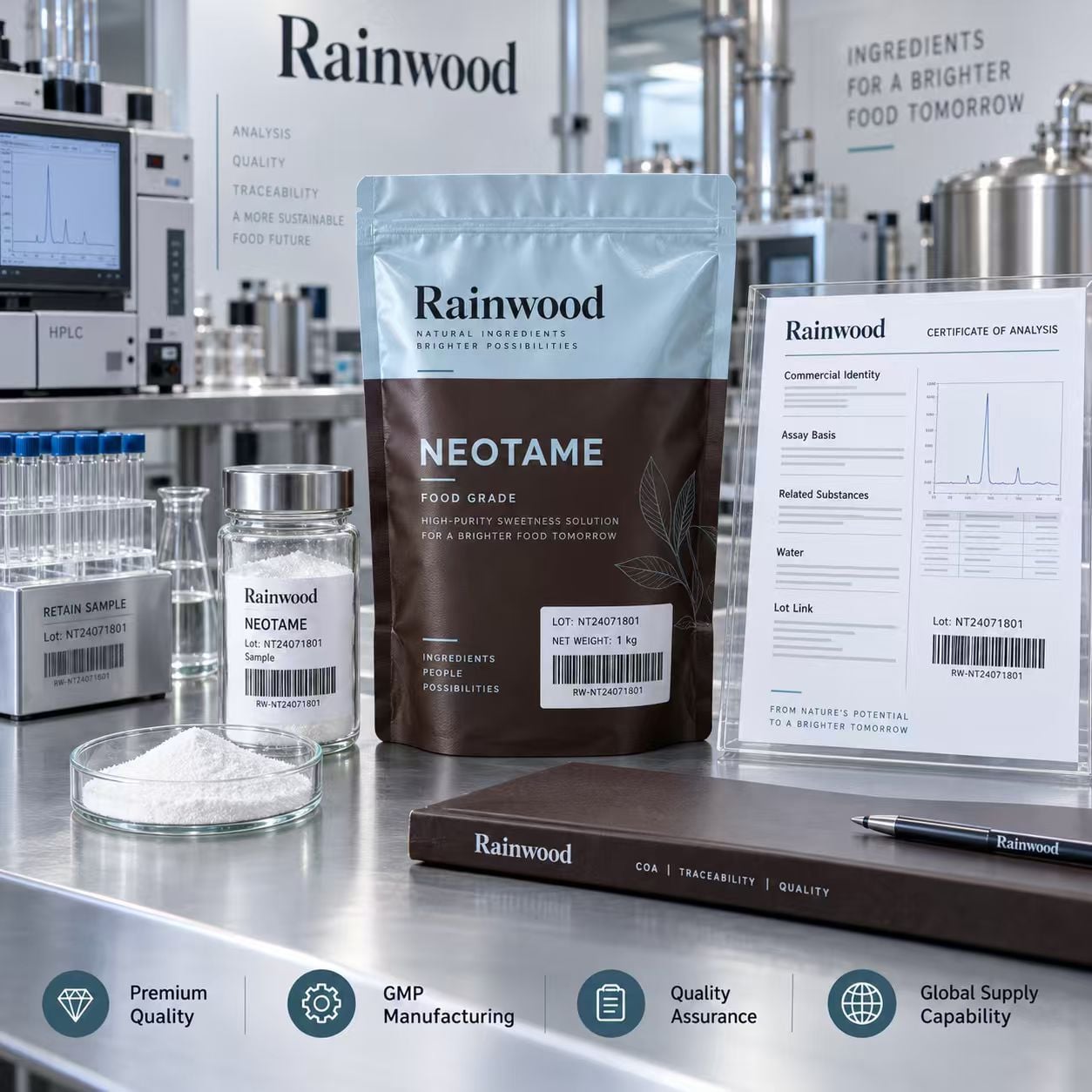
Meta title: Your 99% Neotame COA May Not Prove the Dose
Meta description: A high neotame assay can still leave identity, related-substance, moisture, and lot-traceability gaps. Learn what importers should verify before release.
The quotation says “neotame, 99%.” The COA says “assay: 99.4%.” Purchasing approves the premium sweetener.
Then the formulation team asks a harder question: does that number prove the exact neotame that will be dosed into the finished product?
Neotame is an extremely high-intensity sweetener. Because the use level can be tiny, a small identity, potency, or homogeneity error can change the final sweetness far more than the raw-material percentage suggests. A COA that looks perfect can still leave unanswered questions about dry-basis calculation, free dipeptide acid, other related substances, water, rotation, lot identity, and the actual material in your drum.
For importers, OEM buyers, and private-label brands, the risk is not academic. You may approve the wrong material, under-dose a beverage, over-dose a blend, fail a market file, or discover that your finished claim cannot be connected to the released lot.
Review the RainwoodBio neotame powder product context, then make the COA answer the commercial release question rather than simply displaying a large percentage.
What the U.S. specification actually separates
U.S. regulation identifies neotame by its chemical name and CAS number. The specification in 21 CFR 172.829 includes an assay range of 97.0%–102.0% on a dry basis, free dipeptide acid not more than 1.5%, other related substances not more than 2.0%, water not more than 5.0%, residue on ignition not more than 0.2%, lead not more than 2 mg/kg, and a specific-rotation range. [The U.S. regulation](https://www.govinfo.gov/content/pkg/CFR-2020-title21-vol3/pdf/CFR-2020-title21-vol3.pdf) shows why “99% pure” is only one line in a wider specification.
The distinction matters because assay and identity answer different questions:
> Assay: how much neotame response is measured under the stated method and basis?
> Identity: is the material the specified neotame structure, in the agreed form, with the expected related-substance profile?
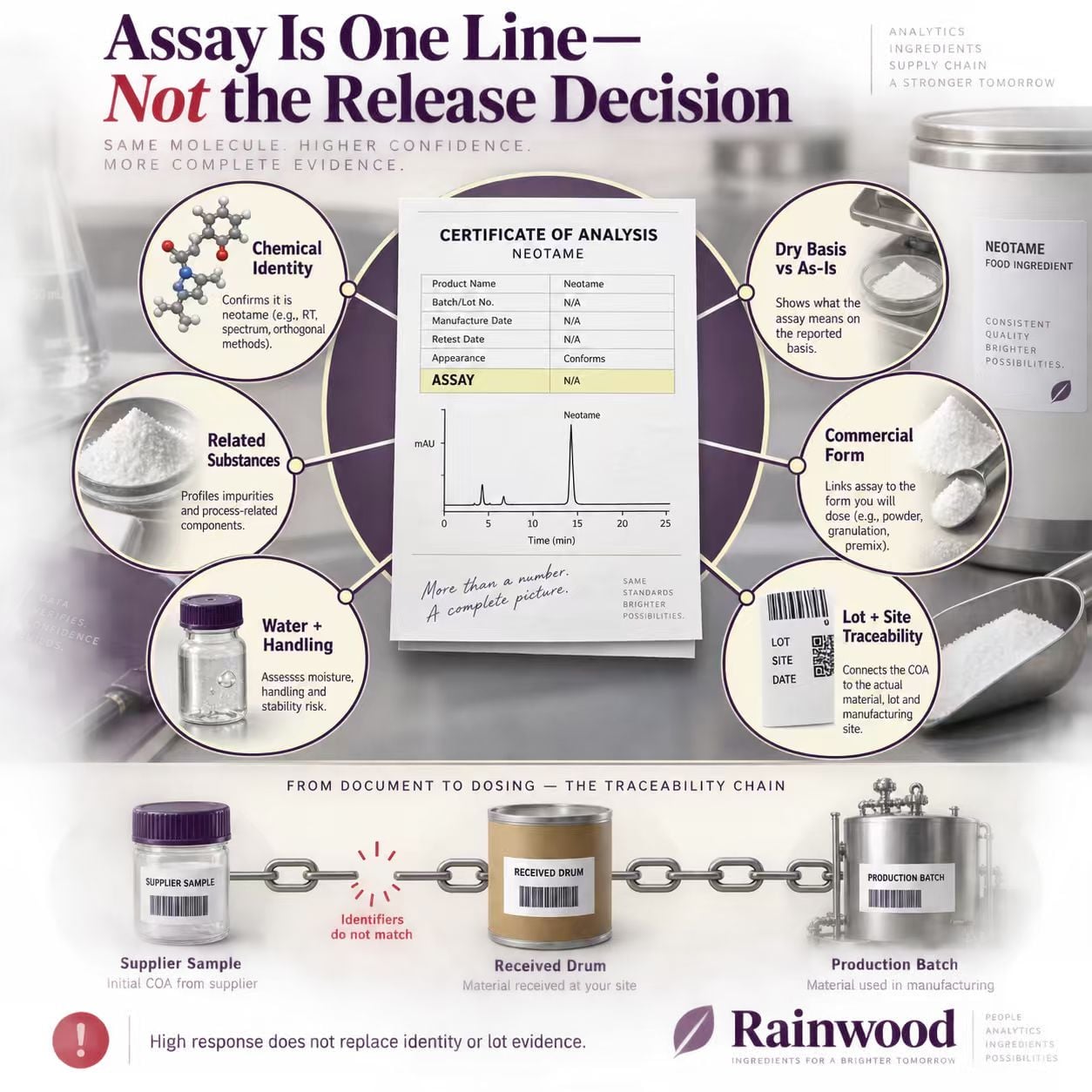
A supplier can report a high assay while the buyer still lacks a fit-for-purpose identity method, lot traceability, or related-substance result.
Read the neotame specification and related-substance checklist before accepting a single “99%” line as a complete release decision.
Dry basis can change the amount you actually buy
Neotame specifications are commonly calculated on a dry basis. If a shipment has 5% water, the as-is amount of neotame is not the same as the dry-basis assay printed on the COA.
Use a controlled calculation:
`as-is neotame equivalent = shipment weight × dry-matter fraction × dry-basis assay`
Then ask whether the material is a pure powder, a premix, or a product containing a carrier. If the quotation uses “99%” without stating the basis, purchasing, formulation, and finance may each be using a different number.
Water also affects caking, storage, flow, and micro-dosing. A release result taken from a sealed sample does not prove what remains after the drum is opened in a humid production room.
Related substances are not a cosmetic detail
Neotame is a chemically manufactured derivative of aspartame. The official specifications distinguish the free dipeptide acid and other related substances. EFSA’s 2025 re-evaluation also identifies the de-esterified form NC-00751 as a main impurity and degradation product. [The EFSA opinion](https://efsa.onlinelibrary.wiley.com/doi/10.2903/j.efsa.2025.9480) explains why related-substance control belongs in both supplier qualification and stability work.
Ask the supplier:
- Which impurities are controlled separately?
- Is the result based on HPLC, and does the method resolve the specified peaks?
- Which reference standard and calculation are used?
- Is the result lot-specific or representative?
- Are degradation products checked after storage or processing?
- Does the method match the exact powder, premix, or finished matrix?
“HPLC tested” is not a method description. The laboratory should provide enough information to show what the method can and cannot prove.
The COA wording that should stop automatic approval
Pause when you see:
- “Neotame 99%” with no dry/as-is basis.
- Assay present but no free dipeptide or related-substance result.
- A specific-rotation requirement in the specification but no lot result.
- A COA showing a different manufacturer, site, or lot than the quotation.
- A representative chromatogram with no lot number or method revision.
- “Food grade” used instead of acceptance limits.
- A tiny-use-level product with no blend or homogeneity plan.
These signals do not prove a supplier is dishonest. They show that the document may not answer the decision you need to make.
Build a layered neotame evidence file
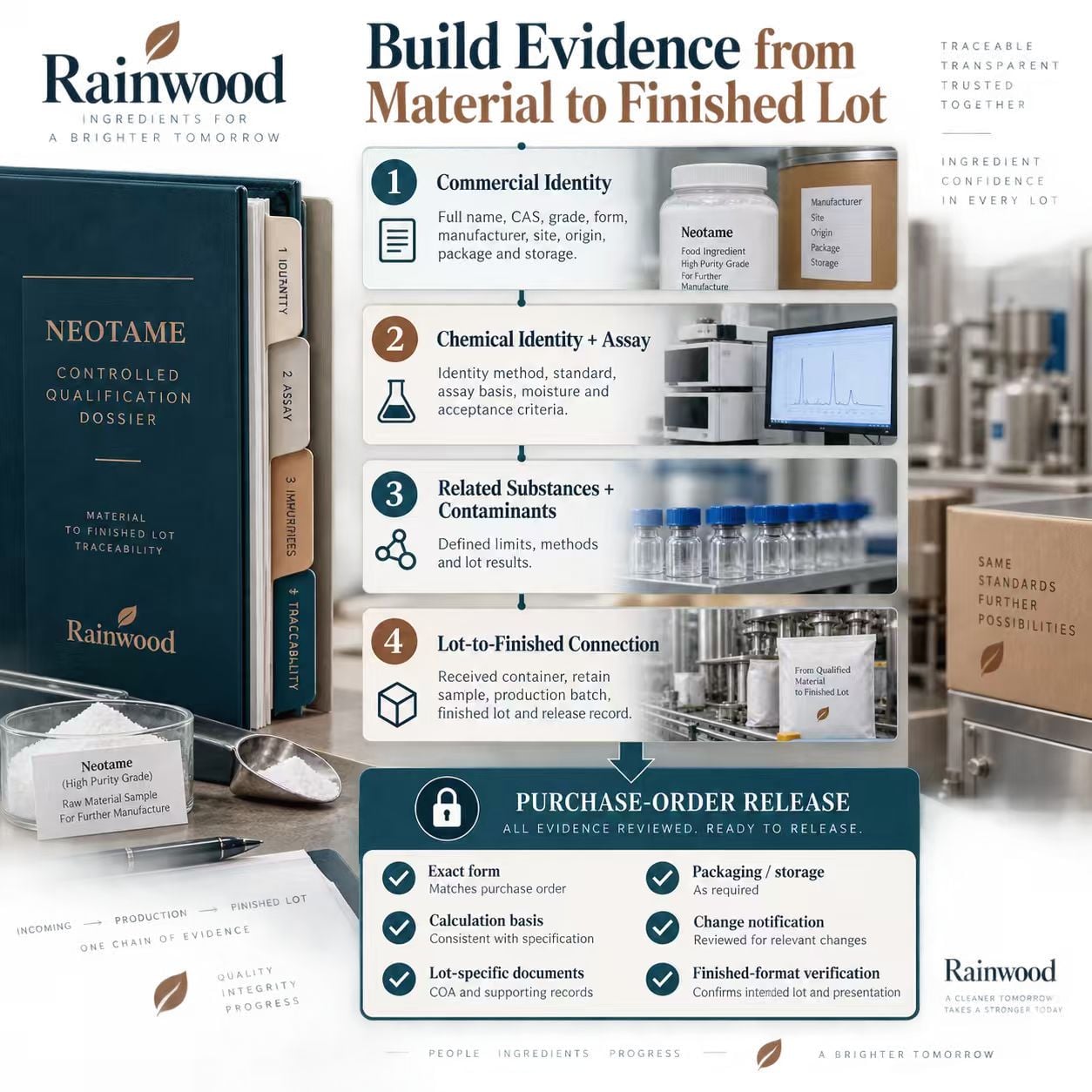
1. Commercial identity
Lock the full name, CAS number, grade, form, manufacturer, production site, country of origin, specification revision, package, and storage conditions. Give the material a controlled internal code and do not let a premix share the same code as pure neotame.
2. Chemical identity and assay
Define the identity method, reference standard, assay method, calculation basis, moisture method, and acceptance criteria. If the method is a compendial or regulatory method, record the exact edition and any validated project modification.
3. Related substances and contaminants
Set limits for free dipeptide acid, other related substances, water, residue on ignition, lead, and any process-specific residues relevant to the route. Match each limit to a test and a reportable result.
4. Lot and finished-product connection
Link the supplier lot to the received container, retain sample, production batch, finished lot, and release record. At the tiny use level, decide whether the finished product needs neotame verification, blend homogeneity testing, or both.
Use the neotame batch-document and sampling process to keep purchasing, QA, and production aligned.
Why a clean chromatogram is not enough
A chromatogram can support a release decision only when it is linked to the right method and lot. Request the sample preparation, column or separation mode, reference standard, system suitability, peak assignment, integration rules, and calculation. If the product is a blend, confirm whether the sample preparation and dilution are suitable for the matrix.
The analytical method should answer the actual risk. A method that measures total neotame may not demonstrate uniform distribution in a premix. A method for pure raw powder may not recover neotame accurately from a gummy, tablet, or beverage.
Read the micro-dose blending guide before using a raw-material COA as finished-product proof.
How RainwoodBio can support a qualification project
RainwoodBio’s public neotame page presents a food-grade powder and lists company-published specification and supply information. It does not, by itself, prove a particular batch, analytical laboratory, method suitability, or destination-market authorization.
For a real project, ask RainwoodBio to confirm:
- exact manufacturer and production site;
- current specification and representative COA;
- identity, assay, related-substance, water, and contaminant methods;
- sample-to-commercial-lot controls;
- premix or carrier options if the dose is too small to handle directly;
- finished-product testing and stability requirements.
Use the neotame supplier-qualification review to turn a product page into a controlled procurement file.
The purchase-order release gate
Before paying a deposit, require written agreement on:
1. Exact material identity and commercial form.
2. Dry-basis or as-is calculation.
3. Identity, assay, and related-substance methods.
4. Lot-specific documents and sampling.
5. Water, residue, lead, and microbiological limits.
6. Packaging, storage, and retest conditions.
7. Change notification and deviation response.
8. Finished-format verification where the use level is extremely low.
Request a neotame COA and identity-gap review. Send RainwoodBio the current COA, specification, supplier quotation, target market, final format, dosage, package, quantity, and proposed label so the team can identify missing proof before release.
Frequently asked questions
1.Does a 99% neotame assay prove the powder is suitable for micro-dosing?
No. It addresses assay under a stated method. Micro-dosing also needs identity, water, related substances, particle or blend behavior, homogeneity, and finished-product controls.
2.Is the U.S. specification automatically the global specification?
No. It is a useful reference for the U.S. regulatory framework. The target market may require different specifications, permitted uses, documentation, or label wording.
3.Can one COA cover every shipment?
Only if the agreement clearly separates representative information from lot-specific release evidence. A historical COA does not prove the contents of a new drum.
References
- U.S. 21 CFR 172.829 Neotame: https://www.govinfo.gov/content/pkg/CFR-2020-title21-vol3/pdf/CFR-2020-title21-vol3.pdf
- FDA Neotame information: https://www.fda.gov/food/food-additives-petitions/aspartame-and-other-sweeteners-food
- EFSA 2025 re-evaluation of neotame: https://efsa.onlinelibrary.wiley.com/doi/10.2903/j.efsa.2025.9480
- FAO/JECFA neotame specifications: https://www.fao.org/fileadmin/user_upload/jecfa_additives/docs/Monograph1/Additive-294.pdf
- RainwoodBio neotame powder page: https://www.rainwoodbio.com/custom-neotame-powder
This article is for international B2B procurement and educational purposes. Identity, assay, related substances, methods, batch evidence, finished-product testing, labelling, and regulatory requirements must be confirmed for the exact material, formula, and destination market.