 EN

Executive Summary & B2B Formulation Guidance
Ubiquinol can change during processing and storage. Learn how to control oxygen, light, package, assay, and shelf life before private-label launch.
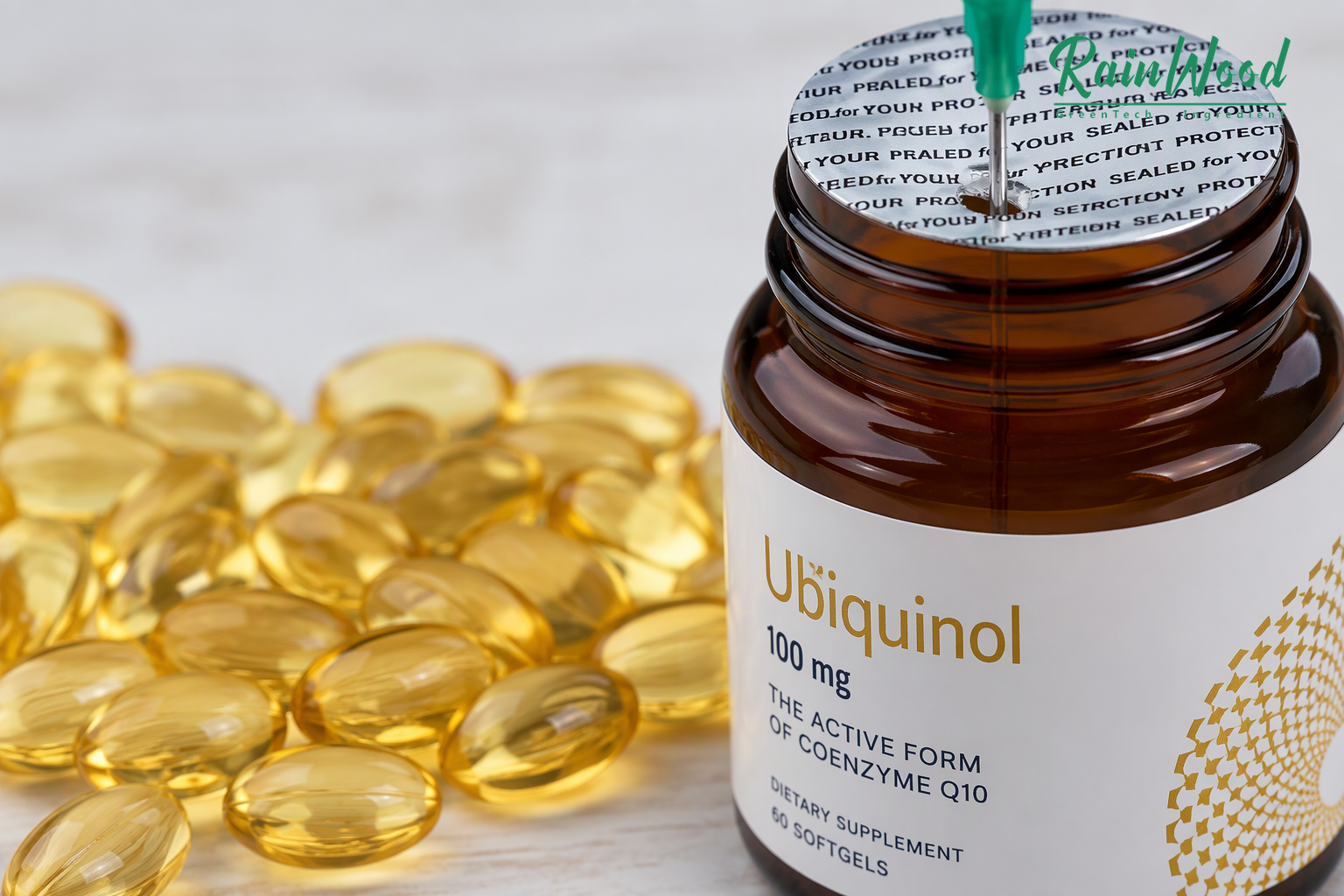
Figure 1: Freshly Encapsulated Golden Ubiquinol Softgels Beside Nitrogen-Purged Amber Glass Packaging with Induction Seal
Your supplier sends a fresh ubiquinol sample. The color looks right and the COA shows a high reduced-form result. Six months later, the finished softgels arrive with a different redox profile. The product may still contain CoQ10, but the material your label and sales team describe has changed. Ubiquinol projects fail when buyers treat a reduced-form ingredient as a normal dry powder with a normal expiry.
Reduced form means a higher control burden
Ubiquinol is the reduced form of CoQ10 and can be converted to ubiquinone through oxidation. That conversion may be influenced by oxygen, light, heat, trace metals, moisture, processing time, and the surrounding formulation. A buyer does not need to assume every lot will fail; the buyer does need to identify which exposure the chosen product can tolerate.
The commercial loss can include a failed stability pull, a label mismatch, a retailer complaint, or a forced relabeling from ubiquinol to total CoQ10. Start with the [INTERNAL LINK -> CoQ10 Ingredient Identity Review] and write the redox requirement into the material and finished-product specifications.
The sample bottle is not your package study
An amber laboratory vial opened once is not equivalent to a bottle opened daily by a consumer. A sealed raw-material bag is not equivalent to a softgel with oxygen in the headspace. A supplier's 24-month raw powder statement may not cover a filled capsule, a gummy, or a stick pack. The package is part of the stability system.
Request the package design, closure, oxygen and moisture barrier information, fill conditions, headspace control, desiccant or antioxidant system, and storage instruction. The [INTERNAL LINK -> CoQ10 Stability and Packaging Blog] helps separate raw-material stability from finished-product stability.
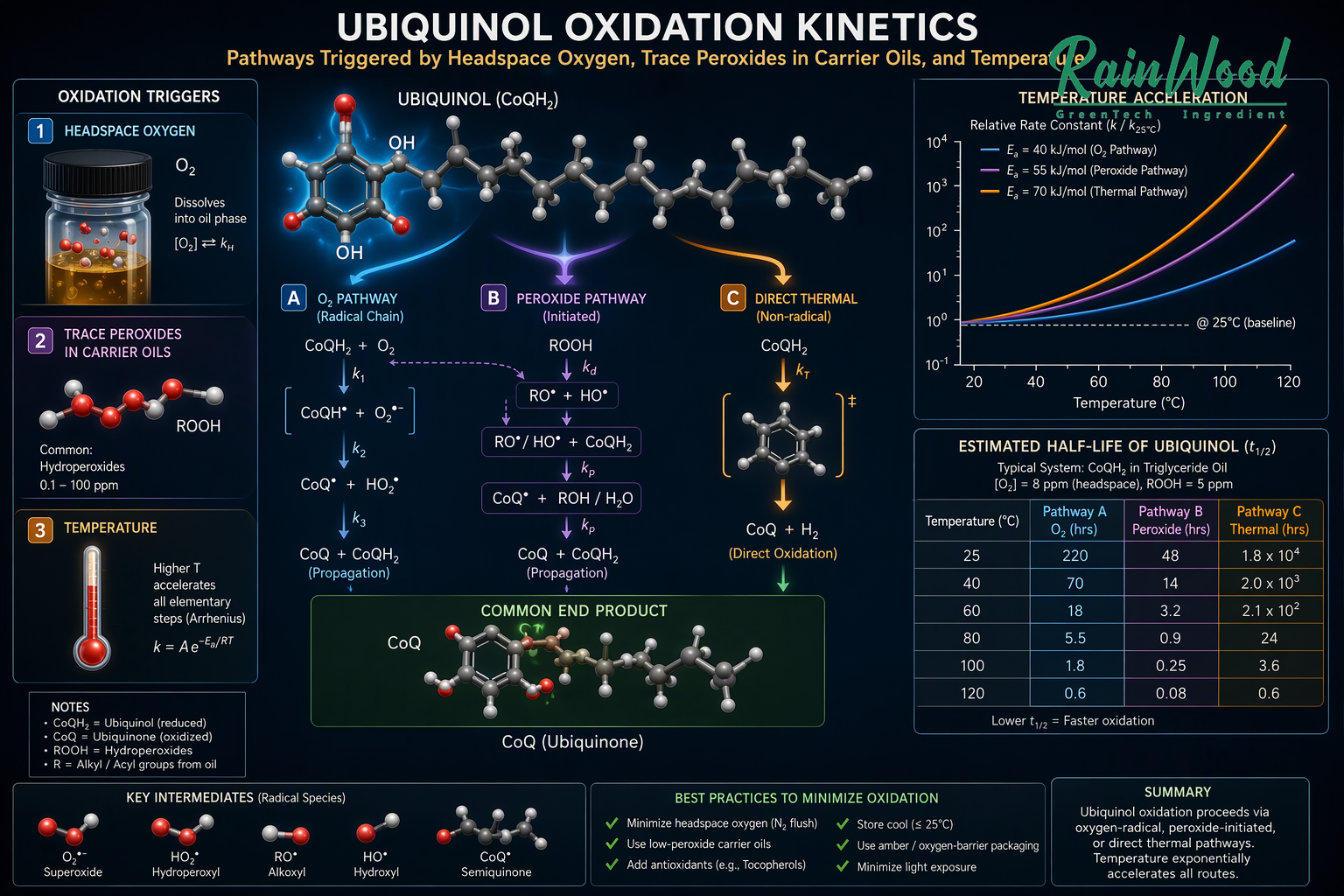
Figure 2: 3D Molecular Oxidation Kinetics Diagram: Ubiquinol Degradation Pathways and Headspace Gas Equilibria
Do not monitor only total CoQ10
Total CoQ10 content can remain close to target while the ratio between ubiquinol and ubiquinone changes. If the product is sold as ubiquinol, a total-content result may not answer the commercial question. The stability protocol should state whether the reduced form, oxidized form, total content, or all three are tested.
Ask for method details, reference standards, sample preparation, and storage time points. Test units from different positions in the production run and retain them in the intended market package. If a result moves, investigate whether the cause is true oxidation, sample handling, method conversion, or nonuniform filling.
Oxygen exposure can begin before filling
Raw material may be exposed during weighing, sieving, blending, transfer, and hold time. A long open processing window can matter even when the final bottle is high barrier. If a formula uses an oil carrier, check whether the carrier itself has an oxidation specification and whether the antioxidant system is compatible with the shell and label.
Ask the manufacturer to map the process points where air, light, heat, or metal contact can occur. Then define practical controls: closed transfer, reduced hold time, controlled lighting, suitable contact materials, nitrogen flush where appropriate, and documented maximum exposure. These are project controls, not claims that every facility uses a specific technology.
A high-priced antioxidant is not automatically protected
Vitamin E or another antioxidant may be included, but its presence does not prove that ubiquinol will remain in the desired form. The concentration, location, compatibility, and package still matter. Adding more antioxidant can change taste, softgel stability, label calculations, and regulatory review.
Run a small compatibility study with the actual ubiquinol lot, oil or powder matrix, capsule shell, and package. Compare reduced-form content, total CoQ10, appearance, odor, peroxide or related oxidation indicators where appropriate, and fill uniformity. Do not borrow a stability conclusion from a different carrier or a different branded ingredient.
Build an excursion and complaint plan
Define what happens if the shipment experiences heat, a warehouse loses climate control, or the customer leaves the bottle open. The plan should specify whether to hold, retest, release, replace, or investigate. Record the lot, package, storage history, and assay method. A vague instruction such as “store in a cool place” does not tell a distributor how to handle a real excursion.
Customer service should not diagnose oxidation from a color photograph. Ask for lot number, opened date, storage, package condition, and product form. Compare the complaint with a retained unit and test the relevant attributes. This turns a sensory concern into a controlled investigation.
How RainwoodBio can support ubiquinol projects
RainwoodBio publishes requirement confirmation, raw-material supplier management, GMP process control, testing and release, compliance documentation, and traceability management. For a ubiquinol project, the buyer should ask for a product-specific stability plan that follows the ingredient from raw material through the finished package. The evidence level must be clear: website capability is not the same as a batch result.
RainwoodBio also lists softgels, hard capsules, tablets, and powder sachets among its OEM options. Compare package and format risk using the [INTERNAL LINK -> CoQ10 OEM Format Comparison] and review the [INTERNAL LINK -> RainwoodBio Quality and Release Process] before selecting a shelf-life target.
Ubiquinol release checklist
Before approving a commercial lot, confirm:
- reduced-form specification and minimum result;
- total CoQ10 and oxidized-form monitoring, if relevant;
- reference standards and method details;
- package barrier and headspace strategy;
- raw-material and finished-product storage;
- processing exposure limits;
- stability time points in the intended package;
- excursion, complaint, and failed-lot decisions;
- change notification for source, carrier, antioxidant, or package.
Send the current COA, package proposal, target expiry, format, storage route, and market to RainwoodBio for a [INTERNAL LINK -> Ubiquinol Stability and Packaging Review]. The output should show what must be tested before launch and what must be monitored after shipment.
Make the oxidation decision visible to sales
Sales should know whether the product is specified as ubiquinol, total CoQ10, or a redox profile, and what storage instruction the label supports. Give the team a simple explanation of what a color or odor complaint can and cannot prove. This prevents an overconfident reply from creating a new claim or safety problem.
Review the script whenever the package, carrier, antioxidant, dose, shelf life, or target market changes. Keep the approved wording with the stability file and complaint procedure. A clear internal explanation helps distributors protect the product during transport and helps customer service collect useful evidence after a complaint.
Send the COA, package, target expiry, shipment route, format, market, and complaint script for a [INTERNAL LINK -> Ubiquinol Contact Us Page] stability review.
Frequently asked questions
Does oxidation mean the product contains no CoQ10?
No. CoQ10 may still be present, but the redox balance or declared form may no longer match the product specification.
Is an amber bottle enough to protect ubiquinol?
Not automatically. Oxygen, closure, headspace, moisture, processing, and opening behavior also matter.
Can a raw ubiquinol COA prove the finished softgel shelf life?
No. Finished-product stability in the intended package is needed for that conclusion.
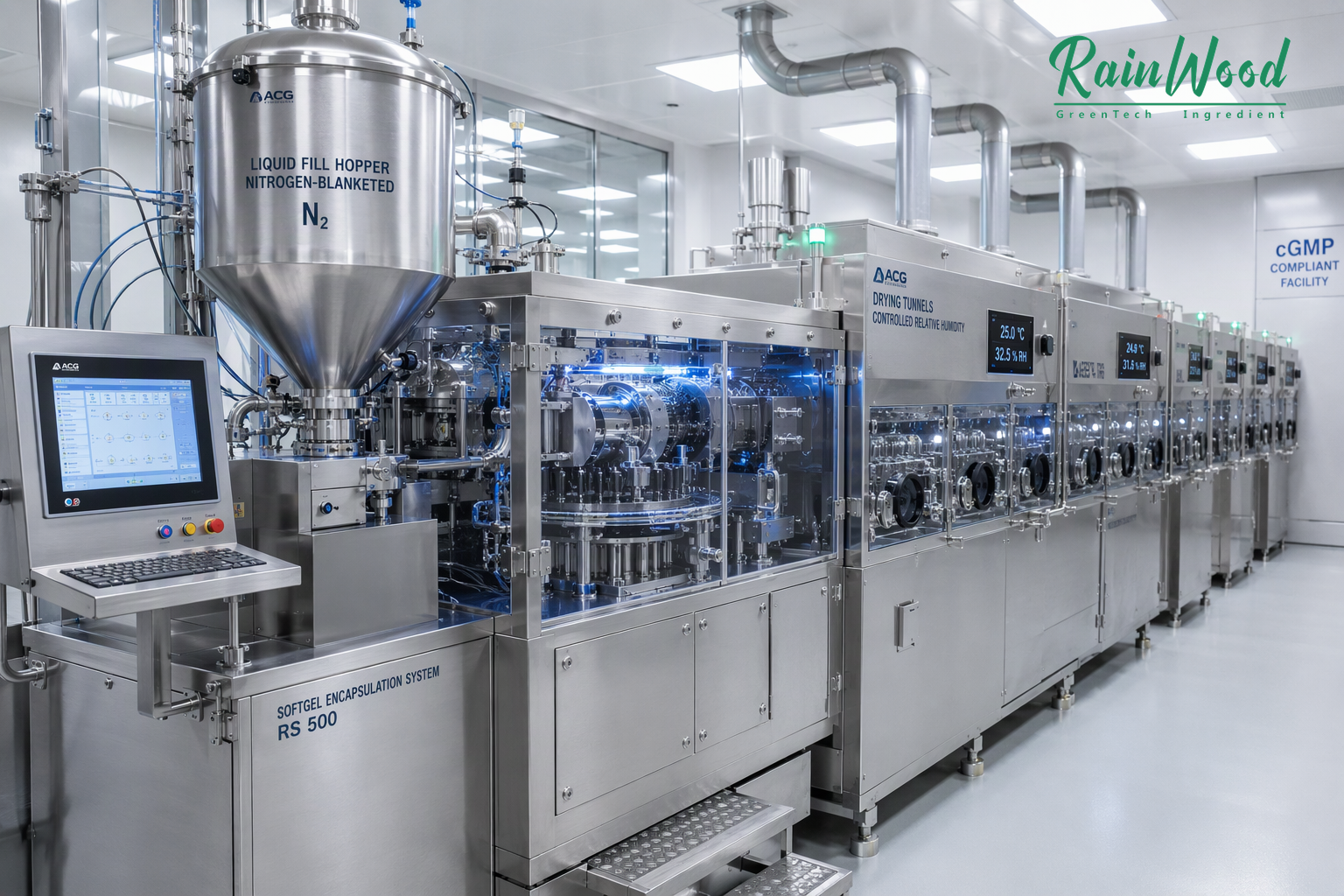
Figure 3: Automated Rotary Die Softgel Encapsulation Line with Nitrogen-Blanketed Hopper and Low-RH Drying Tunnels
References
- Stability of Reduced and Oxidized Coenzyme Q10 in Finished Products: https://pubmed.ncbi.nlm.nih.gov/33673604/
- The Cocrystal of Ubiquinol: Improved Stability and Bioavailability: https://pmc.ncbi.nlm.nih.gov/articles/PMC10610044/
- Ubiquinone-Ubiquinol Redox Cycle Overview: https://pubmed.ncbi.nlm.nih.gov/38928470/
- RainwoodBio OEM service: https://www.rainwoodbio.com/oem
*This article is for B2B procurement and educational purposes. Product identity, analytical, stability, safety, labeling, and regulatory requirements must be confirmed for the exact ingredient, finished product, and destination market.*
Explore RainwoodBio CoQ10 & Custom Formulation Capabilities
- Custom CoQ10 Hard Capsules & High-Potency Blends – Precision cGMP encapsulation for CoQ10 with PQQ, L-Carnitine, and Vitamin E co-factors.
- High-Absorption CoQ10 Softgels & Lipid Suspensions – MCT/Olive oil carrier systems with natural tocopherol stabilization.
- Water-Soluble CoQ10 Micro-Encapsulated Powders & Stick Packs – Enhanced bioavailability single-serve sachets and beverage-grade premixes.
- OEM / ODM Contract Manufacturing Services – End-to-end formulation development, pilot batch scaling, and US/EU regulatory compliance dossiers.
- Contact RainwoodBio Technical Sales – Request CoA, HPLC analytical protocols, pilot stability samples, or commercial quotation.
Table of Contents
- Reduced form means a higher control burden
- The sample bottle is not your package study
- Do not monitor only total CoQ10
- Oxygen exposure can begin before filling
- A high-priced antioxidant is not automatically protected
- Build an excursion and complaint plan
- How RainwoodBio can support ubiquinol projects
- Ubiquinol release checklist
- Make the oxidation decision visible to sales
- Frequently asked questions
- References