Get a Free Quote

Our representative will contact you soon.
Email
Name
Company Name
Message
0/1000

The PAHs Crisis: Why Traditional 'Kettle-Cooked' Shilajit is a Carcinogenic Liability

2026-07-22 08:55:59
The PAHs Crisis: Why Traditional 'Kettle-Cooked' Shilajit is a Carcinogenic Liability

Executive Summary

For centuries, Shilajit has been processed in open-air iron kettles over roaring wood fires. While 'traditional' sounds romantic to the marketing department, it is a nightmare for Quality Assurance. This investigative audit reveals the 'Hidden Fire' risk: Polycyclic Aromatic Hydrocarbons (PAHs). Learn why high-temperature open processing creates carcinogenic combustion byproducts and how Rainwood Biotech’s Low-Temperature Vacuum Extraction secures your brand’s safety sovereignty.


The Romance vs. The Reality: The Ancient Kettle Trap

In the global supplement market, 'Ancient' is often used as a synonym for 'Safe.' Shilajit brands love to show images of stone-ground resins and iron kettles boiling over open fires in remote villages. They call it 'Traditional Processing.' However, in the 2026 regulatory environment, 'Traditional' often means 'Contaminated.'

Shilajit Extract is a complex biomass. It is packed with humic substances and organic acids that are remarkably sensitive to heat. When you boil this resin in an open iron kettle over a wood or charcoal fire for 48 hours, you aren't just concentrating the actives—you are inviting a chemical disaster. The intense, uncontrolled heat from the fire below, combined with oxygen exposure from above, triggers a series of thermal degradation reactions that produce invisible, flavorless, and deadly byproducts.

At Rainwood Biotech, we audit the 'Thermal Biography' of every raw material. We know that the fire used to 'purify' the resin is often the very source of its most dangerous toxins.

Shilajit powder 插图 7(1).png

The Hidden Enemy: Polycyclic Aromatic Hydrocarbons (PAHs)

The primary byproduct of high-heat, open-fire processing is a group of chemicals known as Polycyclic Aromatic Hydrocarbons (PAHs), with Benzo[a]pyrene being the most notorious. These are the same carcinogenic compounds found in cigarette smoke, car exhaust, and charred meat. They are potent mutagens and are strictly regulated by the EFSA (European Food Safety Authority) and the FDA.

Pure Himalayan Shilajit processed over open fires is a PAHs magnet. As the wood fire burns, it releases soot and combustion gases that settle directly into the boiling resin. Simultaneously, the high temperature at the bottom of the iron kettle causes the organic carbon in the Shilajit to 'char' and reorganize into these toxic rings. Most suppliers test for heavy metals, but very few test for PAHs. They are delivering a 'Longevity Resin' that contains known carcinogens.

In our Xi'an laboratory, we have audited 'Grade A' resins from competitors that showed PAH4 levels 20x higher than the EU safety limit. For a brand owner, this is not just a quality issue; it is a massive legal liability.

Thermodynamics of Toxicity: Why 60°C is the Red Line

Chemical stability in Shilajit has a 'Red Line': $60^circ ext{C}$ ($140^circ ext{F}$). Once you exceed this temperature in an open environment, the molecular integrity of the fulvic acid begins to collapse, and the formation of Benzo[a]pyrene accelerates. Traditional kettle cooking often reaches temperatures of $100^circ ext{C}$ ($212^circ ext{F}$) or higher to speed up the evaporation process.

The result is a resin that looks thick and 'Premium' but is actually thermally damaged. This heat-damaged resin is darker, has a stronger 'burnt' smell, and is packed with combustion byproducts. Procurement managers often mistake the 'smoky' aroma for 'authenticity,' unaware that they are smelling the proof of thermal degradation.

Rainwood Biotech operates a strict 'Cold-Standard.' Our 10,000 sqm facility utilizes Siemens-controlled automation to ensure that our Shilajit never crosses the $60^circ ext{C}$ threshold during the entire extraction and concentration cycle.

Low-Temperature Vacuum Circulation: The Rainwood Solution

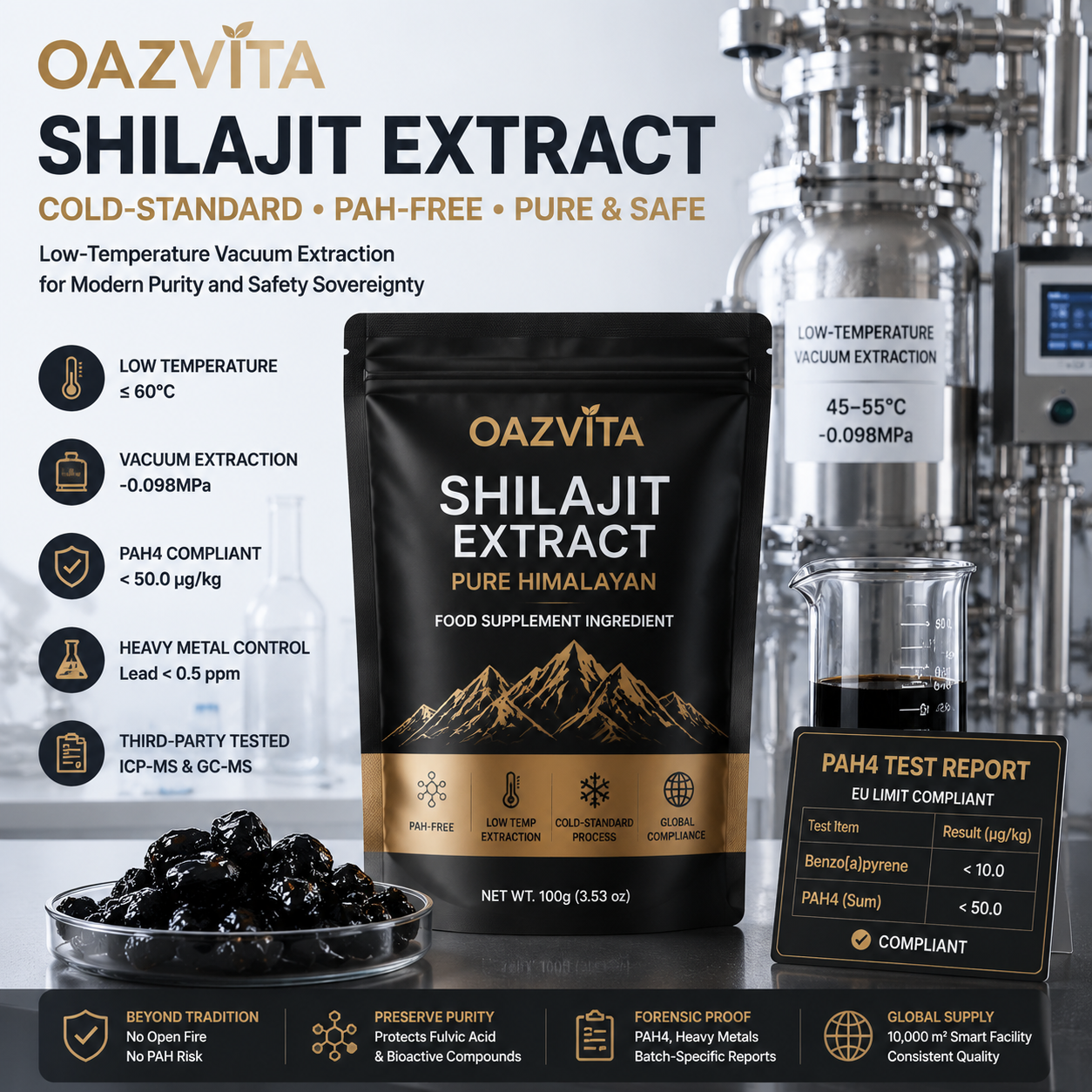
To produce a truly clean Shilajit Extract, you must eliminate the fire and the oxygen. Rainwood Biotech uses a closed-loop, Low-Temperature Vacuum Circulation system. By creating a vacuum environment (-0.098MPa), we lower the boiling point of the water, allowing us to evaporate and concentrate the resin at temperatures as low as $45^circ ext{C}$ to $55^circ ext{C}$.

This closed system prevents any airborne soot or combustion byproducts from entering the material. Furthermore, the low heat ensures that the delicate molecular structures of the Fulvic Acid and trace minerals remain intact. We aren't 'cooking' the Shilajit; we are 'concentrating' its biological essence in a controlled, pharmaceutical-grade environment.

The result is a resin with a clean, earthy profile—not a burnt one. It is a resin that meets the EU PAH4 limits (typically < 50.0 µg/kg for PAHs and < 10.0 µg/kg for Benzo[a]pyrene) every single time.

The Testing Gap: Why Heavy Metal Reports are a False Security

Most brands feel safe because they have a 'Clean' heavy metal report. But heavy metals (Lead, Arsenic, Cadmium) and PAHs are two completely different categories of risk. Heavy metals come from the soil; PAHs come from the *process*. You can have the cleanest Himalayan raw material in the world, but if you cook it over an open fire, you will produce a toxic final product.

When you audit a supplier for Pure Himalayan Shilajit, don't just ask for the Lead test. Ask for a **PAH4** or **PAH12** audit. Ask for the **Benzo[a]pyrene** chromatogram. If they don't have it—or if they don't even know what PAHs are—they are a 'Traditional Liability' to your brand.

Rainwood Biotech provides batch-specific PAH testing as a standard part of our quality dossier. We understand that in the 2026 market, 'Trust' must be backed by 'Forensic Proof.'

Shilajit powder 插图 7(2).png

Brand Sovereignty: Protecting Your Label from the 'Fire'

The supplement industry is moving toward 'Clean-Label 2.0.' Consumers are increasingly aware of contaminants and are using third-party lab services to test their favorite products. A single 'Contaminant Scandal' involving PAHs in your Shilajit resin could lead to a massive recall, lawsuits, and the destruction of your brand's LTV.

Choosing Rainwood Biotech is a strategic insurance policy. You aren't just buying a resin; you are buying the peace of mind that comes from 10,000 sqm of industrial control. We provide the technical transparency that allows your marketing team to tell a 'Traditional Wisdom + Modern Purity' story without fear of the 'Fire.'

Secure your brand's safety sovereignty. Move beyond the iron kettle and join the Rainwood Biotech 'Cold-Standard' revolution.

About Rainwood Biotech

Rainwood Biotech is a premier, asset-heavy global manufacturer specializing in the low-temperature purification of botanical resins. Operating a 10,000 sqm state-of-the-art facility, we leverage advanced vacuum-circulation technology to solve the 'Traditional Toxicity' challenges of ancient supplements. Our commitment to high-purity, PAH-free Pure Himalayan Shilajit and specialized heavy-metal filtration makes us the strategic partner of choice for the world's leading premium wellness brands.