 EN
EN

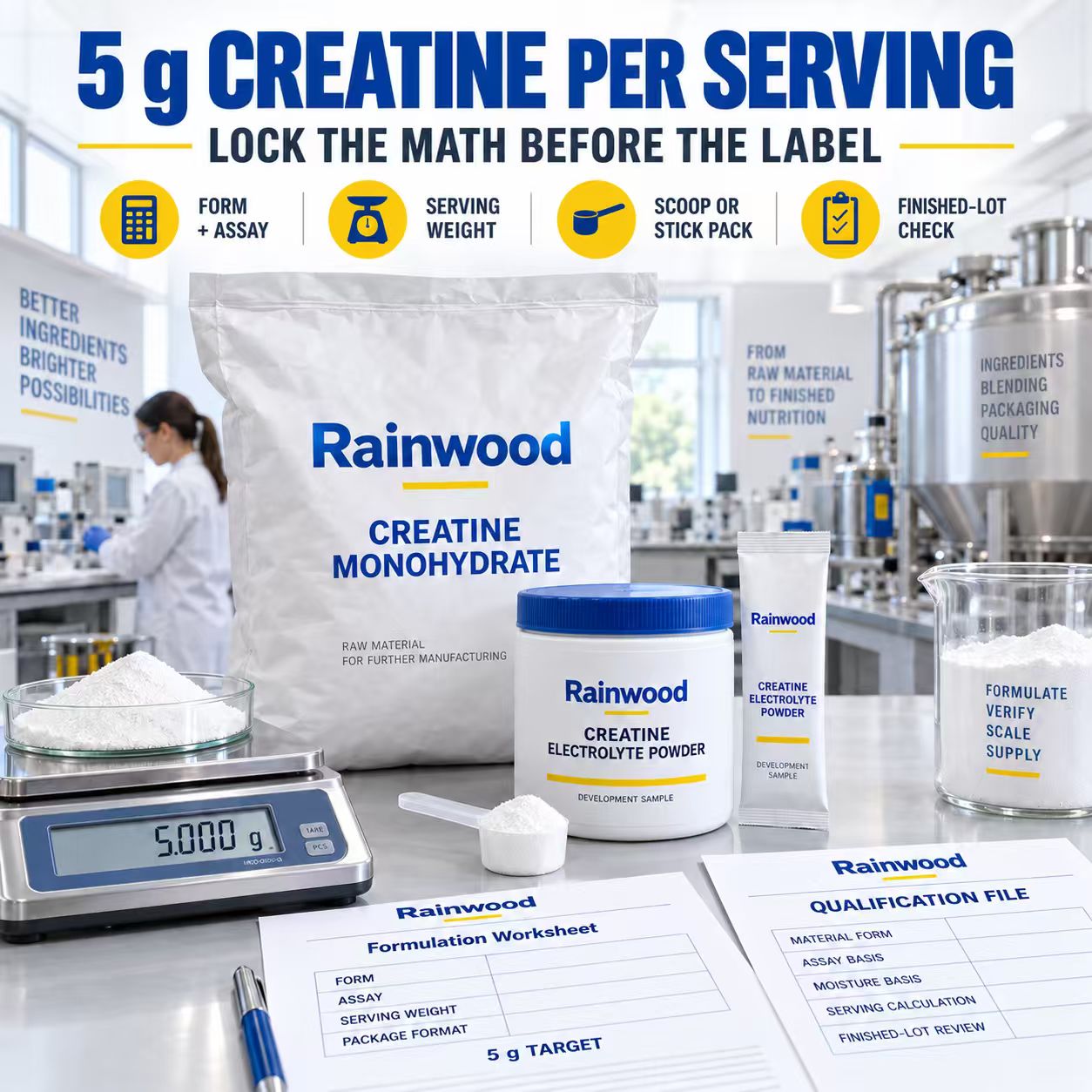
Meta title: 5 g Creatine Serving and Scoop Math Guide
Meta description: A “5 g creatine” claim can hide serving, assay, moisture, scoop, and blend calculations. Use a clear formula before approving the package.
The front panel says “5 g creatine.” The scoop holds 8 g of powder. The Supplement Facts panel lists creatine monohydrate, sodium, potassium, and magnesium below a sweetener and flavor system. Which number is the customer actually receiving?
This is the label-math problem behind many creatine electrolyte powders. Buyers often begin with a marketing target and work backward. The formula team must work forward from the exact raw materials, assay, hydration state, mineral salts, serving weight, and expected manufacturing yield. If those calculations are not locked, a large scoop can create the appearance of a full dose while the actual label basis remains unclear.
Define the word “creatine” before you calculate it
The formula should distinguish at least three values:
1. Creatine raw material weight. The amount of creatine monohydrate, HCl, or another form added to the batch.
2. Assayed or calculated creatine content. The amount supported by the agreed method and calculation basis.
3. Customer-facing declaration. The quantity printed per serving under the rules of the target market.
These values can be close, but they are not automatically identical. Moisture, purity, salt form, and label conventions may require a conversion. Use our creatine serving and scoop calculator framework to keep them separate.
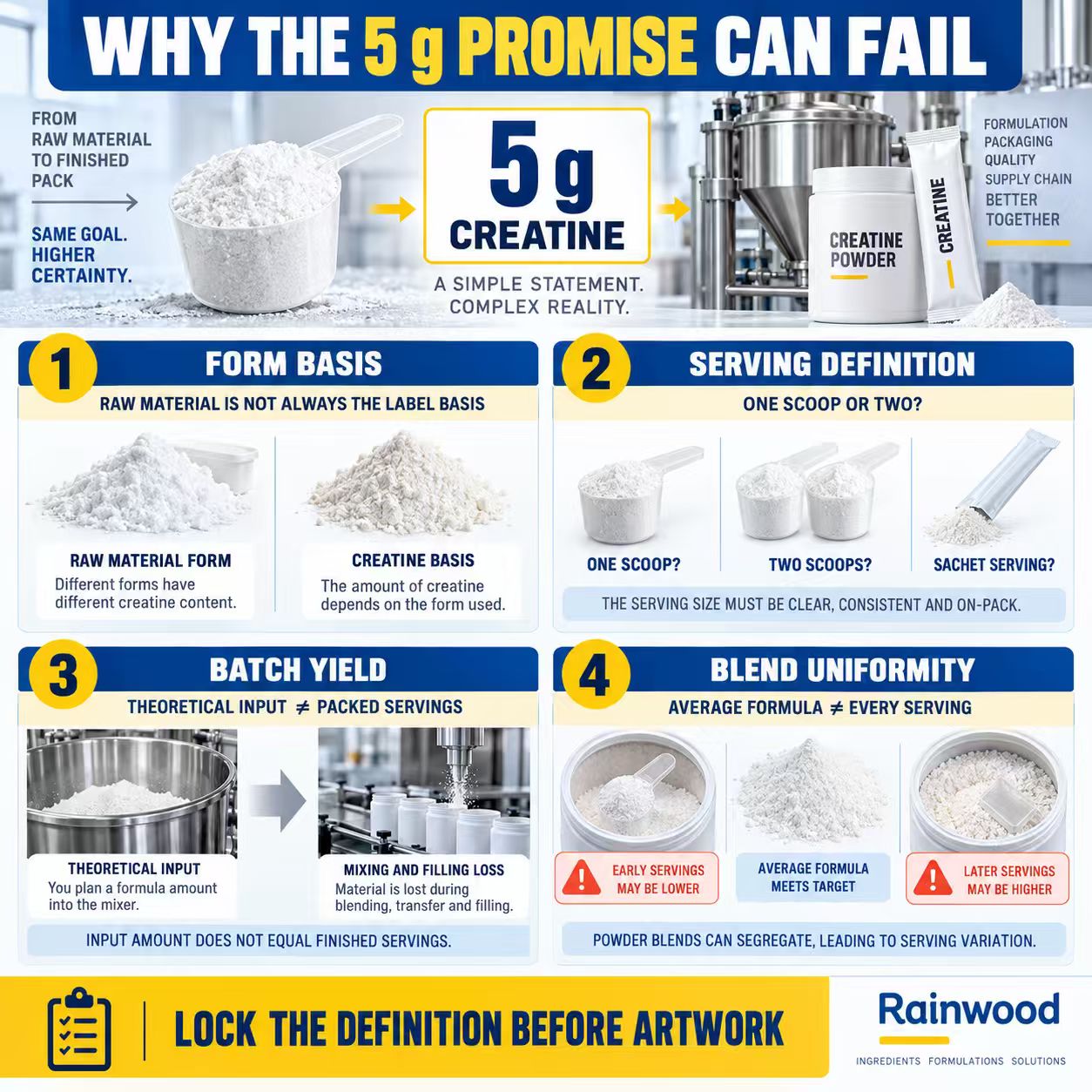
The five-gram promise can fail in four ways
The wrong form basis
Five grams of creatine monohydrate is not the same statement as five grams of pure creatine equivalent. The label and sales copy must use a consistent basis.
The wrong serving definition
If one serving is two scoops, a one-scoop visual can mislead the user. If a sachet contains more than one serving, the front panel and directions must make that clear.
The wrong batch calculation
The theoretical batch yield may not equal the packed yield. Powder retained in the mixer, transfer line, hopper, or packaging equipment changes the actual number of servings available.
The wrong blend uniformity assumption
A formula that contains five grams on average can still deliver variable servings if the creatine and electrolyte salts segregate before filling.
Read the COA-to-finished-serving verification guide before you treat a raw-material assay as proof of the label amount.
Build the formula math in a single controlled sheet
Use one row for every ingredient and include:
- material name and form;
- supplier lot and assay;
- moisture or dry-basis correction;
- raw-material weight per batch;
- active or elemental contribution;
- intended amount per serving;
- overage and processing loss assumptions;
- final batch yield and number of packed servings.
Then have formulation, QA, regulatory, and purchasing review the same sheet. A procurement quotation should not use kilograms while the label team uses grams of active and the sales team uses scoop volume.
Electrolyte math has a second layer
Sodium chloride, sodium citrate, potassium chloride, potassium citrate, magnesium citrate, and magnesium glycinate have different elemental mineral contributions. The amount of raw salt is not the amount of sodium, potassium, or magnesium the customer sees. A product can carry a large mineral-salt number and still deliver a modest elemental amount, or it can overshoot the target when several salts contribute the same mineral.
Create a second table:
| Raw material | Raw weight | Elemental contribution | Label amount |
|---|---:|---:|---:|
| Creatine form | g | Creatine basis | g per serving |
| Sodium salt | mg | Sodium | mg per serving |
| Potassium salt | mg | Potassium | mg per serving |
| Magnesium salt | mg | Magnesium | mg per serving |
Keep the units consistent. Ask the supplier to provide assay and elemental-conversion information for each mineral salt.
The scoop is a packaging component, not a measuring instrument
Powder density changes with particle size, moisture, compaction, and the time between filling the tub and using it. A scoop marked “5 g” may deliver more or less depending on whether it is level, heaped, tapped, or packed. If the product promise depends on a precise dose, a pre-portioned stick pack may offer a clearer control than a loose scoop.
If you use a tub, validate the scoop with the final blend and define user instructions. Consider an overfill or underfill tolerance, but do not let a broad tolerance undermine the promised amount. Test the first, middle, and last part of the run.
How RainwoodBio can reconcile serving math and packaging
RainwoodBio publishes powder drinks, stick packs and sachets, requirement confirmation, sample development, testing and release documentation, packaging, and traceability. For a five-gram creatine promise, the relevant capability is comparing a scoop format with pre-portioned packaging before the label and tooling are finalized.
Request a creatine serving-size and package feasibility review with your formula, scoop target, package size, daily servings, and forecast volume.
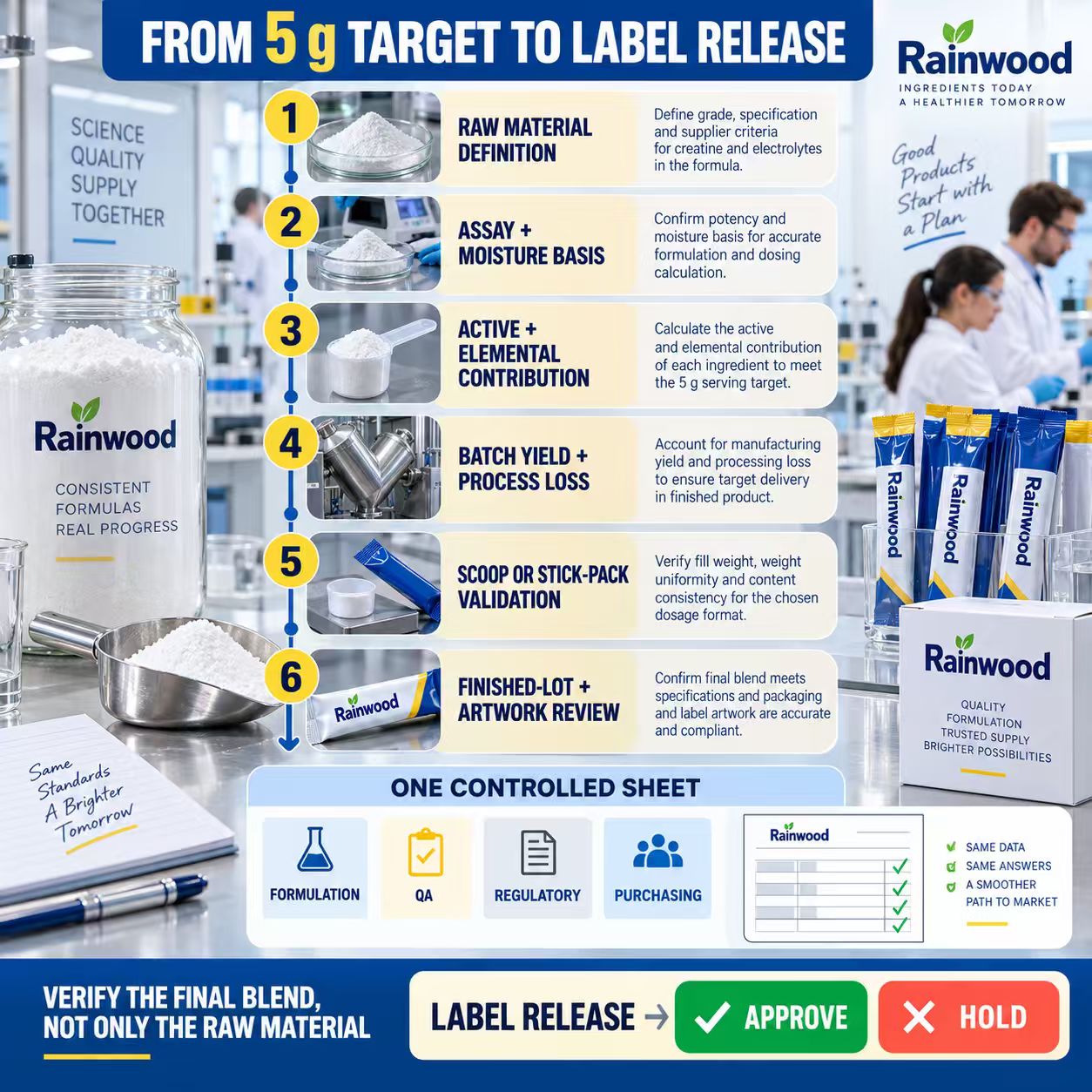
The label-release gate
Do not approve artwork until:
- the exact creatine form and declaration basis are documented;
- the serving size and scoop or sachet count are unambiguous;
- assay, moisture, and batch-yield assumptions are recorded;
- elemental mineral amounts reconcile to the raw materials;
- fill-weight and blend-uniformity results are available;
- directions match the actual serving definition;
- the target market has reviewed the claim and panel format.
Send your draft label, formula spreadsheet, COAs, scoop or sachet plan, and target market for a creatine electrolyte label-math review. RainwoodBio can identify mismatches before the packaging order turns a calculation problem into inventory.
Keep the commercial yield visible
One often-missed input is the number of saleable servings the batch actually produces. Theoretical yield may assume zero powder loss, while real production leaves material in the mixer, transfer line, dust collector, hopper, or rejected packs. If the package count is calculated from theoretical yield, the brand may underbuy raw material or overpromise inventory. Record the expected yield range, the sampling loss, the filling rejection rate, and the finished-pack count in the same controlled calculation. Reconcile it after the first commercial run and update the cost model before the next quotation. That is how a “5 g per serving” promise stays connected to the amount customers can actually purchase.
Frequently asked questions
1.Does a scoop labeled 5 g guarantee 5 g of creatine?
No. The scoop may measure total blend weight, not creatine alone. The formula and label must state what the serving contains and how the scoop was validated.
2.Should I use a stick pack for a high-dose creatine formula?
It may improve portion control and user clarity, but it adds packaging, filling, and moisture-barrier considerations. Compare the full cost and production feasibility.
3.Can I round the creatine amount on the label?
Rounding depends on the target market and label rules. Use a qualified regulatory review and keep the internal calculation more precise than the printed claim.
References
- NIH Office of Dietary Supplements, Exercise and Athletic Performance: https://ods.od.nih.gov/factsheets/ExerciseAndAthleticPerformance-HealthProfessional/
- FDA, Dietary Supplement Labeling Guide: https://www.fda.gov/food/dietary-supplements-guidance-documents-regulatory-information/dietary-supplement-labeling-guide
- International Society of Sports Nutrition creatine position stand: https://jissn.biomedcentral.com/counter/pdf/10.1186/s12970-021-00412-w.pdf
- RainwoodBio OEM information: https://www.rainwoodbio.com/oem
This article is for B2B procurement and educational purposes. Serving math, analytical results, safety, labeling, packaging, and regulatory requirements must be confirmed for the exact ingredient, finished formula, and destination market.