 EN
EN

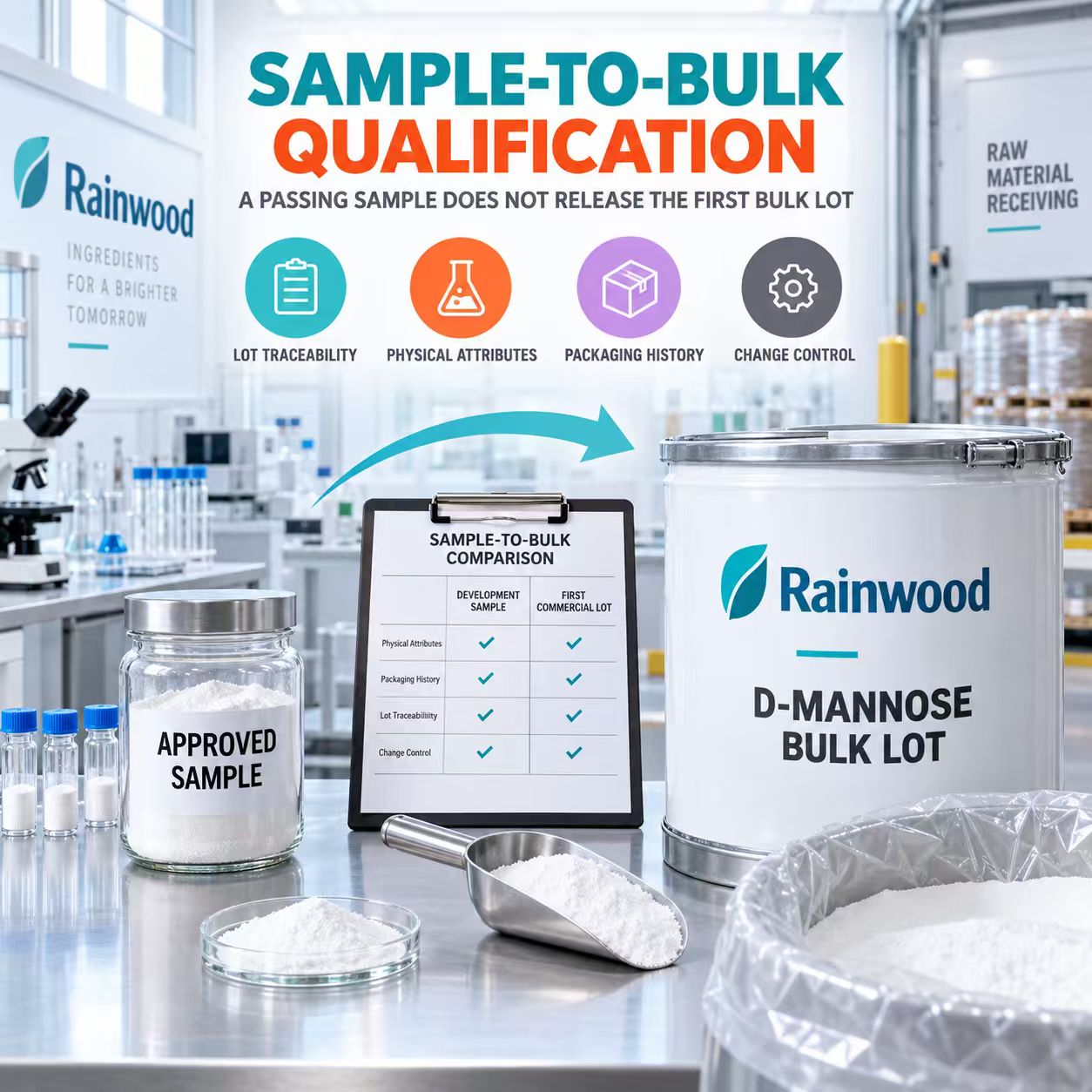
Meta title: D-Mannose Sample vs Bulk: Lock the Approval Gate
Meta description: A passing D-mannose sample is not proof of commercial-lot equivalence. Control identity, particle size, moisture, packaging, and change history.
The sample dissolves cleanly, fills the pilot capsules, and receives a quick approval email. The first bulk drum arrives with a different flow pattern and a stronger odor. Production slows while the team debates whether the material is “the same.”
The answer should not depend on memory. It should be written into the sample-to-bulk approval gate before the purchase order is released.
Use the D-mannose raw-material page as the starting point, then define what “same” means for the exact grade and format.
A sample is a decision tool, not a promise of commercial identity
The sample may come from a retained lot, a development lot, a trader’s stock, or a production batch that is not yet allocated to your order. Its passing result is useful only when you know:
- manufacturer and site;
- lot number;
- production date;
- packaging and storage history;
- grade and assay basis;
- quantity represented;
- test method and laboratory;
- intended commercial source.
Ask the supplier to state whether the sample is representative of the proposed commercial lot and what changes would require re-approval.
Read the D-mannose COA identity and lot-traceability article before signing a blanket sample approval.
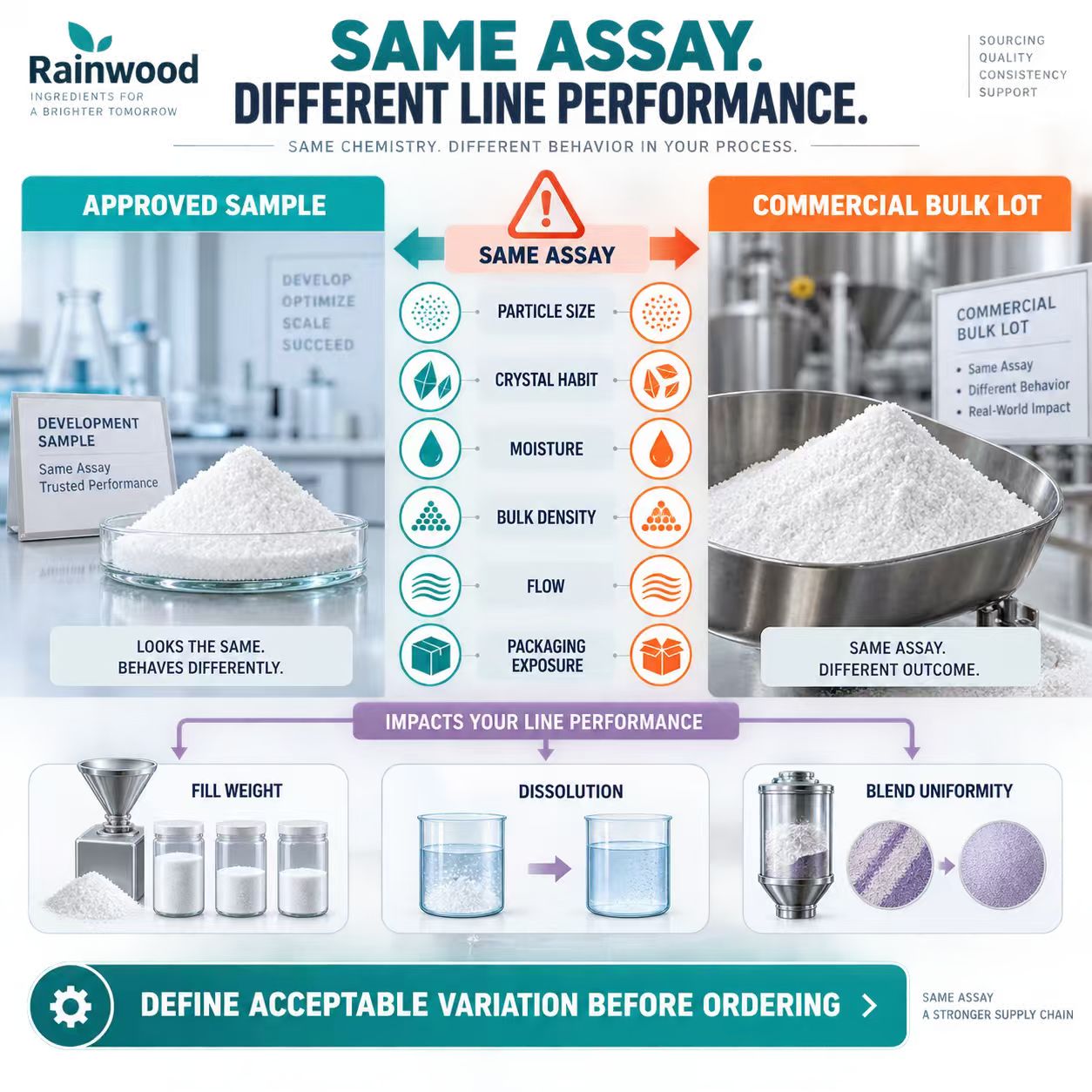
“Same assay” does not mean “same process performance”
Two D-mannose lots can meet the same assay range while behaving differently in your line. Particle-size distribution, crystal habit, moisture, bulk density, electrostatic behavior, and packaging exposure can affect flow, filling, dissolution, and blend uniformity.
Compare sample and bulk for:
- appearance and odor;
- particle-size profile;
- bulk and tapped density;
- water or loss on drying;
- flow behavior;
- dissolution time in the intended format;
- fill-weight variation;
- microbiology where relevant;
- packaging and liner condition.
These are not reasons to reject normal lot variation. They are reasons to define which variation your process can tolerate.
USP’s Mannose monograph specifies the article and assay range, but a monograph does not describe how your exact filling machine will behave with every lot. [USP Mannose Monograph](https://doi.org/10.31003/USPNF_M5509_02_01)
The bulk package can create a new material condition
A small sample is often opened once. A commercial drum may travel through multiple humidity and temperature zones, sit in a warehouse, and be opened repeatedly during production. The material can pick up moisture, compact, or form a different flow profile before use.
Specify:
- inner liner material;
- closure and reseal method;
- maximum open time;
- storage humidity and temperature;
- drum or bag handling;
- pallet and transport conditions;
- retest or reinspection after opening.
If the product is supplied in a premix or blend, also define segregation controls and sampling locations. A top sample is not enough if vibration can create concentration differences.
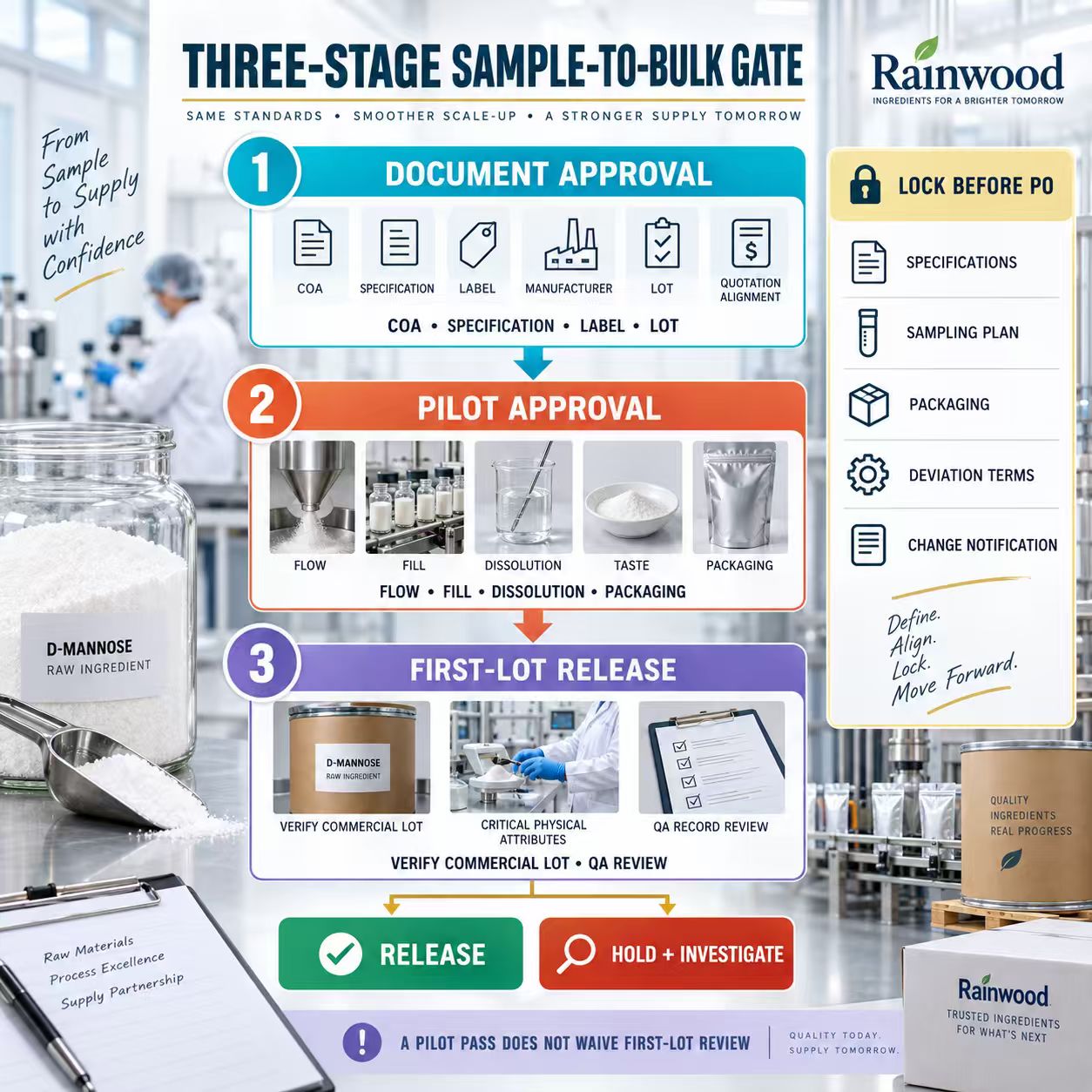
Build a three-stage approval gate
Stage 1: document approval
Match the sample COA, specification, label, manufacturer, lot, and quotation. Resolve every identity or basis mismatch.
Stage 2: pilot approval
Run the sample through the intended dosage form and record fill, flow, dissolution, taste, and packaging behavior.
Stage 3: first-lot release
Verify the commercial lot against the agreed specification and compare critical physical attributes with the approved sample. Release only after QA reviews the records.
Do not let Stage 2 become a permanent waiver for Stage 3.
Use the sample-to-bulk release checklist to document the handoff from development to purchasing.
Define acceptable differences before the argument starts
Your approval record should state:
- assay range and basis;
- water limit;
- particle-size or flow expectation;
- density range if fill depends on it;
- appearance and odor limits;
- packaging requirements;
- test methods and sampling plan;
- deviation process;
- replacement or rework terms;
- change-notification timing.
If a physical attribute is critical to your line but absent from the specification, the supplier may reasonably treat it as non-binding. Add it before ordering.
The “same supplier” assumption is not enough
A trading company may change the upstream manufacturer, route, site, or packaging while keeping the same sales name. A manufacturer may also change a process or raw material within a broad specification. Neither event is automatically unacceptable, but both can require a new sample or risk review.
Ask for written notice of changes to:
1. manufacturer or site;
2. source or route;
3. purification or drying;
4. particle-size control;
5. packaging;
6. analytical method;
7. specification limits.
Read the D-mannose backup-supplier and change-control guide when the product is part of a subscription or retailer program.
How RainwoodBio can support the transition
RainwoodBio’s public workflow describes sample development, supplier management, production control, testing and release, documentation, packaging, logistics, and traceability. These company-published capabilities can support a defined sample-to-bulk process, but the exact acceptance criteria must be written for your D-mannose grade and format.
Ask for a comparison table that shows sample lot, commercial lot, test result, deviation, disposition, and approval owner. Use the D-mannose sample-to-bulk OEM review before scaling a capsule, sachet, or gummy program.
Put the approval boundary in the purchase order
Write the sample approval conditions into the order: exact product identity, specification version, critical physical attributes, package, test plan, lot documentation, and change-notice requirement. State whether the supplier may ship a different lot or grade without written approval. This is especially important when the sample was supplied by a trader and the commercial lot will come from another site.
The purchase order should also define what happens after a failure: hold, investigation, retest limits, replacement, credit, or return. A clear boundary protects both sides because the supplier knows what was approved and the buyer knows what evidence is required before using the material.
Approval gate before releasing the first bulk lot
Release only when:
- the commercial lot is traceable to the approved specification;
- critical physical attributes are within agreed limits;
- the lot passes the defined identity, assay, moisture, and applicable safety tests;
- packaging and storage history are acceptable;
- any deviation is documented and accepted by the right owner;
- future changes trigger requalification.
Request a D-mannose sample-to-bulk qualification review. Send RainwoodBio the approved sample COA, bulk COA, specification, format, pilot notes, and current supplier terms so the team can identify gaps before the first production release.
Frequently asked questions
1.If the sample and bulk both test at 99%, can they be treated as identical?
No. Assay is only one comparison point. Identity, basis, moisture, physical properties, packaging, and lot traceability also matter.
2.Should every new D-mannose lot be fully retested?
The scope depends on your qualification plan, market, risk, and supplier history. At minimum, define first-lot verification and triggers for expanded testing.
3.What if the bulk lot is outside the sample’s particle size but still meets assay?
Assess whether the difference affects your process or finished product. If it does, use the deviation and change-control process rather than accepting it informally.
References
- United States Pharmacopeia, Mannose Monograph: https://doi.org/10.31003/USPNF_M5509_02_01
- FDA, Dietary Supplements Guidance: https://www.fda.gov/food/guidance-documents-regulatory-information-topic-food-and-dietary-supplements/dietary-supplements-guidance-documents-regulatory-information
- RainwoodBio About Us: https://www.rainwoodbio.com/about-us
This article is for B2B procurement and educational purposes. Product, analytical, safety, labeling, and regulatory requirements should be confirmed for the exact ingredient, finished product, and destination market.