 EN
EN

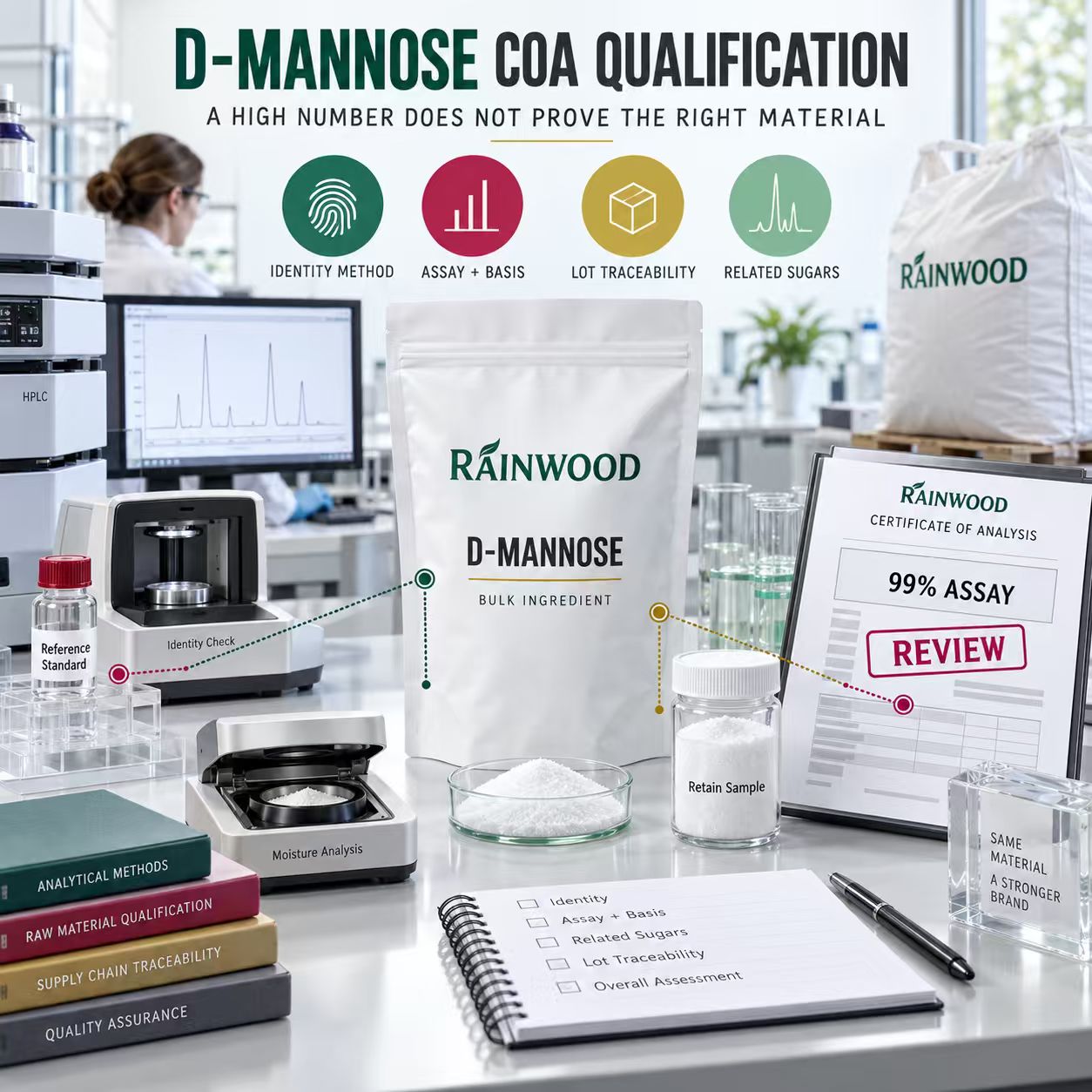
Meta title: 99% D-Mannose COA: What It Does Not Prove
Meta description: A 99% D-mannose assay does not automatically prove identity, dry-basis strength, or batch consistency. Build a defensible release file.
The supplier sends a COA showing “D-mannose 99%.” Purchasing marks the lot approved. Three months later, the finished label, taste, or dose calculation does not match the development sample.
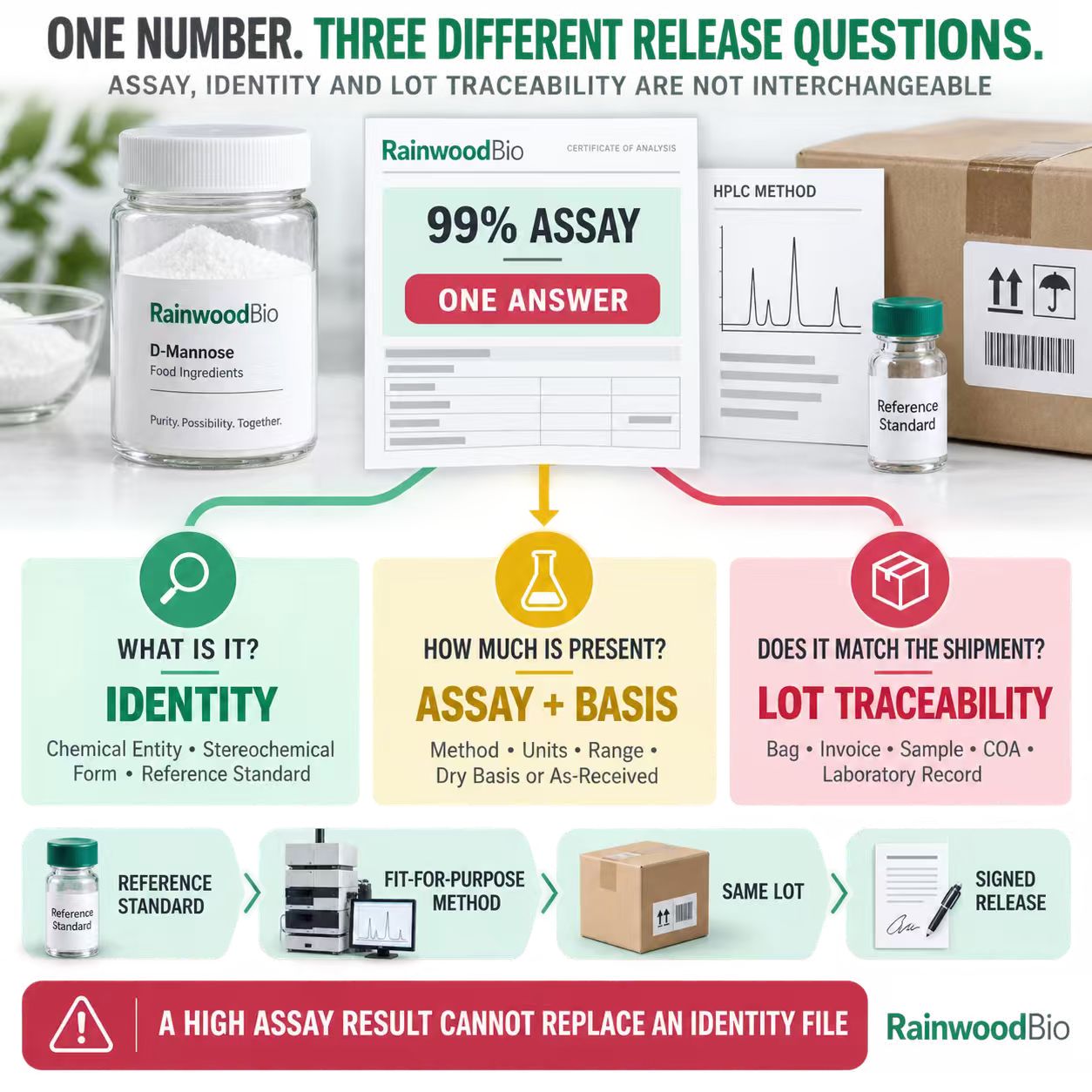
The problem is not that 99% is meaningless. The problem is that one number answers only one question. It may describe assay under a stated method and basis. It does not automatically prove that the material is the correct stereoisomer, that the result belongs to the shipped lot, or that the powder will perform in your chosen format.
If you are importing D-mannose, treat the COA as the beginning of qualification, not the end. Review the D-mannose raw-material specification against the exact identity, method, grade, and application you are buying.
Assay and identity are different release decisions
D-mannose is a defined monosaccharide. A chromatographic assay can quantify a peak, but the release file still needs an identity test that distinguishes the intended material from a related sugar or an incorrectly named blend. USP’s Mannose monograph defines the article as containing 98.0% to 102.0% mannose on a dried basis; that specification is stronger than a vague “99% pure” statement because it defines the article and the calculation basis. [USP Mannose Monograph](https://doi.org/10.31003/USPNF_M5509_02_01)
Ask four questions before accepting the certificate:
- Is the analyte reported as D-mannose, mannose, or total sugars?
- Is the result calculated as received or on a dried basis?
- Does the identity method confirm the chemical entity, not only the presence of a carbohydrate peak?
- Does the laboratory report the method, reference standard, sample number, and lot number?
An identity result and an assay result should be traceable to the same lot. If the COA lists only “HPLC” without a method reference or chromatogram, you do not yet know whether the test is fit for this material.
A dry-basis result can change your label math
Suppose a COA reports 99.0% on a dried basis, while the powder contains 2.0% water. The amount of D-mannose delivered per gram as received is not the same as 99.0%. That difference may be small in a laboratory calculation and material in a high-dose product or a contract specification.
Your purchasing file should record:
1. assay basis;
2. water or loss-on-drying result;
3. serving amount as received;
4. target D-mannose amount per serving;
5. overage policy, if any;
6. finished-product release limit.
Do not silently convert a dry-basis number into a finished-product claim. The Supplement Facts panel, batch record, and specification must use the same declared basis.
Read the D-mannose dose and label-math guide before approving packaging artwork.
Related sugars and process history still matter
D-mannose can be produced through chemical synthesis or biotransformation, so the route and purification history can affect what the buyer needs to control. A supplier may legitimately use a different process than another supplier. That does not make process history irrelevant. It determines which related substances, residuals, color, moisture, and microbiological questions belong in the specification.
Request a technical statement covering:
- source and manufacturing route at a useful level;
- whether the material is single ingredient or contains a carrier;
- known related sugars or process-related impurities;
- purification and drying steps;
- storage and retest conditions;
- change-notification rules.
The request is not asking the supplier to disclose a trade secret. It is asking whether the COA is connected to a controlled commercial grade.
The COA may be disconnected from your shipment
A polished PDF can be copied, reformatted, or issued for a retained sample rather than the production lot. Confirm the chain:
- manufacturer name and address;
- lot number on the bag, invoice, sample, and COA;
- production date and retest date;
- sampling date and laboratory identity;
- quantity represented by the result;
- signed release or electronic verification process.
For a new supplier, compare the certificate with an independent identity or assay check on the first commercial lot. For an established supplier, define periodic verification and a trigger for increased testing after a source, process, packaging, or site change.
Use the sample-to-bulk verification checklist to turn a document review into a purchasing gate.
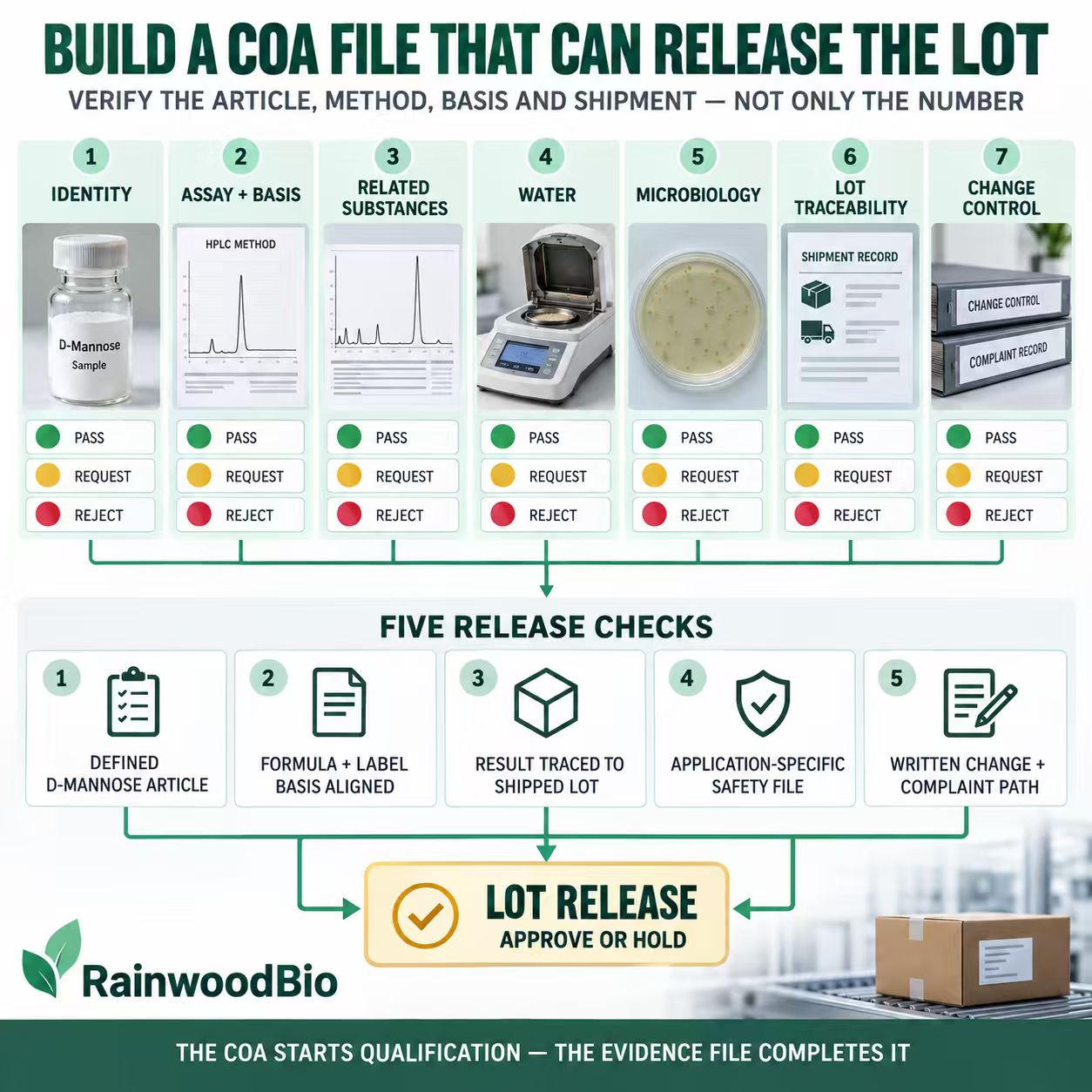
A practical D-mannose COA scorecard
Score each item as pass, request, or reject:
| COA element | Pass condition | Buyer action if missing |
|---|---|---|
| Identity | Method and result identify the intended mannose article | Request method and confirmatory identity |
| Assay | Result has basis, units, range, and method | Recalculate as received and dry basis |
| Related substances | Limits match the grade and route | Add a risk-based impurity request |
| Water | Limit and method are stated | Assess caking and label math |
| Microbiology | Limits fit the raw material and market | Set a release panel |
| Lot traceability | Lot appears on all commercial documents | Hold the shipment |
| Change control | Supplier agrees to notify relevant changes | Add a contract requirement |
Do not award a supplier solely because the score looks tidy. The scorecard tells you what to verify before the material enters your formula.
How RainwoodBio can support the qualification
RainwoodBio’s public company information describes raw-powder sourcing, supplier management, testing and release, warehousing, logistics, and traceability as part of its operating workflow. Those are company-published capabilities, not proof of a particular D-mannose lot. The project file should still define the exact identity method, assay basis, water limit, impurity panel, and lot documents.
Ask for a D-mannose COA and specification gap review that compares your current supplier certificate with your target market, daily dose, format, and release requirements.
Release gate before payment
Hold the order until you can answer yes to all five questions:
1. Do we know exactly what “D-mannose” means in this specification?
2. Is the assay basis consistent with our formula and label math?
3. Can we trace the result to the shipped lot?
4. Do we have enough identity, moisture, impurity, and microbiology evidence for this application?
5. Is there a written change-control and complaint-response path?
Request a D-mannose specification and COA review. Send RainwoodBio your current COA, target market, serving size, format, and annual quantity so the team can identify missing tests before you approve the lot.
Frequently asked questions
1.Is 99% D-mannose enough for a supplement raw material?
Not by itself. It may be a useful assay result, but identity, basis, moisture, related substances, microbiology, lot traceability, and market requirements still need review.
2.Should the assay be reported on a dry basis?
It depends on the agreed specification, but the basis must be explicit and consistent with the formula. If a dry-basis result is used, water must be considered in the as-received calculation.
3.Does HPLC alone prove D-mannose identity?
Not automatically. The method must be suitable for distinguishing and quantifying the intended article, and the identity package should be reviewed with the method and reference standard.
References
- United States Pharmacopeia, Mannose Monograph: https://doi.org/10.31003/USPNF_M5509_02_01
- FDA, Questions and Answers on Dietary Supplements: https://www.fda.gov/food/information-consumers-using-dietary-supplements/questions-and-answers-dietary-supplements
- RainwoodBio company homepage: https://www.rainwoodbio.com/
This article is for B2B procurement and educational purposes. Product, analytical, safety, labeling, and regulatory requirements should be confirmed for the exact ingredient, finished product, and destination market.