 EN
EN

Meta title: Cheap D-Mannose Quote? Normalize the Real Cost First
Meta description: A lower D-mannose price can hide assay basis, moisture, carrier, packaging, testing, and landed-cost differences. Compare quotes line by line.
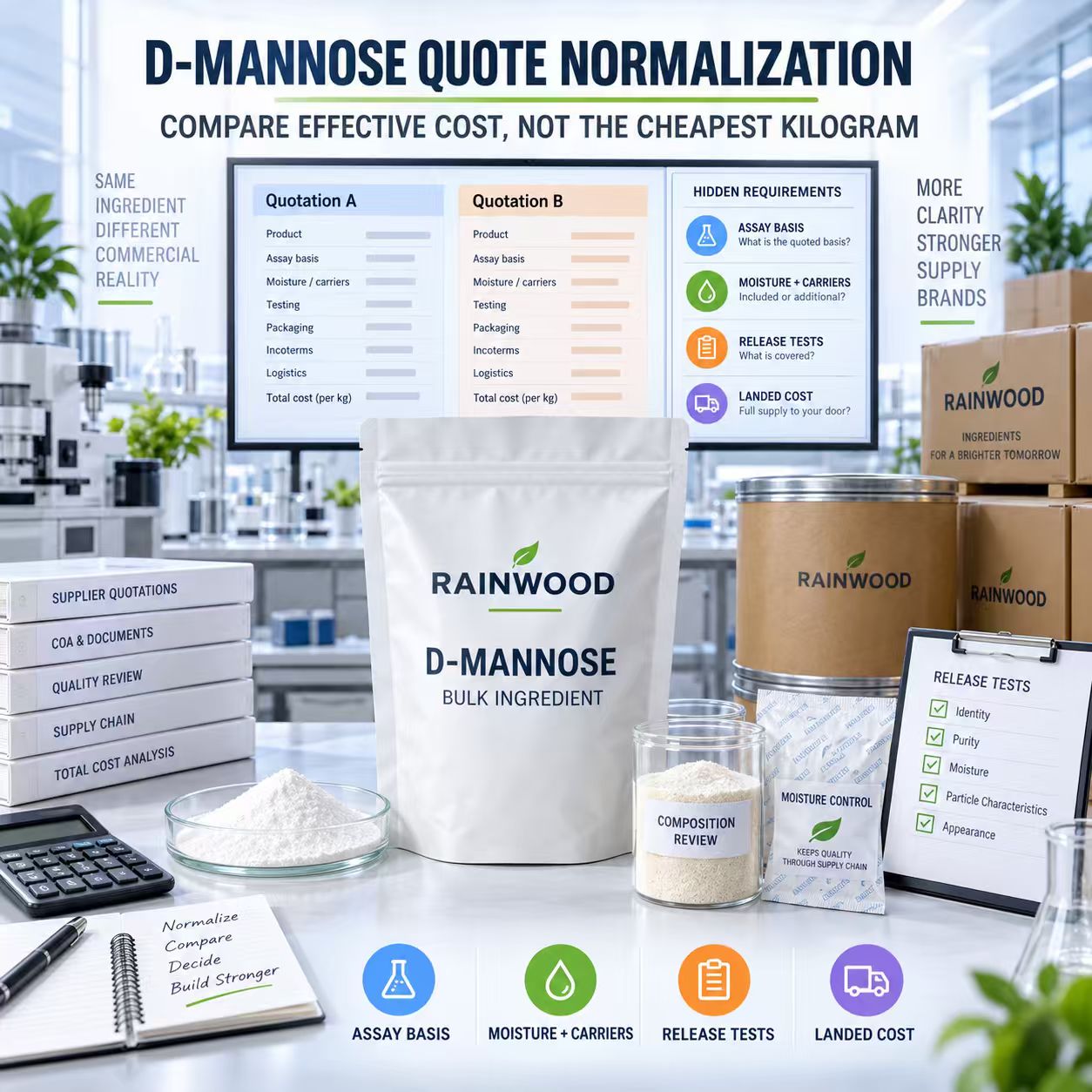
Two D-mannose quotes arrive on the same afternoon. Supplier A is 18% cheaper. Purchasing recommends the lower number. The formulator later discovers a different assay basis, larger packaging, a carrier, and no independent verification allowance.
The cheap quote may still be the right quote. You simply cannot know until both offers describe the same commercial material and the same risk allocation.
Use the D-mannose bulk quotation checklist to normalize the offer before comparing unit prices.
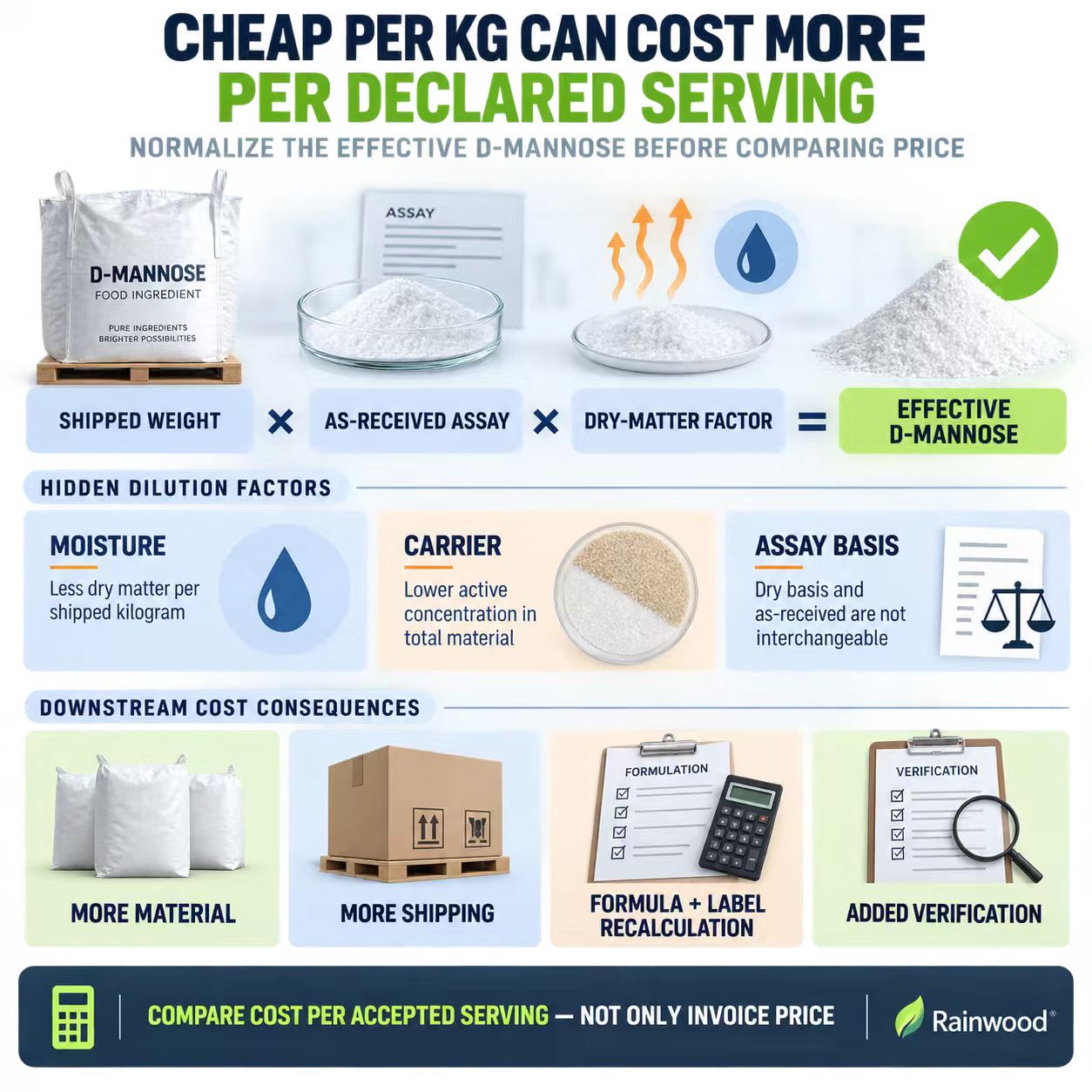
Price per kilogram is not price per declared serving
D-mannose is commonly purchased as a high-dose powder or used in formats where the daily amount affects capsule count and shipping weight. A supplier can quote a lower kilogram price while delivering a lower effective amount per kilogram because of moisture, carrier, or an assay reported on a different basis.
Calculate:
`effective D-mannose per shipped kilogram = shipped weight × as-received assay × dry-matter factor`
Then calculate the ingredient cost per declared serving, not only the invoice price. If your formula uses a defined amount of D-mannose per serving, the relevant comparison is the cost of meeting that amount with the accepted specification.
USP’s Mannose monograph sets an assay range on a dried basis. That makes the basis a commercial variable that must be visible in the quote and formula review. [USP Mannose Monograph](https://doi.org/10.31003/USPNF_M5509_02_01)
The quote may describe a carrier-containing material
“D-mannose powder” does not always mean 100% single ingredient. A premix can improve handling, especially when a dose is difficult to weigh or distribute, but the carrier changes the formula, label, shipping weight, and test plan.
Ask for:
- complete composition by percentage;
- carrier name and food status;
- active assay on total material and active basis;
- blend homogeneity data;
- ingredient declaration impact;
- packaging and storage requirements;
- whether the material is a physical blend or co-processed grade.
If the quote refuses to identify the carrier, you are not comparing like with like.
Read the pure powder versus premix decision guide before treating a lower concentration as a simple discount.
Testing included in one quote may be excluded from another
One supplier may include identity, assay, water, microbiology, and heavy metals in the release price. Another may provide only an internal assay. Both can write “COA included.”
Normalize the test package:
| Cost line | Supplier A | Supplier B | Your requirement |
|---|---:|---:|---|
| Identity | | | Fit-for-purpose method |
| Assay and basis | | | Agreed range |
| Water | | | Caking and math control |
| Related substances | | | Route-specific request |
| Microbiology | | | Market and format dependent |
| Heavy metals | | | Finished daily intake review |
| Packaging | | | Liner, drum, pallet, labels |
| Verification sample | | | New supplier or first lot |
The purpose is not to make every supplier run the same expensive panel. The purpose is to reveal which quote has transferred risk to you.
MOQ and packaging can reverse the ranking
A low unit price with a high MOQ can tie up cash and create a slow-moving lot. A 25 kg drum may be efficient for a manufacturer but excessive for a pilot brand. Smaller packaging can cost more per kilogram yet reduce exposure during formula validation.
Include:
- requested quantity and annual forecast;
- minimum order quantity;
- shelf life and retest period;
- number of containers;
- inner liners and resealing method;
- pallet and loading configuration;
- storage space and humidity controls;
- freight, insurance, customs, and destination charges.
For D-mannose, packaging is not a clerical detail. Moisture pickup or repeated opening can change powder behavior and create a retest problem before the material is consumed.
Ask what the cheap number excludes
Send each supplier the same written questions:
1. Is the price for single-ingredient D-mannose or a premix?
2. Is assay quoted as received or dry basis?
3. Which tests are included in the COA?
4. Is the COA from the manufacturer or a trader?
5. What happens if the lot fails your specification?
6. Who pays for re-testing, replacement, or disposal?
7. How are changes to source, route, site, or packaging notified?
8. What are the Incoterms and expected landed charges?
Do not accept “same quality, better price” as an answer. Ask for the document and contract line that makes the comparison real.
Use the two-quotation normalization worksheet to create a purchase recommendation your finance and QA teams can both defend.
How RainwoodBio can make the comparison concrete
RainwoodBio’s public company information describes requirement confirmation, supplier management, testing and release, packaging, logistics, and traceability. For a D-mannose project, ask for a quotation that separates material, testing, packaging, sample, format development, and logistics assumptions rather than hiding everything inside one kilogram number.
Explore the D-mannose OEM and packaging options when comparing bulk powder with capsules, sachets, or a finished private-label product.
Separate a real saving from a transferred liability
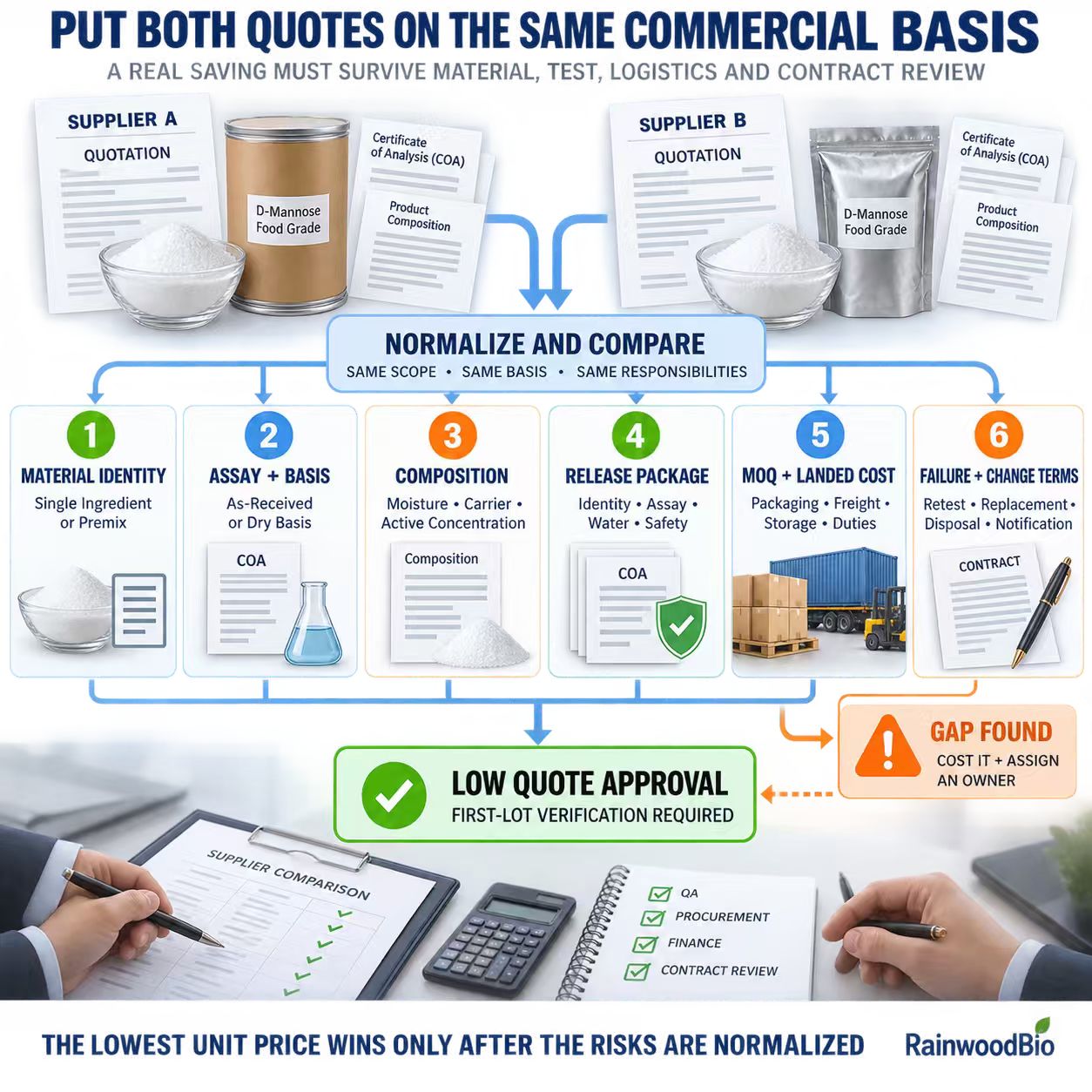
A quote can be cheaper because the supplier has a more efficient process, a better freight lane, or a larger planned production run. It can also be cheaper because testing, packaging, replacement, or compliance work has been left for you. Ask which explanation applies and record the answer in the comparison file.
For each difference, assign a cost and an owner. If your company must pay for an external identity check, add it. If the lower quote requires a new premix validation or a larger warehouse footprint, add it. If the supplier refuses a change-notice clause, assign a continuity risk rather than pretending the offers are equivalent. This makes the final recommendation easier to defend when finance asks why the lowest unit price was not selected.
Approval gate for the low quote
Approve the cheaper offer only when:
- the identity and assay basis match your specification;
- any carrier is declared and accepted;
- the test package is equivalent or the gap is costed;
- MOQ, packaging, and landed cost are comparable;
- failure and change-control terms are written;
- first-lot verification is included in the launch plan.
Request a D-mannose quotation normalization and landed-cost review. Send RainwoodBio both quotations, your annual volume, destination country, format, and target serving so the team can compare effective cost instead of headline price.
Frequently asked questions
1.Is a higher D-mannose price always safer?
No. Price alone does not prove quality. The decision should compare identity, assay basis, test coverage, packaging, traceability, and failure controls.
2.Should buyers reject all premixes?
No. A premix can improve dosing and blending. It must simply be specified as a different commercial material with a declared carrier and homogeneity requirement.
3.What is the most common quotation mistake?
Comparing price per kilogram while ignoring assay basis, moisture, active concentration, testing scope, MOQ, and landed charges.
References
- United States Pharmacopeia, Mannose Monograph: https://doi.org/10.31003/USPNF_M5509_02_01
- FDA, Dietary Supplements Guidance and Regulatory Information: https://www.fda.gov/food/guidance-documents-regulatory-information-topic-food-and-dietary-supplements/dietary-supplements-guidance-documents-regulatory-information
- RainwoodBio OEM service context: https://www.rainwoodbio.com/oem
This article is for B2B procurement and educational purposes. Product, analytical, safety, labeling, and regulatory requirements should be confirmed for the exact ingredient, finished product, and destination market.