 EN
EN

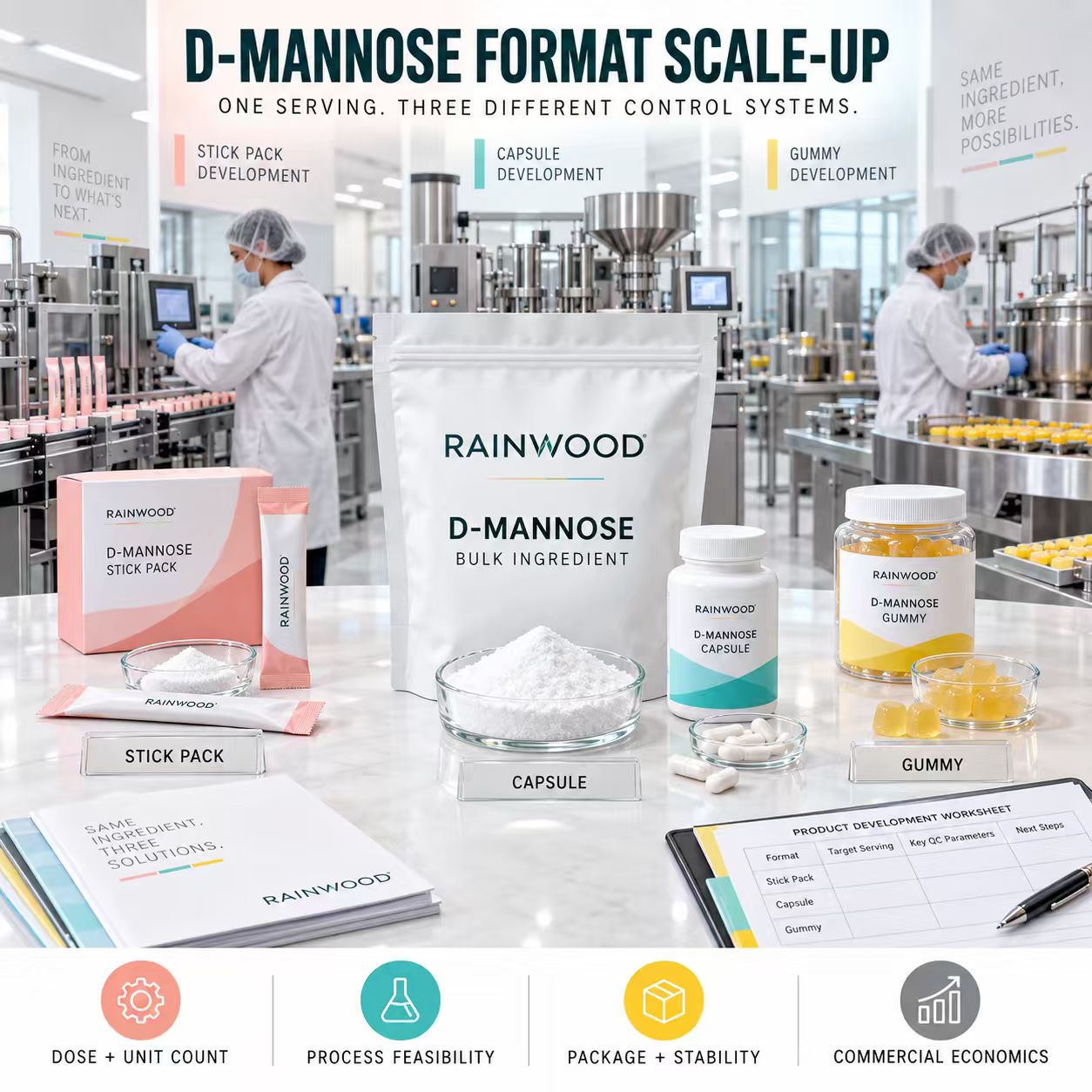
Meta title: D-Mannose Format Choice: Stick Pack, Capsule, or Gummy?
Meta description: Compare D-mannose stick packs, capsules, and gummies by dose, flow, taste, moisture, testing, packaging, and scale-up risk before choosing a format.
The marketing team wants a gummy because it is easy to promote. The formulator points to the gram-level serving and asks where the active will fit. Purchasing prefers capsules because the supplier already has a bottle. The decision is delayed until packaging, flavor, and production costs start pulling the project in different directions.
D-mannose format selection is not a popularity contest. Each format changes the dose, material handling, sensory experience, stability program, label, and commercial economics. Choose the format your quality and manufacturing systems can control.
Start with the D-mannose raw powder and grade information, then compare formats using the same target serving.
Stick packs solve dose volume but expose powder behavior
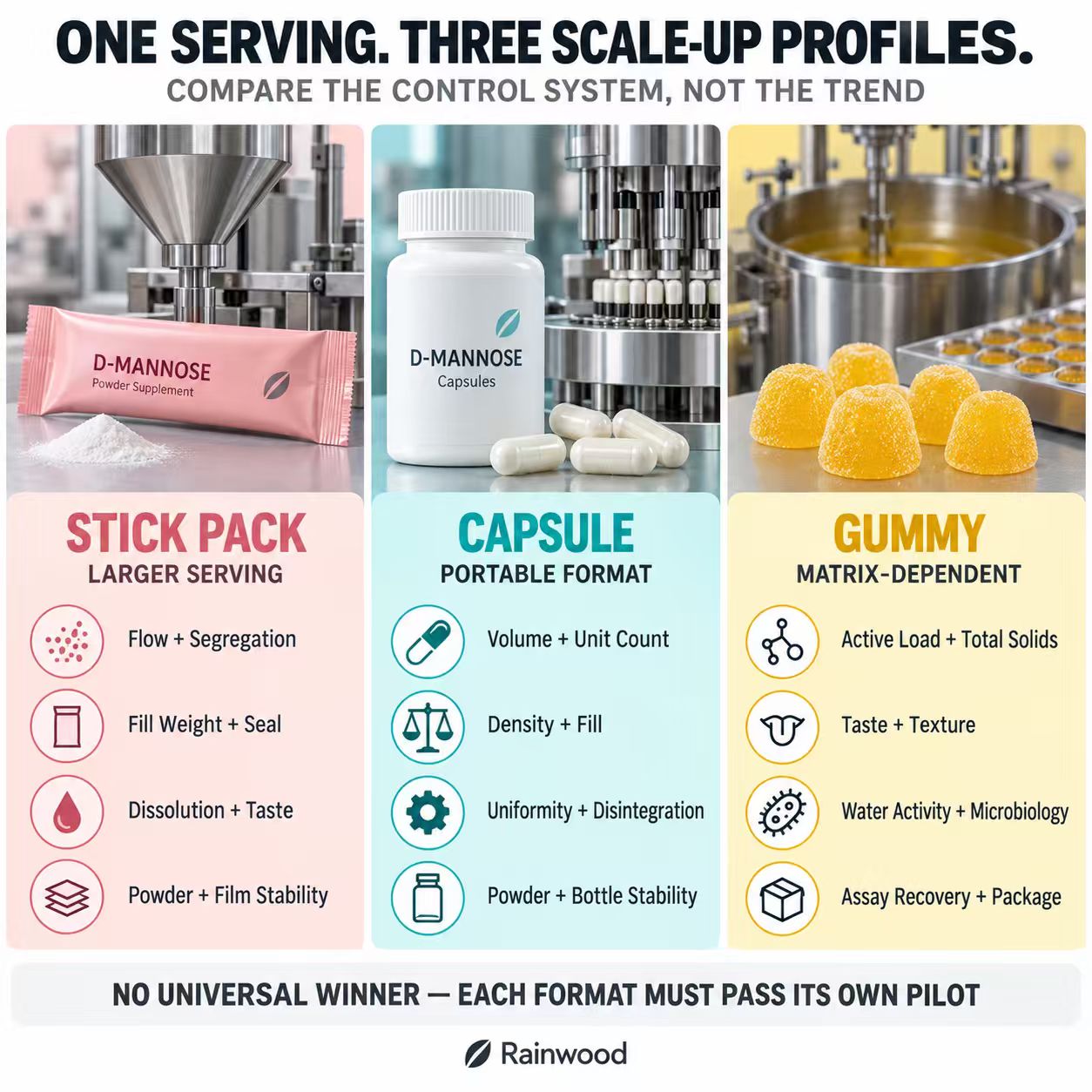
Powder stick packs can accommodate a larger serving than a capsule and preserve a simple single-ingredient story. They also expose the project to:
- flow variation during filling;
- segregation in a multi-ingredient blend;
- caking after humidity exposure;
- fill-weight variation;
- seal contamination;
- dissolution and taste complaints;
- barrier-film and storage requirements.
If D-mannose is blended with acidulants, flavors, cranberry, electrolytes, or probiotics, every component needs a compatible particle size, density, and moisture strategy. A stick pack that fills smoothly in the laboratory may bridge or segregate on a production line.
Read the D-mannose drink-powder stability guide before approving a flavored sachet.
Capsules improve portability but make the serving math visible
Capsules offer a familiar delivery format and protect the powder from immediate environmental exposure. The trade-off is volume. A gram-level serving may require multiple capsules, extra excipients, a larger bottle, and a higher fulfillment cost.
Confirm:
- target D-mannose per serving;
- powder density and fill weight;
- capsule size and count;
- uniformity sampling;
- disintegration or dissolution requirements where applicable;
- bottle, desiccant, and moisture-barrier assumptions;
- consumer tolerance for daily capsule count.
Use the D-mannose capsule dose calculator to compare the actual cost of the finished serving.
Gummies create a different ingredient problem
A gummy must carry D-mannose inside a matrix that already contains water, sugars or polyols, gelling agents, acids, flavors, colors, and processing heat. The amount of active that fits may be limited by taste, texture, and total solids rather than by the label concept.
Gummy development should test:
- D-mannose load per piece and per serving;
- sweetness balance and aftertaste;
- water activity and moisture migration;
- texture after drying and storage;
- interaction with acids, minerals, and botanicals;
- microbial controls;
- assay recovery from the matrix;
- package seal and oxygen or moisture barrier.
Do not transfer a powder COA directly into a gummy release plan. The raw material may meet its specification while the finished matrix fails taste, texture, potency, or microbiology.
Use a format scorecard instead of a trend argument
| Decision factor | Stick pack | Capsule | Gummy |
|---|---|---|---|
| Larger serving | Usually easier | May require several units | Limited by taste and matrix |
| Moisture exposure | High during filling and opening | Lower but not zero | High and intrinsic to matrix |
| Taste control | Flavor needed | Mostly hidden | Flavor and texture critical |
| Dose uniformity | Blend and fill control | Blend and capsule fill control | Piece and batch uniformity |
| Stability | Powder and film | Powder and bottle | Matrix and package |
| Consumer use | Mix with liquid | Swallow | Chew |
| Development risk | Flow and dissolution | Volume and density | Process, sensory, and microbiology |
The scorecard is not a universal ranking. It shows which questions the selected format must answer.
The same ingredient needs different pilot samples
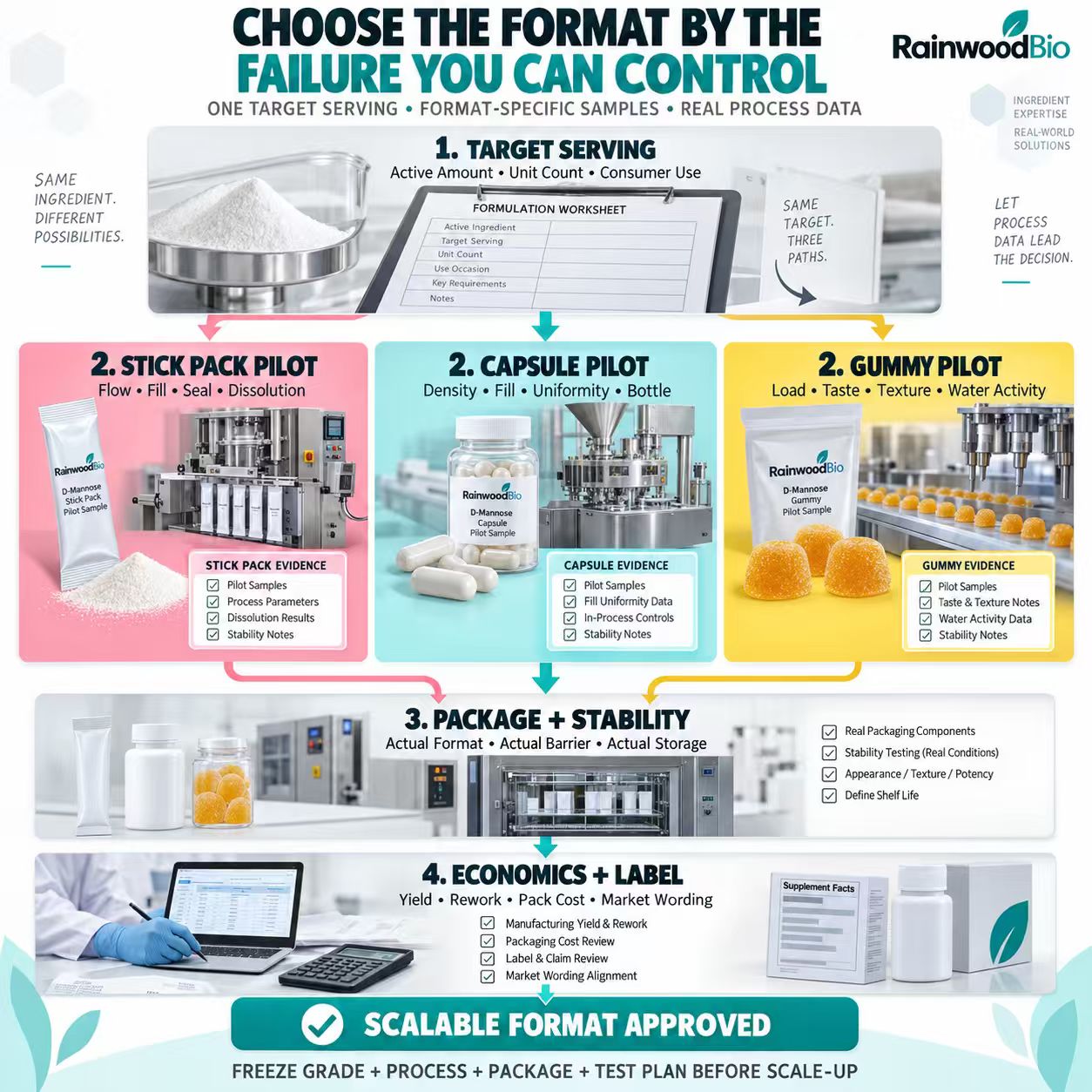
Ask for format-specific samples, not one bag of powder and a generic finished sample. For each format, define:
1. target serving and unit count;
2. exact D-mannose grade and assay basis;
3. addition sequence and process temperature;
4. packaging material;
5. in-process checks;
6. finished-product release tests;
7. stability checkpoints;
8. sample approval criteria.
The approved sample becomes a reference, but it should not replace commercial-lot verification. If the supplier changes particle size, source, premix ratio, flavor system, or gummy process, the relevant pilot must be repeated.
Explore the D-mannose private-label format options when you need the supplier to compare more than one delivery form.
How RainwoodBio can support a controlled comparison
RainwoodBio’s current site lists hard capsules, gummies, powders and sachets, tablets, softgels, and raw powders, and describes requirement confirmation, sample development, production control, testing, packaging, and logistics. These are company-published capabilities. Ask for a side-by-side D-mannose feasibility file rather than a generic catalog recommendation.
The file should show the proposed serving, unit count, critical process variables, packaging, expected MOQ, testing plan, and unresolved questions for each format. Use the **D-mannose multi-format OEM assessment** **[INTERNAL LINK -> OEM Service Page]** before committing to a single format.
Select the format by the first failure you can control
Ask each project team to name its most expensive likely failure. For a capsule, it may be an unrealistic unit count or fill-weight drift. For a stick pack, it may be caking, slow dissolution, or a failed seal. For a gummy, it may be taste, moisture migration, or a potency method that cannot recover D-mannose from the matrix.
Then design the pilot to expose that failure early. The purpose of multi-format development is not to create three attractive samples; it is to identify which format gives your business the clearest release criteria and the lowest uncontrolled risk. Once a format wins, freeze the raw-material grade, process, package, and testing assumptions that made it work.
The launch gate
Choose a format only when:
- the target serving fits without hiding an unrealistic unit count;
- the raw and finished specifications are defined;
- the sensory and physical risks have a test plan;
- packaging and shelf-life assumptions are documented;
- the economics include rejects, freight, and fulfillment;
- the market’s label and claim requirements are reviewed.
Request a D-mannose format comparison. Send RainwoodBio your target dose, market, preferred format, serving experience, annual quantity, packaging idea, and target cost for a practical side-by-side proposal.
Frequently asked questions
1.Which D-mannose format is easiest to launch?
It depends on the dose, equipment, sensory expectations, market, and quality system. A capsule may be simple for a low-volume pilot, while a stick pack may be more practical for a larger serving.
2.Are gummies suitable for every D-mannose dose?
No. The dose must fit the gummy’s size, taste, texture, and matrix without creating unacceptable moisture or stability problems.
3.Can the same stability data cover all three formats?
No. Each format has different moisture, packaging, processing, and finished-product risks. Use a format-specific stability plan.
References
- United States Pharmacopeia, Mannose Monograph: https://doi.org/10.31003/USPNF_M5509_02_01
- RainwoodBio homepage and format capabilities: https://www.rainwoodbio.com/
- RainwoodBio OEM service: https://www.rainwoodbio.com/oem
This article is for B2B procurement and educational purposes. Product, analytical, safety, labeling, and regulatory requirements should be confirmed for the exact ingredient, finished product, and destination market.