 EN
EN

Meta title: D-Mannose Drink Powder: Test Solubility and Clumping
Meta description: D-mannose drink powders can fail through slow dissolution, sweetness imbalance, caking, or moisture pickup. Build the right pilot and package test.
The first bench sample dissolves in a glass. The pilot batch leaves sediment, forms wet lumps around the sachet seal, and tastes much sweeter than the tasting spoon suggested.
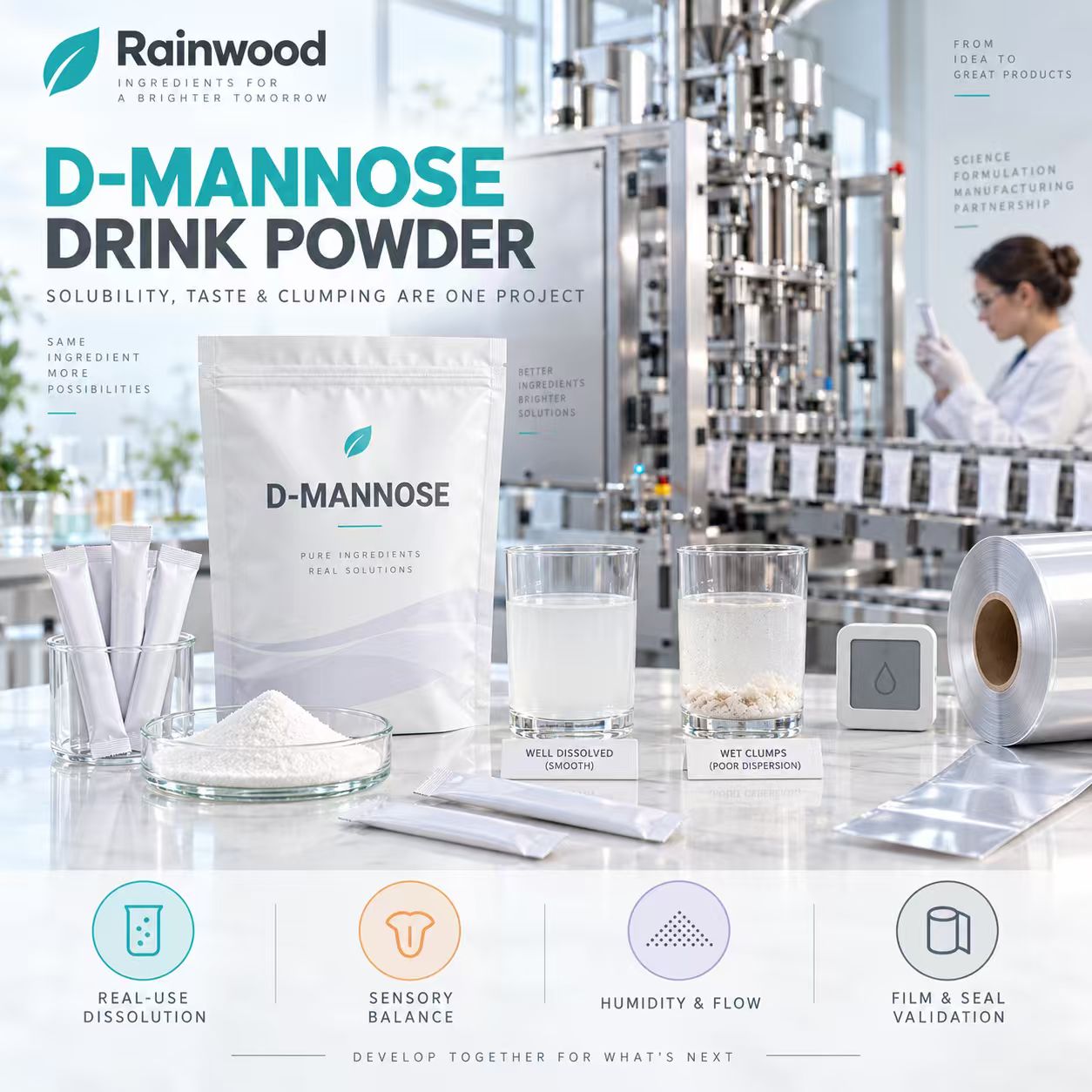
That is a classic drink-powder mistake: treating solubility, taste, moisture, and packaging as separate tasks. In a D-mannose sachet, they are one system. Particle size and density affect wetting. Formula acids and flavors change perception. Humidity changes flow and caking. The film determines whether the powder survives storage.
Use the D-mannose powder specification as the raw-material starting point, then qualify the finished drink powder in its intended serving and package.
A clear solution in the lab does not prove production performance
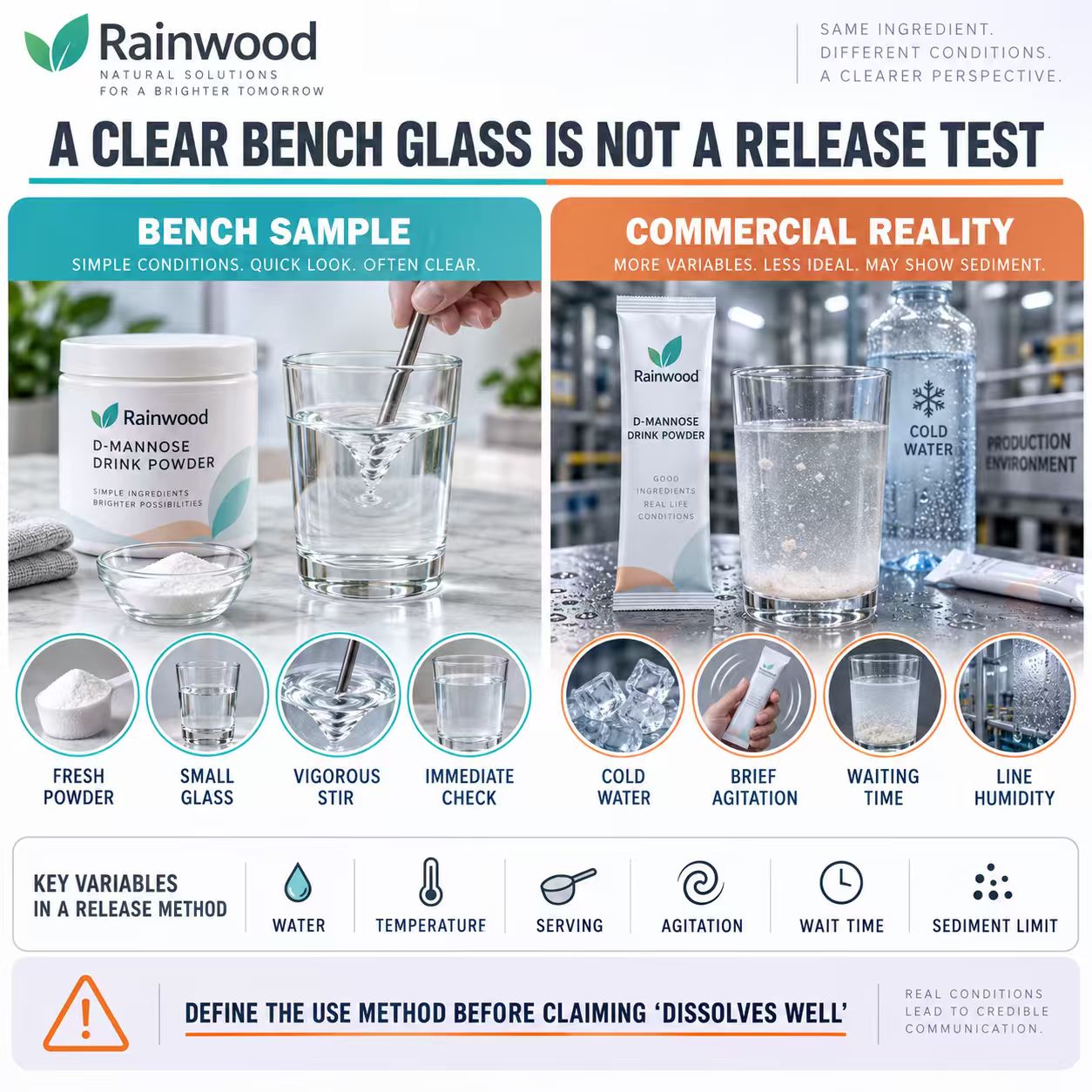
Bench mixing often uses a fresh open container, a small glass, vigorous stirring, and immediate consumption. Commercial users may pour the sachet into cold water, shake briefly, wait, and drink. The line may fill at a different humidity and run a different particle-size distribution.
Record the intended use:
- water volume and temperature;
- powder mass and sachet size;
- stirring, shaking, or no agitation;
- waiting time before consumption;
- acceptable sediment or haze;
- flavor and sweetness at the real dilution.
Test at least three lots or pilot conditions if the launch depends on a smooth consumer experience. A “dissolves well” statement without a test method is not a release criterion.
D-mannose can make the sweetness plan deceptively easy
D-mannose is itself a sugar, so the formula team must model the total sweetness contribution instead of adding flavor and acid first and correcting later. Cranberry, vitamin C, botanical extracts, electrolytes, and natural flavors can add bitterness, acidity, or astringency that shifts the perceived balance.
Use a controlled sensory sheet with:
- sweetness onset and intensity;
- acidity and bitterness;
- aftertaste;
- aroma release;
- mouthfeel and chalkiness;
- sediment perception;
- consumer preparation behavior.
Do not use a high-purity raw-material certificate as proof of acceptable finished taste. Assay and sensory performance answer different questions.
Read the D-mannose and cranberry blend design guide if the drink powder carries urinary-support positioning.
Moisture pickup can change the entire sachet
Powders may pick up moisture during weighing, blending, filling, transport, or repeated opening. The result can be caking, poor flow, fill-weight variation, seal contamination, and a slower dissolve after storage.
Set controls for:
- room humidity during blending and filling;
- powder water or loss-on-drying;
- water activity where relevant;
- particle-size distribution;
- bulk density and flow;
- film water-vapor transmission;
- seal temperature, pressure, and dwell time;
- storage temperature and humidity.
A sachet can protect the powder only if the film, seal, and handling process are matched to the material. “Packed in foil” is not a complete barrier specification.
Clumping is often a formulation and process interaction
Large D-mannose crystals may wet differently from fine acid or flavor particles. A carrier can improve flow but alter dissolution or the label. A hygroscopic companion ingredient can pull moisture into the blend even when the D-mannose itself appears dry.
Ask the formulator to compare:
1. raw D-mannose alone;
2. D-mannose with acids and flavors;
3. the final blend after transport simulation;
4. aged sachets at the proposed storage condition.
Sample from the beginning, middle, and end of a production run. If the blend segregates, a single composite sample can hide a low or high D-mannose portion.
Use the powder flow and moisture verification checklist to define the evidence before release.
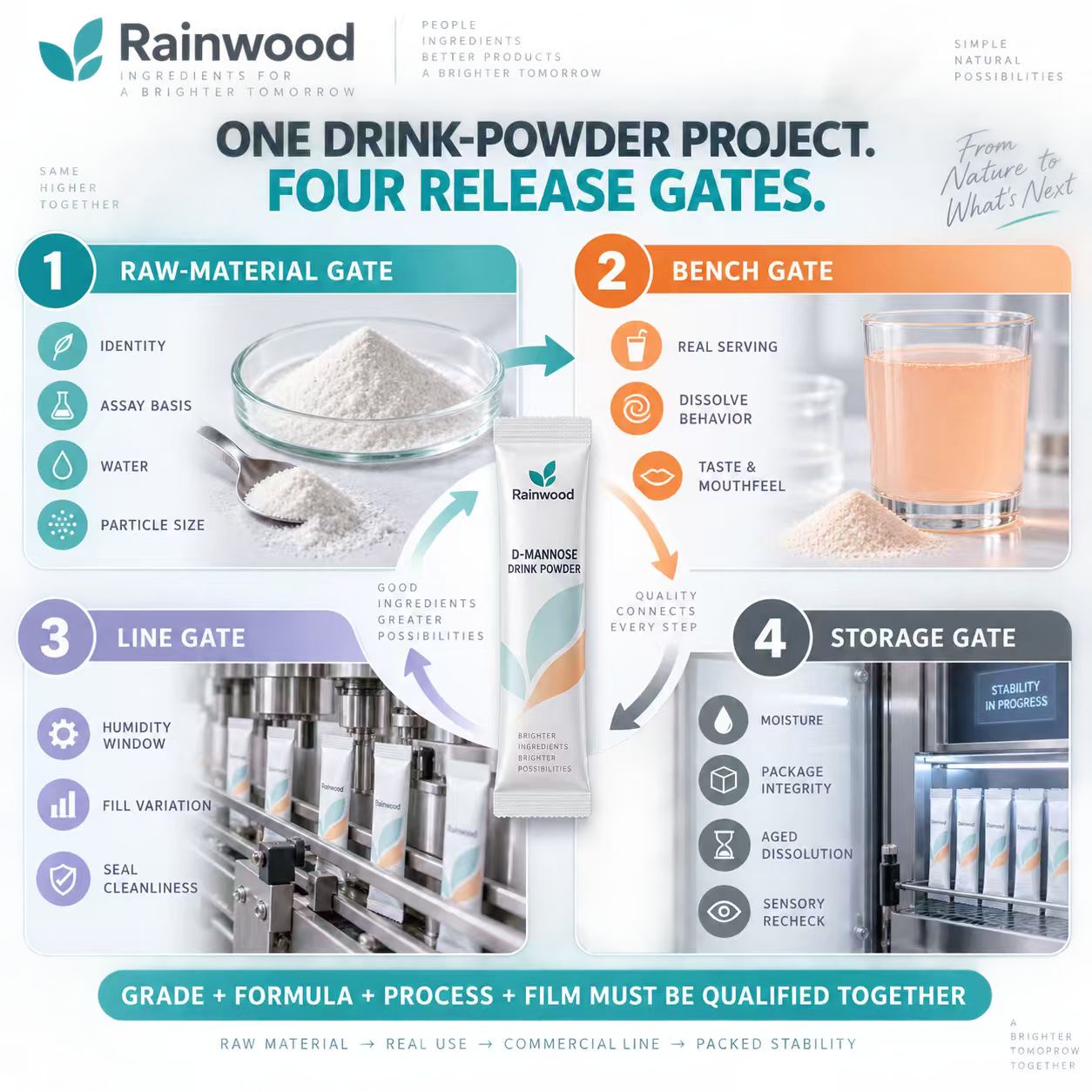
A practical drink-powder pilot
Raw-material gate
Confirm identity, assay basis, water, appearance, lot traceability, and particle-size expectations. If the D-mannose is supplied as a premix, define the active fraction and carrier.
Bench gate
Prepare the exact serving in the intended water volume and temperature. Record dissolve time, visible sediment, sweetness, acidity, and aftertaste.
Line gate
Run the intended filling equipment at a controlled humidity. Measure fill-weight variation, seal defects, dust, and stoppages.
Storage gate
Place packed sachets under intended and justified stress conditions. Recheck flow after opening, dissolve behavior, moisture, package integrity, microbial risk where relevant, and sensory performance.
Explore the D-mannose stick-pack development service when you need the raw-material, filling, and packaging decisions reviewed together.
How RainwoodBio can support the sachet project
RainwoodBio’s website lists powder stick packs or sachets and describes sample development, production control, testing, packaging, logistics, and traceability. These are company-published capabilities. Ask for a project-specific protocol that identifies the film, seal process, humidity window, fill-weight limits, and stability checkpoints for your D-mannose blend.
The supplier should also confirm whether the sample uses the same D-mannose grade, flavor system, and packaging concept planned for commercial production. Use the **D-mannose drink-powder feasibility review** **[INTERNAL LINK -> OEM Service Page]** before approving a large sachet order.
Test preparation instructions like a product feature
The label should tell the user enough to reproduce the tested serving: water volume, preparation method, and whether the powder should be consumed immediately. If the formula needs vigorous shaking or a waiting period, that affects the product promise and the package design.
Ask the pilot team to test realistic misuse as well as the ideal method: cold water, an undersized glass, a delayed drink, and a sachet opened after a humid storage period. The purpose is not to guarantee perfect behavior under every condition. It is to identify which instructions and tolerances are commercially reasonable before the first review arrives.
Document the tested water temperature and sensory panel conditions. “Good taste” means little unless the team knows the dilution, preparation, and comparison sample.
Release gate before printing thousands of sachets
Approve only when:
- the serving dissolves under real consumer instructions;
- sweetness and aftertaste are acceptable at the declared dilution;
- the blend remains free-flowing through the intended filling window;
- sachet seals stay clean and intact;
- storage testing supports the proposed shelf life;
- the finished label matches the actual formula and active amount.
Request a D-mannose drink-powder and sachet review. Send RainwoodBio your formula, serving mass, water volume, target market, package film, annual quantity, and current pilot complaint so the team can propose the right test gates.
Frequently asked questions
1.Does D-mannose need a flavor system in a sachet?
Not always, but the decision should be made at the intended dilution and with the full formula. Companion ingredients can change sweetness, acidity, and aftertaste.
2.Can anti-caking agents solve every clumping problem?
No. Clumping can involve moisture, particle size, packaging, humidity, seal heat, and storage. Any processing aid must also be reviewed for label and market suitability.
3.Is a foil sachet automatically moisture-proof?
No. Film construction, seal quality, pinholes, handling, and storage all affect protection. Validate the actual package.
References
- United States Pharmacopeia, Mannose Monograph: https://doi.org/10.31003/USPNF_M5509_02_01
- RainwoodBio homepage and sachet formats: https://www.rainwoodbio.com/
- RainwoodBio OEM service: https://www.rainwoodbio.com/oem
This article is for B2B procurement and educational purposes. Product, analytical, safety, labeling, and regulatory requirements should be confirmed for the exact ingredient, finished product, and destination market.