 EN
EN

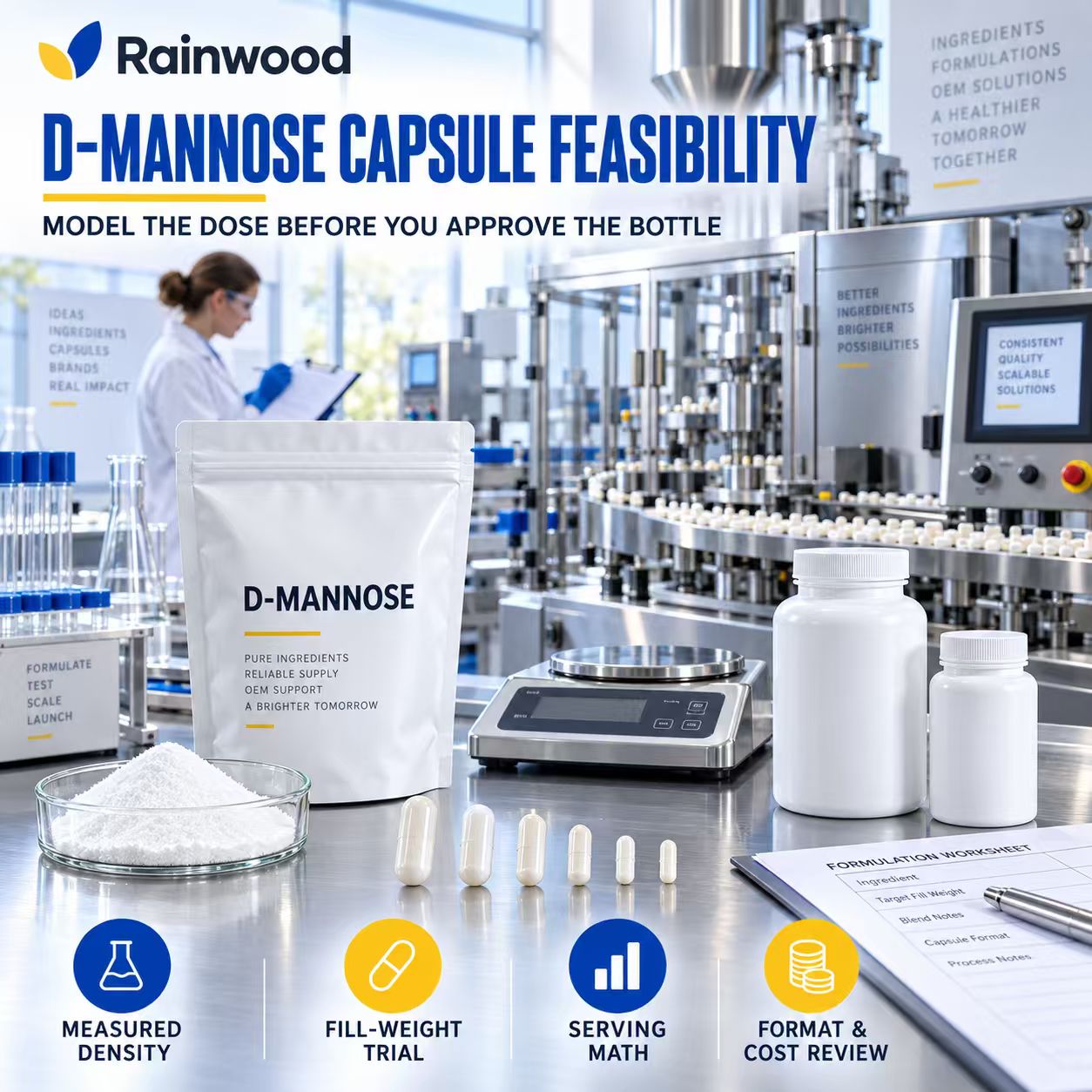
Meta title: D-Mannose Capsule Dose: Check Fill Weight Before Launch
Meta description: High-dose D-mannose can create capsule-count, fill-weight, margin, and label problems. Use a real dose calculation before approving the bottle.
The product team approves a two-capsule serving because the bottle looks clean in the mock-up. The pilot batch needs four capsules. The new serving size raises freight, bottle count, swallowability complaints, and the cost per subscription order.
This is a formulation math problem, not a packaging surprise. D-mannose is often planned at a meaningful gram-level amount, so the active dose must be checked against capsule size, excipient load, powder density, machine capability, and the finished label before the bottle design is approved.
Start with the D-mannose bulk powder specification, then model the entire serving rather than assuming “one capsule equals one dose.”
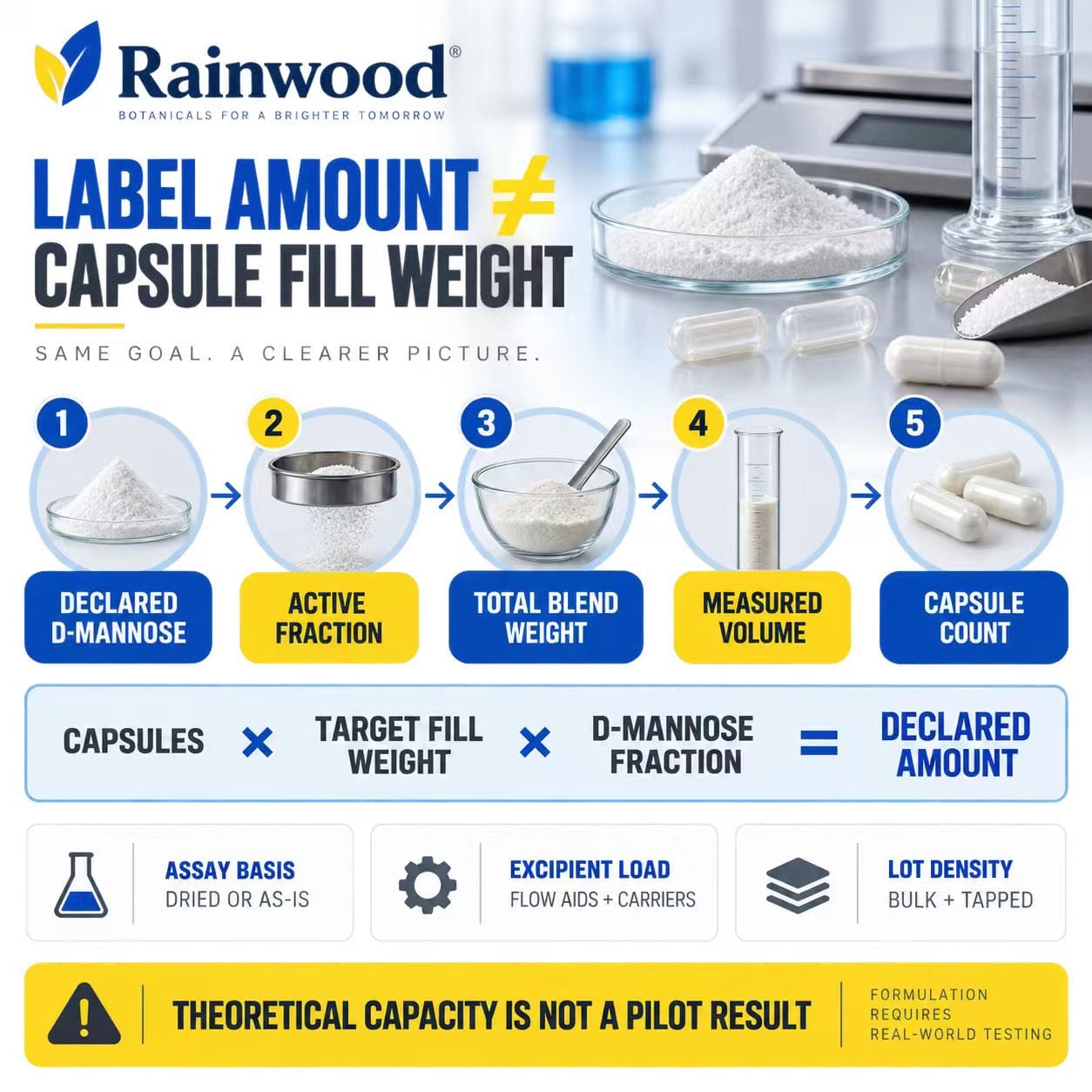
The label amount is not the same as the fill weight
If the label promises a specific amount of D-mannose per serving, the batch must contain enough material to meet that claim within the agreed finished-product specification. The capsule fill weight may be higher because of flow aids, diluents, lubricant, or a carrier premix.
Use this basic calculation:
`number of capsules × target fill weight × D-mannose fraction = declared D-mannose per serving`
Then check whether the fill weight fits the selected capsule size at the measured bulk density. Do not use a theoretical density from a supplier brochure as the final answer. Measure the actual lot or pilot blend.
The powder’s assay basis and moisture also matter. USP’s Mannose monograph defines assay on a dried basis, while your capsule is filled with material as received. Keep those bases visible in the batch record. [USP Mannose Monograph](https://doi.org/10.31003/USPNF_M5509_02_01)
Density changes the commercial plan
Two D-mannose lots with similar assay can occupy different volumes because particle-size distribution, crystal habit, moisture, milling, and handling change bulk and tapped density. A formula that fits in a laboratory capsule may overflow on a high-speed line.
Measure during pilot development:
- bulk density;
- tapped density;
- flow through the intended hopper;
- angle of repose or another agreed flow indicator;
- fill-weight variation;
- capsule-lock and powder retention behavior;
- dust and electrostatic behavior.
These are not claims about the ingredient’s health effect. They are line-control questions that protect the finished product and the launch schedule.
Read the D-mannose powder-flow and batch-control guide before selecting a capsule shell.
A higher capsule count changes more than the bottle
Moving from two capsules to four can change:
- daily swallowability;
- number of servings per bottle;
- bottle size and shipping carton;
- label panel and directions;
- subscription weight and fulfillment fee;
- retail shelf footprint;
- cost of encapsulation and inspection;
- customer expectation of a “convenient” product.
Run the economics using the finished serving, not only the raw material price. Include capsule shells, excipients, labor, line speed, rejects, bottle, label, desiccant, carton, freight, and expected replacement cost.
If a premix is used to improve dosing, include its active fraction and the additional weight in the same calculation. A larger fill may solve one production problem while creating a margin problem.
Do not hide an infeasible dose behind a proprietary blend
If the formula combines D-mannose with cranberry, vitamin C, probiotics, or botanical extracts, the label still needs a clear serving calculation. A proprietary blend may make the panel look shorter, but it does not remove the need to know how much D-mannose reaches the serving.
For a multi-ingredient capsule, confirm:
1. amount of D-mannose per serving;
2. amount per capsule;
3. carrier and excipient contribution;
4. active fraction if a premix is used;
5. overage policy;
6. finished-product assay and uniformity plan.
Read the D-mannose and cranberry formula evidence guide when the capsule is positioned for urinary support.
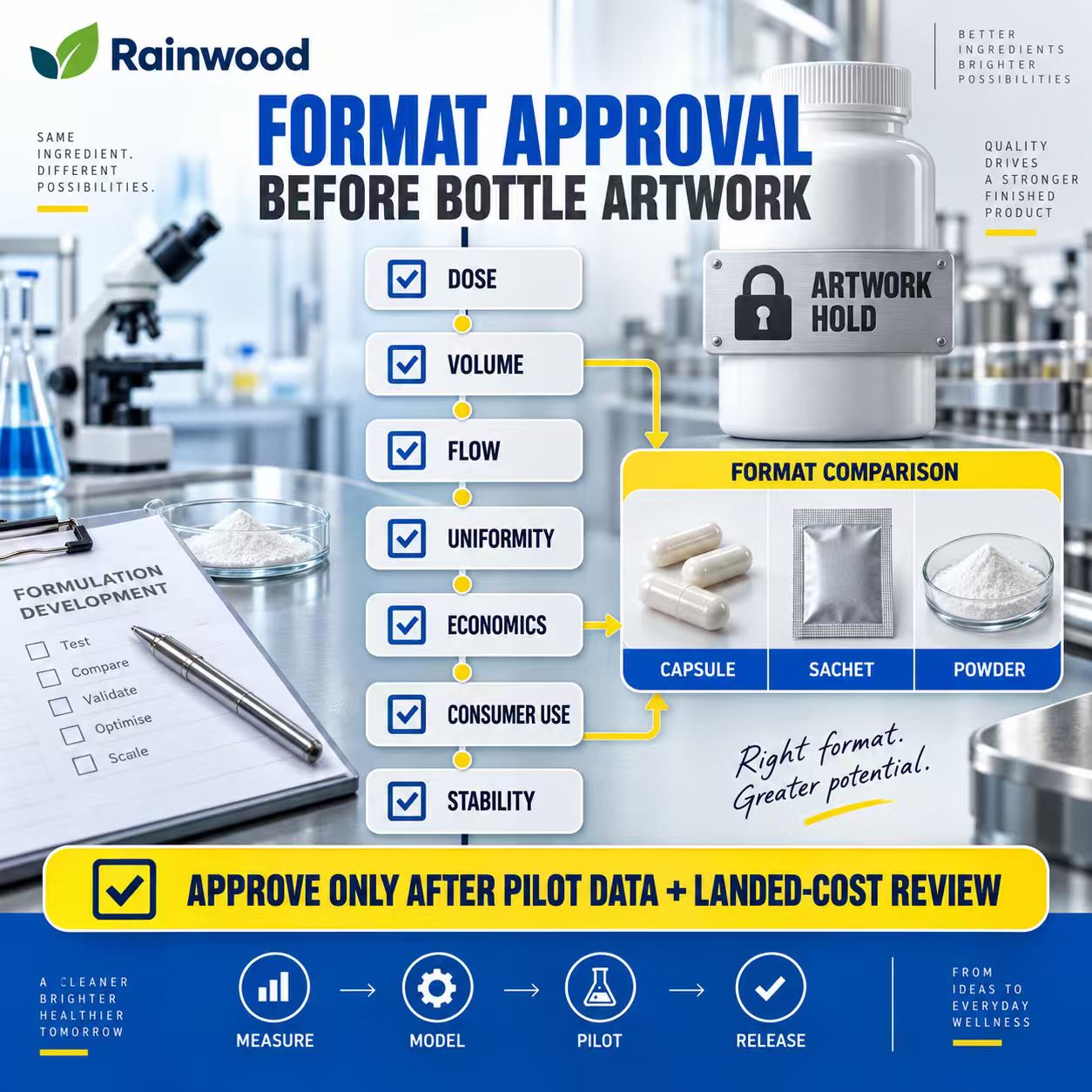
A simple feasibility scorecard
Score the formula before packaging approval:
| Gate | Pass condition | If it fails |
|---|---|---|
| Dose | Declared amount is clear and achievable | Rework serving or formula |
| Volume | Blend fits selected capsule size | Increase capsule count or change format |
| Flow | Hopper and filler stay within tolerance | Adjust process or excipients |
| Uniformity | Sampling plan can detect variation | Validate blending and filling |
| Economics | Finished serving meets target margin | Reprice or redesign |
| Consumer use | Directions are realistic | Test swallowability and adherence |
| Stability | Packaging protects through shelf life | Add barrier or choose another format |
Use the capsule versus sachet feasibility comparison if the dose cannot fit the first bottle concept.
How RainwoodBio can support the format decision
RainwoodBio’s current website describes custom hard capsules, powder stick packs or sachets, tablets, gummies, softgels, and raw powders, along with requirement confirmation, sample development, testing, packaging, and logistics. These capabilities are company-published context. The correct D-mannose format still depends on your measured dose, density, market, and target cost.
Ask for a pilot that compares the same D-mannose specification in two formats, with fill-weight data, serving math, packaging assumptions, and a clear finished-product test plan. Explore the **D-mannose format feasibility review** **[INTERNAL LINK -> OEM Service Page]** before ordering printed bottles.
Model the reorder, not only the launch batch
A capsule plan can look profitable at a small pilot quantity and fail at reorder scale. Add the real serving count to the model: capsules per day, days per bottle, bottles per master carton, pallets per shipment, and expected fulfillment weight. Then test the effect of a one-capsule increase on the label, bottle, freight, subscription price, and customer instructions.
Also define the tolerance for fill-weight drift. If the line must slow down or add an operator to hold the dose, that labor belongs in the commercial model. If a premix is used, include the carrier’s nutrition and label effect rather than treating it as invisible processing material. A decision that survives these calculations is much less likely to be reversed after artwork approval.
Approval gate before bottle artwork
Do not approve the bottle until you have:
- measured bulk and tapped density for the intended lot or pilot blend;
- a capsule-size and fill-weight calculation;
- a finished serving and label review;
- a uniformity and release-testing plan;
- a landed cost using the actual capsule count;
- stability and packaging assumptions;
- a fallback format if the dose does not fit.
Request a D-mannose capsule-dose feasibility review. Send RainwoodBio your target daily amount, capsule size, formula, market, bottle count, and target cost so the team can return a practical format comparison.
Frequently asked questions
1.Can D-mannose be put into one large capsule?
Possibly, but the answer depends on measured density, total serving weight, excipients, machine capability, and the customer’s swallowability expectations. Confirm with a pilot rather than a theoretical calculation.
2.Does a 99% assay guarantee the capsule dose?
No. The finished product must be mixed, filled, sampled, and tested to show that the declared serving is achieved within the agreed limits.
3.Are sachets always better for a gram-level dose?
Not always. Sachets can provide more room for a larger serving, but they introduce dissolution, taste, moisture, fill-weight, and packaging questions that also need validation.
References
- United States Pharmacopeia, Mannose Monograph: https://doi.org/10.31003/USPNF_M5509_02_01
- RainwoodBio homepage and formats: https://www.rainwoodbio.com/
- RainwoodBio OEM service: https://www.rainwoodbio.com/oem
This article is for B2B procurement and educational purposes. Product, analytical, safety, labeling, and regulatory requirements should be confirmed for the exact ingredient, finished product, and destination market.