 EN
EN

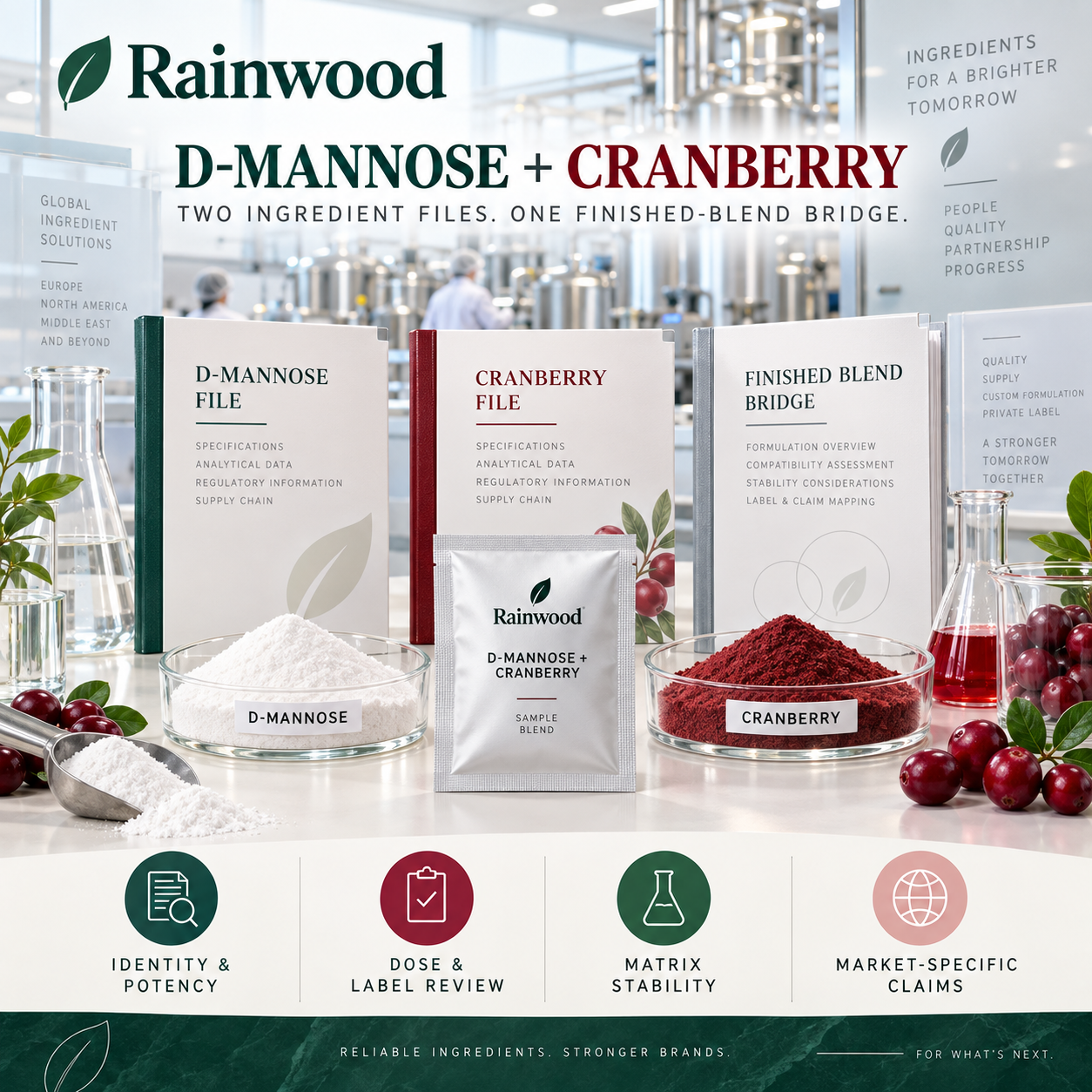
Meta title: D-Mannose and Cranberry: Build Two Evidence Files
Meta description: D-mannose and cranberry are not one interchangeable active. Separate identity, dose, testing, stability, and claim evidence before launch.
The front panel says “D-mannose + cranberry urinary support.” The raw-material file contains one D-mannose COA, one cranberry extract sheet, and a marketing paragraph that treats the blend as if it were a single ingredient.
That shortcut creates two problems. The formula team cannot prove what amount of each active reaches the serving, and the compliance team cannot connect a broad urinary claim to the exact finished product. D-mannose and cranberry may be used together, but they need separate specifications, evidence, and release controls.
Review the D-mannose ingredient information and build the blend around what each component actually is, not around a single attractive front-panel phrase.
D-mannose and cranberry answer different technical questions
D-mannose is a defined sugar. Cranberry materials may be juice powder, fruit powder, extract, or a standardized preparation with a stated marker. “Cranberry” does not specify the same thing as “cranberry extract 36% PACs,” and a D-mannose assay does not prove cranberry potency.
Your formula file should separately record:
- exact ingredient name and form;
- source and manufacturer;
- assay or marker basis;
- serving amount;
- carrier and excipients;
- identity method;
- contaminants and microbiology;
- stability and packaging needs.
Do not let a supplier’s blend COA replace the individual raw-material files unless the finished blend method is validated for both components.
Read the D-mannose identity and COA review before asking the supplier to combine documents.
“Urinary support” is not a universal claim permission
The phrase may be interpreted differently across the United States, European Union, United Kingdom, Canada, and other markets. FDA explains that supplement manufacturers and distributors carry initial responsibility for safety and labeling, and that FDA does not pre-approve supplements before marketing. [FDA dietary supplement Q&A](https://www.fda.gov/food/information-consumers-using-dietary-supplements/questions-and-answers-dietary-supplements)
In the EU, food-supplement safety responsibility also rests with the food business operator placing the product on the market, while national rules can affect substances and claims. [EFSA food supplement overview](https://www.efsa.europa.eu/en/topics/topic/food-supplements)
Treat “urinary support” as a claim-review trigger. Do not upgrade it into treatment, prevention, or cure language. Build a claim-to-evidence table for the exact formula, dose, population, and market.
The dose relationship must be visible
A product can list D-mannose and cranberry on the front while providing an amount that differs materially from the studies, guidance, or internal rationale the marketing team has in mind. A proprietary blend can make that problem harder to detect.
Calculate:
- D-mannose per serving;
- cranberry material per serving;
- marker compound per serving if standardized;
- number of servings per day;
- source of every declared amount;
- overage and end-of-shelf-life target.
Then ask whether each claim is supported by the finished product—not by a different cranberry extract, a different D-mannose dose, or a product with additional ingredients.
Use the D-mannose capsule dose and label-math guide when the blend is high-dose or split across several capsules.
Two ingredients can create one difficult stability problem
Cranberry powders and extracts may bring acids, polyphenols, color, moisture, or carrier materials into contact with D-mannose. The blend can change color, taste, flow, or assay recovery during storage. In a gummy or drink powder, the matrix adds another layer of moisture and process exposure.
The stability plan should monitor, as applicable:
- D-mannose assay;
- cranberry marker or agreed potency measure;
- moisture and water activity;
- color and odor;
- microbial quality;
- package integrity;
- sensory profile;
- relevant degradation or interaction indicators.
Do not conclude that the blend is stable because both raw materials were stable separately. The final matrix is the product customers buy.
The test method must see both actives
Ask the laboratory whether the selected method can distinguish D-mannose from other sugars and quantify the cranberry marker in the presence of flavors, acids, vitamins, or excipients. A method name on a quotation is not evidence of suitability.
Request:
1. sample preparation and extraction details;
2. reference standards;
3. specificity and recovery information;
4. precision and range;
5. matrix suitability;
6. reporting limit and acceptance criteria;
7. finished-product versus raw-material application.
Use the blend testing and stability checklist to keep the analytical package connected to the commercial claim.
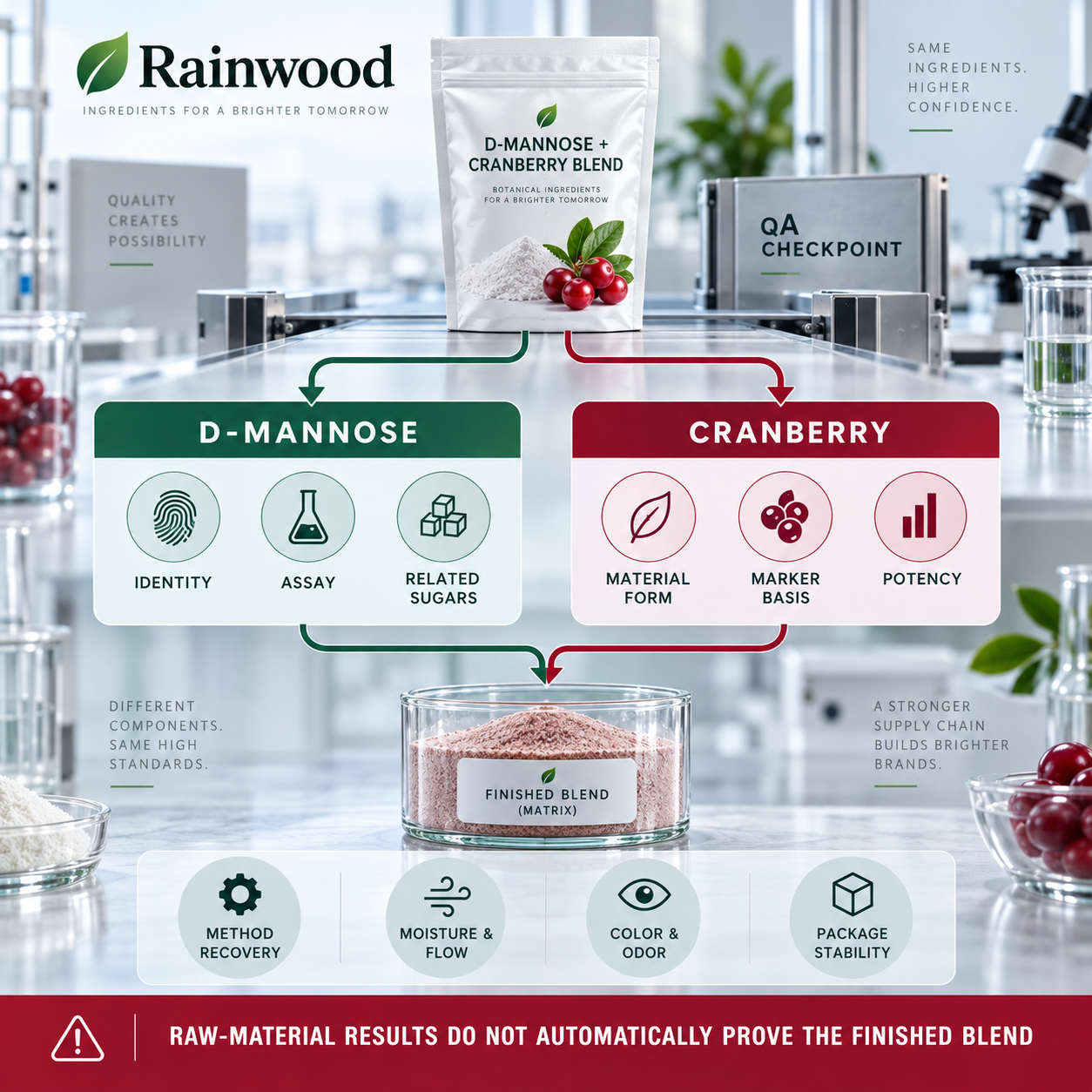
A two-file evidence structure
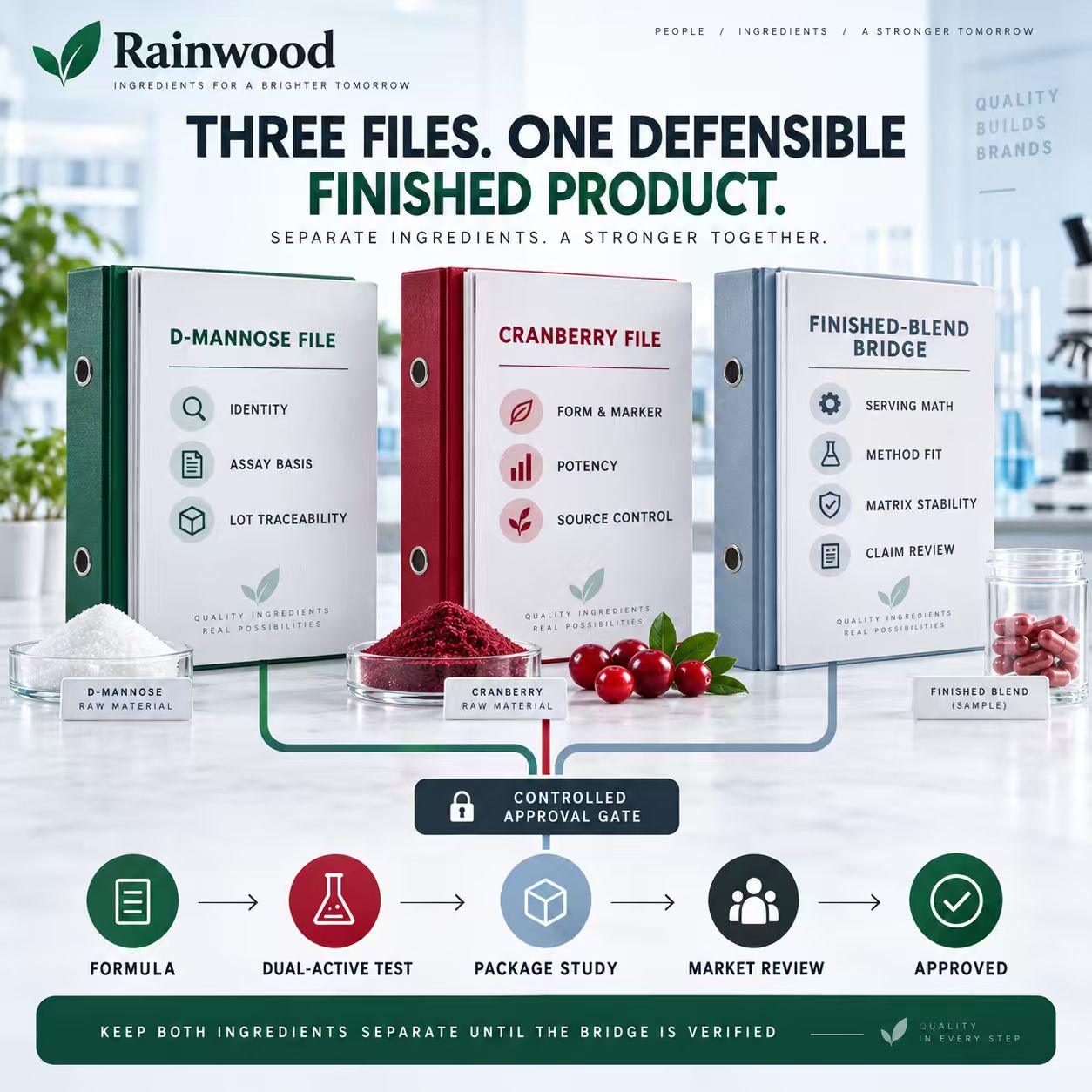
Create one file for each ingredient and one bridge file for the finished blend.
D-mannose file
Identity, assay basis, water, related substances, microbiology, lot traceability, storage, and change control.
Cranberry file
Material form, marker definition, source, extract ratio if used, contaminants, microbiology, stability, and certification.
Finished-blend bridge file
Formula, per-serving amounts, process, sampling, finished potency, label wording, stability, packaging, and market review.
Explore the D-mannose and cranberry private-label development service if you need the three files coordinated before launch.
How RainwoodBio can support the blend
RainwoodBio’s current site describes formula development, multiple dosage forms, testing and release, packaging, documentation, logistics, and traceability. Those capabilities are company-published context. For this blend, ask for a specification and testing plan that keeps D-mannose and cranberry separate until the finished-product method and claim file are approved.
Use the D-mannose urinary-support formula review to compare capsule, sachet, gummy, and powder options without assuming that one format or claim language fits every market.
The blend brief your supplier should receive
Send one controlled brief instead of a loose list of ingredients. State the exact D-mannose form, the cranberry form and marker, amount per serving, number of daily servings, target format, package, market, and proposed wording. Ask the supplier to return the formula as a table showing the amount of every active and carrier before and after processing.
Then ask where each result will be tested: incoming raw material, in-process blend, finished product, or stability pull. This prevents a finished-product claim from being supported only by two unrelated raw-material COAs. It also exposes whether the supplier is quoting a standardized cranberry extract, a fruit powder, or a carrier-heavy material under the same short name.
Keep the brief version-controlled. If the cranberry marker, D-mannose serving, package, or market changes, reopen the evidence review instead of updating only the marketing copy.
Approval gate before the first campaign
Require:
- separate identity and potency evidence for both raw materials;
- a visible per-serving and daily-dose calculation;
- finished-blend testing that can see both ingredients;
- stability data for the actual matrix and package;
- market-specific review of all urinary wording;
- written supplier change-control expectations.
Request a D-mannose and cranberry evidence-file review. Send RainwoodBio your draft formula, COAs, target market, format, daily serving, packaging, and proposed claims so the team can identify gaps before the listing or artwork is finalized.
Frequently asked questions
1.Can one COA cover a D-mannose and cranberry blend?
Only if the certificate represents the finished blend and the methods are suitable for both components. Individual raw-material COAs are still needed for supplier qualification and traceability.
2.Does adding cranberry make a D-mannose claim stronger?
Not automatically. The finished formula, dose, evidence, wording, and market rules must be reviewed together.
3.Can “urinary support” be used globally?
No. Claim treatment differs by jurisdiction and product category. Use a market-specific claim review and avoid disease-treatment language unless the applicable legal pathway allows it.
References
- FDA, Questions and Answers on Dietary Supplements: https://www.fda.gov/food/information-consumers-using-dietary-supplements/questions-and-answers-dietary-supplements
- EFSA, Food Supplements: https://www.efsa.europa.eu/en/topics/topic/food-supplements
- EFSA, Uroval and urinary tract infection claim opinion: https://efsa.onlinelibrary.wiley.com/doi/10.2903/j.efsa.2009.1421
- RainwoodBio OEM service: https://www.rainwoodbio.com/oem
This article is for B2B procurement and educational purposes. Product, analytical, safety, labeling, and regulatory requirements should be confirmed for the exact ingredient, finished product, and destination market.