 EN
EN

Meta title: Your Tagatose COA May Prove Purity—not Identity
Meta description: Learn why a high tagatose assay may not prove D-tagatose identity, and how importers can connect methods, lots, specifications, and release decisions.
The quotation says “D-tagatose, 99%.” The COA says “assay: 99.2%.” Purchasing approves the order.
Then the customs file asks a simple question: what test proved that the material is D-tagatose rather than another sugar with a similar response?
That question matters because tagatose is a rare sugar sold into a market that also contains allulose, fructose, galactose, glucose, lactose, and blended sweeteners. A total assay can show that a large amount of carbohydrate responds under one method. It may not establish the exact stereoisomer, the process-related sugar profile, the commercial grade, or the identity of the lot in your warehouse.
For an importer, contract manufacturer, or private-label brand, the risk is not academic. An identity gap can lead to a rejected shipment, a wrong nutrition calculation, an unsupported “D-tagatose” label, or a finished product that cannot support the marketing story used to justify its price.
Review the RainwoodBio tagatose powder product context before requesting a quotation, but treat the public product description as a starting point. The purchase decision still needs a lot-linked identity and specification package.
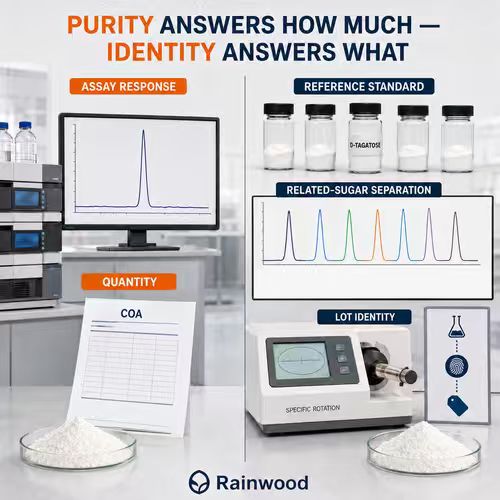
Assay and identity answer different questions
A supplier’s “99%” line normally answers a question such as:
> How much material is measured as tagatose under this assay and calculation basis?
Identity answers a different question:
> Is the measured material the specified D-tagatose structure, in the agreed form, with the expected related-sugar profile?
The European Union’s authorised novel-food entry identifies D-tagatose by chemical name, CAS number, formula, dry-basis assay, loss on drying, specific rotation, melting range, and heavy-metal limits. That structure is useful because it does not reduce qualification to one percentage. [The EUR-Lex D-tagatose specification](https://eur-lex.europa.eu/legal-content/en/ALL/?uri=CELEX%3A32017R2470) shows how identity, purity, physical constants, and contaminants can sit in one release framework.
The FCC monograph also describes D-tagatose as a stereoisomer of D-fructose and links the commercial material to a defined manufacturing route. [The USP Food Chemicals Codex entry](https://doi.usp.org/USPFCC/FCC_F101611_07_01.html) is a reference point, not automatic proof that a supplier’s batch complies with every project requirement.
If a supplier reports only an assay result, ask what the method separates, what reference standard is used, whether the result is as-is or dry basis, and whether related sugars are quantified separately. “HPLC” is an instrument category, not a complete method description.
Why similar sugars create a real procurement problem
Tagatose and allulose share the molecular formula C6H12O6, but they are different sugars with different stereochemical arrangements and different commercial names. A method designed only for a broad carbohydrate response may not resolve the compounds that matter to your purchase.
The problem becomes sharper when the starting material and process are not disclosed. Commercial D-tagatose may be produced from galactose or fructose through different enzymatic or chemical conversions. Each route can create a different process mixture before purification. A supplier may have a perfectly reasonable route, but the buyer still needs to know which route, which specification, and which identity package apply to the offered material.
Read the tagatose versus allulose comparison guide before approving a quote that uses “rare sugar” as the product description.
The COA wording that should stop release
Pause when you see one of these combinations:
- Product name: “D-tagatose”; test: “total sugar by HPLC,” with no resolution information.
- Assay: “99% minimum”; basis: not stated.
- Identification: “retention time conforms,” with no reference standard, chromatogram, or system-suitability result.
- Specific rotation listed in the specification but absent from the lot report.
- A representative COA supplied for a different manufacturer, site, or lot.
- “Food grade” used as a substitute for a defined commercial specification.
- A powder quotation that does not identify whether water, carrier, or blend components are included.
None of these lines automatically proves fraud. They show that the document may not answer the release question. Your quality agreement should define the minimum evidence before the material is accepted, not after a customer challenges the label.
Build a layered identity package
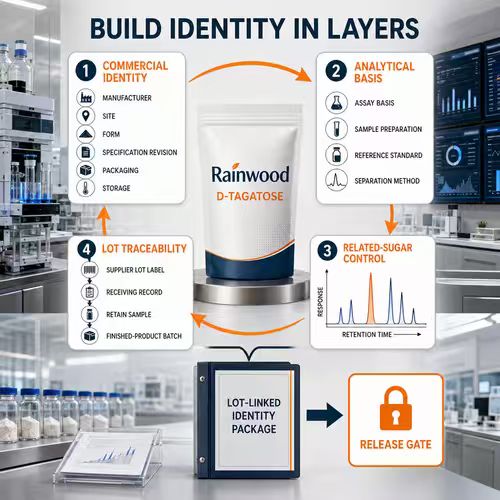
1. Lock the commercial identity
Write the full material description into the purchase order: D-tagatose, grade, form, manufacturer, production site, country of origin, specification revision, packaging, and storage conditions. Give the material one controlled internal code. Do not allow tagatose, allulose, and a “rare sugar blend” to share a stock code.
2. Define the analytical basis
State whether assay and moisture are reported on an as-is or dry-weight basis. A 99% dry-basis result and a 99% as-is result are not the same commercial number. Record the sample preparation, reference standard, detector, column or separation mode, calculation, and acceptance criterion.
3. Ask for related-sugar control
For a product made from lactose, galactose, fructose, or a mixed stream, identify the relevant residual sugars and process-related impurities. A method that measures the main peak but does not resolve galactose, fructose, glucose, lactose, or allulose may be insufficient for the intended claim.
4. Connect the report to the lot
The report should show the manufacturer lot, production date or retest date, sample date, laboratory, method revision, and release status. Tie the supplier lot to the drum labels, receiving record, retain sample, and finished-product batch.
Use the tagatose specification and sampling checklist to make the chain visible to purchasing, QA, and production.
Why a supplier chromatogram is not enough
A chromatogram can be useful evidence, but only when the buyer understands what it proves. A clean-looking image without axes, standards, method conditions, resolution data, integration rules, or lot identification is a presentation image—not a release record.
Ask:
- Does the method separate the relevant sugars under the stated conditions?
- Is the reference standard traceable and suitable for D-tagatose?
- Are the peaks assigned by standard, retention time, spectral data, or another justified approach?
- Does the sample preparation match the powder or syrup actually shipped?
- Are the result, chromatogram, and COA tied to the same lot?
- What happens if the result falls outside the agreed range?
If you are making a premium rare-sugar claim, consider whether the finished product requires a verification step. Raw-material identity can be weakened by an unapproved substitution, a blend change, or a formulation that uses only a small amount of the named ingredient.
How RainwoodBio can support the qualification step
RainwoodBio’s public tagatose page presents a food-grade tagatose powder specification and lists general company-published product information. That page does not, by itself, prove a particular lot, test method, manufacturer, or destination-market authorization.
For a real project, ask RainwoodBio to confirm the exact source and available evidence for your quotation:
- manufacturer and site for the proposed tagatose;
- current specification and representative COA;
- identity, assay, moisture, ash, heavy-metal, microbiological, and related-sugar methods;
- lot sampling and retain-sample arrangements;
- change-notification and replacement conditions;
- finished-product testing needed for your label and market.
This is where sample-to-bulk verification support can turn a generic ingredient inquiry into a controlled procurement project.
The purchase-order release gate
Before paying a deposit, require written agreement on:
1. The exact chemical and commercial identity.
2. The dry-basis or as-is calculation basis.
3. The identity method and related-sugar control.
4. The lot-specific documents delivered with each shipment.
5. Sampling, retest, deviation, and rejection procedures.
6. Change notification for source, process, site, or specification.
7. The finished-product evidence needed for the customer-facing claim.
Request a tagatose COA and identity-gap review. Send RainwoodBio the current COA, specification, supplier quote, target market, format, label wording, quantity, and launch date so the team can identify missing proof before the material enters production.
Frequently asked questions
1.Does a 99% assay prove that the powder is D-tagatose?
No. It proves the reported response under the stated assay method. Identity, stereochemistry, related sugars, moisture basis, and lot traceability require additional evidence when they matter to the purchase.
2.Is a specific-rotation result enough?
It can contribute to identity when the concentration, solvent, temperature, instrument, reference range, and material form are controlled. It should not automatically replace a fit-for-purpose chromatographic or compendial identity package.
3.Can a supplier use one COA for every shipment?
Only if the agreement clearly defines what is representative and what lot-specific release documents are required. A historical or representative COA is not proof of the material currently in your warehouse.
References
- European Union D-tagatose specification and labelling conditions: https://eur-lex.europa.eu/legal-content/en/ALL/?uri=CELEX:32017R2470
- USP Food Chemicals Codex, d-Tagatose: https://doi.usp.org/USPFCC/FCC_F101611_07_01.html
- FAO/JECFA D-Tagatose specification: https://www.fao.org/food/food-safety-quality/scientific-advice/jecfa/jecfa-additives/detail/en/c/449/
- RainwoodBio tagatose powder page: https://www.rainwoodbio.com/ja/custom-tagatose-powder
This article is for international B2B procurement and educational purposes. Identity, assay, specifications, analytical methods, batch evidence, finished-product testing, labelling, and regulatory requirements must be confirmed for the exact material, formula, and destination market.