 EN
EN

Meta title: Tagatose vs Allulose: The Ingredient Difference Buyers Miss
Meta description: Compare tagatose and allulose by identity, sourcing, sweetness, label evidence, formulation behavior, and procurement controls before choosing a rare sugar.
The buyer asks for “a rare sugar with the same low-calorie story as allulose.” The supplier answers with a tagatose quote. The formula team assumes the two ingredients can be swapped.
That shortcut can create a launch problem.
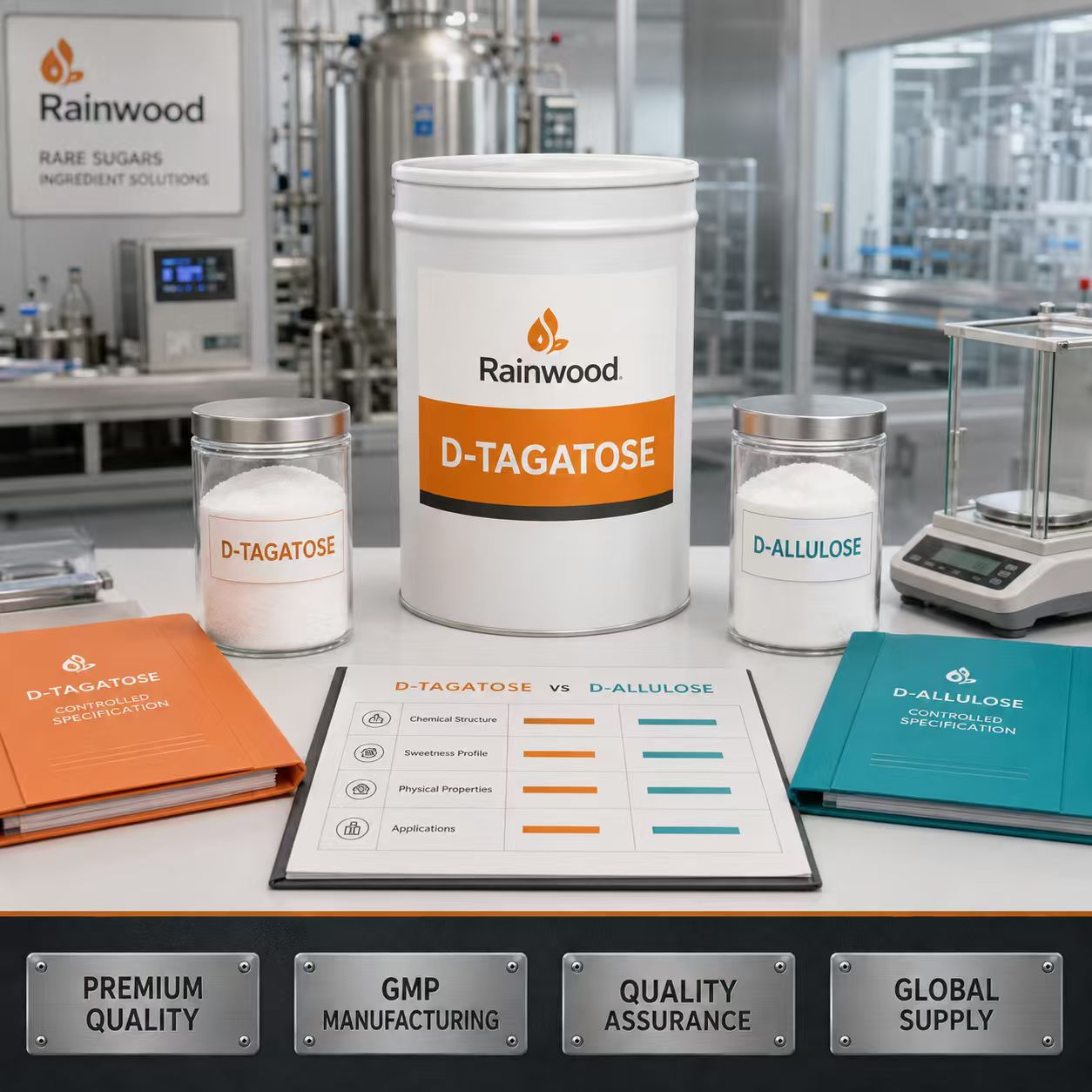
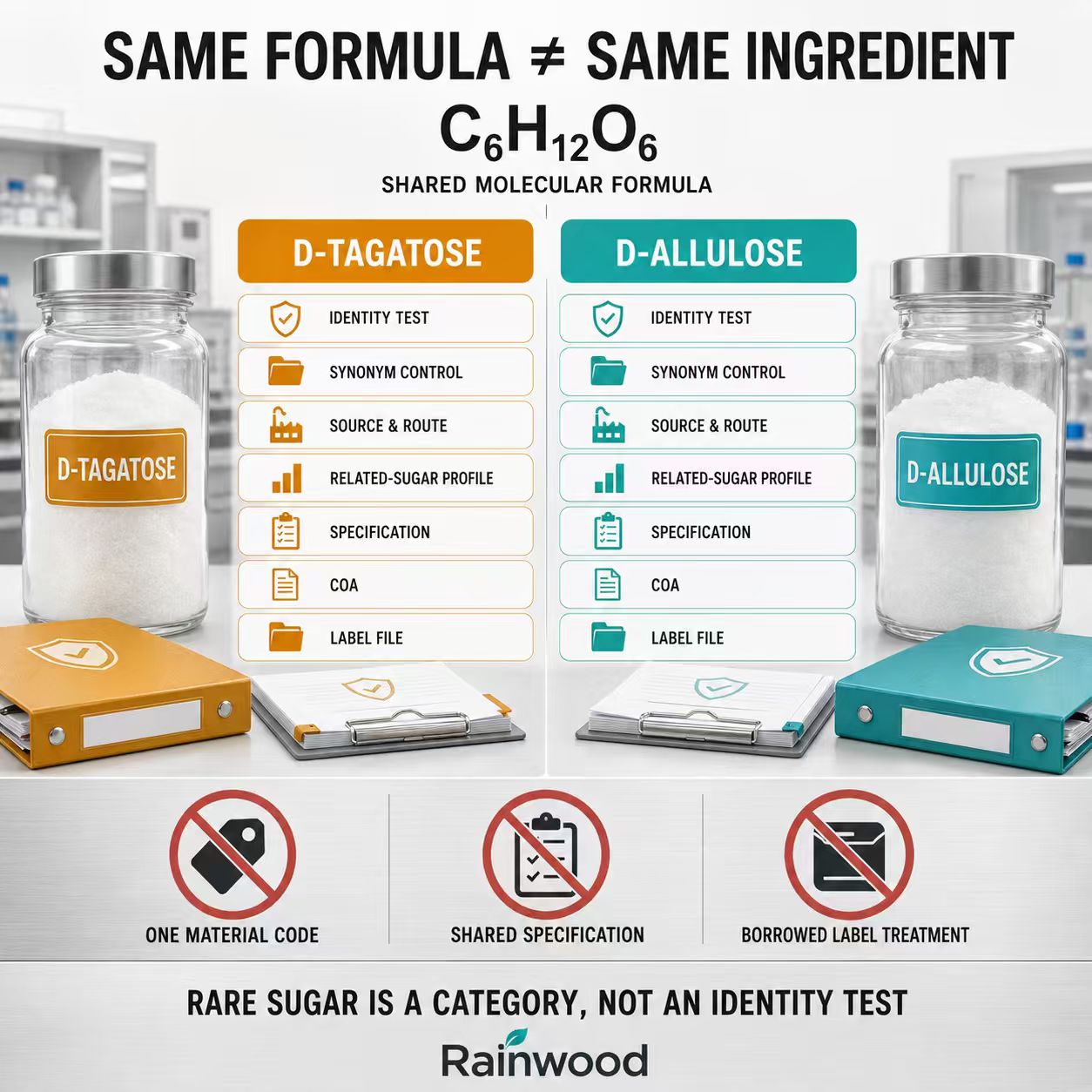
Tagatose and allulose are related rare sugars, but they are not the same ingredient. Both have the molecular formula C6H12O6, yet their stereochemical structures, manufacturing routes, analytical controls, regulatory files, sensory profiles, and formulation behavior can differ. A supplier who treats them as interchangeable may be simplifying the conversation; a buyer who accepts the simplification may be accepting the risk.
For brand owners, importers, and OEM formulators, the decision is not “which rare sugar sounds trendier?” It is “which exact material can deliver the intended sweetness, texture, label, cost, evidence, and market access in the finished product?”
Start with the RainwoodBio tagatose powder information, then compare the proposed material against the formula and destination market rather than approving it by category name.
Same formula, different structure
Allulose is also known as D-psicose. PubChem identifies D-psicose as a C6H12O6 sugar and lists D-allulose as a synonym. [PubChem’s D-psicose record](https://pubchem.ncbi.nlm.nih.gov/compound/Allulose) is useful for confirming the naming relationship, but a chemical formula alone cannot identify a commercial lot.
D-tagatose is a different stereoisomer. The FCC describes it as a stereoisomer of D-fructose, and the EU specification identifies D-tagatose by its own chemical name, CAS number, assay basis, specific rotation, and melting range. [The USP FCC tagatose entry](https://doi.usp.org/USPFCC/FCC_F101611_07_01.html) and [the EU specification](https://eur-lex.europa.eu/legal-content/en/ALL/?uri=CELEX%3A32017R2470) show why the two names should not share one uncontrolled ingredient code.
If a quotation says “tagatose/allulose alternative,” ask the supplier to separate the materials, specifications, COAs, labels, and prices. “Rare sugar” is a category description, not an identity test.
The sourcing route changes the evidence file
Commercial D-tagatose can be produced by converting galactose or fructose through chemical or enzymatic processes. Allulose is commonly produced through enzymatic conversion of fructose. The route affects the starting material, process aids, expected related sugars, purification steps, allergen questions, and the documents a buyer should request.
A route is not automatically good or bad. It is a control point. If your buyer needs dairy-free positioning, a lactose-derived tagatose route may require a different allergen and source review from a route using another feedstock. If the supplier changes from a galactose route to a fructose route, the identity remains a question of specification and evidence, not marketing vocabulary.
Read the tagatose COA identity guide before allowing an “allulose equivalent” statement into a purchase order.
Sweetness is not a swap instruction
Suppliers often describe both ingredients as close to sucrose in sweetness. That does not mean a gram-for-gram replacement will preserve the finished product. Perceived sweetness depends on concentration, temperature, pH, food matrix, particle size, co-sweeteners, and the timing of the taste response.
In a beverage, the replacement changes solids, osmotic pressure, mouthfeel, acid balance, and flavor release. In a gummy, it can change the solids profile, heating response, gel strength, and browning. In a dry stick pack, it can change bulk density, flow, dust, and fill weight.
The formula team should run a controlled sensory and process comparison, not just a spreadsheet substitution. Use the 1:1 sugar-replacement calculation guide to document the test basis and decision.
Label and regulatory files are not interchangeable
In the United States, FDA states that D-tagatose must be declared as an added sugar on the Nutrition Facts label, while the agency has described enforcement discretion around using 1.5 kcal/g for the calorie contribution in a specific petition context. [FDA’s 2023 D-tagatose labeling update](https://www.fda.gov/food/hfp-constituent-updates/fda-issues-supplemental-response-labeling-d-tagatose-nutrition-facts-label) does not create a blanket rule for every sugar or every market.
Allulose has its own U.S. labeling history and evidence file. A brand cannot borrow the allulose label treatment simply because the formula uses tagatose. The finished product, serving size, ingredient declaration, nutrition panel, claim wording, and jurisdiction all matter.
The EU’s D-tagatose entry requires the designation “D-Tagatose” and includes a warning condition for products above 15 g per serving and beverages above 1% as consumed. That is a different control question from a U.S. Nutrition Facts decision. Confirm the target market before approving artwork.
The sensory and process comparison buyers should run
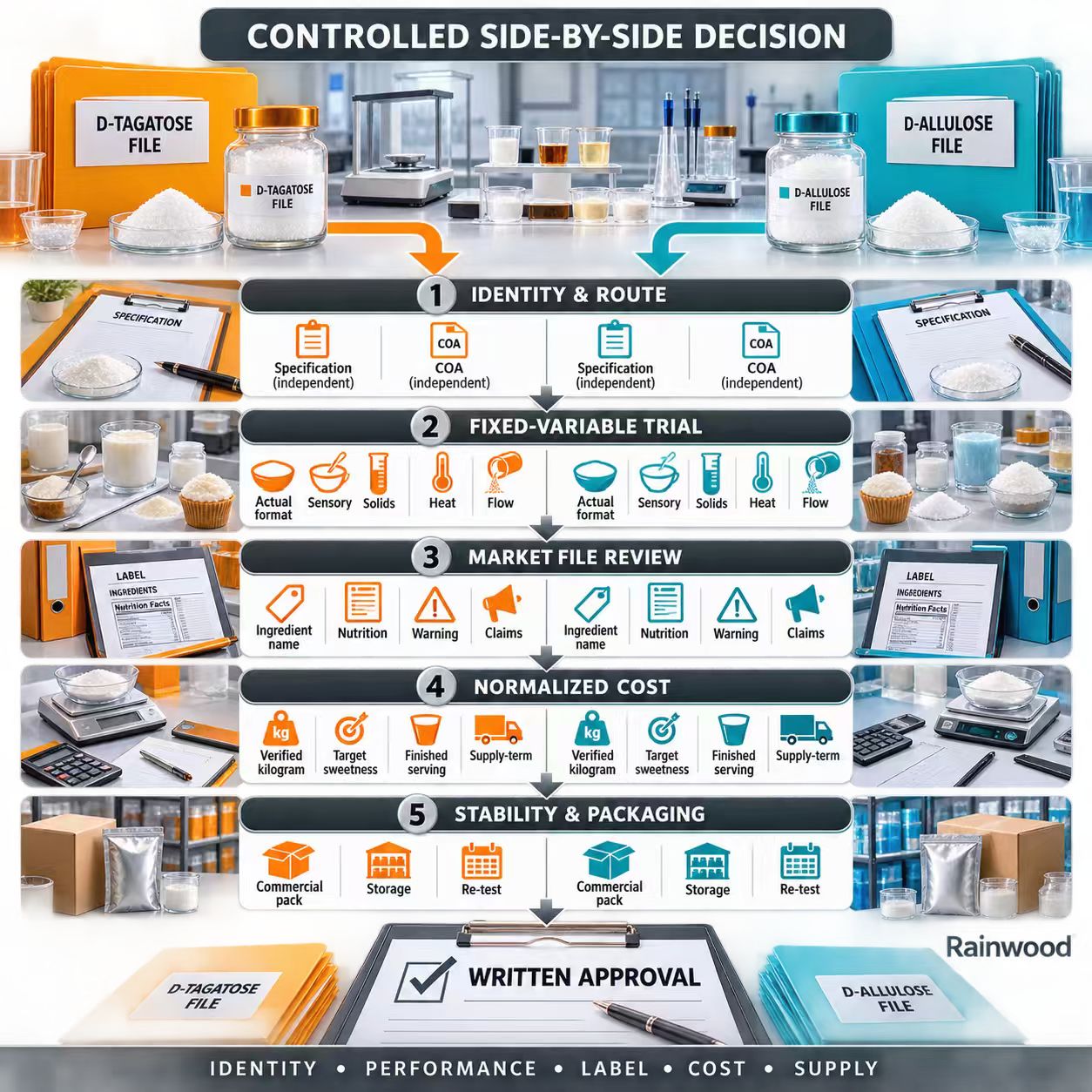
Use a side-by-side trial with the intended format and fixed variables:
| Test area | Tagatose question | Allulose question |
|---|---|---|
| Identity | Does the lot match D-tagatose? | Does the lot match D-allulose? |
| Sweetness | What concentration delivers the target profile? | What concentration delivers the target profile? |
| Flavor | Is there a clean profile or a process note? | Does the product need masking? |
| Solids | What is the as-is and dry-basis contribution? | What is the as-is and dry-basis contribution? |
| Heat | Does browning or caramelization change the process? | Does the selected heat profile change color or flavor? |
| Flow | Does the powder bridge, dust, or segregate? | Does the powder behave the same in the blend? |
| Label | Which name and nutrition treatment apply? | Which name and nutrition treatment apply? |
Do not let a supplier’s sensory sample answer the commercial-batch question. Lock the physical specification, packaging, storage, and re-test plan.
A hidden cost appears when teams compare price per kilogram
Tagatose may be priced differently from allulose because the source, conversion yield, purification burden, production scale, market authorization, and supply continuity differ. A cheaper kilogram may deliver a different sweetness contribution, a different moisture level, or a different usable solids cost.
Normalize the quote using:
- cost per verified kilogram of active ingredient;
- cost per target sweetness unit;
- cost per finished serving;
- rejected or reworked batch exposure;
- documentation and testing included;
- lead time, MOQ, and storage requirements;
- change-control and replacement obligations.
Ask the supplier to show whether the offer is pure powder, a syrup on an as-is basis, or a blend. Use the two-quotation normalization checklist before selecting the apparent low price.
How RainwoodBio can support a side-by-side decision
RainwoodBio’s public materials show tagatose powder as a food-grade ingredient and describe OEM formats such as powders, gummies, and other private-label products. These pages are company-published context; they do not prove that tagatose and allulose have identical availability, specifications, or evidence in a specific project.
For a comparison project, ask RainwoodBio to provide:
- separate product identities and current specifications;
- source and manufacturing-route information available for each option;
- representative COAs and physical-property data;
- sample quantities for a controlled sensory and processing trial;
- format-specific feasibility feedback;
- label and target-market questions to resolve before artwork.
Use the format feasibility comparison service to test the ingredient in the real product, not just in a quotation table.
The approval gate for rare-sugar substitution
Before substituting tagatose for allulose, require written sign-off on:
1. Exact chemical identity and synonym control.
2. Feedstock, process, allergen, and source requirements.
3. Assay, moisture, related sugars, and contaminant limits.
4. Sweetness, solids, sensory, and process comparison.
5. Nutrition and ingredient-label treatment in the destination market.
6. Finished-product stability and packaging requirements.
7. Price per verified serving and supply-continuity terms.
Request a tagatose-versus-allulose substitution review. Send RainwoodBio the current formula, target sweetness, format, serving size, market, competitor benchmark, quantity, and existing supplier documents so the team can return a practical comparison instead of a category-level recommendation.
Frequently asked questions
1.Can tagatose and allulose share one product specification?
No. They are different compounds. Each should have its own identity, assay, related-sugar, physical, contaminant, label, and release requirements.
2.Is one ingredient always better than the other?
No. The better choice depends on the format, sensory target, label rules, supply route, evidence, cost, and buyer market. A controlled application trial is more useful than a generic ranking.
3.Can a finished-product study on allulose support a tagatose claim?
Not automatically. Match the study material, dose, formula, population, endpoint, and jurisdiction to the exact claim and finished product.
References
- PubChem D-psicose/D-allulose: https://pubchem.ncbi.nlm.nih.gov/compound/Allulose
- USP Food Chemicals Codex, d-Tagatose: https://doi.usp.org/USPFCC/FCC_F101611_07_01.html
- EU Regulation 2017/2470 D-tagatose entry: https://eur-lex.europa.eu/legal-content/en/ALL/?uri=CELEX:32017R2470
- FDA D-tagatose Nutrition Facts update: https://www.fda.gov/food/hfp-constituent-updates/fda-issues-supplemental-response-labeling-d-tagatose-nutrition-facts-label
- RainwoodBio tagatose powder page: https://www.rainwoodbio.com/ja/custom-tagatose-powder
This article is for international B2B procurement and educational purposes. Ingredient identity, formulation performance, nutrition labelling, claims, and regulatory status must be confirmed for the exact material, finished product, and destination market.