 EN
EN

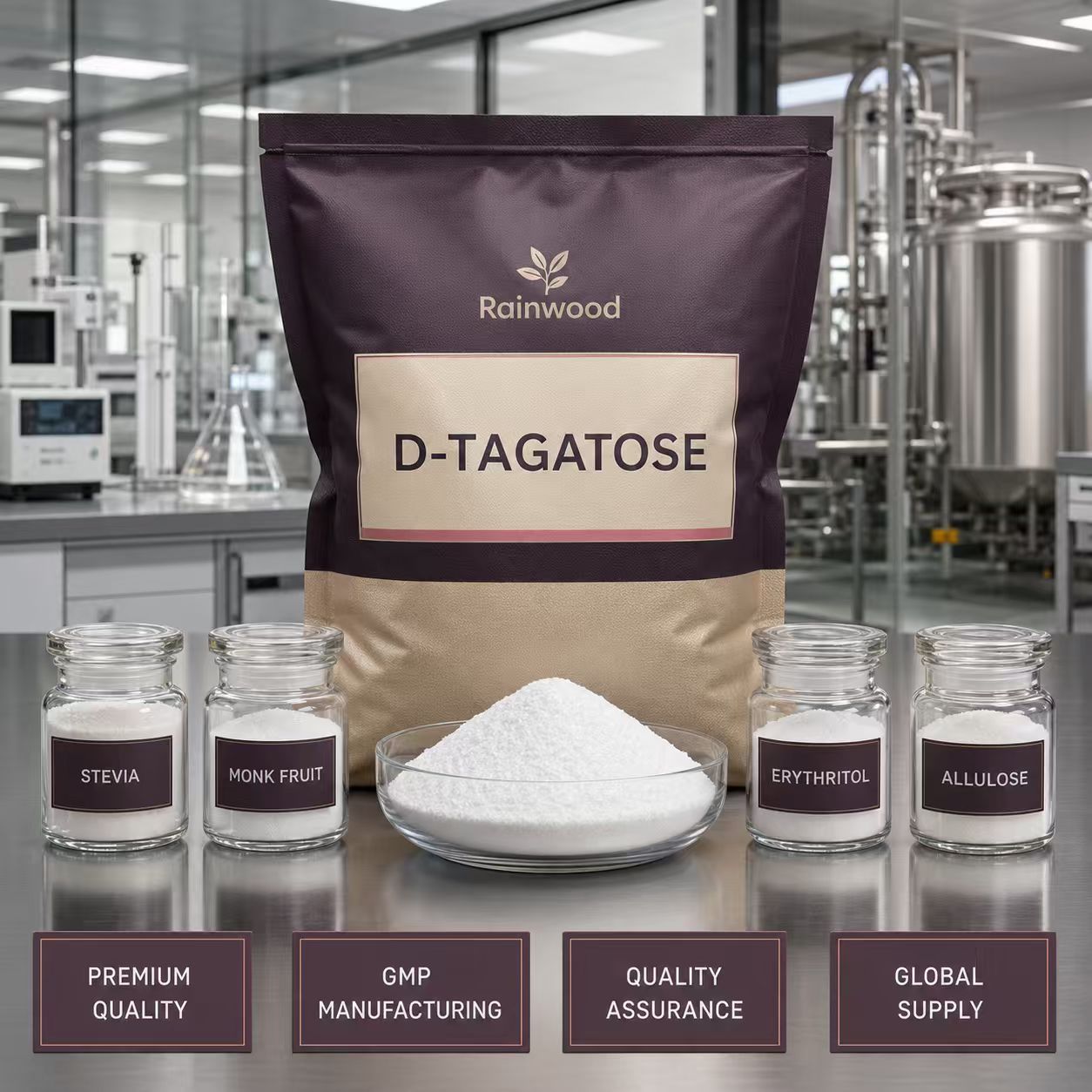
Meta title: Tagatose Blends: Stevia, Monk Fruit, Erythritol, or Allulose?
Meta description: Compare tagatose blends by sweetness curve, aftertaste, solids, label math, segregation, cost, and evidence before choosing a commercial formula.
The product brief says “a clean-label rare-sugar blend with no aftertaste.” The supplier adds stevia, monk fruit, erythritol, and allulose to make the sweetness work. The sample tastes good.
Then the label team asks for the exact ratio, the purchasing team asks for cost per serving, and QA asks whether the blend is uniform after shipping.
That is when the word “blend” becomes a real procurement decision.
Tagatose can be paired with high-intensity sweeteners, polyols, or other rare sugars to tune sweetness, reduce cost, improve texture, or mask an aftertaste. But every additional component changes the evidence file: taste timing, bulk, flow, moisture, calorie calculation, claims, tolerability, and regulatory review.
Use the RainwoodBio tagatose powder context, then qualify the exact ratio and finished format instead of buying a marketing concept called “rare sugar blend.”
Why a blend can work—and still be hard to defend
Each sweetener contributes differently:
- Tagatose contributes bulk sweetness and a rare-sugar positioning.
- Steviol glycosides can provide intense sweetness but may bring bitterness, licorice, or delayed onset.
- Monk fruit extracts can change flavor balance and cost depending on mogroside standardization.
- Erythritol contributes bulk, cooling, crystallization, and polyol-related tolerance considerations.
- Allulose changes the rare-sugar profile, solids, label treatment, and formula economics.
The combination may be technically useful. The problem begins when the supplier does not disclose the ratio, grade, carrier, or standardization and the brand still wants a single clean claim.
Read the tagatose versus allulose identity guide before treating all rare sugars as one interchangeable family.
Sweetness curves are not additive in a simple way
Sweetness perception depends on concentration and time. A high-intensity sweetener may arrive quickly and fade slowly; tagatose may provide a different body and onset. Erythritol can create cooling, while acids and flavors alter the perceived balance.
Do not calculate the blend by adding brochure sweetness percentages. Run a controlled sensory design:
1. Set the reference sucrose or current product.
2. Test tagatose alone at the intended solids level.
3. Add one co-sweetener at a time.
4. Test the full blend in the final matrix.
5. Record onset, peak, duration, aftertaste, cooling, acidity, and flavor compatibility.
6. Test after storage, not only on day one.
The right blend is the one that meets the agreed sensory and label target with a repeatable specification, not the one with the most attractive ingredient list.
The ratio must be controlled like an identity
A blend quotation should state:
- exact component names and grades;
- percentage or weight ratio with tolerance;
- tagatose assay basis;
- stevia or monk-fruit standardization;
- erythritol or allulose content;
- carrier, anti-caking agent, or processing aid;
- mixing order and homogeneity method;
- particle-size and density compatibility;
- packaging and segregation controls.
If the formula is 80% tagatose and 20% erythritol, a lot at 75/25 may taste and label differently even if “blend assay” passes. Ratio tolerance belongs in the release specification.
Use the tagatose form and dry-basis calculation guide before accepting a total-blend purity number.
Physical segregation can destroy the intended formula
Different particles can separate during blending, filling, vibration, and transport. Density, size, shape, surface texture, and electrostatic behavior all matter. A small sample collected from the top of a bag may not represent the bottom.
For a dry blend, test:
- homogeneity at multiple sampling locations;
- segregation after vibration or transport simulation;
- bulk and tapped density;
- flow through the intended equipment;
- moisture and caking after storage;
- fill-weight and active distribution.
For a liquid or syrup blend, test concentration, viscosity, phase stability, pH, and crystallization. Do not use a powder blend COA for a syrup product.
Read the sample-to-bulk powder-flow checklist when the blend will be packed into stick packs, sachets, or tabletop containers.
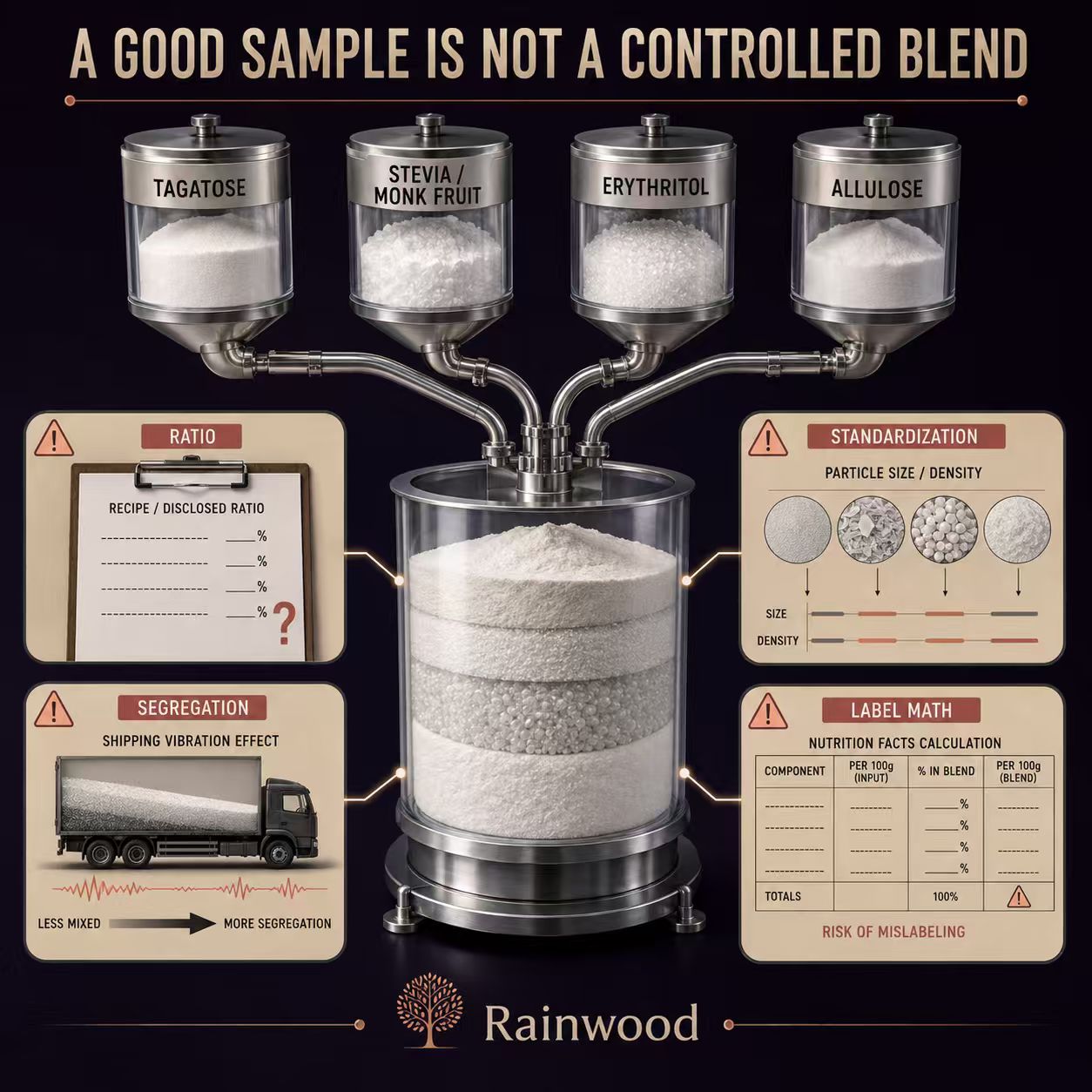
Label and tolerance review must include every component
FDA’s D-tagatose update says D-tagatose must be declared as an added sugar on the U.S. Nutrition Facts label and discusses calorie treatment in a specific context. [FDA’s update](https://www.fda.gov/food/hfp-constituent-updates/fda-issues-supplemental-response-labeling-d-tagatose-nutrition-facts-label) does not answer the label treatment for every co-sweetener or blend.
The EU D-tagatose entry specifies the ingredient name and includes a warning condition above 15 g per serving and above 1% in beverages as consumed. [The EU regulation](https://eur-lex.europa.eu/legal-content/en/ALL/?uri=CELEX%3A32017R2470) must be considered with the complete blend and serving size.
Erythritol and other polyols may have their own labeling and tolerance rules. Stevia and monk fruit may require extract standardization and market-specific status checks. A blend cannot borrow the most favorable rule from each ingredient.
Evidence for one component is not evidence for the blend
A study on pure tagatose does not automatically support a claim for tagatose plus erythritol, stevia, and allulose. The finished blend may have a different dose, matrix, sensory profile, tolerance, and consumer response.
Build the evidence chain:
| Layer | Question |
|---|---|
| Ingredient | What exact tagatose and co-sweetener grades are used? |
| Ratio | Is the blend controlled within a defined tolerance? |
| Serving | How much of each component does the consumer receive? |
| Matrix | Is the evidence from the same gummy, drink, powder, or bar? |
| Population | Does the tested group match the intended claim? |
| Endpoint | Was the outcome sensory, glycemic, tolerance, or another measure? |
| Market | Is the wording accepted in the destination country? |
Use the tagatose claim and evidence-gap review before putting “prebiotic,” “low glycemic,” or disease-adjacent language on a blend.
How RainwoodBio can support blend development
RainwoodBio’s public OEM materials describe custom formulation and multiple formats. They are company-published context, not proof that every proposed blend, extract standardization, or claim is available or authorized. Ask for a project-specific formula, sample, specification, and market review.
Useful outputs include:
- sensory comparison against the benchmark;
- blend ratio and homogeneity specification;
- active and label calculation;
- powder-flow or beverage-stability trial;
- packaging and storage recommendation;
- MOQ, cost-per-serving, and lead-time estimate;
- change-control and replacement terms.
Use the custom tagatose blend feasibility assessment to keep the ingredient story connected to the production reality.
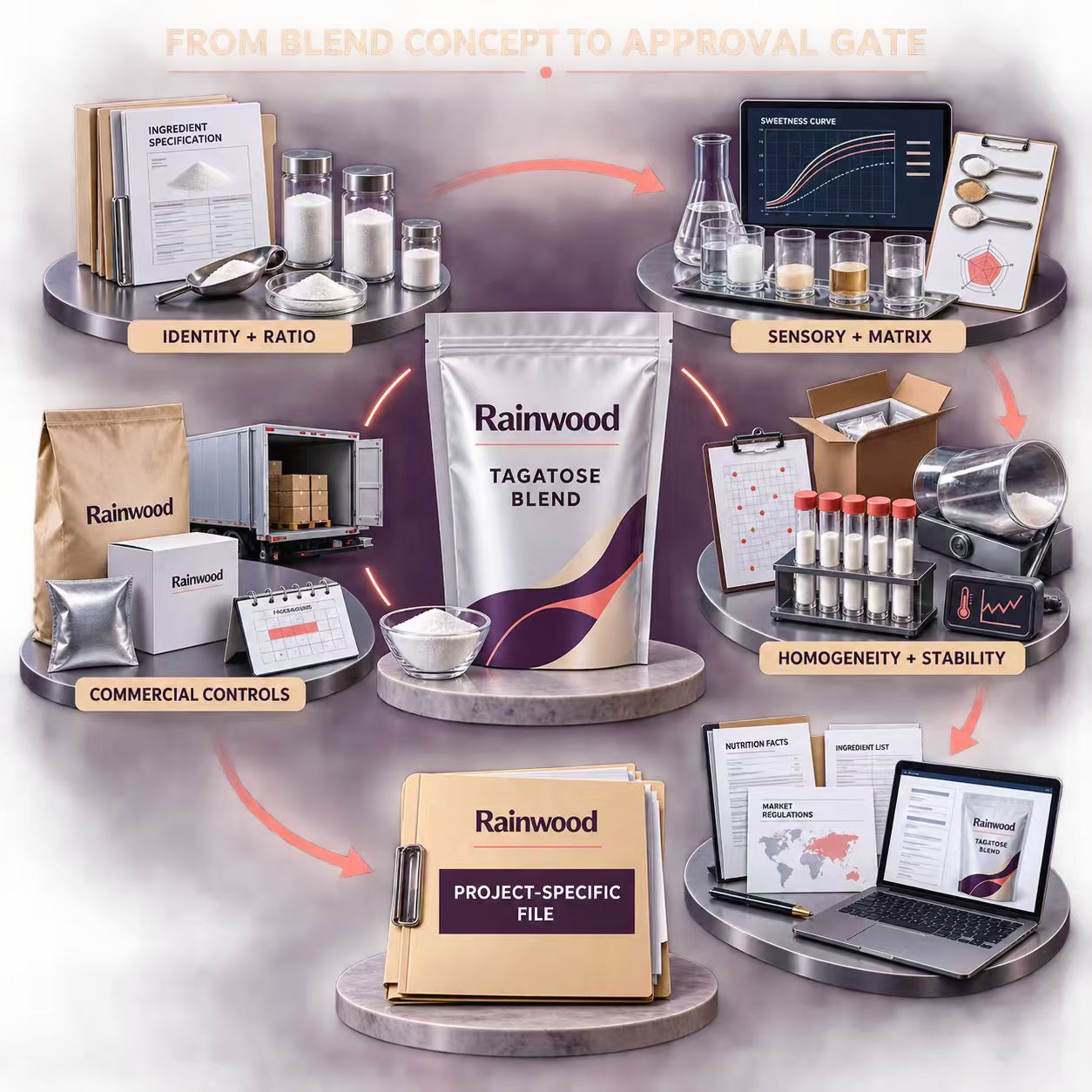
The approval gate for a defensible blend
Before ordering, confirm:
1. Every component, grade, and ratio is named.
2. The blend is homogeneous and remains stable during storage and transport.
3. The sensory profile meets the target in the finished matrix.
4. The serving and nutrition calculation includes every component.
5. Claims match the exact blend, dose, evidence, and market.
6. Packaging, MOQ, price, and change-control terms are documented.
Request a tagatose blend formula and evidence review. Send RainwoodBio the target sweetness, benchmark product, current formula, market, serving, package, quantity, cost target, and desired claims so the team can identify the blend controls before the label is printed.
Frequently asked questions
1.Is a tagatose-stevia blend automatically lower calorie?
Not automatically. Calculate the complete serving using the actual ratio, carriers, and market-specific rules.
2.Can a supplier report one “purity” number for the whole blend?
A total-blend result does not replace component identity, ratio, standardization, or homogeneity controls. Require a specification that answers each relevant question.
3.Does a pure tagatose study prove a tagatose-plus-erythritol claim?
No. The evidence must be matched to the exact blend, dose, formula, population, endpoint, and wording.
References
- FDA D-tagatose Nutrition Facts update: https://www.fda.gov/food/hfp-constituent-updates/fda-issues-supplemental-response-labeling-d-tagatose-nutrition-facts-label
- EU D-tagatose labelling conditions: https://eur-lex.europa.eu/legal-content/en/ALL/?uri=CELEX:32017R2470
- PubChem D-allulose record: https://pubchem.ncbi.nlm.nih.gov/compound/Allulose
- FSANZ D-tagatose technical report: https://www.foodstandards.govt.nz/sites/default/files/publications/Documents/29_D-tagatose.pdf
- RainwoodBio OEM service: https://www.rainwoodbio.com/oem
This article is for international B2B procurement and educational purposes. Blend composition, sensory performance, tolerance, nutrition, claims, safety, and regulatory requirements must be confirmed for the exact formula, finished lot, and destination market.