 EN
EN

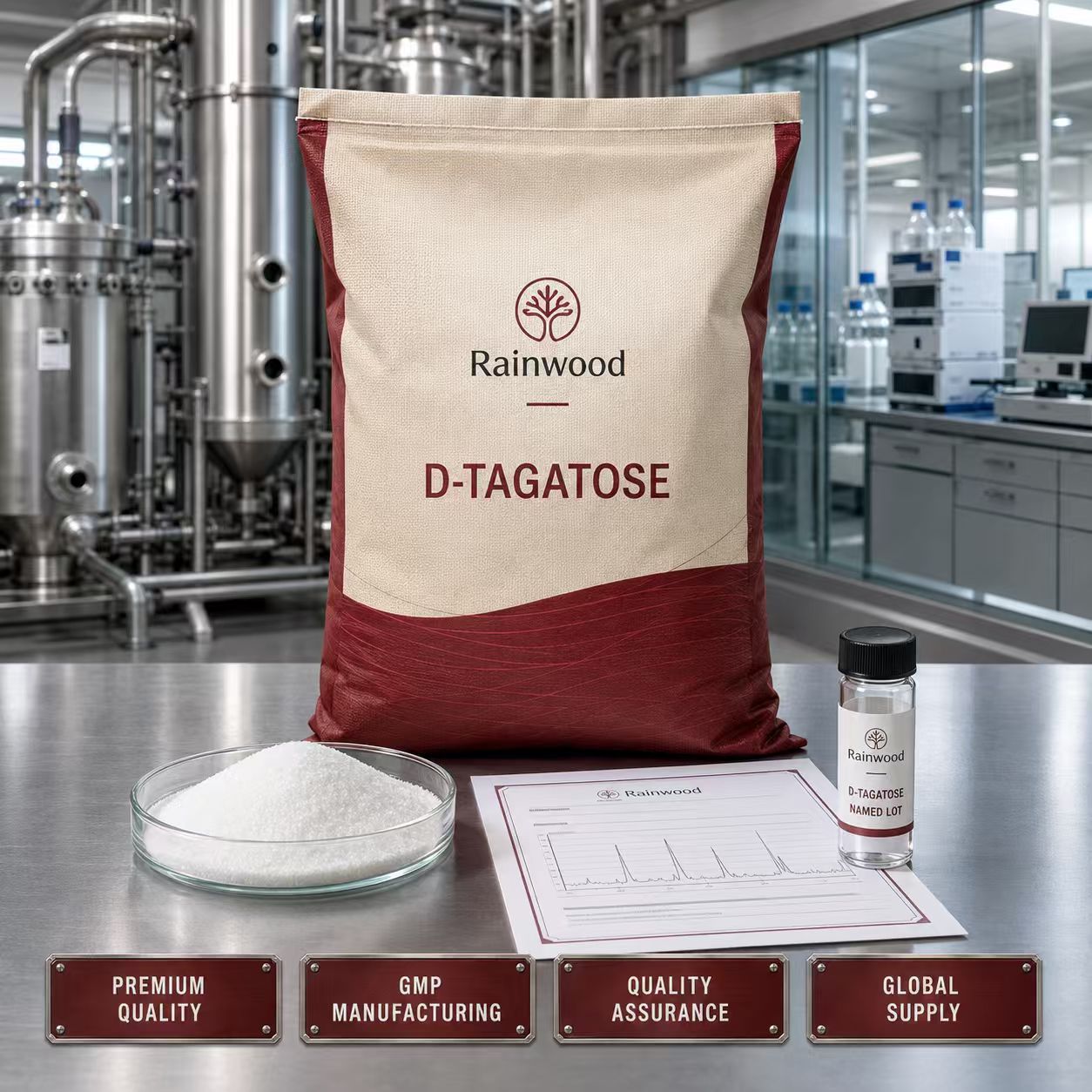
Meta title: The Cheap Tagatose Quote That Hides Purification Risk
Meta description: A low tagatose price may transfer separation, impurity, testing, and rejection risk to your factory. Learn how to normalize quotes before buying.
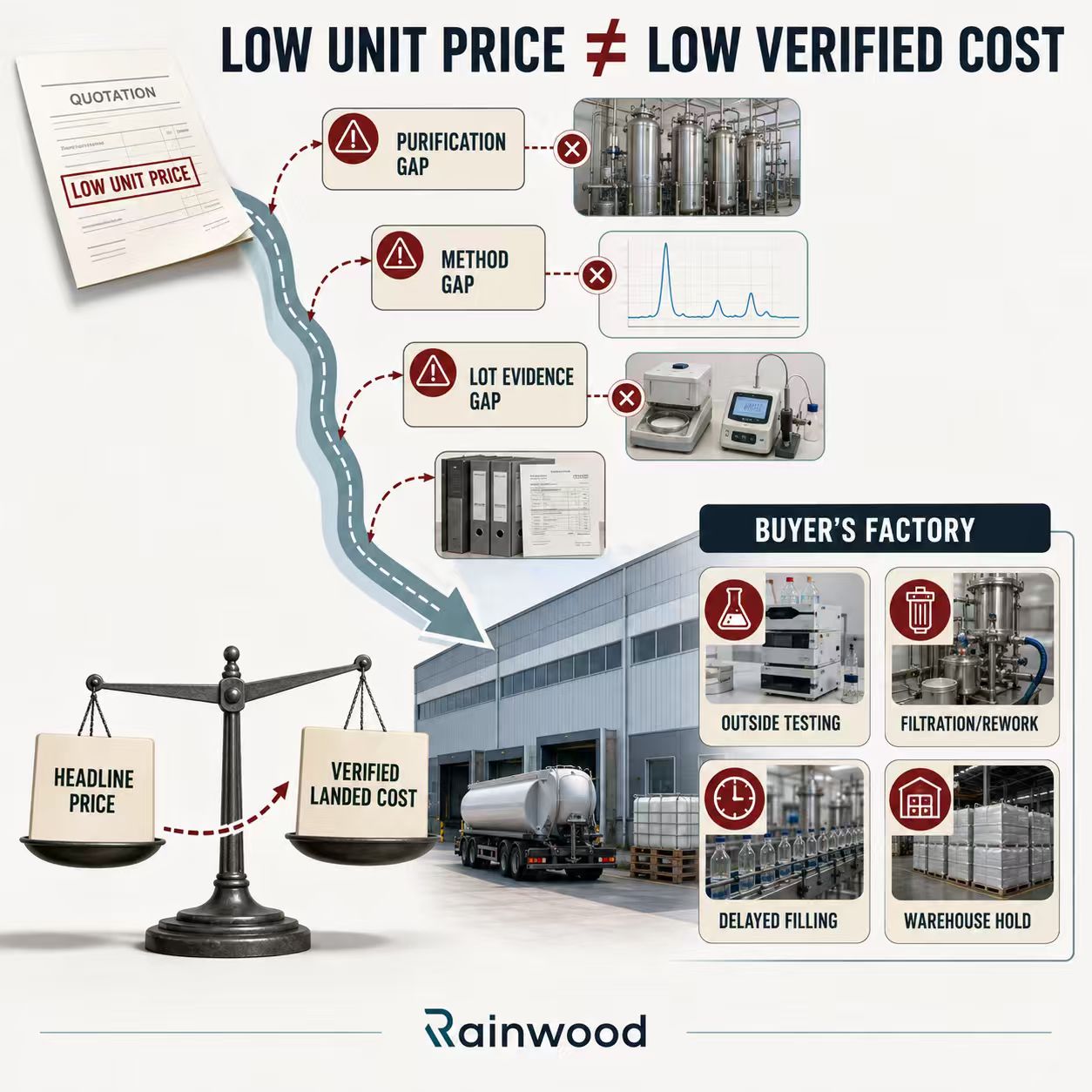
Two tagatose quotations arrive on the same morning. One is 18% cheaper. The supplier says both are food grade and “99% pure.” Purchasing chooses the lower price.
At production, the syrup contains a wider related-sugar profile, the powder needs extra filtration, and the method package is incomplete. Your team now pays for additional testing, reformulation, delayed filling, and a customer explanation.
The cheap quote did not remove the purification cost. It moved the uncertainty downstream.
D-tagatose is not created by simply mixing a sweet powder. Commercial routes involve conversion, separation, concentration, crystallization, and drying. Public regulatory and technical documents describe those steps and the need to control identity, related sugars, moisture, contaminants, and physical properties. [The FDA GRAS notice for a novel enzymatic route](https://www.fda.gov/media/155246/download) discusses downstream processing and lot testing; [the EU specification](https://eur-lex.europa.eu/legal-content/en/ALL/?uri=CELEX%3A32017R2470) sets multiple release parameters rather than a single price-defining number.
Review the RainwoodBio tagatose product information, then make every supplier quote answer the same process and evidence questions.
Conversion yield is only the beginning
Tagatose can be produced from galactose or fructose through enzymatic or chemical conversion. The feedstock and reaction route influence the composition of the product stream. A conversion step may leave unconverted substrate, by-products, salts, color bodies, or other sugars that need to be removed.
Research on D-tagatose production repeatedly identifies separation and purification as practical bottlenecks. One recent process study reported chromatography, decolorization, desalination, concentration, and crystallization before obtaining high-purity crystals. [The 2025 Food Microbiology study](https://doi.org/10.1016/j.fm.2025.104785) is a research result, not a guarantee about every commercial supplier, but it shows why a quote that omits purification details deserves a closer look.
The buyer does not need to demand one “correct” route. The buyer needs to know whether the proposed route can consistently meet the agreed identity, related-sugar, contaminant, and physical specifications at commercial scale.
Read the tagatose COA identity article before accepting “99%” as a complete manufacturing answer.
The supplier incentives behind a low number
A lower price can be legitimate. It may reflect larger scale, a different feedstock, lower packaging cost, shorter Incoterms, or a simpler service scope. It can also reflect risk that the buyer has not yet priced:
- less extensive purification or narrower impurity testing;
- a higher moisture allowance;
- a representative rather than lot-specific COA;
- a different manufacturer or production site;
- bulk packaging that creates extra handling work;
- a longer lead time or larger MOQ;
- no finished-format feasibility support;
- unclear replacement terms when the material fails.
Do not accuse a supplier because a quote is low. Ask which cost has changed and which control has changed with it.
A quote-normalization table buyers can use
| Field | Supplier A | Supplier B |
|---|---|---|
| Feedstock and route | Documented? | Documented? |
| Final form | Powder/syrup/blend | Powder/syrup/blend |
| Assay basis | Dry or as-is? | Dry or as-is? |
| Related sugars | Method and limits? | Method and limits? |
| Moisture/ash | Lot result? | Lot result? |
| Heavy metals | Limits and method? | Limits and method? |
| Microbiology | Release criteria? | Release criteria? |
| Sample-to-bulk gate | Defined? | Defined? |
| Packaging/storage | Included? | Included? |
| MOQ/lead time | Contracted? | Contracted? |
| Deviation response | Replacement terms? | Replacement terms? |
| Cost per verified serving | Calculated? | Calculated? |
The table prevents a 20-line quotation from hiding the one line that matters: the buyer’s cost if the lot is not fit for the intended product.
Purification risk shows up in the analytical method
A broad assay can look excellent while the related-sugar profile remains unclear. Ask how the method handles galactose, fructose, glucose, lactose, allulose, and other process-related components relevant to the route.
The method should state the separation mode, reference standards, sample preparation, calibration, system suitability, reportable range, and calculation basis. A named instrument or “HPLC tested” statement is not a validated method description.
For a high-risk launch, request a representative chromatogram plus the raw data or test report for a named lot. Then decide whether the first commercial shipment receives independent verification. Use the fit-for-purpose tagatose testing checklist to define the release gate.
The factory loss created by a weak quote
The buyer’s loss may arrive in several forms:
1. The incoming lot requires a new method or outside-lab test.
2. The formula must be changed because sweetness or solids are different.
3. The powder does not flow through the planned filling equipment.
4. The customer label cannot support the promised ingredient identity.
5. A shipment is delayed while the supplier clarifies the COA.
6. A rejected lot occupies warehouse space and ties up cash.
7. The launch team pays for new samples, artwork, and stability work.
These costs are often larger than the original price gap. Include them in the landed-cost estimate instead of treating testing and rework as someone else’s problem.
What the supplier should prove before the deposit
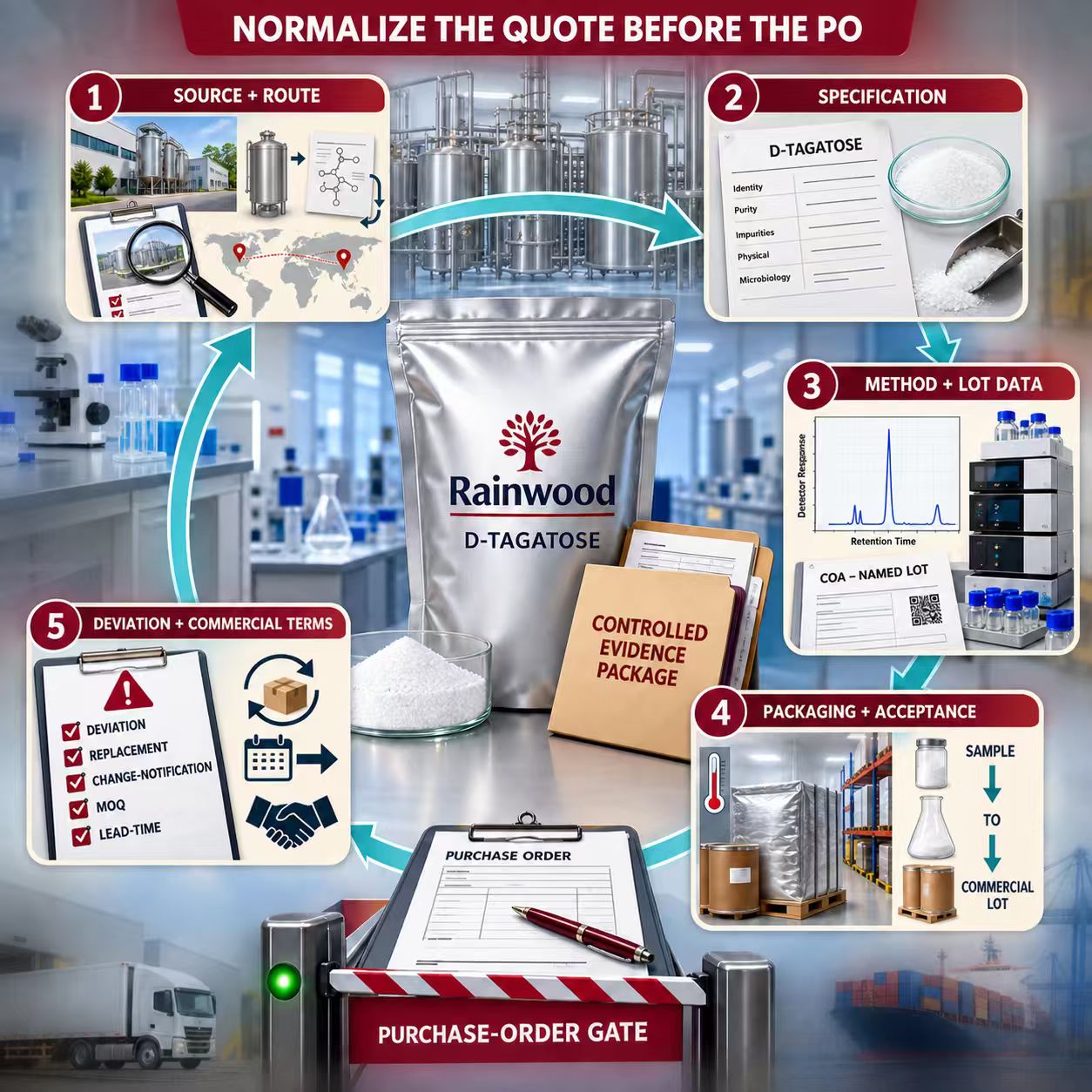
Ask for a controlled evidence package:
- current specification with revision date;
- manufacturer and site identity;
- feedstock and process description to the level needed for the risk review;
- representative and lot-specific COAs;
- related-sugar and contaminant methods;
- moisture, ash, microbiology, and physical-property limits;
- packaging and storage validation relevant to the form;
- change-notification and deviation procedure;
- sample-to-commercial-lot acceptance conditions.
If a supplier cannot disclose a proprietary detail, convert the gap into a test or contractual control. “Confidential process” is not a reason to accept an undefined commercial result.
How RainwoodBio can turn a low quote into a controlled project
RainwoodBio’s public pages describe tagatose powder and OEM support for private-label formats. They do not prove that every quotation includes the same source, test plan, or batch evidence. A professional supplier conversation should make those details explicit.
Ask RainwoodBio to prepare:
- a normalized comparison of competing offers;
- an exact material and form specification;
- sample and commercial-lot document requirements;
- target-market label and evidence questions;
- an MOQ, lead-time, packaging, and landed-cost estimate;
- a deviation and replacement plan.
Use the supplier qualification and two-quotation review to decide whether the low number is a true efficiency or an unpriced risk transfer.
The purchase-order gate
Do not approve on unit price alone. Approve only when the quote defines:
- what is being sold;
- how it is measured;
- which impurities are controlled;
- which documents arrive with each lot;
- who pays for retesting or replacement;
- what changes require notice;
- how the material will work in your final format.
Request a tagatose quote-normalization and purification-risk review. Send RainwoodBio both quotations, the target specification, formula, market, format, quantity, timeline, and current supplier concern; the team can identify the cost items that the headline price does not show.
Frequently asked questions
1.Does a low tagatose price prove the material is lower quality?
No. Price differences can come from scale, route, packaging, Incoterms, or service scope. The buyer should identify which variable changed and whether the resulting specification still fits the project.
2.Is a process description enough to approve the supplier?
No. Process information explains how risk could arise. Release still requires an agreed specification, suitable methods, lot evidence, and a response plan for deviations.
3.Can I use an independent lab to fix a weak supplier document?
Independent testing can reduce uncertainty, but it should be planned before purchase and matched to the identity, assay, impurity, and format questions. It cannot recreate missing traceability after an unmarked bulk shipment arrives.
References
- FDA GRAS Notice 977, D-tagatose: https://www.fda.gov/media/155246/download
- EU Regulation 2017/2470 D-tagatose entry: https://eur-lex.europa.eu/legal-content/en/ALL/?uri=CELEX:32017R2470
- D-tagatose biotransformation and purification study: https://doi.org/10.1016/j.fm.2025.104785
- USP Food Chemicals Codex, d-Tagatose: https://doi.usp.org/USPFCC/FCC_F101611_07_01.html
- RainwoodBio tagatose powder page: https://www.rainwoodbio.com/ja/custom-tagatose-powder
This article is for international B2B procurement and educational purposes. Manufacturing routes, specifications, test methods, price, supply continuity, and regulatory requirements must be confirmed for the exact supplier, lot, finished product, and destination market.