 EN
EN

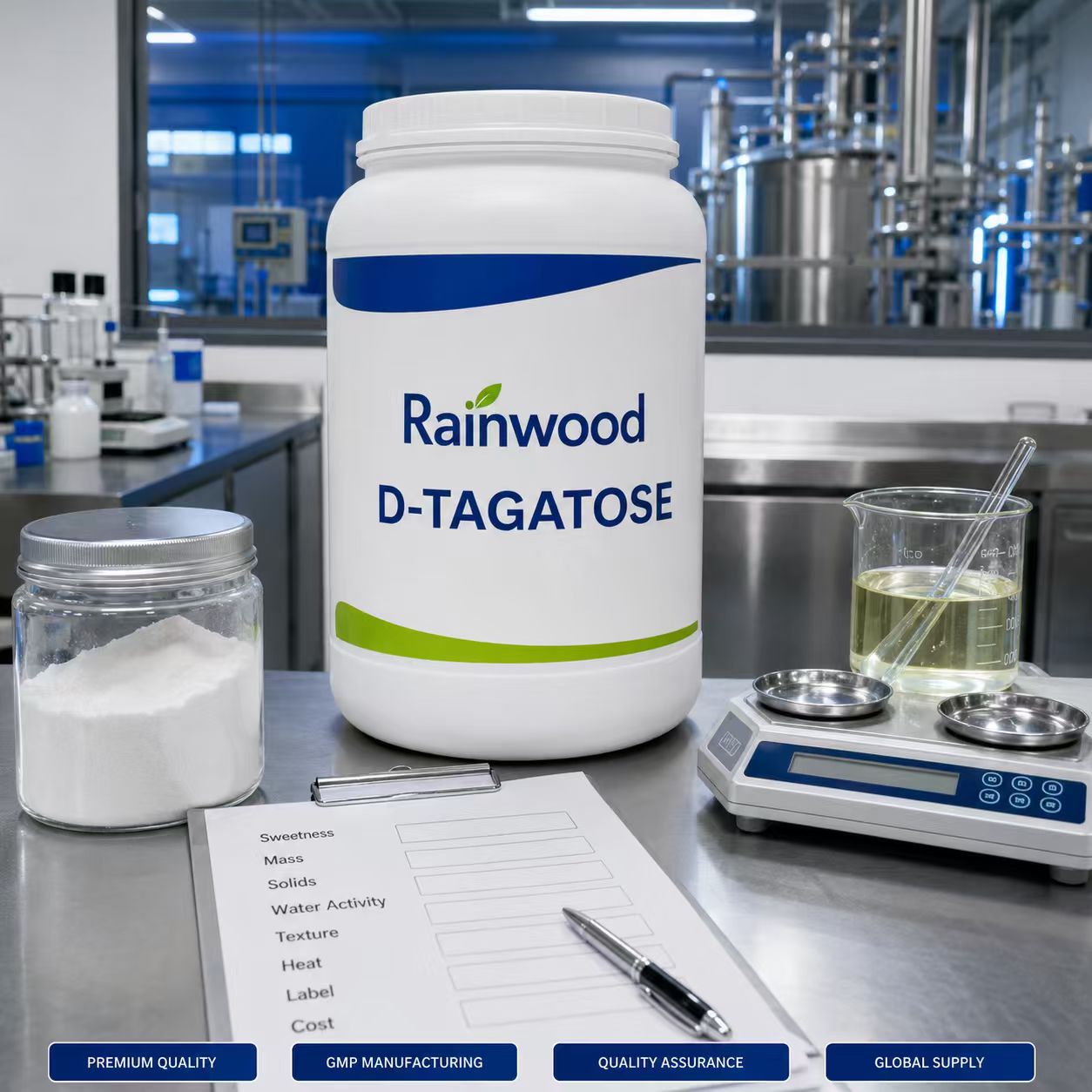
Meta title:** Tagatose Is Not Automatically a 1:1 Sugar Substitute
**Meta description:** Tagatose sweetness does not guarantee a gram-for-gram sugar replacement. Recalculate solids, volume, flavor, heat response, label, and serving cost.
The brief says: “Replace sucrose with tagatose at 1:1.”
The first bench sample tastes acceptable. The pilot batch does not set correctly, the beverage body feels thin, and the label math no longer matches the intended serving.
The problem is not that tagatose cannot replace sugar. The problem is that sweetness is only one job that sucrose performs.
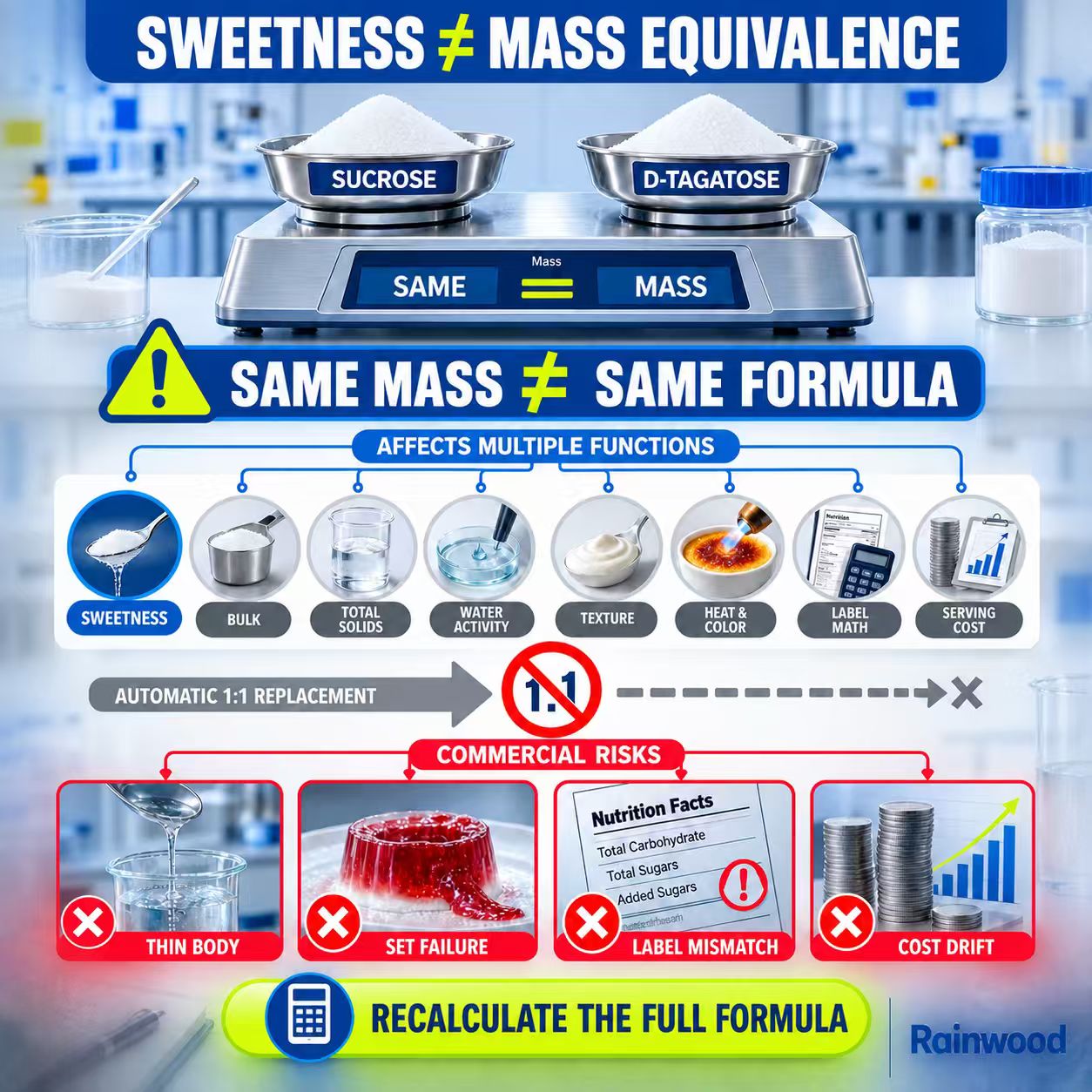
In a finished food, sugar can contribute sweetness, solids, bulk, water activity, browning, freezing-point depression, texture, preservation, and color. D-tagatose can contribute some of these functions differently. A successful substitution starts with a function map and a controlled formula trial, not an automatic kilogram-for-kilogram swap.
Use the RainwoodBio tagatose product page to identify the proposed ingredient form, then ask for a formula feasibility review based on your actual format and target market.
Sweetness does not equal mass equivalence
Supplier descriptions often place tagatose near sucrose in relative sweetness. The exact perception varies with concentration, temperature, pH, food matrix, co-sweeteners, and tasting method. A 90% sweetness assumption is not a universal formulation rule.
If the formula uses 100 kg sucrose and the target sensory intensity requires 110 kg tagatose, you have already changed cost, solids, and physical behavior. If you use 100 kg anyway, the product may taste less sweet even if the raw-material brochure suggests a close comparison.
Run a controlled sensory trial with the same base, temperature, serving size, and tasting protocol. Record early sweetness, peak sweetness, aftertaste, cooling, acidity balance, and consumer acceptance.
Read the **tagatose versus allulose comparison article** **[INTERNAL LINK -> Tagatose vs Allulose Blog]** when the alternative ingredient is being selected only by category label.
Sugar performs more than one technical job
Bulk and solids
Sucrose contributes mass and soluble solids. Changing the ingredient can reduce or increase total solids, alter viscosity, and change the relationship between water and other ingredients.
Water activity and shelf life
Sweeteners influence osmotic pressure and water activity. A substitution can change microbial stability, crispness, chewiness, or moisture migration. Do not infer finished-product shelf life from the raw ingredient’s shelf life.
Texture and mouthfeel
In a gummy, bar, filling, or sauce, sugar affects chew, body, stickiness, and bite. The formula may need a bulking agent, fiber, polyol, or hydrocolloid adjustment—but every addition changes label and regulatory questions.
Heat and color
D-tagatose is a reducing sugar and participates in Maillard reactions; technical food standards describe a distinct browning effect and easier decomposition or caramelization under some conditions. [The FSANZ D-tagatose report](https://www.foodstandards.govt.nz/sites/default/files/publications/Documents/29_D-tagatose.pdf) makes this a formulation variable, especially in heated products.
Freezing and concentration
In frozen desserts and concentrated beverages, the replacement can change freezing-point behavior and the perceived sweetness at low temperature. Test the finished format instead of relying on a room-temperature bench sample.
Use the tagatose heat and texture gate if the product includes cooking, concentration, or gel formation.
A substitution worksheet for the formulation team
Create a before-and-after table:
| Function | Original sucrose | Proposed tagatose | Required check |
|---|---|---|---|
| Sweetness | Target intensity | Concentration trial | Sensory panel |
| Mass | kg per batch | kg per batch | Formula balance |
| Total solids | % | % | Refractometer or validated method |
| Water activity | Target | Target | Finished product test |
| Viscosity/body | Target | Target | Process and texture test |
| Color | Target | Target | Heat and storage test |
| pH/acid balance | Set point | Set point | Finished matrix |
| Serving calories | Label value | Market-specific calculation | Regulatory review |
| Cost | $ per batch | $ per batch | Verified serving cost |
Do not fill the proposed column with theoretical numbers only. Use the exact commercial grade, actual moisture, and intended processing conditions.
The label calculation can change with the market
FDA states that D-tagatose must be declared as an added sugar on the U.S. Nutrition Facts label, while its 2023 update discusses enforcement discretion around a 1.5 kcal/g calorie contribution in the context of a petition. [FDA’s update](https://www.fda.gov/food/hfp-constituent-updates/fda-issues-supplemental-response-labeling-d-tagatose-nutrition-facts-label) is not a universal instruction for all countries or all sweetener blends.
The EU D-tagatose entry requires the name “D-Tagatose” and includes a warning condition above 15 g per serving and above 1% in beverages as consumed. A 1:1 formula swap can therefore change the warning assessment even when the serving size remains the same. [The EU regulation](https://eur-lex.europa.eu/legal-content/en/ALL/?uri=CELEX%3A32017R2470) should be reviewed alongside the finished formula and local labeling rules.
The hidden cost of a “simple” replacement
The raw tagatose price may be higher or lower than sucrose, but the total project cost also includes:
- additional sensory trials;
- bulking or texture adjustment;
- new packaging or moisture control;
- process-temperature changes;
- extra stability testing;
- label and regulatory review;
- revised nutrition calculations;
- new claims evidence;
- minimum-order and inventory exposure.
Calculate cost per finished serving and cost per accepted batch, not just cost per kilogram. Use the formula-input and cost model review to show management what the substitution really changes.
How RainwoodBio can support the formula gate
RainwoodBio publicly describes tagatose powder and OEM support for multiple formats. That company-published context does not prove that a generic tagatose powder is suitable for every formula. The correct project control is a sample, a defined trial, and a commercial specification connected to the final format.
Ask RainwoodBio to help compare:
- powder or syrup input at the required serving;
- sweetness and flavor with the current benchmark;
- solids and texture in the target product;
- heat, water activity, and stability requirements;
- packaging, MOQ, and lead-time implications;
- market-specific label questions.
Use the OEM formula feasibility assessment before approving the final ingredient ratio.
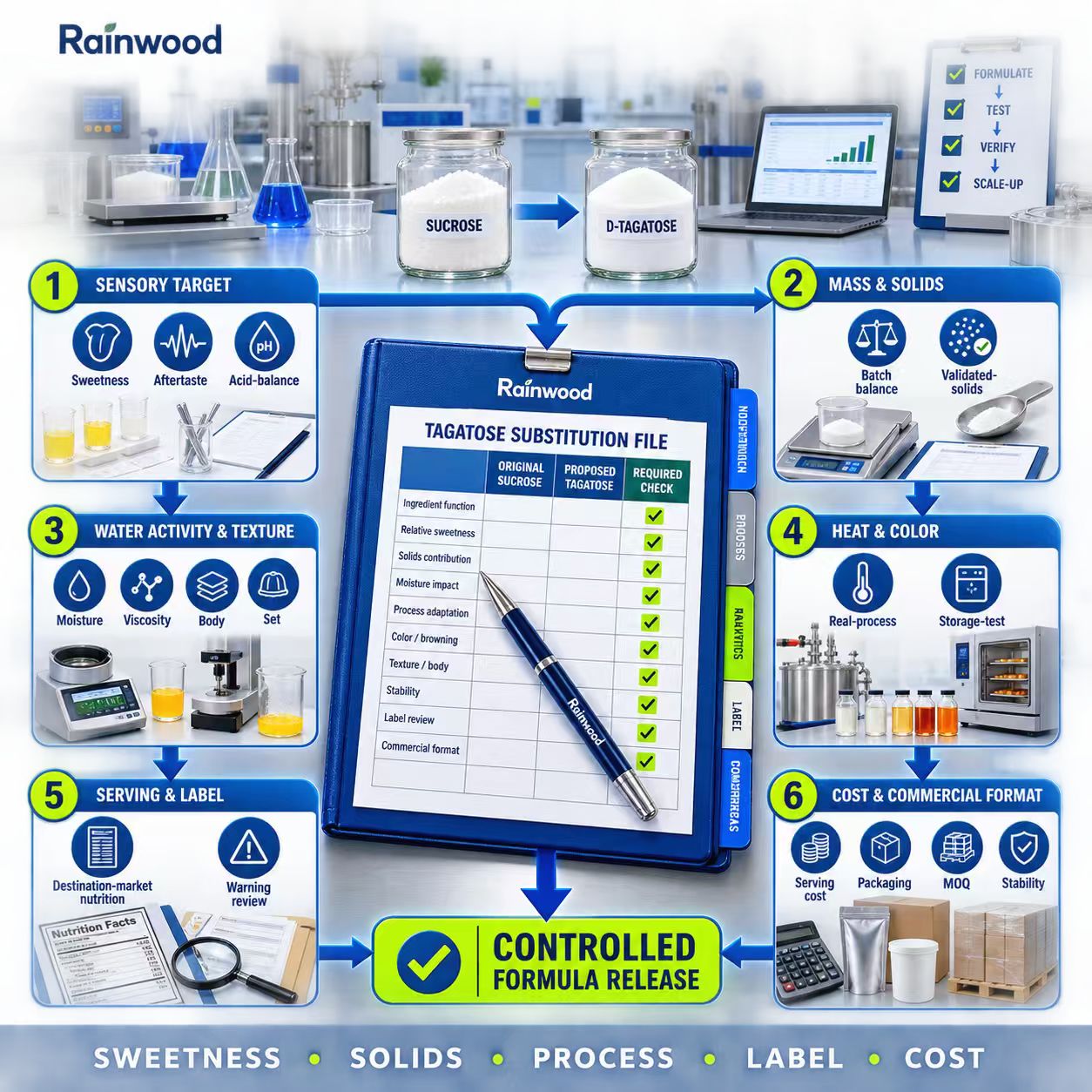
The release gate for a tagatose substitution
Approve the formula only after:
1. Sensory equivalence or an accepted new sensory target is documented.
2. Total solids, water activity, texture, and process settings are confirmed.
3. Heat and color behavior are acceptable.
4. Serving and nutrition calculations are checked for the target market.
5. Stability and packaging are tested in the commercial format.
6. The exact ingredient grade and lot controls are written into the specification.
Request a tagatose substitution and label-math review. Send RainwoodBio the current formula, sugar amount, target sweetness, format, serving size, processing temperature, packaging, market, and cost target so the team can return a controlled replacement plan.
Frequently asked questions
1.Can I start with a 1:1 bench replacement?
Yes, as a screening point—not as a final formula. Use it to identify the direction, then optimize sweetness, solids, texture, process, and label math.
2.Does similar sweetness mean similar calories?
No. Calorie and added-sugar treatment depend on the ingredient, jurisdiction, and finished label rules. Confirm with the applicable regulator and qualified label reviewer.
3.Should the raw material be tested in every finished batch?
Set the testing plan according to the formula risk, supplier qualification, claim, market, and batch-release requirements. Do not promise a frequency without a defined project plan.
References
- FSANZ D-tagatose technical report: https://www.foodstandards.govt.nz/sites/default/files/publications/Documents/29_D-tagatose.pdf
- FDA D-tagatose Nutrition Facts update: https://www.fda.gov/food/hfp-constituent-updates/fda-issues-supplemental-response-labeling-d-tagatose-nutrition-facts-label
- EU D-tagatose labelling conditions: https://eur-lex.europa.eu/legal-content/en/ALL/?uri=CELEX:32017R2470
- USP Food Chemicals Codex, d-Tagatose: https://doi.usp.org/USPFCC/FCC_F101611_07_01.html
- RainwoodBio OEM service: https://www.rainwoodbio.com/oem
This article is for international B2B procurement and educational purposes. Formula performance, nutrition values, claims, safety, stability, and regulatory treatment must be confirmed for the exact ingredient, finished product, serving, and destination market.