 EN
EN

Meta title: Tagatose Gummies: The Browning and Texture Gate
Meta description: Tagatose can change gummy color, gel texture, moisture migration, and stability. Use a format-specific trial before approving a private-label launch.
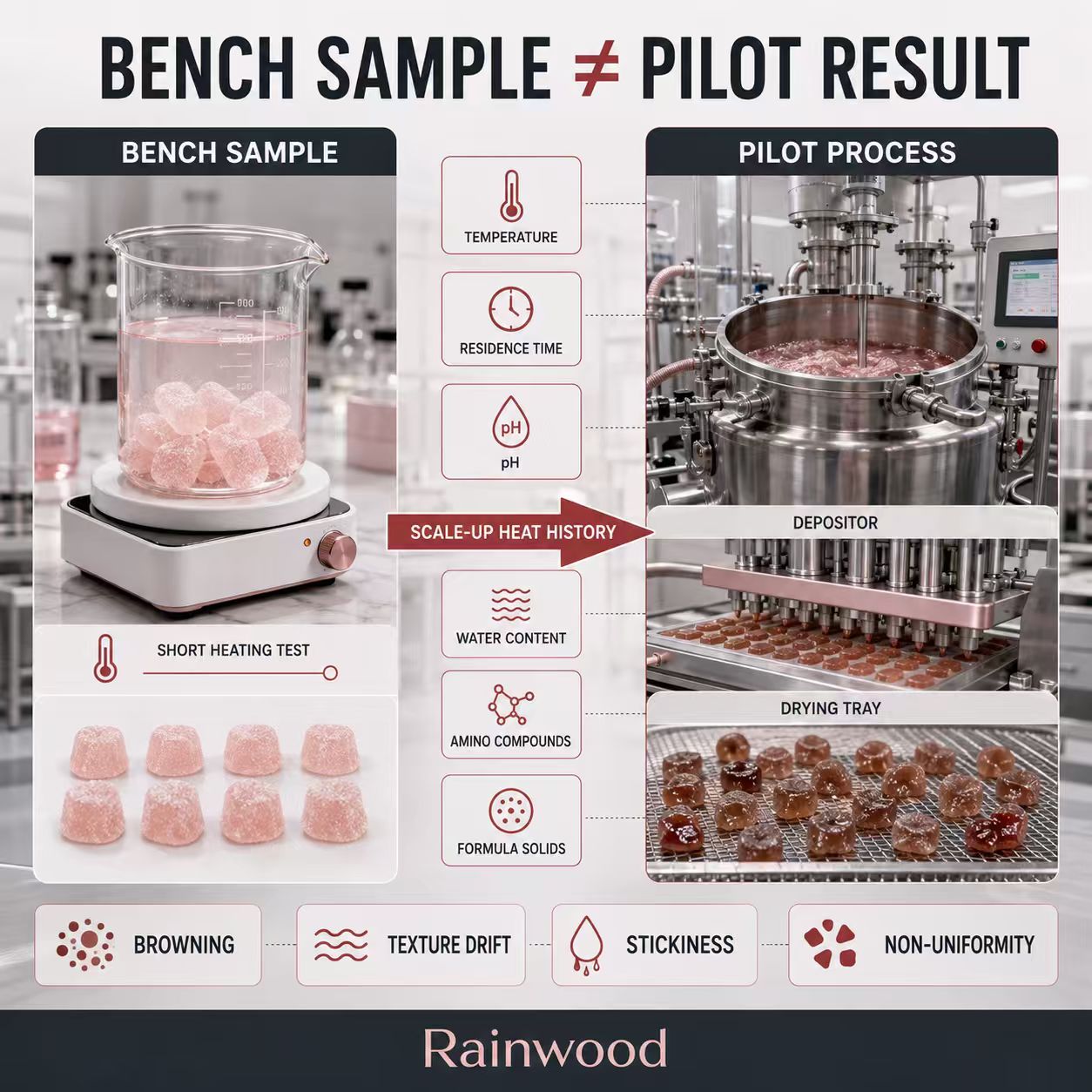
The gummy sample looks bright, clean, and soft. The pilot kettle runs hotter and longer. The finished pieces come out darker, stickier, and less uniform than the benchmark.
The ingredient did not fail because the label said tagatose. The formulation team failed to test what tagatose does under the real heat, pH, solids, and drying conditions of a gummy process.
D-tagatose is a reducing sugar. Technical food standards describe its participation in Maillard reactions and a distinct browning effect in food. [The FSANZ D-tagatose report](https://www.foodstandards.govt.nz/sites/default/files/publications/Documents/29_D-tagatose.pdf) also discusses its heat and solution behavior. That does not mean every tagatose gummy will brown or fail. It means the risk belongs in the pilot protocol, not in a last-minute complaint review.
Use the RainwoodBio gummy OEM context after the raw material and target process have been defined. A generic tagatose powder sample cannot prove the final gummy will hold color, texture, and shelf life.
Why tagatose changes the gummy process
Gummies are not simply sweetened powders. The process combines syrup concentration, hydrocolloid hydration, acid addition, active dispersion, cooking, depositing, cooling, drying, oiling, and packaging. A sweetener change can affect several steps at once.
Browning and heat history
Tagatose can participate in Maillard reactions and may caramelize or decompose under certain conditions. The risk depends on temperature, time, pH, water content, amino compounds, minerals, and the rest of the formula. A short bench heating step may not reproduce the residence time in a production kettle.
Gel and bite
Changing soluble solids can change gel strength, chew, elasticity, and set time. If the formula compensates with more pectin, gelatin, starch, or fiber, the label and process must be reviewed again.
Moisture migration
Tagatose and the other solids influence water activity and moisture movement between the gummy, coating, and package. A gummy can be acceptable at day one and become sticky, hard, or crystallized during storage.
Flavor release
Sweetness timing and acid balance can change. Fruit flavors may appear sharper or flatter, and masking agents can interact with the new solids profile.
Read the tagatose 1:1 substitution guide before changing the sugar system without rebalancing the full gummy formula.
The pilot trial must reproduce the production risk
Use a staged trial:
1. Raw-material check: confirm identity, assay basis, moisture, appearance, particle size, and storage history.
2. Syrup trial: measure dissolution, viscosity, solids, color before and after heating, and hold time.
3. Lab gummy: run the intended hydrocolloid, acid, flavor, active, and sweetener system.
4. Pilot kettle: reproduce heating rate, residence time, vacuum, shear, deposit temperature, and cooling.
5. Drying and packaging: record weight loss, water activity, texture, seal, and package compatibility.
6. Stability: compare color, texture, stickiness, flavor, water activity, and active content over time.
If the pilot uses different equipment or a different batch size, record the differences and do not present the result as full-scale proof.
A gummy scorecard buyers can use
| Decision area | Pass question |
|---|---|
| Color | Is the initial color within the approved range? |
| Heat | Does the syrup remain stable at the actual hold time? |
| Texture | Does the gummy meet bite, chew, and set targets? |
| Water activity | Is the target stable after drying and packing? |
| Moisture migration | Does the coating or package protect the piece? |
| Flavor | Is sweetness and acid balance acceptable? |
| Active dispersion | Is the active uniform across pieces? |
| Stability | Does color, texture, and flavor hold through the claim period? |
| Label | Does the serving and added-sugar calculation match the market? |
Use the gummy format feasibility checklist to keep a raw-material discussion connected to the final product.
The label and claim risk arrives with the formula
FDA states that D-tagatose must be declared as an added sugar on the U.S. Nutrition Facts label and has published a specific calorie discussion. [FDA’s update](https://www.fda.gov/food/hfp-constituent-updates/fda-issues-supplemental-response-labeling-d-tagatose-nutrition-facts-label) should be reviewed with the finished gummy serving size, not applied as a generic “low sugar” claim.
The EU D-tagatose entry includes a warning condition when the amount exceeds 15 g per serving. [The EU regulation](https://eur-lex.europa.eu/legal-content/en/ALL/?uri=CELEX%3A32017R2470) also specifies the ingredient name. A gummy serving can cross a threshold that a powder serving does not, especially when the buyer increases piece count or serving size.
Do not promise “diabetic friendly,” “weight-loss,” “prebiotic,” or disease-related outcomes simply because tagatose is discussed as a low-calorie or functional sweetener. Match each claim to the finished product, dose, evidence, and market.
Packaging is part of the texture specification
Gummies often fail after production because the package was selected from appearance rather than moisture control. Define:
- primary film barrier;
- seal temperature and integrity;
- headspace and oxygen exposure;
- desiccant or humidity control where permitted;
- coating compatibility;
- storage temperature;
- transport and warehouse conditions;
- retained-sample and stability schedule.
A two-year raw-material shelf life does not prove a two-year gummy shelf life. The finished product needs its own stability evidence.
How RainwoodBio can support a tagatose gummy project
RainwoodBio’s OEM pages describe custom gummy development and private-label production as company-published capabilities. The exact formulation, line, certification scope, testing, MOQ, and stability evidence still need to be confirmed for the tagatose project.
Ask for:
- a tagatose gummy sample with a defined formula brief;
- heat, color, texture, and water-activity trial data;
- active uniformity and serving calculation;
- package and storage recommendations;
- pilot-to-commercial scale-up controls;
- target-market label and claim review questions.
Use the gummy pilot and scale-up assessment to identify the failure gate before placing the first mass-production order.

The release gate for a tagatose gummy
Approve the formula only after:
1. Raw material and lot documents are accepted.
2. The syrup and pilot process meet color and heat criteria.
3. Texture and active uniformity pass the agreed range.
4. Water activity, moisture migration, and package integrity are controlled.
5. Stability testing supports the intended shelf life.
6. Label, warning, and claim wording are reviewed for the destination market.
Request a tagatose gummy feasibility and stability review. Send RainwoodBio the current formula, target piece weight, serving, hydrocolloid, cooking temperature, flavor, package, market, quantity, and launch date so the team can identify the technical and document gaps before production.
Frequently asked questions
1.Will tagatose always make gummies darker?
No. Browning depends on the complete formula and heat history. Because tagatose can participate in Maillard reactions, the process should be tested under realistic conditions.
2.Can I fix stickiness by adding more drying time?
Maybe, but longer drying can change texture, color, active stability, and cost. Identify whether the root cause is solids, water activity, package barrier, coating, or process control.
3.Is the tagatose powder COA enough for the gummy label?
No. The finished serving, formula, market, and label calculation must be reviewed. Raw-material evidence is only one part of the finished-product file.
References
- FSANZ D-tagatose technical report: https://www.foodstandards.govt.nz/sites/default/files/publications/Documents/29_D-tagatose.pdf
- FDA D-tagatose labeling update: https://www.fda.gov/food/hfp-constituent-updates/fda-issues-supplemental-response-labeling-d-tagatose-nutrition-facts-label
- EU D-tagatose entry: https://eur-lex.europa.eu/legal-content/en/ALL/?uri=CELEX:32017R2470
- RainwoodBio OEM service: https://www.rainwoodbio.com/oem
This article is for international B2B procurement and educational purposes. Gummy color, texture, stability, safety, claims, label treatment, and regulatory requirements must be confirmed for the exact formulation, process, finished lot, and destination market.