 EN
EN

Meta title: Tagatose Beverages and Stick Packs: The Stability Gate
Meta description: Tagatose can change dissolution, crystallization, moisture pickup, fill weight, and shelf life. Qualify the powder in the final beverage or stick-pack format.
The development sample dissolves in a glass of water. The first export batch forms sediment, the stick packs bridge in the hopper, and the finished beverage changes sweetness after storage.
That is not one problem. It is a chain: powder properties, formula concentration, pH, temperature, packaging, transport, and label serving all interact.
Tagatose can be a useful sweetener in beverages and dry sachets, but a clean cup test does not prove commercial performance. The buyer needs a format-specific specification and a stability plan that follows the ingredient from warehouse to consumer.
Review the RainwoodBio tagatose powder context, then qualify the exact powder grade, sachet fill, beverage concentration, and package before approving the launch.
Dissolution is a system property
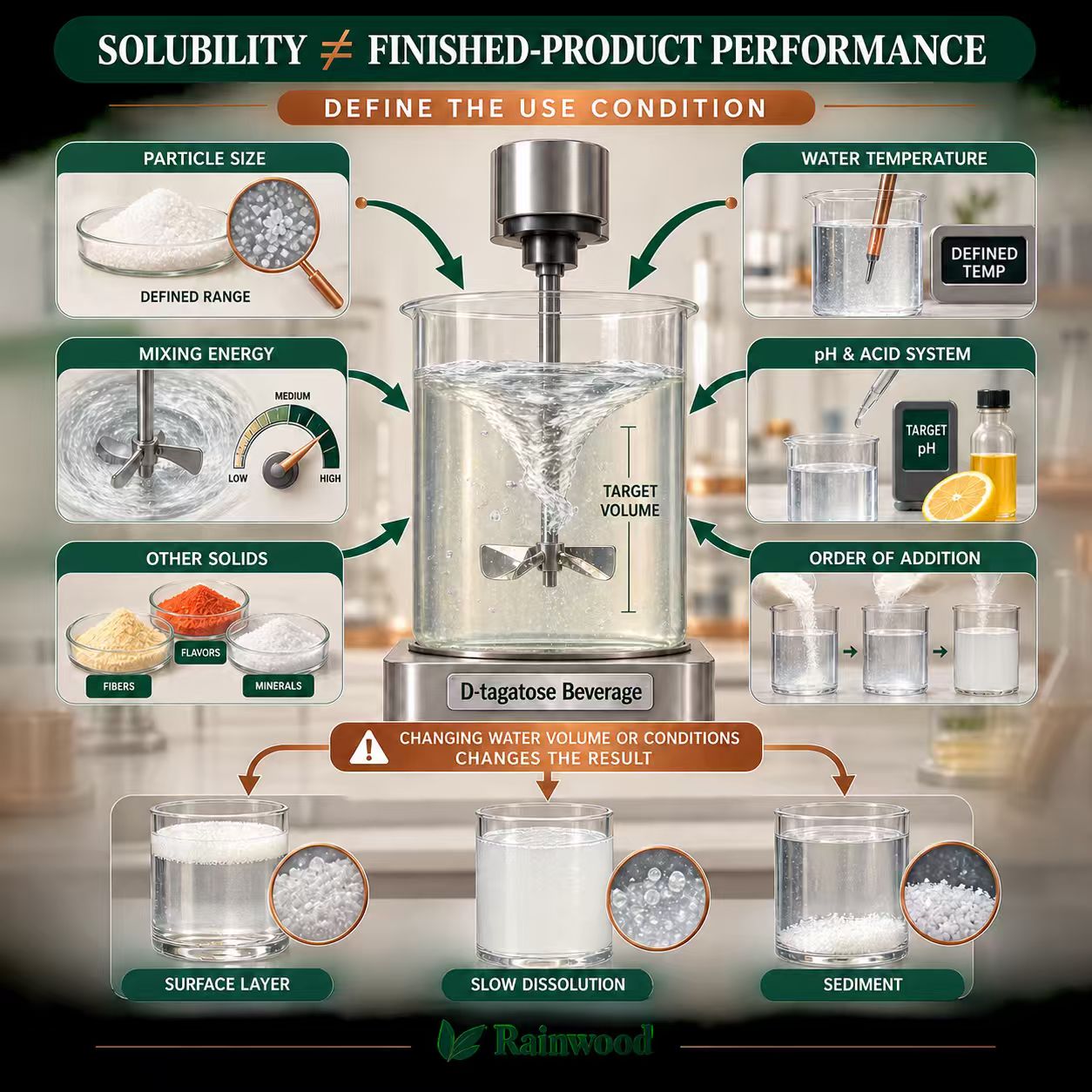
The solubility of a raw powder is only the first question. In a finished beverage, dissolution depends on particle size, water temperature, mixing energy, pH, ionic strength, other solids, flavor oils, fibers, proteins, and the order of addition.
A powder that dissolves rapidly in warm laboratory water may dissolve slowly in cold water, form a surface layer in a shaker bottle, or interact with minerals in a functional beverage. If the product is a stick pack, the consumer may use a lower water volume than the development protocol.
Define the use condition:
- water volume and temperature;
- mixing method and time;
- powder dose and particle size;
- pH and acid system;
- other sweeteners, fibers, and actives;
- visual and sensory acceptance criteria.
Read the tagatose 1:1 formula calculation guide before changing solids or sweetness without repeating the use test.
Crystallization and moisture need separate controls
Crystals can form when a solution becomes supersaturated during concentration, cooling, evaporation, or storage. The risk depends on concentration, temperature history, impurities, seed crystals, agitation, and package conditions. A powder blend can also cake or segregate when moisture moves through the package.
For a liquid beverage, monitor clarity, sediment, turbidity, viscosity, and crystal formation at the intended storage temperatures. For a dry stick pack, monitor moisture, caking, flow, fill-weight variation, and dissolution after storage.
Do not describe “high solubility” as a finished-product guarantee. It is a testable property under defined conditions.
A beverage and stick-pack test plan
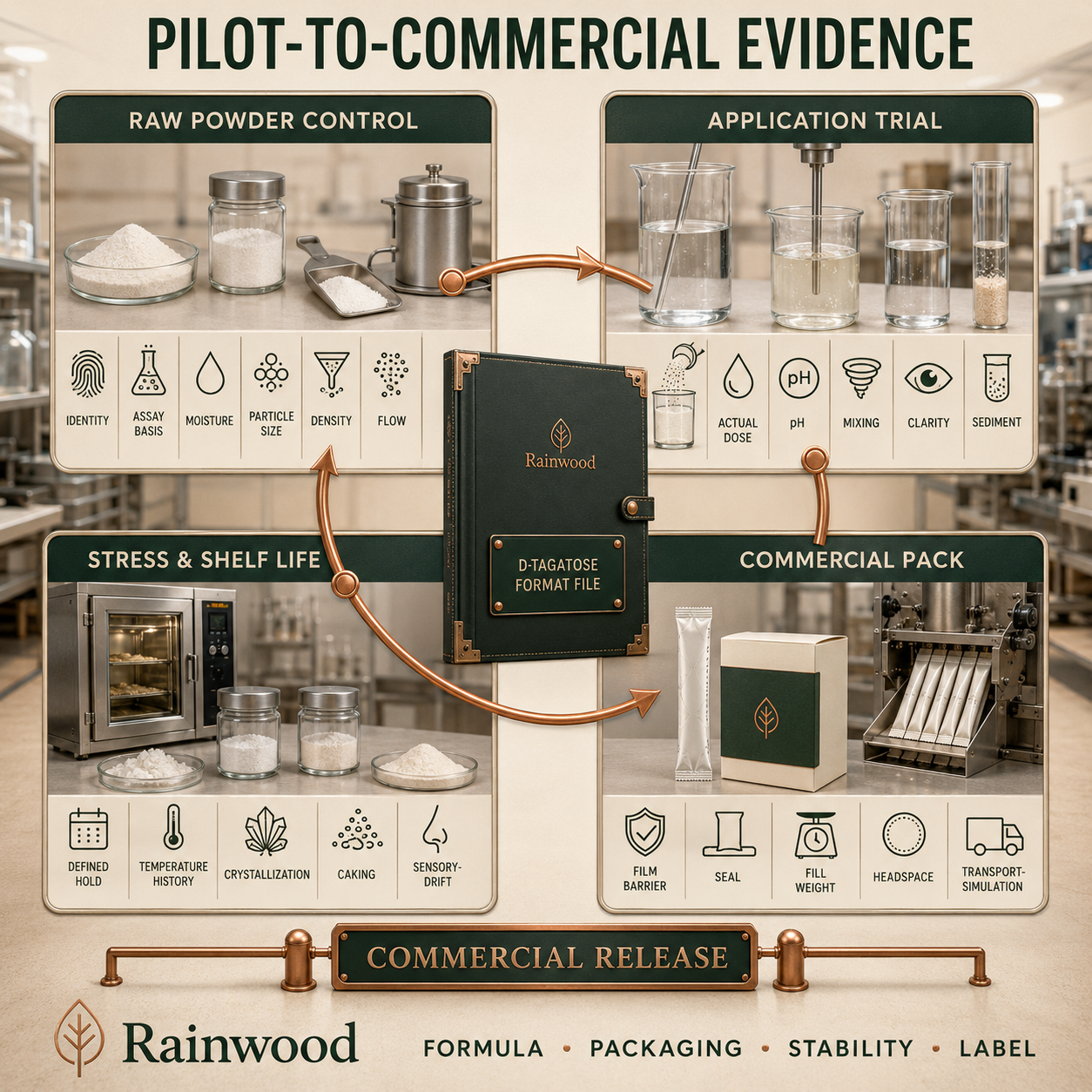
Raw powder
Record identity, assay basis, moisture, particle size, density, flow, appearance, and packaging. Keep a retain sample from the same lot.
Bench beverage
Test the target concentration in the actual water type. Record dissolution time, temperature, pH, clarity, color, flavor, mouthfeel, and sediment after a defined hold.
Stress conditions
Store samples at the intended temperature plus a justified stress condition. Check for crystallization, sediment, package swelling, seal changes, moisture pickup, and sensory drift.
Commercial pack
Use the intended stick-film barrier, seal, fill weight, headspace, carton, pallet, and transport simulation. A glass beaker test does not qualify the commercial package.
Use the powder packaging and stick-pack feasibility guide to align the raw-material and packaging decisions.
The label threshold can affect the serving design
The EU D-tagatose entry requires the name “D-Tagatose” and includes a warning condition when a product exceeds 15 g per serving or a beverage exceeds 1% as consumed. [The EU regulation](https://eur-lex.europa.eu/legal-content/en/ALL/?uri=CELEX%3A32017R2470) makes serving design a compliance variable, not just a flavor decision.
In the United States, FDA says D-tagatose must be declared as an added sugar and has discussed a 1.5 kcal/g calculation in a specific labeling response. [FDA’s update](https://www.fda.gov/food/hfp-constituent-updates/fda-issues-supplemental-response-labeling-d-tagatose-nutrition-facts-label) should be reviewed with the final serving, recipe, and market.
Changing the sachet from 8 g to 12 g or the beverage concentration from 0.8% to 1.2% can change the regulatory review even if the ingredient list remains the same.
The procurement loss from a weak beverage trial
If the ingredient is approved from a simple cup test, the buyer may later face:
- sediment complaints and poor reviews;
- a stick-pack filling stoppage from bridging or density drift;
- a package that allows moisture pickup;
- revised serving sizes and artwork;
- repeated stability testing;
- returned inventory or relabeling;
- an expensive reformulation after launch.
These losses are avoidable when the buyer defines the final use condition before approving the raw material.
Do not confuse clarity with stability
A drink can look clear immediately after mixing and still develop haze, sediment, or crystals later. Check the product after a defined hold at room temperature and under the temperatures it will experience in transport, retail, and the consumer’s home. Record whether the package is shaken before use and whether the label instructs the user to do so.
For a dry powder, sample from several locations in the filled stick-pack case after vibration. For a liquid, test the top, middle, and bottom of a stored container where stratification is plausible. Photograph the sample under consistent light, measure pH and relevant physical properties, and keep a retained unit. A visual “pass” without a time point, temperature, and sampling record is difficult to defend when a complaint arrives.
How RainwoodBio can support a beverage or sachet project
RainwoodBio’s public OEM materials describe powder sub-packing and other private-label formats. Treat this as company-published context and confirm the exact line, fill weight, film, MOQ, and quality evidence for the tagatose project.
Ask RainwoodBio for:
- a target-concentration beverage sample;
- powder flow and fill-weight trial;
- packaging barrier and storage recommendation;
- dissolution and stability test plan;
- label and serving-size review questions;
- pilot-to-commercial change-control conditions.
Use the beverage and stick-pack format assessment to make the first order a controlled launch test.
The release gate
Do not release the ingredient or final pack until:
1. Powder identity, assay, moisture, and flow meet the agreed range.
2. The actual beverage concentration dissolves under consumer-use conditions.
3. Crystallization, sediment, caking, and moisture risks are assessed.
4. Packaging and sealing are tested with the commercial fill.
5. Stability supports the intended shelf life.
6. Serving and label requirements match the destination market.
Request a tagatose beverage and stick-pack feasibility review. Send RainwoodBio your formula, water volume, dose, pH, package film, fill weight, target market, quantity, and launch timeline so the team can identify the process and evidence gates before production.
Frequently asked questions
1.If tagatose dissolves in warm water, is it suitable for cold drinks?
Not automatically. Test the actual water temperature, concentration, pH, mixing method, and hold time used by the consumer.
2.Can a desiccant solve stick-pack caking?
It may help in some packages, but film barrier, sealing, powder moisture, storage humidity, and formulation are also important. Confirm suitability and regulatory acceptability before adding one.
3.Does a two-year powder shelf life prove a two-year beverage shelf life?
No. The beverage has a different matrix, package, pH, temperature history, and stability mechanism. Finished-product stability is required.
References
- EU D-tagatose labelling conditions: https://eur-lex.europa.eu/legal-content/en/ALL/?uri=CELEX:32017R2470
- FDA D-tagatose labeling update: https://www.fda.gov/food/hfp-constituent-updates/fda-issues-supplemental-response-labeling-d-tagatose-nutrition-facts-label
- FSANZ D-tagatose technical report: https://www.foodstandards.govt.nz/sites/default/files/publications/Documents/29_D-tagatose.pdf
- RainwoodBio OEM service: https://www.rainwoodbio.com/oem
This article is for international B2B procurement and educational purposes. Solubility, crystallization, packaging, shelf life, label treatment, claims, and regulatory requirements must be verified for the exact formula, format, commercial lot, and destination market.