 EN
EN

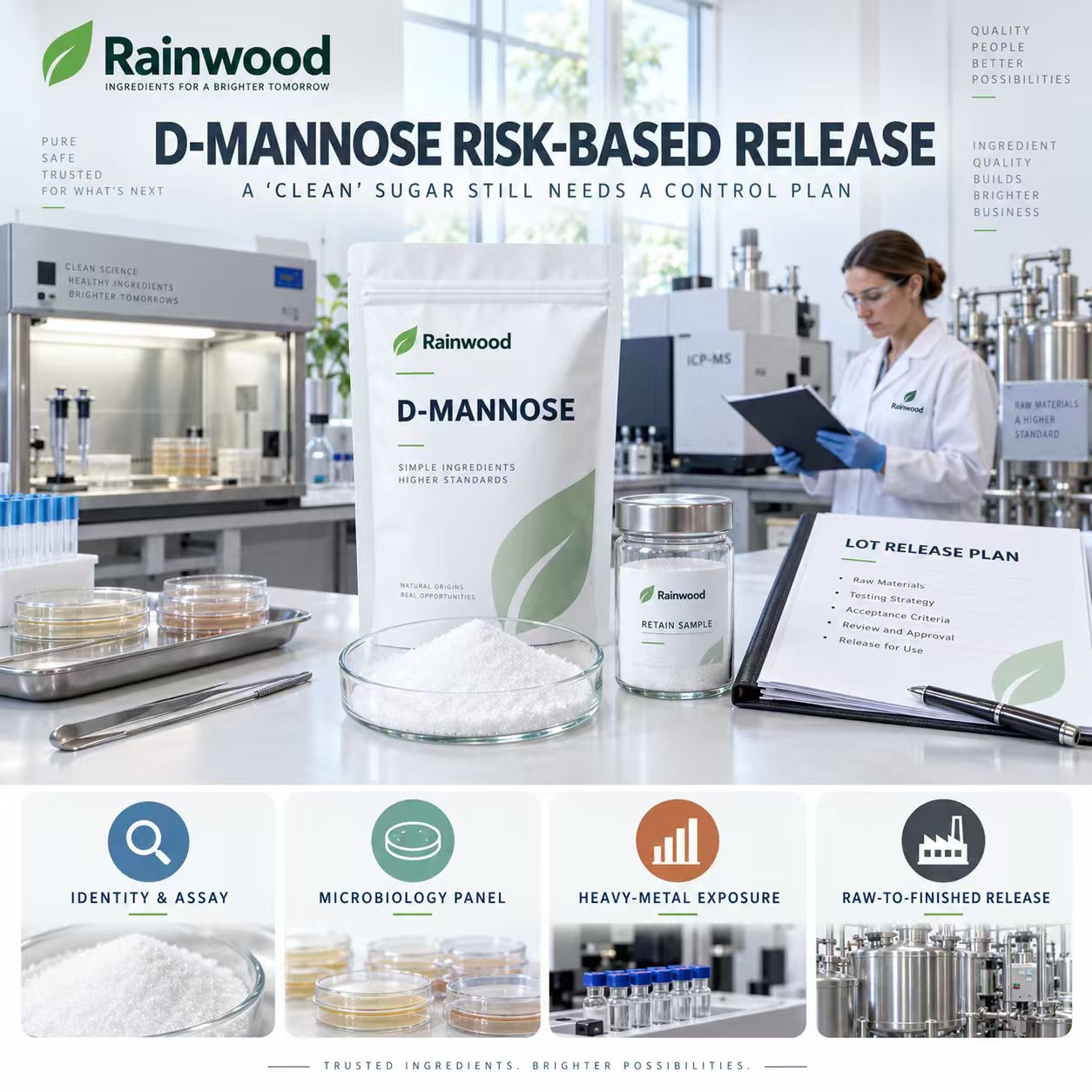
Meta title: D-Mannose Testing: Microbiology and Heavy Metals Matter
Meta description: A single-ingredient sugar still needs a risk-based release plan. Separate raw-material tests from finished-product requirements for D-mannose.
The supplier says D-mannose is a clean, crystalline sugar and sends an assay result. Your QA manager asks for microbiology, heavy metals, packaging history, and the finished-product exposure calculation. Purchasing calls the extra tests unnecessary.
The right answer is not “test everything forever.” The right answer is a documented risk-based panel for the exact grade, route, market, and finished format.
Start with the D-mannose ingredient specification, then separate what must be checked at raw-material receipt from what must be checked in the finished product.
“Clean sugar” is a description, not a release specification
A white powder with a high assay can still require controls for water, microbial quality, heavy metals, related substances, foreign matter, and packaging contamination. Risk depends on how the material was made, dried, packed, stored, shipped, and combined with other ingredients.
USP’s Mannose monograph defines identity and assay, but the commercial release plan still needs to reflect your application and market. [USP Mannose Monograph](https://doi.org/10.31003/USPNF_M5509_02_01)
Ask the supplier to identify which tests are routine, which are periodic, and which are triggered by a source or process change. Then document why the panel is appropriate.
Read the D-mannose COA gap review before accepting a certificate that lists only assay.
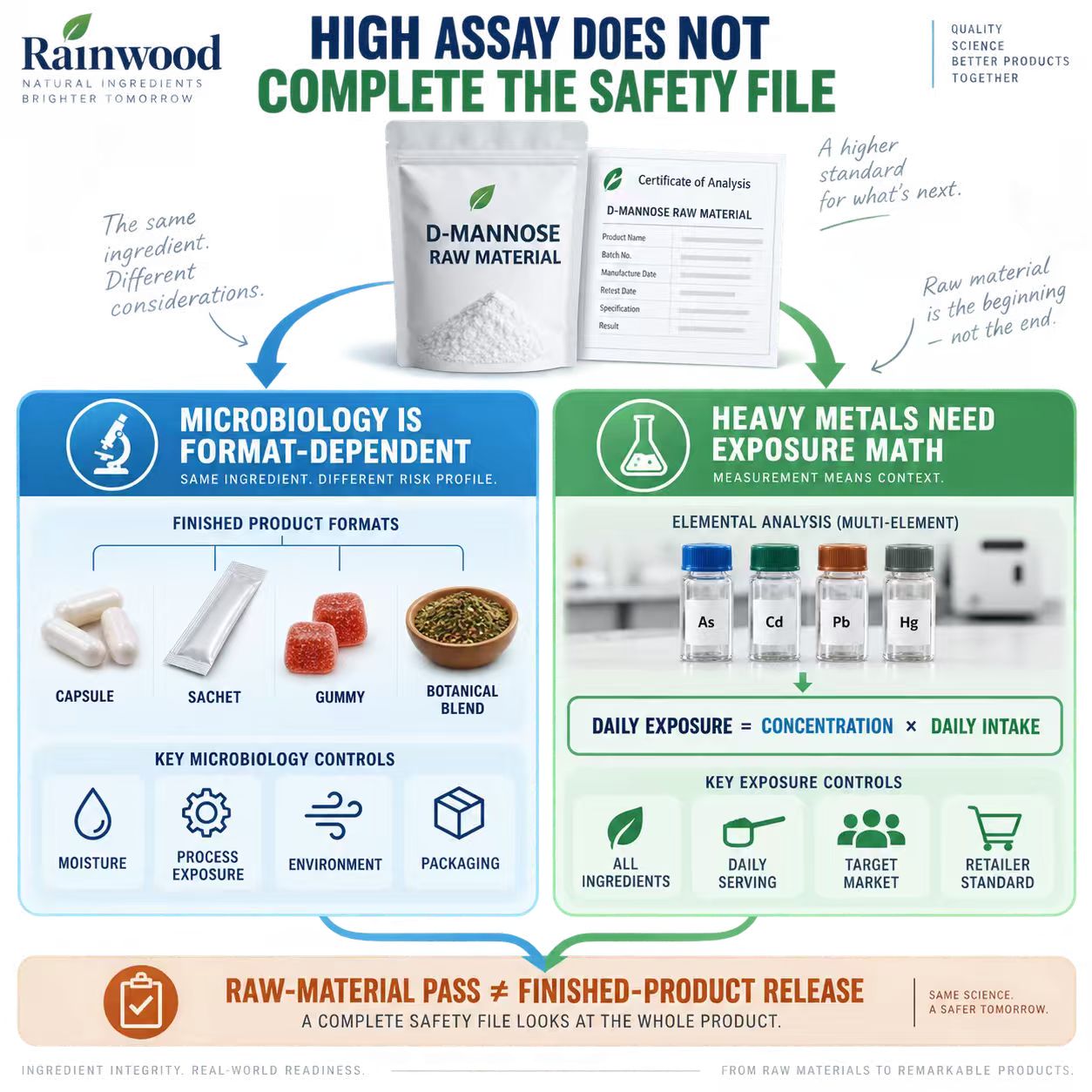
Microbiology risk is format-dependent
A dry raw material may have a different microbial risk profile from a water-containing gummy, a flavored drink powder, or a blend with botanical extracts. The same D-mannose can enter a finished product with a different exposure and process environment.
Consider:
- total aerobic count;
- yeast and mold;
- specified pathogens required by the market;
- water activity or moisture;
- post-process exposure;
- sanitation and environmental controls;
- package opening and storage;
- companion botanicals or probiotics.
Do not use one raw-material result as a substitute for finished-product release where the matrix or process introduces new risk.
Heavy metals need an exposure calculation
A heavy-metal result is meaningful only when connected to the amount consumed and the target market’s requirements. Review arsenic, cadmium, lead, and mercury as applicable, but do not assume a raw-material result automatically proves finished-product compliance.
Calculate:
`daily exposure = concentration in material × material amount consumed per day`
Then include all relevant ingredients and the destination market’s limit or retailer standard. A cranberry or botanical companion can contribute more exposure than the D-mannose itself, so the finished formula needs an ingredient-by-ingredient assessment.
FDA’s dietary supplement guidance makes the manufacturer or distributor responsible for ensuring that the marketed product meets applicable safety requirements. FDA does not pre-approve every supplement before sale. [FDA dietary supplement Q&A](https://www.fda.gov/food/information-consumers-using-dietary-supplements/questions-and-answers-dietary-supplements)
Related substances and residuals belong to the process discussion
The supplier’s manufacturing route can affect which related sugars, process residues, or solvent questions are appropriate. You do not need a speculative list of every chemical. You do need a route-informed justification for the tests you select.
Request:
- process or source statement;
- known related-substance controls;
- residual-solvent statement where applicable;
- cleaning and foreign-matter controls;
- change-control triggers;
- laboratory method and reporting limit.
Do not confuse a broad “food grade” statement with proof that every finished-product or market-specific requirement has been met.
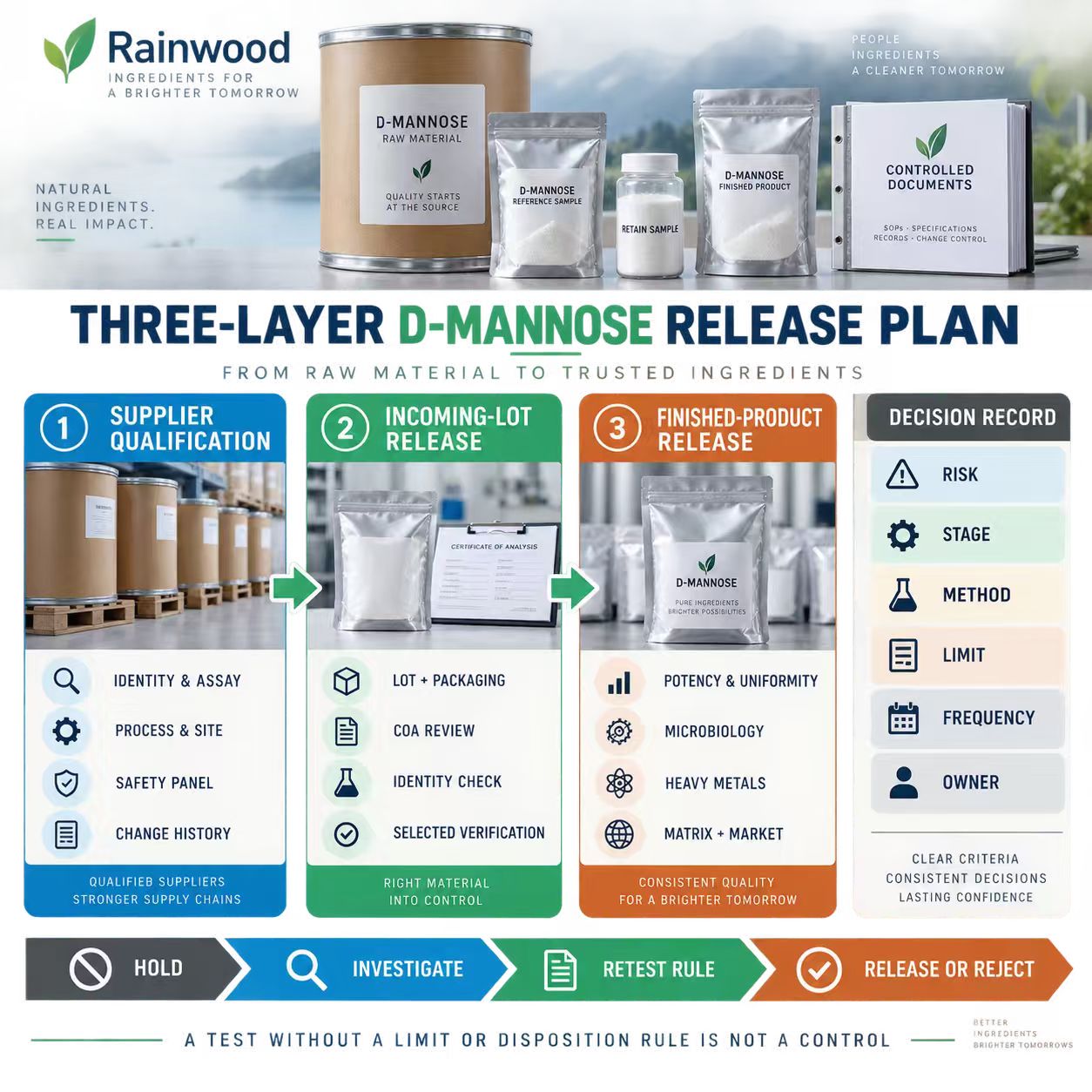
Build a three-layer release plan
Layer 1: supplier qualification
Review identity, assay, basis, water, microbiology, heavy metals, process statement, manufacturer, site, certifications, and change history.
Layer 2: incoming-lot release
Verify the lot number, packaging, COA, identity, assay, and selected safety tests according to the qualification plan. Increase testing for a new supplier, new source, unusual result, or change notification.
Layer 3: finished-product release
Test the actual capsule, sachet, gummy, or blend against its finished specification. Include potency, uniformity, microbiology, heavy metals, and other endpoints that the matrix and market require.
Use the D-mannose raw-to-finished release checklist to keep the three layers from being collapsed into one COA.
Avoid both under-testing and “test everything” theater
Under-testing leaves a gap between the document and the customer’s exposure. Over-testing without a reason consumes budget and may produce data that no one reviews.
For each test, record:
- risk mechanism;
- applicable stage;
- method;
- acceptance limit;
- frequency;
- owner;
- action if the result fails.
This turns the panel into a decision system. A test that has no acceptance limit or disposition rule is paperwork, not control.
How RainwoodBio can support a risk-based panel
RainwoodBio’s public workflow describes supplier management, testing and release, documentation, packaging, warehousing, and traceability. These are company-published capabilities. Ask for a project-specific D-mannose release matrix that links the raw material, finished format, target market, daily serving, and supplier history to the selected tests.
Explore the D-mannose testing and documentation review when the product includes cranberry, botanicals, probiotics, or a water-containing matrix.
The release panel should match the risk owner
Assign each control to a person who can act on the result. QA may own lot release, formulation may own dose and matrix compatibility, regulatory may own market limits, and purchasing may own supplier change notices. Put the owner beside the method and acceptance limit in the specification.
This matters when results disagree. A supplier COA may pass while an incoming verification result is outside your internal limit. The team then needs a documented hold, investigation, retest rule, and disposition—not an informal decision to average the numbers. The same logic applies when a finished gummy has acceptable raw-material microbiology but fails its finished-product limit.
Risk-based testing is strongest when it leads to a clear action. If nobody knows who can release, reject, investigate, or change the frequency, the panel is not yet operational.
Release gate before importing or launching
Require:
- a written identity and assay specification;
- a justified microbiology and heavy-metal panel;
- a clear raw-material versus finished-product boundary;
- lot traceability and change-control terms;
- a market-specific exposure review;
- a failure, hold, retest, and replacement procedure.
Request a D-mannose risk-based testing plan. Send RainwoodBio your COA, manufacturing route statement, formula, daily serving, format, target country, and retailer requirements so the team can separate essential controls from unnecessary testing.
Frequently asked questions
1.Does dry D-mannose need microbiology testing?
The answer depends on the grade, supplier history, specification, market, and intended format. A risk-based plan should explain the chosen test frequency and limits.
2.Can a raw-material heavy-metal result cover the finished product?
Not automatically. Calculate daily exposure for the full formula and confirm the target market’s requirements.
3.Is a “food grade” certificate enough?
No. It is context, not a substitute for identity, potency, safety, traceability, and finished-product evidence.
References
- United States Pharmacopeia, Mannose Monograph: https://doi.org/10.31003/USPNF_M5509_02_01
- FDA, Questions and Answers on Dietary Supplements: https://www.fda.gov/food/information-consumers-using-dietary-supplements/questions-and-answers-dietary-supplements
- RainwoodBio About Us: https://www.rainwoodbio.com/about-us
This article is for B2B procurement and educational purposes. Product, analytical, safety, labeling, and regulatory requirements should be confirmed for the exact ingredient, finished product, and destination market.