 EN
EN

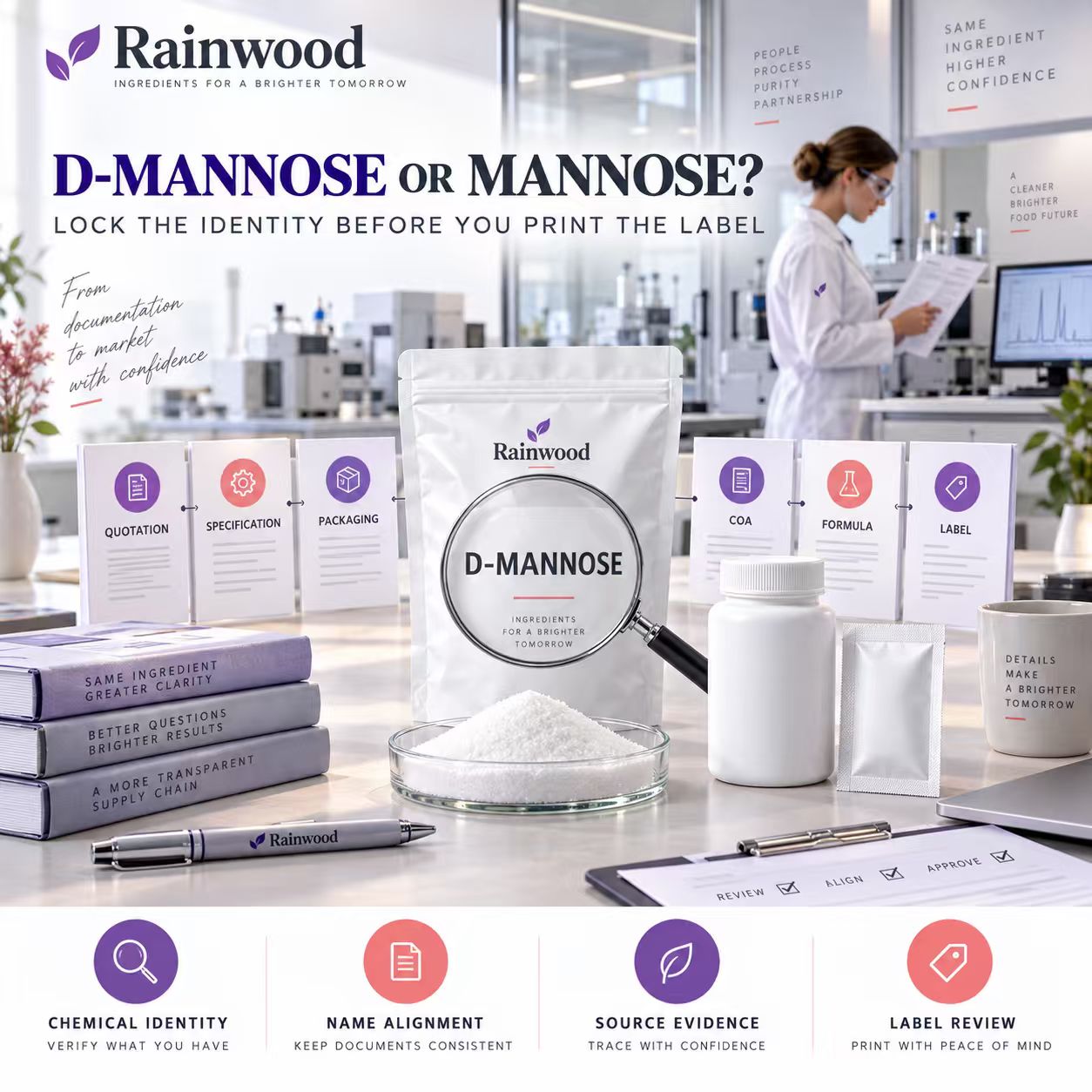
Meta title: D-Mannose vs Mannose: The Label Identity Check
Meta description: “Mannose” is not a complete procurement specification. Learn how brands verify identity, source, grade, and label language before launch.
The supplier quotation says “mannose.” The product developer writes “D-mannose.” The artwork team shortens it again to “mannose powder.” Everyone assumes they are discussing the same ingredient until customs, a retailer, or a testing laboratory asks for the exact identity.
This is not a grammar problem. It is a commercial-control problem. A name that is too broad can hide the wrong isomer, a different grade, a carrier-containing material, or a document set that does not match the product you plan to sell.
Before you approve the quotation, lock the identity in the D-mannose ingredient specification and make the same wording flow through the COA, purchase order, formula, label, and finished-product record.
The short name is not the purchasing definition
Mannose is the chemical family name. D-mannose identifies the stereochemical form normally used in the supplement trade. USP’s official monograph uses “Mannose” and lists D-mannose as a synonym, but the article is still defined by a specification, identity tests, assay range, and dried-basis calculation—not by a casual product title. [USP Mannose Monograph](https://doi.org/10.31003/USPNF_M5509_02_01)
Your specification should state, as applicable:
- accepted name and synonym;
- stereochemical designation;
- chemical formula and molecular weight;
- CAS or other internal identifier if used;
- source or manufacturing route;
- grade and intended use;
- carrier or excipient status;
- assay basis and acceptance range;
- identity method;
- packaging and storage.
The purpose is not to make a label unnecessarily technical. The purpose is to stop a sales name from becoming the only control on the material.
A supplier can use a familiar word and still quote a different product
One “mannose” listing may refer to a single-ingredient crystalline powder. Another may describe a premix, a research reagent, or a material sold under a regional naming convention. A third may use “mannose” as a search keyword while the actual certificate reports a different composition.
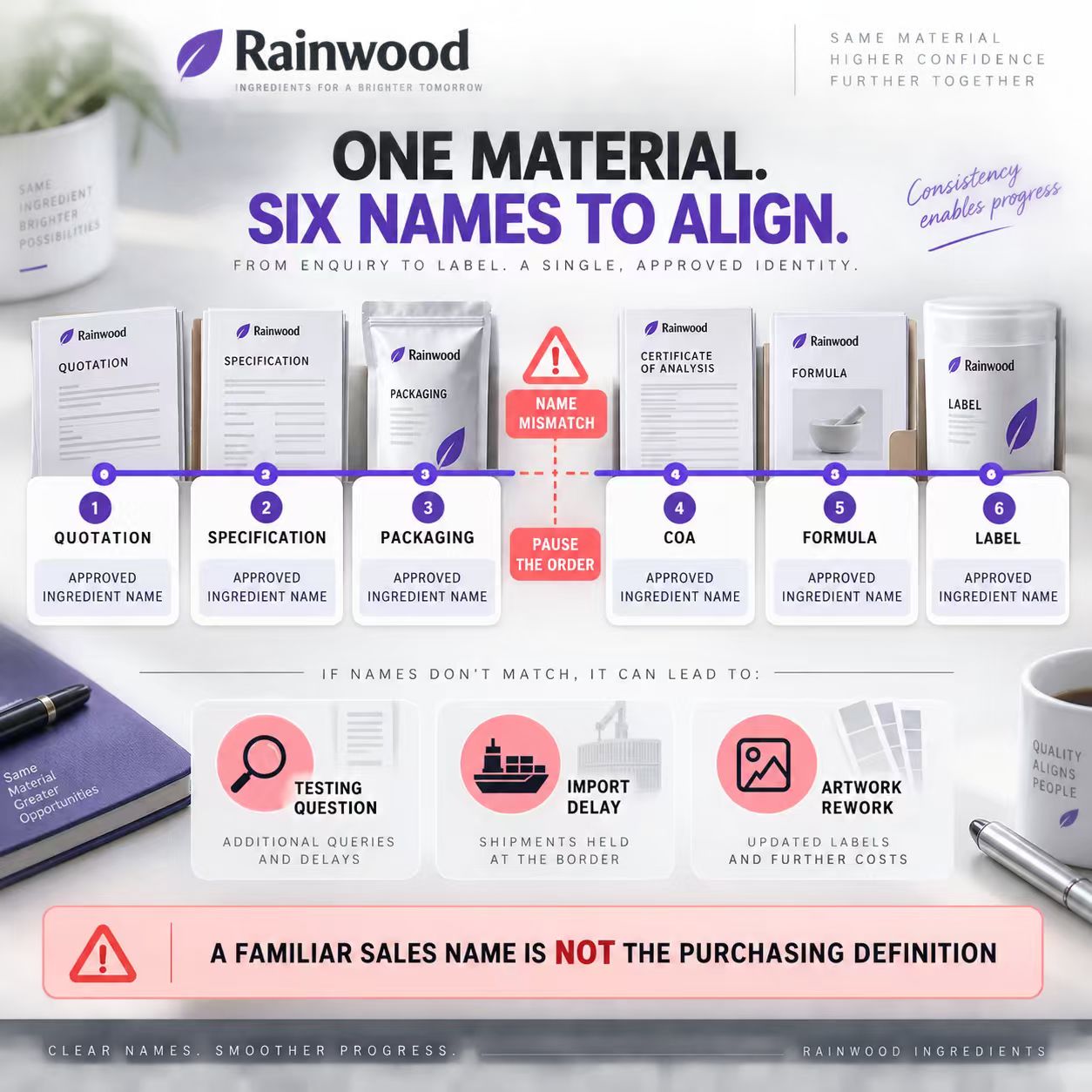
Ask the supplier to map the commercial name to the identity statement on the COA. Then compare:
1. name on quotation;
2. name on specification;
3. name on packaging;
4. name on COA;
5. name used in your formula and label;
6. name used in import and product-registration documents.
If the six lines do not match, pause the order. A mismatch may be harmless, but you should resolve it before the documents become inconsistent.
Read the D-mannose COA identity review for the document questions that sit behind the name.
Do not confuse a clean label with a complete specification
Some buyers prefer a simple “D-mannose” declaration because it keeps the Supplement Facts panel clear. That does not remove the need to define the incoming material. Internal records can be more precise than consumer-facing copy.
For example, your procurement specification may identify the article as D-mannose with a defined assay range on a dried basis, while the finished label uses the market-accepted ingredient name. The compliance team then confirms whether that name, source disclosure, and any “natural” or “plant-derived” wording are allowed in the destination market.
FDA explains that supplement labels must identify dietary ingredients, serving size, amount per serving, other ingredients, and the responsible business. FDA does not pre-approve every supplement or label before sale, so the brand carries the initial responsibility for ensuring the product and claims meet applicable requirements. [FDA dietary supplement Q&A](https://www.fda.gov/food/information-consumers-using-dietary-supplements/questions-and-answers-dietary-supplements)
That makes the naming file a business asset, not a cosmetic exercise.
The “natural” word creates another verification layer
D-mannose can be obtained through different commercial routes. A supplier may describe a source or process in broad marketing language. If your label, retailer listing, or certification depends on “natural,” “fermentation-derived,” “non-GMO,” organic, or another origin claim, ask for evidence specific to the purchased grade and market.
Do not carry a raw-material descriptor into consumer copy without checking:
- whether the term has a legal definition in the target market;
- whether the evidence covers the exact manufacturer and site;
- whether the material is chemically altered or blended;
- whether the certification scope covers this ingredient;
- whether the finished formula still qualifies after processing.
A source statement can be useful. It is not automatically a finished-product authorization.
A label-identity worksheet for brand teams
Complete this table before artwork approval:
| Question | Required answer |
|---|---|
| What exact ingredient is purchased? | Defined chemical identity and synonym |
| What appears on the COA? | Same identity, method, and lot |
| What appears on the label? | Market-accepted name reviewed for the target jurisdiction |
| Is a source claim used? | Evidence for source, process, and certification |
| Is a carrier present? | Full composition and “other ingredients” review |
| What amount is declared? | Consistent serving and assay-basis math |
| Who approves changes? | Named owner and written change-control trigger |
Keep the worksheet with the formula and technical dossier. It gives sales, regulatory, purchasing, and manufacturing one version of the ingredient story.
Use the label and specification alignment checklist before sending artwork to a retailer or marketplace.
How RainwoodBio can help align the file
RainwoodBio’s public workflow describes requirement confirmation, compliance assessment, raw-material supplier management, production control, testing and release, documentation, and traceability. These are useful controls for aligning a commercial name with a project specification; the exact D-mannose evidence still needs to be agreed for your order.
Ask RainwoodBio to create a one-page identity map connecting the quotation, COA, packaging, formula, label wording, target market, and finished-product documents. Use the **D-mannose OEM documentation review** **[INTERNAL LINK -> OEM Service Page]** if you are launching capsules, sachets, gummies, or a blend.
Decision gate before artwork
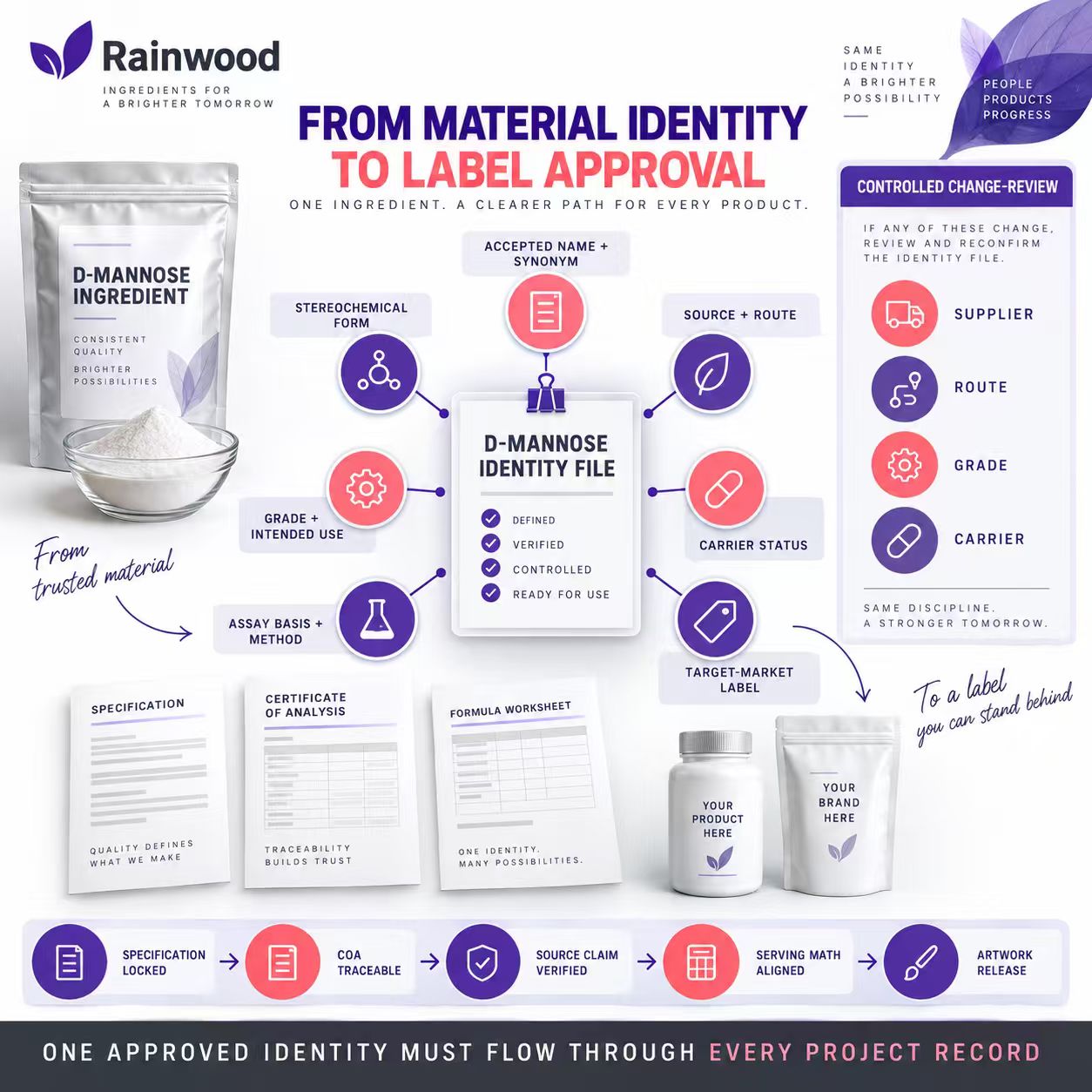
Do not approve the label until:
1. The purchased identity is written in the specification.
2. The COA and packaging use traceable wording.
3. Any source or “natural” language has market-specific evidence.
4. The serving amount matches the assay basis and formula.
5. A change in supplier name, route, grade, or carrier triggers review.
Request a D-mannose label and identity check. Send RainwoodBio your draft label, supplier COA, target market, formula, and planned claims so the team can flag identity and documentation gaps before printing.
Frequently asked questions
1.Is “mannose” acceptable on every label?
Not automatically. The acceptable declaration depends on the jurisdiction, product category, and exact material. Confirm the market-specific naming and the relationship between the label name and the procurement specification.
2.Is D-mannose always naturally sourced?
Do not assume that from the name. Ask for the source and manufacturing statement if origin affects your positioning, certification, or regulatory file.
3.Can the internal specification be more detailed than the consumer label?
Yes. A detailed internal specification can protect identity and quality while the consumer label uses the legally accepted ingredient name.
References
- United States Pharmacopeia, Mannose Monograph: https://doi.org/10.31003/USPNF_M5509_02_01
- FDA, Questions and Answers on Dietary Supplements: https://www.fda.gov/food/information-consumers-using-dietary-supplements/questions-and-answers-dietary-supplements
- RainwoodBio About Us: https://www.rainwoodbio.com/about-us
This article is for B2B procurement and educational purposes. Product, analytical, safety, labeling, and regulatory requirements should be confirmed for the exact ingredient, finished product, and destination market.