 EN
EN

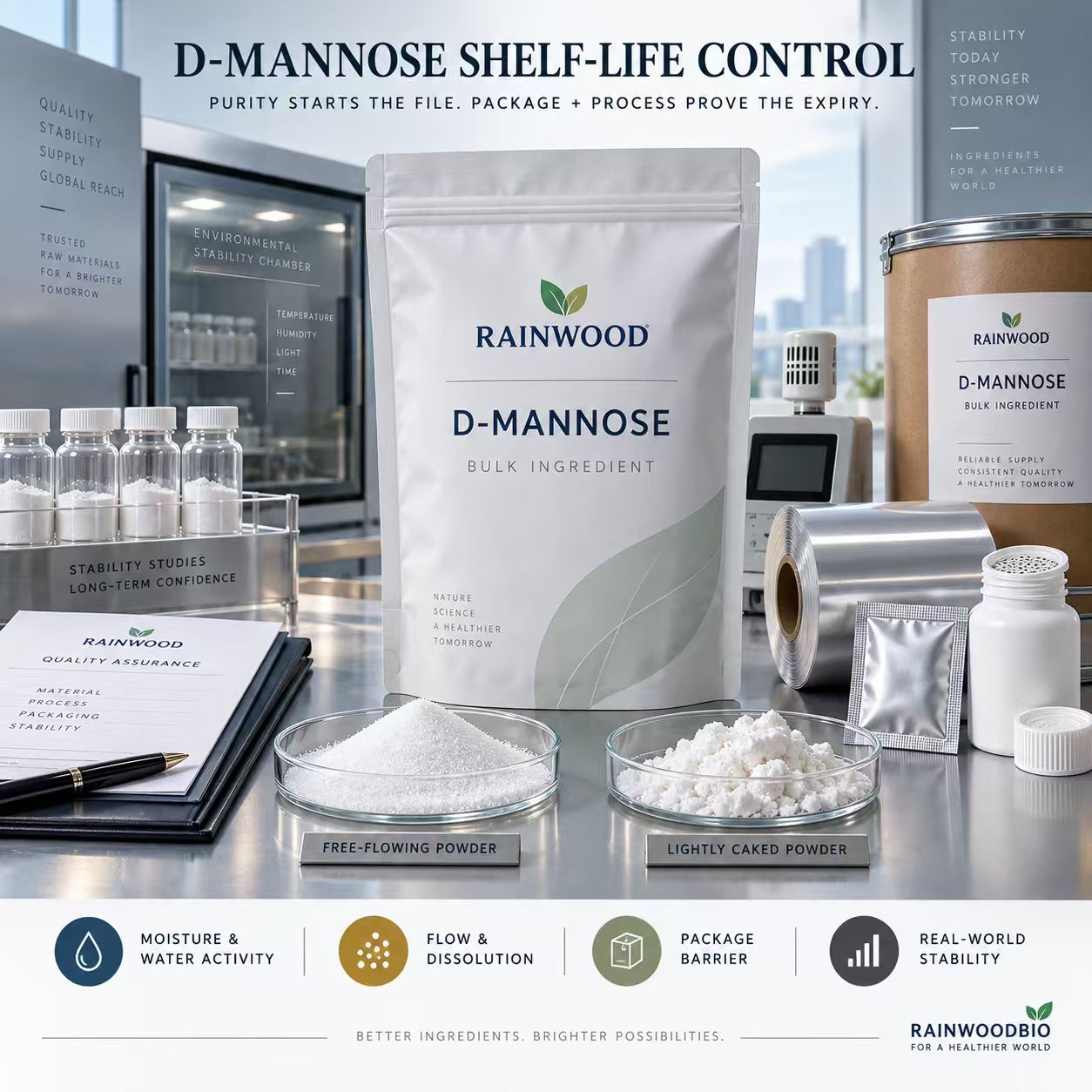
Meta title: D-Mannose Shelf Life: Moisture, Packaging, and Stability
Meta description: Starting purity does not guarantee D-mannose shelf life. Control moisture, packaging, storage, flow, potency, and finished-format stability.
The incoming D-mannose tests at 99.5%. The brand prints a two-year shelf life. Eight months later, the powder cakes inside the pouch and the capsule line begins rejecting fills.
Starting purity is useful. It is not a shelf-life study.
D-mannose stability is a material-plus-package-plus-process question. Water pickup, humidity, temperature, particle size, repeated opening, and the final dosage form can change what the customer receives. Build the stability file around the actual product, not the first COA.
Review the D-mannose raw-material quality information before approving a retest date or finished-product expiry.
Raw-material retest and finished-product expiry are different
A raw-material retest period describes how long the ingredient is expected to remain within its specification under stated storage conditions. A finished-product expiry describes a formula in a package after processing, filling, sealing, distribution, and consumer use.
Do not copy the supplier’s raw-material date onto your label without checking:
- exact grade and lot;
- original packaging and barrier;
- storage condition;
- open-container exposure;
- finished matrix;
- process heat and moisture;
- assay and safety limits at end of shelf life.
The same D-mannose can have different stability behavior in a sealed powder sachet, a repeatedly opened jar, and a water-containing gummy.
Read the D-mannose format stability comparison before treating one format’s data as universal.
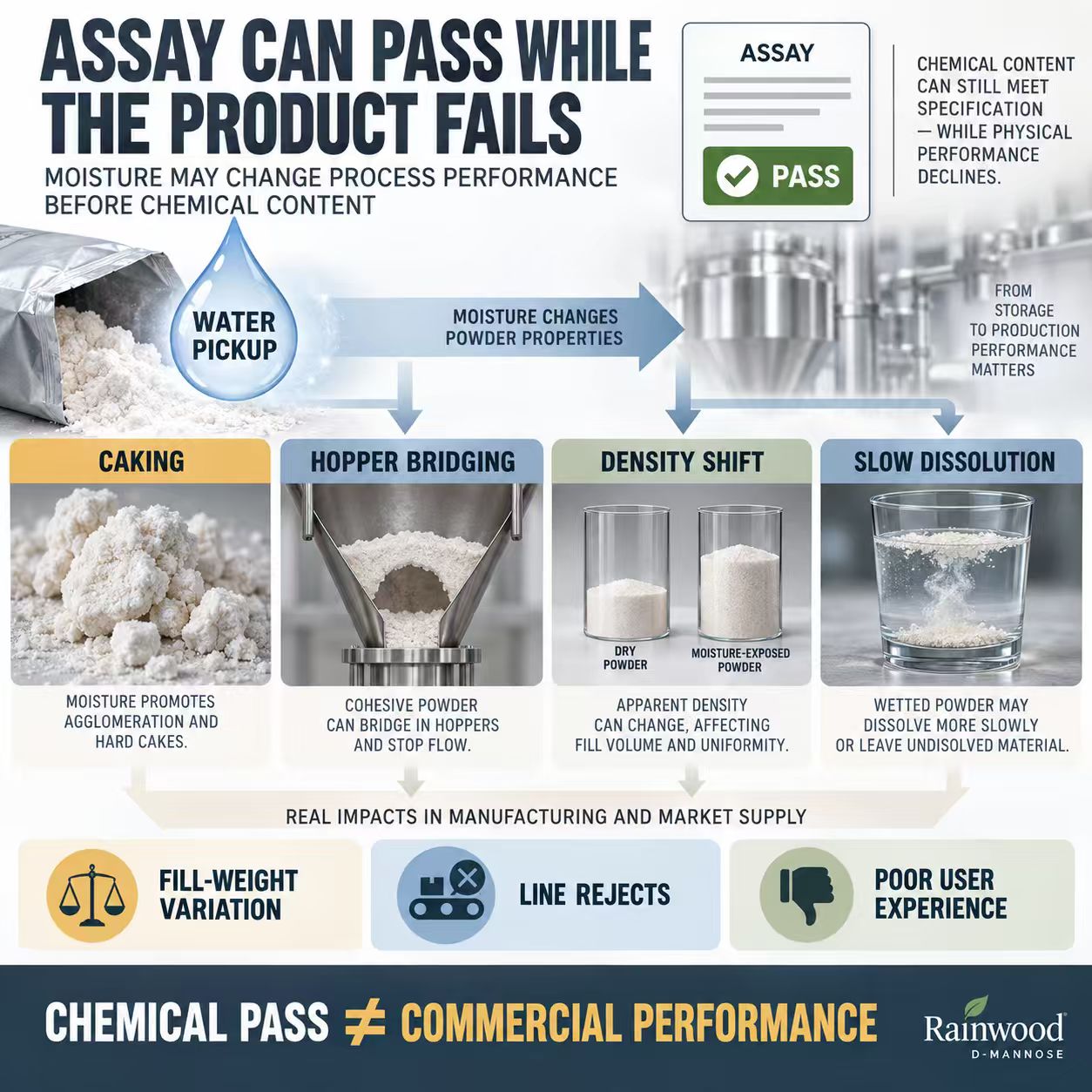
Moisture can change the process before it changes the assay
Powder can pick up moisture and still meet assay. The first visible failures may be caking, poor flow, hopper bridging, altered density, or slow dissolution. Those process failures can create fill-weight variation or a poor consumer experience before a chemical result crosses the release limit.
Track:
- water or loss on drying;
- water activity where relevant;
- bulk and tapped density;
- flow or compressibility;
- particle-size distribution;
- package moisture ingress;
- storage humidity and temperature;
- time after opening.
Use a critical-attribute map that connects each result to a business consequence. For example, a rise in water may trigger a flow investigation even if assay remains within range.
Packaging is part of the specification
“Store in a cool, dry place” is not a package design. Define the protection the ingredient and finished product actually need.
For bulk D-mannose, review:
- inner liner material;
- closure and reseal performance;
- drum or bag dimensions;
- headspace and exposure;
- pallet wrapping;
- transport temperature and humidity;
- warehouse opening practice.
For finished products, add:
- bottle or pouch barrier;
- desiccant or oxygen absorber if used;
- seal integrity;
- dosing spoon or scoop exposure;
- consumer opening frequency;
- package interaction with flavors, acids, or gummies.
The correct package depends on the product and the target shelf life. Do not infer it from an attractive sample pouch.
Stability testing should include the failure customers will notice
Chemical potency is one endpoint. For D-mannose formats, the program may also need:
- appearance and color;
- odor;
- caking or flow;
- dissolve time and sediment;
- capsule fill or tablet performance;
- gummy texture and water activity;
- microbial quality;
- package seal;
- sensory profile.
Select time points that support the proposed shelf life and include a justified stress condition. If the product is sold internationally, consider the temperature and humidity exposure expected in production, transit, warehouses, and the destination market.
Do not hide instability inside a composite sample
If a powder cakes unevenly or a blend segregates, a composite sample can dilute the problem. Sample from defined positions and retain the location record. For a finished batch, consider beginning, middle, and end of the run where the process can create gradients.
The report should connect sample location, package, lot, storage history, method, result, and disposition. That record is more useful than a single average number.
Use the D-mannose sampling and release checklist to define the stability sample map.
A practical stability decision table
| Observation | What it may indicate | Next control |
|---|---|---|
| Assay stable, powder cakes | Moisture ingress or particle change | Review package and humidity |
| Assay stable, dissolve slows | Compaction or formula interaction | Recheck particle size and matrix |
| Fill weight drifts | Density or flow change | Measure density and hopper behavior |
| Color changes in blend | Ingredient interaction or package exposure | Test individual and finished lots |
| Gummy texture softens | Moisture migration or matrix change | Review water activity and barrier |
| Microbiology rises | Moisture or process hygiene issue | Investigate water activity and controls |
Use the table to trigger investigation, not to assign blame before the evidence is available.
How RainwoodBio can support the stability file
RainwoodBio’s public company information describes testing and release, packaging, warehousing, logistics, and traceability, as well as multiple formats. Those are company-published capabilities. Request a D-mannose stability plan that names the exact lot, format, package, storage condition, time points, endpoints, and acceptance criteria.
If you are choosing between powder, capsules, sachets, or gummies, use the D-mannose stability and packaging review to compare the risk before the expiry date is printed.
Retain the evidence that explains the expiry
Keep reserve samples in the same package configuration used for the study, with the lot, storage condition, pull date, and test results recorded. When a complaint arrives, the team can compare the returned product with a retained sample instead of guessing whether the issue began in manufacturing, transport, warehouse storage, or consumer handling.
For powders, photograph or describe caking, flow, and appearance consistently. For capsules, record shell condition, fill behavior, and disintegration or dissolution where relevant. For gummies, retain texture, water activity, package seal, and sensory observations. A stability file that contains only an assay table will not explain why a customer says the product no longer dissolves or chews the same way.
Shelf-life approval gate
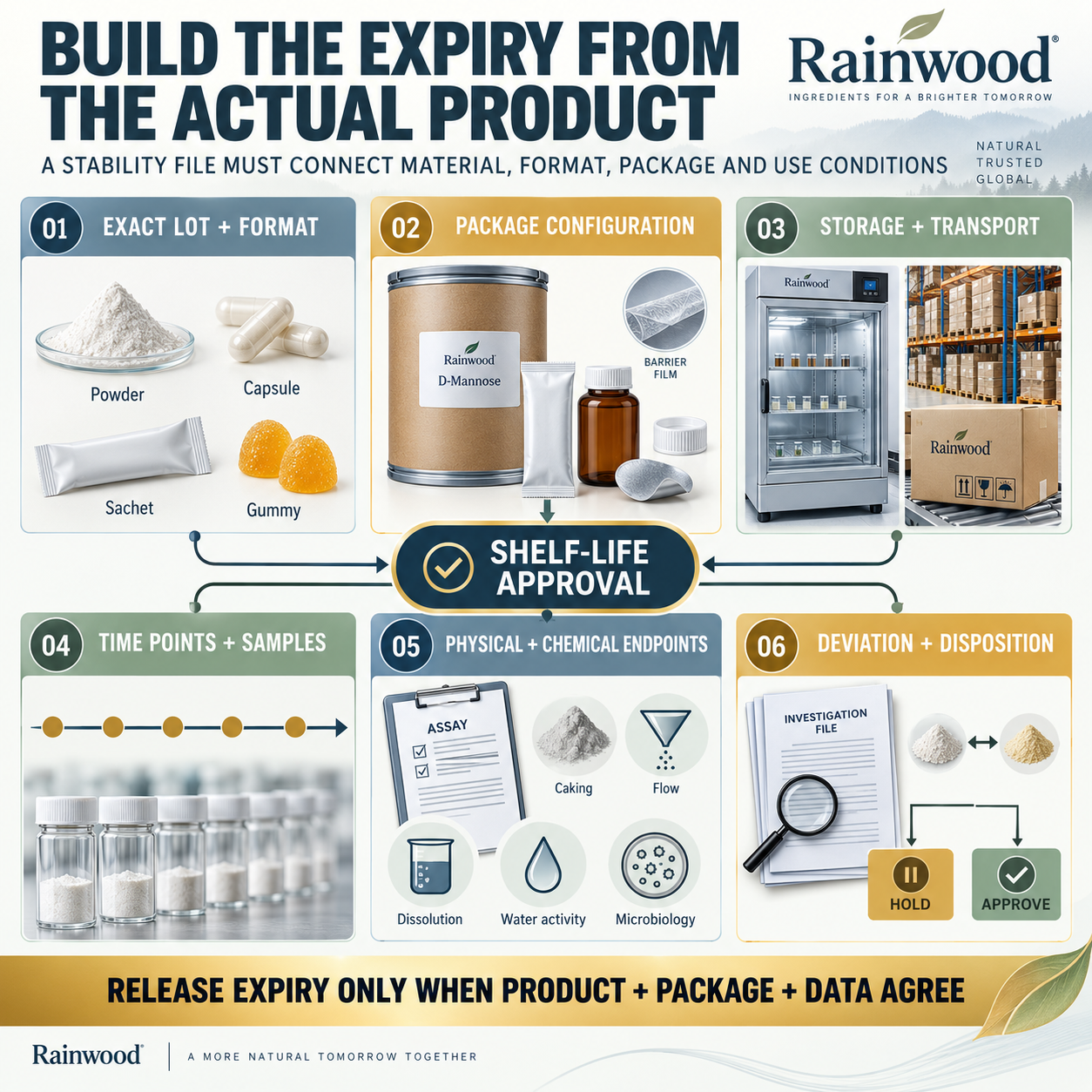
Approve the claimed shelf life only when:
- the exact product and package are defined;
- raw-material and finished-product specifications are separate;
- stability endpoints include physical and sensory risks where relevant;
- sampling locations and methods are documented;
- storage and transport assumptions are realistic;
- deviations trigger a documented investigation;
- the target market’s expiry and storage wording are reviewed.
Request a D-mannose shelf-life and packaging assessment. Send RainwoodBio your current COA, package design, format, target shelf life, storage route, and any caking or potency concern so the team can suggest a focused stability plan.
Frequently asked questions
1.Does 99% purity mean the powder has a two-year shelf life?
No. Purity is a starting result. Shelf life depends on the specification, storage, package, process, and end-of-life data.
2.Is moisture always a failure?
Not necessarily. The question is whether moisture remains within the agreed limit and whether it changes flow, potency, microbiology, dissolution, or finished-product performance.
3.Can a raw-material stability study support a gummy expiry?
Not by itself. The gummy needs finished-product data in its actual matrix and package.
References
- United States Pharmacopeia, Mannose Monograph: https://doi.org/10.31003/USPNF_M5509_02_01
- FDA, Dietary Supplement Guidance: https://www.fda.gov/food/guidance-documents-regulatory-information-topic-food-and-dietary-supplements/dietary-supplements-guidance-documents-regulatory-information
- RainwoodBio homepage: https://www.rainwoodbio.com/
This article is for B2B procurement and educational purposes. Product, analytical, safety, labeling, and regulatory requirements should be confirmed for the exact ingredient, finished product, and destination market.