 EN
EN

Meta title: D-Mannose “UTI Support” Claims: Check the Market First
Meta description: D-mannose urinary claims can create listing and regulatory risk. Separate education, structure-function language, disease claims, and market evidence.
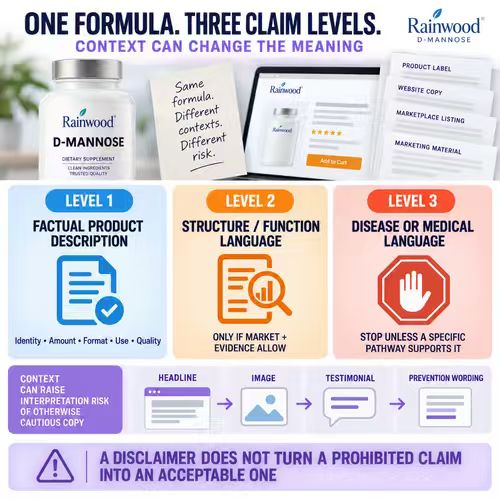
The marketplace listing says “supports urinary tract health.” The social post says “helps prevent UTIs.” The distributor asks for clinical proof. The same D-mannose formula now has three different claim levels—and three different risks.
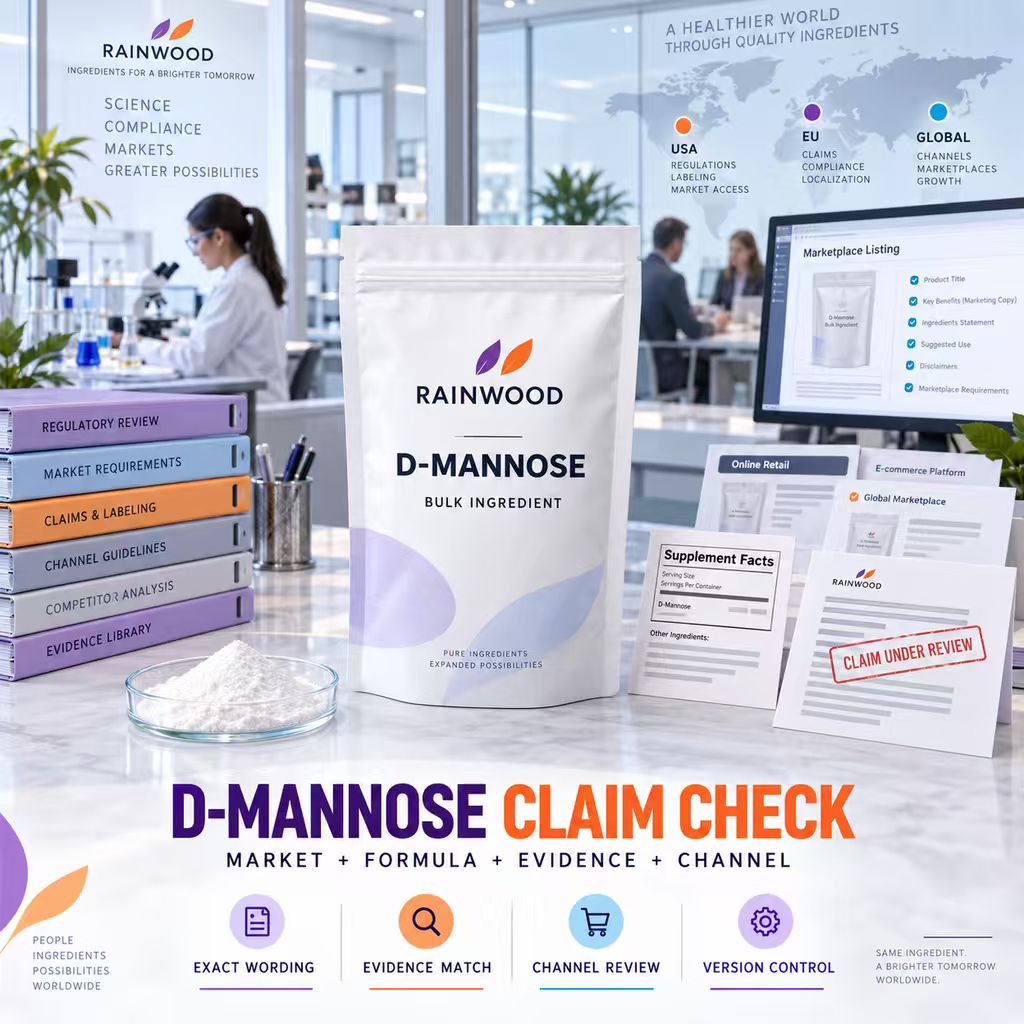
Do not let a familiar consumer phrase decide your regulatory position. D-mannose products need a market-specific claim file connecting the exact formula, dose, evidence, label, website, advertising, and seller channel.
Review the D-mannose ingredient and format information, then audit every public sentence before launch.
A support phrase can become a disease claim by context
Words do not operate alone. “Urinary support” may appear in a lower-risk educational context, but a product page that mentions infection, bacteria, symptoms, prevention, treatment, or a clinical outcome can change how the claim is interpreted.
FDA states that dietary supplements are not generally approved before marketing and that manufacturers and distributors are responsible for meeting applicable requirements. [FDA dietary supplement Q&A](https://www.fda.gov/food/information-consumers-using-dietary-supplements/questions-and-answers-dietary-supplements)
In the EU, food supplements are regulated as foods and the business placing the product on the market carries responsibility for safety; national rules can affect non-vitamin substances and claims. [EFSA food supplements](https://www.efsa.europa.eu/en/topics/topic/food-supplements)
The practical lesson: “allowed” cannot be answered without the destination market, product category, channel, wording, and evidence file.
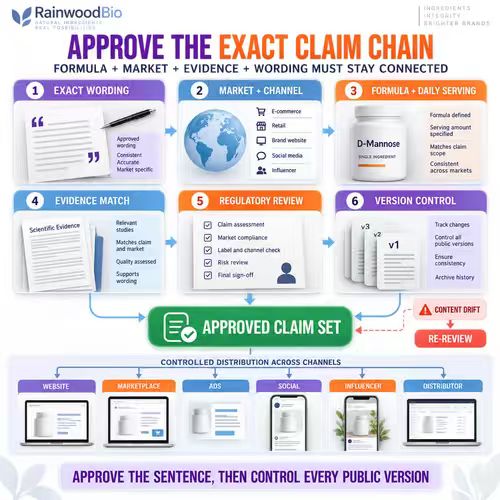
The claim-to-product chain must be unbroken
Build a table with these columns:
- exact customer-facing claim;
- market and channel;
- formula and ingredient amounts;
- daily serving;
- population and use instructions;
- supporting study or regulatory source;
- limitations and prohibited extensions;
- reviewer and approval date.
If a study uses D-mannose plus cranberry but your label sells D-mannose alone, the chain is incomplete. If the study uses a different dose or product form, the evidence may not transfer directly.
Read the D-mannose and cranberry evidence-file guide before borrowing language from combination research.
Do not treat an ingredient study as a finished-product authorization
An ingredient’s identity and assay do not authorize a health claim. A study’s result does not automatically authorize every marketing sentence. The relevant evidence must be matched to:
- exact ingredient form;
- dose and schedule;
- finished formula;
- target population;
- endpoint;
- study duration;
- target market;
- wording and presentation.
Avoid claims that state or imply diagnosis, treatment, cure, or guaranteed prevention. Add a disclaimer only where appropriate; a disclaimer does not convert a prohibited disease claim into an acceptable one.
Amazon and DTC brands have a second risk: content drift
Your approved website copy may be compliant while an affiliate, marketplace bullet, influencer video, or customer-service script uses stronger language. Capture every channel in the review:
1. product title;
2. bullets and images;
3. enhanced content;
4. paid ads;
5. email flows;
6. social posts;
7. influencer briefs;
8. customer-service templates;
9. distributor listings.
Assign one owner to archive the approved claim set and review changes. A supplier cannot control your downstream copy, but the supplier can help you understand what the formula and evidence actually support.
Use the D-mannose label and listing audit to compare every public channel with the approved evidence file.
A safer claim architecture
Organize copy into three levels:
Level 1: factual product description
Ingredient identity, amount, format, flavor, use instructions, and quality information.
Level 2: permitted structure or function language
Only where the target market allows it and the wording is supported by the required substantiation.
Level 3: disease or medical language
Do not use unless a specific legal pathway, authorization, and evidence support it. For many supplement launches, this level is a stop sign.
The same sentence can move between levels when a headline, image, testimonial, or “before and after” story changes its meaning.
How RainwoodBio can support the evidence file
RainwoodBio’s public workflow describes requirement confirmation, compliance assessment, formula development, testing and release, documentation, and multiple formats. These are company-published capabilities. Ask for a factual ingredient and finished-product dossier; do not ask a raw-material supplier to “approve” a disease claim for your market.
Explore the D-mannose label and OEM compliance review to align formula, format, label, and target market before production.
Give sales and distributors a controlled language sheet
The claim file should not stop with the regulatory reviewer. Give sales, distributors, affiliates, and customer-service staff a short approved-language sheet showing what the product is, what it is not, and which phrases require escalation. Include the exact product name, serving, format, target market, approved benefit wording, prohibited disease wording, and the evidence version.
Ask distributors to submit translated listings and image text before publication. A single stronger phrase added to a marketplace bullet can create more exposure than the carefully reviewed label. Keep an archive of approved versions so the team can identify when a claim changed and which inventory or campaign it affected.
Keep education separate from the sales promise
An educational article can explain what a study measured and where its limits sit. A product page asks a customer to buy. Do not copy a study summary into the product page without rewriting it for the exact formula, dose, market, and permitted claim category. Remove implied certainty from headlines, testimonials, comparison tables, and “before and after” language.
If a distributor wants a stronger phrase, make the request a formal review item. Record the proposed wording, the evidence requested, the decision, and the person who approved it. This simple version trail protects the brand when a listing is translated, syndicated, or updated by an outside agency.
Claim approval gate
Before launch, require:
- target market and channel identified;
- every claim written exactly as it will appear;
- formula and dose matched to the evidence;
- disease language removed or legally justified;
- website, marketplace, advertising, and influencer copy aligned;
- reviewer, source, date, and version recorded;
- a process for monitoring post-launch changes.
Request a D-mannose claim and listing evidence-gap review. Send RainwoodBio your draft label, product page, formula, daily serving, target market, and current evidence so the team can flag unsupported jumps before a retailer or platform does.
Frequently asked questions
1.Can I say “supports urinary health” on every D-mannose product?
No. The answer depends on the market, product category, wording, context, and evidence. Review the exact sentence and channel.
2.Does adding a disclaimer make “prevents UTI” acceptable?
No. A disclaimer does not automatically cure a disease claim or remove the need for substantiation and legal review.
3.Can supplier studies be used in my marketing?
Only after checking the study material, dose, population, product equivalence, rights, market, and permitted wording. A supplier document is not automatic authorization.
References
- FDA, Questions and Answers on Dietary Supplements: https://www.fda.gov/food/information-consumers-using-dietary-supplements/questions-and-answers-dietary-supplements
- EFSA, Food Supplements: https://www.efsa.europa.eu/en/topics/topic/food-supplements
- EFSA, Uroval and urinary tract infection claim opinion: https://efsa.onlinelibrary.wiley.com/doi/10.2903/j.efsa.2009.1421
- RainwoodBio OEM service: https://www.rainwoodbio.com/oem
This article is for B2B procurement and educational purposes. Product, analytical, safety, labeling, and regulatory requirements should be confirmed for the exact ingredient, finished product, and destination market.