 EN
EN
Meta title: Bovine Porcine Avian or Marine Chondroitin Source Guide
Meta description: Chondroitin source affects specifications, traceability, dietary positioning, and market access. Use this evidence chain before approving a supplier.
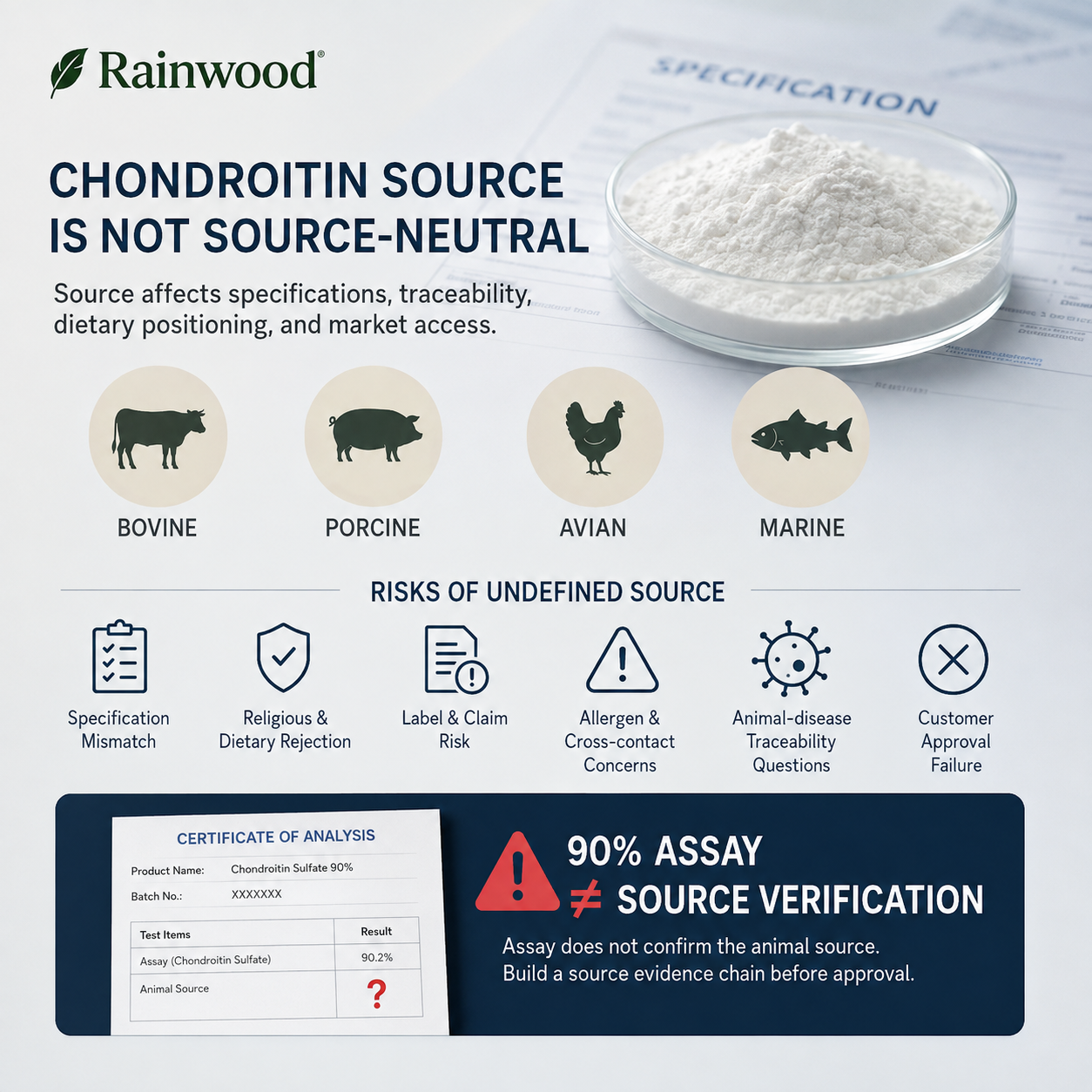
The quotation says “chondroitin sulfate 90%.” Your customer says “no porcine material.” The sales team says the ingredient is marine. The COA does not mention an animal source.
That is not a small document gap. It can invalidate the customer's positioning, religious review, specification, and purchase decision at the same time.
Commercial chondroitin can be obtained from bovine, porcine, avian, or marine tissues. Source can also influence structural characteristics. A source word in an email is therefore not decorative. It must remain connected from raw tissue through manufacturing, lot release, finished-product label, and change control.
For distributors serving multiple markets, source is a controlled product attribute—not a sales note.
“Chondroitin” is not one source-neutral commodity
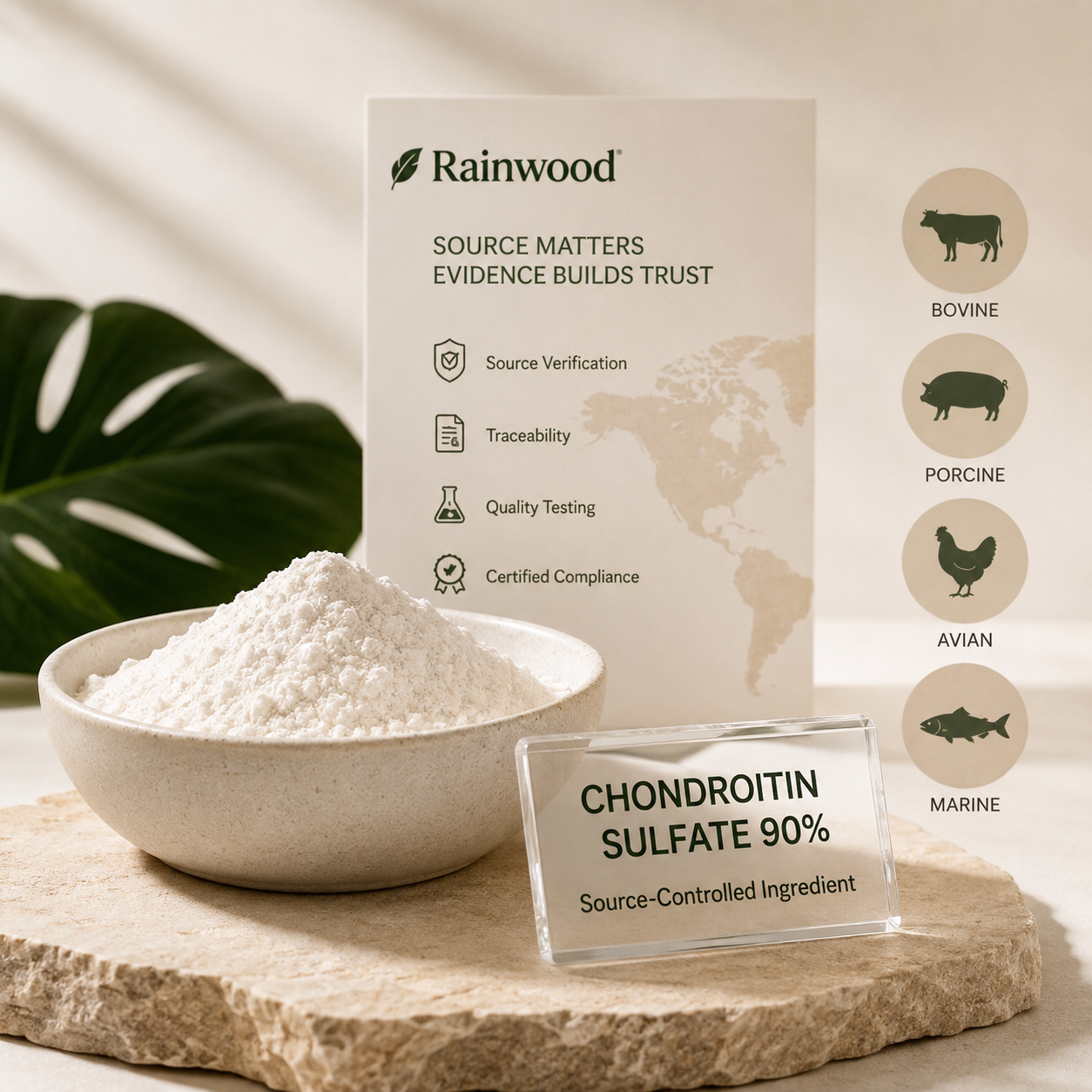
USP's public Chondroitin Sulfate Sodium definition identifies bovine, porcine, or avian cartilage from healthy domestic food animals. Scientific literature also describes commercial marine sources, including cartilaginous and bony fish.
These origins are not automatically interchangeable. They can affect:
- the applicable monograph or customer specification;
- structural profile and molecular characteristics;
- religious and dietary acceptance;
- fish or shellfish allergen review where relevant;
- animal-disease and tissue traceability questions;
- sustainability and species claims;
- customer-approved supplier and source status.
No single source is universally superior. A bovine source can be appropriate for one market and unacceptable for another. A marine source can support a positioning goal while creating its own species, allergen, sustainability, or standard-scope questions.
Use a source-specific chondroitin specification rather than purchasing an undefined generic powder.
Build the source evidence chain
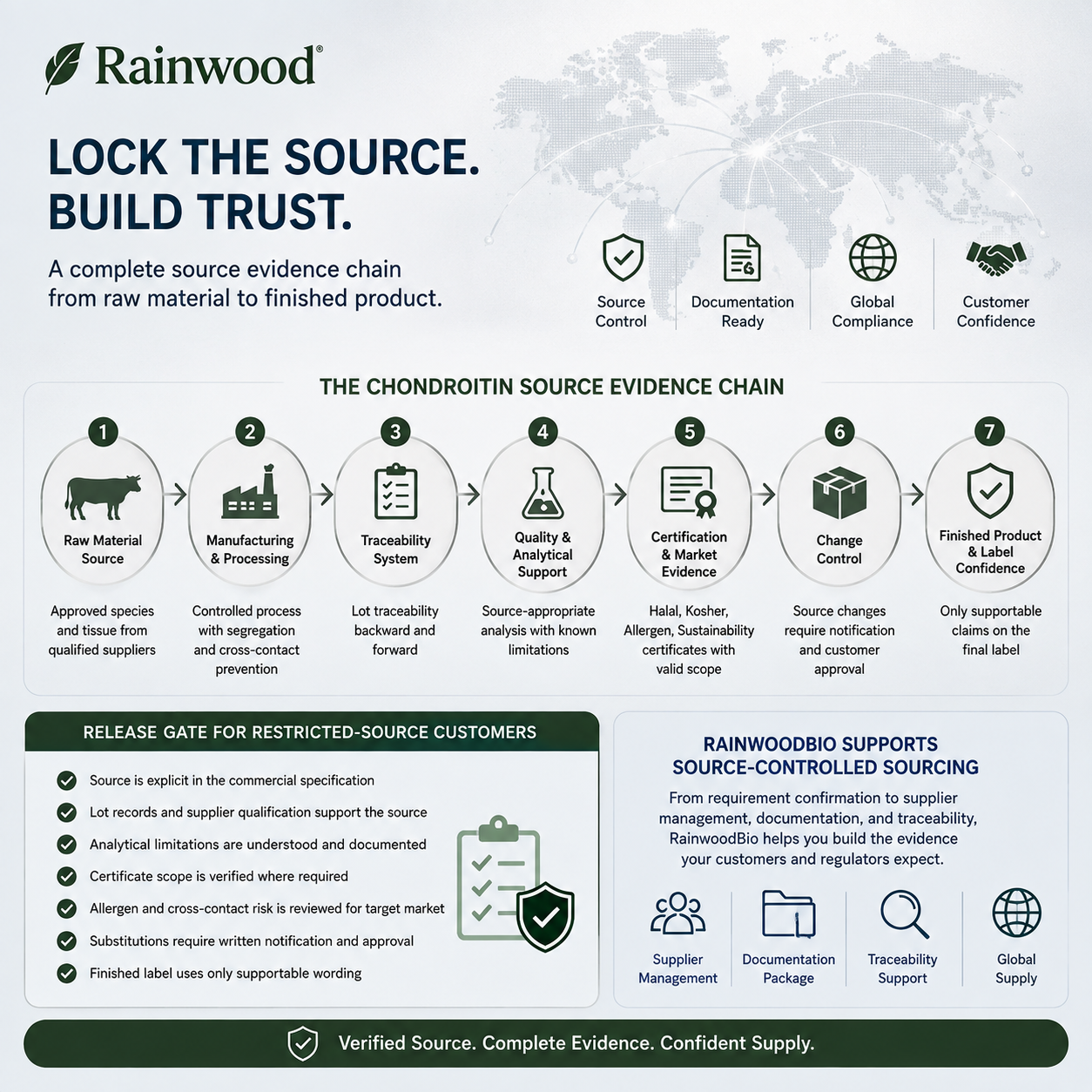
Ask for evidence at five levels.
1. Commercial declaration
The quotation, specification, purchase order, and COA should use consistent source language. “Animal,” “marine,” or “natural” may be too broad for the customer's decision.
2. Manufacturing records
Identify the actual manufacturer, manufacturing site, raw tissue, species or approved source category, process flow, and controls against unapproved substitution or mixing. A trader's declaration should be connected to the manufacturer.
3. Traceability
Lot records should connect the commercial chondroitin to incoming source material and finished containers. Define how far backward and forward the traceability system goes and what happens during an investigation.
4. Analytical support
Chondroitin source can influence sulfation patterns and molecular characteristics. Risk-appropriate analytical profiling may support a source assessment. It is not magic: mixed sources and low-level cross-contamination can be difficult to identify, and the selected method must be fit for purpose.
5. Market evidence
Halal, Kosher, allergen, vegetarian, species, sustainability, or other claims require their own scope review. Check issuer, entity, site, material, process, date, and wording. A company-level logo cannot prove that one lot is acceptable for one customer's claim.
The mixed-source risk must be addressed contractually
A supplier may need sourcing flexibility when raw tissue availability or price changes. That flexibility is commercially understandable. It is also a change to the product if your specification, market, evidence, or customer promise depends on origin.
Place source controls in writing:
- approved species and tissue category;
- prohibited sources;
- dedicated or controlled processing expectations where relevant;
- cleaning and cross-contact controls;
- supplier/manufacturer change notification;
- analytical or documentary confirmation plan;
- customer approval before substitution;
- disposition and remedy if an unapproved source is found.
“Same 90% assay” is not an acceptable substitution argument when source is a signed requirement.
Score the source dossier before the order
| Evidence area | Pass question |
|---|---|
| Definition | Is the exact allowed source written consistently? |
| Manufacturer | Is the producing entity and site identified? |
| Raw material | Is tissue/species documentation available to the required depth? |
| Segregation | Are mixing and cross-contact risks addressed? |
| Analysis | Is any source method fit for the stated purpose and limitation? |
| Certification | Does the certificate cover the right entity, site, process, and product? |
| Traceability | Can the lot be traced backward and forward? |
| Change control | Must the buyer approve a source change before shipment? |
One missing item does not automatically make the material unacceptable. It tells you where the commercial risk remains and which party must close it.
Explore RainwoodBio's published supplier and traceability workflow and convert it into source-specific records for the proposed project.
How RainwoodBio can support source-controlled sourcing
RainwoodBio's website describes requirement confirmation, supplier management, documentation, and traceability. It also publishes finished joint-support options. These statements do not verify which chondroitin sources are currently commercial, certified, or available for a particular lot.
A strong inquiry should therefore ask RainwoodBio to confirm:
- available source options and current product codes;
- specification and document package for each option;
- manufacturing-source and change-control information;
- relevant certificate scope and validity;
- formula and label consequences for the target market.
This turns “Can you supply marine chondroitin?” into a decision-ready project instead of a yes/no sales answer.
Release gate for restricted-source customers
Do not approve source-sensitive artwork or customer commitments until:
- the source is explicit in the commercial specification;
- lot records and supplier qualification support it;
- analytical limitations are understood;
- certificate scope is verified where required;
- allergen and cross-contact risk is reviewed for the target market;
- substitutions require written notification and approval;
- the finished label uses only supportable wording.
Request a chondroitin source and traceability dossier check. Send RainwoodBio your allowed and prohibited sources, destination markets, certificate needs, annual quantity, dosage form, customer claims, and current supplier documents; the team can return a source-evidence request list.
Frequently asked questions
1.Is marine chondroitin automatically Halal or Kosher?
No. Religious acceptability depends on the exact source, process, facility, certification body, scope, and customer requirements. Verify the relevant certificate rather than inferring status from “marine.”
2.Can laboratory testing identify the animal source?
Structural profiling can contribute to source assessment, but mixed material and method limitations can complicate attribution. Combine analytical evidence with controlled supply-chain records.
3.Does bovine chondroitin automatically create a BSE risk?
Risk depends on species, tissue, geography, animal health controls, processing, and applicable requirements. Do not make a universal safety conclusion; request the market-appropriate source and process evidence.
4.Can a supplier change from bovine to porcine if the assay still passes?
Not when source is an approved product attribute. Treat it as a material change requiring assessment of specification, labels, certificates, evidence, customers, and regulatory impact.
References
- USP Chondroitin Sulfate Sodium: https://doi.usp.org/USPNF/USPNF_M17460_04_01.html
- Chondroitin Sulfate Safety and Quality review: https://pmc.ncbi.nlm.nih.gov/articles/PMC6515237/
- Review of Chondroitin Sulfate Preparation and Properties: https://pmc.ncbi.nlm.nih.gov/articles/PMC10609508/
- FDA Food Allergies: https://www.fda.gov/food/nutrition-food-labeling-and-critical-foods/food-allergies
- RainwoodBio About Us: https://www.rainwoodbio.com/about-us
- RainwoodBio OEM: https://www.rainwoodbio.com/oem
*This article is for international B2B procurement and educational purposes. Source, species, traceability, analytical methods, allergens, religious or dietary claims, safety, import, and regulatory requirements must be confirmed for the exact material, lot, finished product, and destination market.*