 EN
EN
Meta title: Clinically Studied MSM or Borrowed Evidence? Buyer Checklist
Meta description: How supplement brands match an MSM formula to the exact ingredient, dose, study design, population, claims, and finished-product evidence.
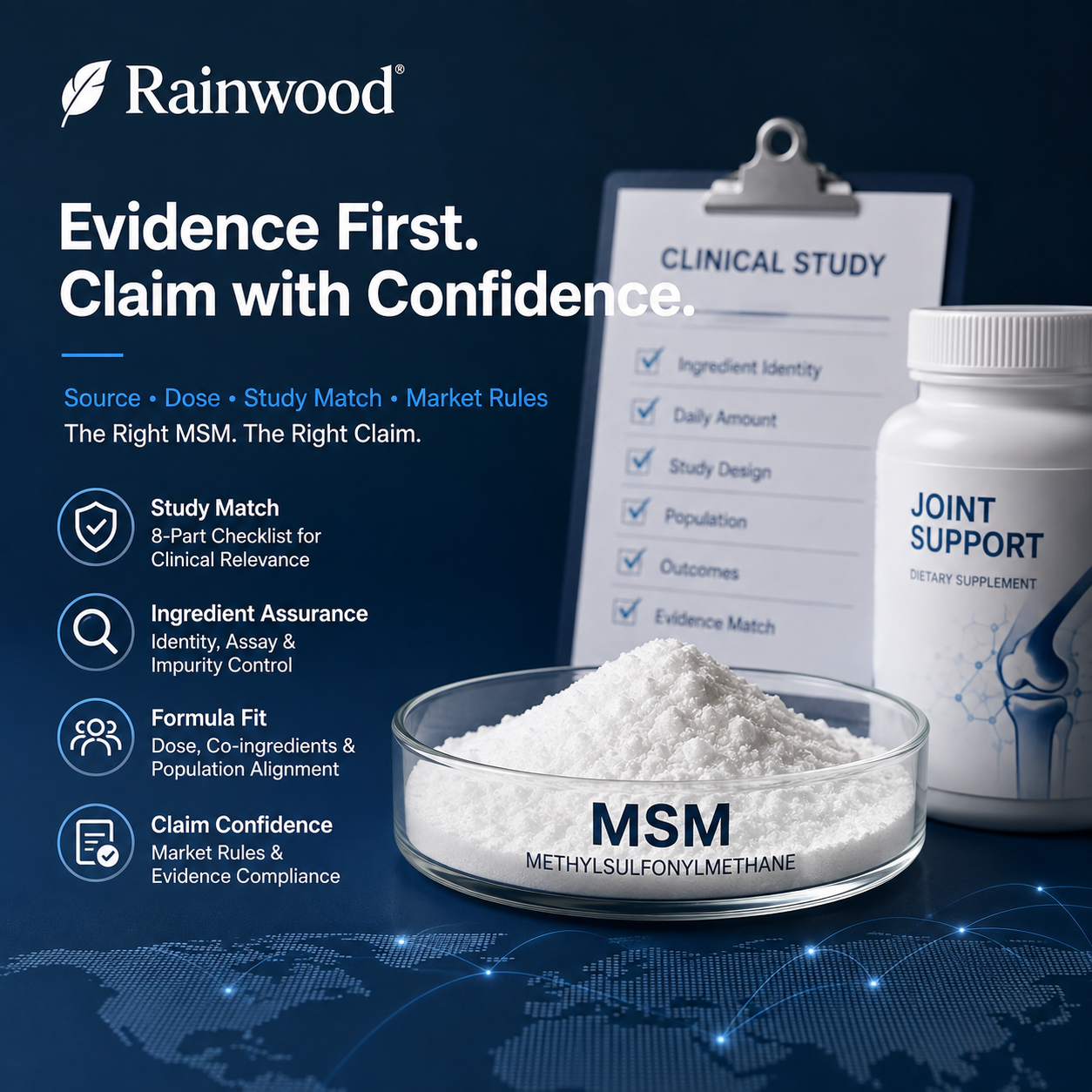
A supplier sends a published MSM study. Marketing writes “clinically studied.” The final formula uses another MSM source, a lower daily amount, different co-ingredients, and a two-capsule serving that consumers may not take as studied.
The citation is real. The product inference may not be.
For joint-supplement brands, “clinically studied” is not a decorative synonym for “contains an ingredient that has appeared in research.” It is a claim requiring a traceable match between the marketed product and the evidence being invoked.
A study can be valid and still be wrong for your product
Published trials and reviews have examined MSM in musculoskeletal contexts, but the evidence base has limitations. NCCIH describes the available evidence for MSM in osteoarthritis as limited. A 2008 critical review likewise concluded that definitive conclusions could not be drawn from the evidence then available. These cautions matter because aggressive marketing often removes the uncertainty while keeping the citation.
The task is not to decide that all research is useless. The task is to state only what the exact evidence can support.
Before reviewing clinical relevance, complete the MSM identity, assay, and impurity release review. A literature file cannot rescue an unidentified or uncontrolled raw material.
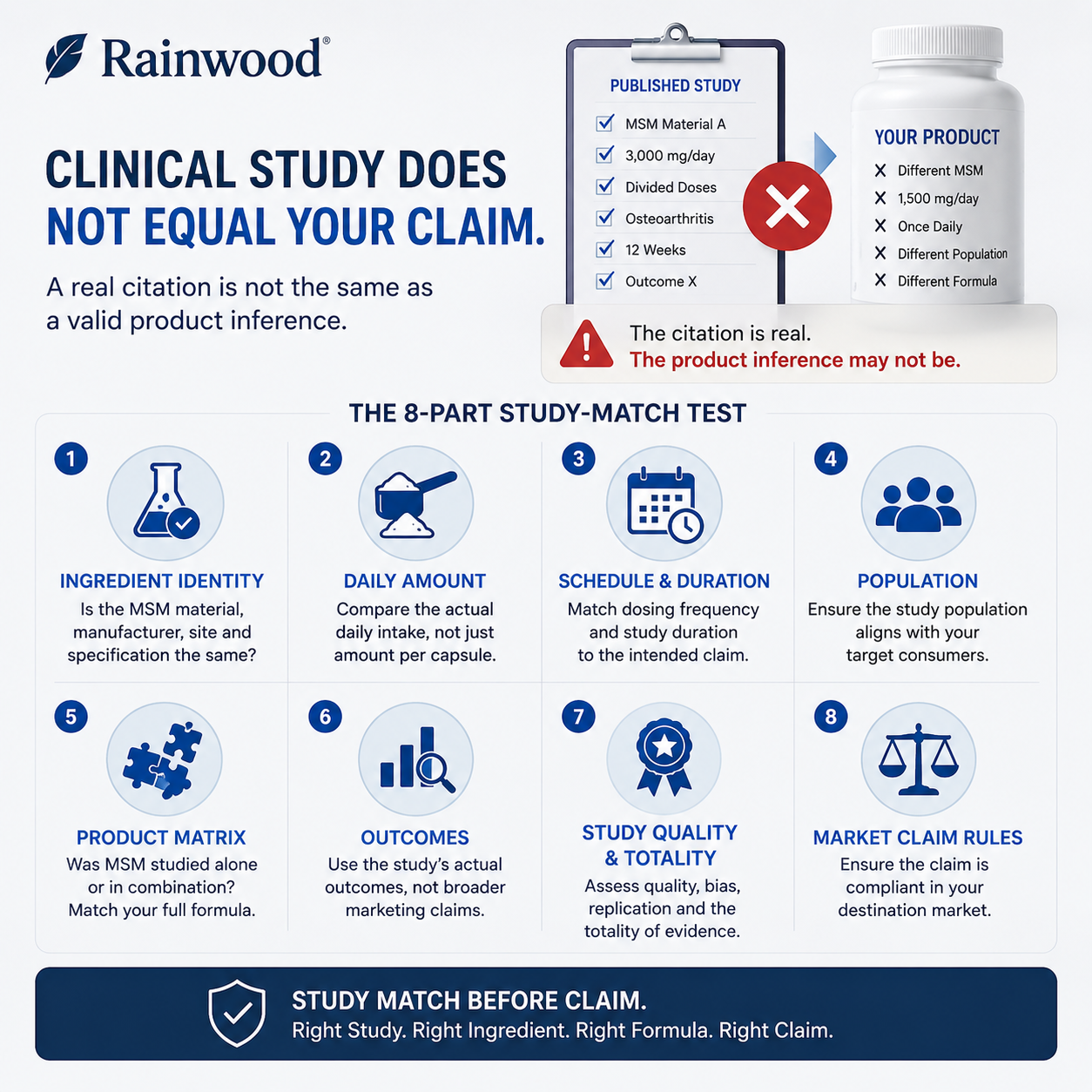
The eight-part study-match test
1. Ingredient identity
Was the tested MSM a named or specifically manufactured material? Can your supplied lot be traced to that same material, manufacturer, site, and specification? If not, document the difference.
An ingredient name alone does not prove sameness. The evidence may depend on a defined manufacturing process, impurity profile, or branded supply chain.
2. Daily amount
Compare the actual amount consumed per day, not merely the amount per capsule. If the study used multiple daily doses and your label delivers a smaller amount, the match is incomplete.
3. Dosing schedule and duration
Once daily is not identical to divided doses. A short launch campaign cannot imply an outcome observed only after a particular study duration. Record both the regimen and time point.
4. Population
Healthy active adults, people with diagnosed osteoarthritis, athletes after exercise, older adults, and mixed populations answer different questions. A consumer-facing structure/function statement should not borrow a disease-treatment context and silently generalize it.
5. Product matrix
Was MSM studied alone or with other ingredients? Was it a tablet, capsule, powder, or topical product? A combination trial does not isolate MSM unless the design supports that inference. A single-ingredient study does not automatically prove the performance of a complex blend.
6. Outcomes
Separate objective measurements, validated questionnaires, exploratory biomarkers, and subjective reports. Then distinguish the study's actual outcome from the much broader phrase marketing wants to use.
7. Study quality and totality
Review randomization, blinding, comparator, sample size, attrition, statistical analysis, preregistration where available, funding, conflicts, replication, systematic reviews, and contrary results. One favorable paper is not the entire evidence base.
8. Destination-market claim rules
Even a well-matched study does not automatically make a claim lawful. The wording, implied disease meaning, disclosure, label context, audience, and market-specific rules all matter.
Use the distilled MSM process-claim review separately; a manufacturing story and a clinical substantiation story require different proof.
Build an evidence bridge, not a bibliography dump
A useful evidence file contains a one-page bridge for every central citation:
| Evidence field | Study | Proposed product | Match status |
|---|---|---|---|
| Exact MSM material | Named/defined? | Named/defined? | Full/partial/no |
| Manufacturer/site | Traceable? | Traceable? | Full/partial/no |
| Daily amount | Recorded | Recorded | Full/partial/no |
| Schedule | Recorded | Recorded | Full/partial/no |
| Duration | Recorded | Intended statement | Full/partial/no |
| Population | Recorded | Target consumer | Full/partial/no |
| Co-ingredients | Recorded | Full formula | Full/partial/no |
| Dosage form | Recorded | Recorded | Full/partial/no |
| Outcome | Exact endpoint | Proposed wording | Full/partial/no |
| Claim category | Study context | Market context | Approved/pending/no |
If the bridge is partial, narrow the claim or use the study as background rather than direct product substantiation. If the bridge fails, remove the product implication.
The borrowed-evidence patterns to catch before artwork
Ingredient-name borrowing
The formula contains generic MSM, while the cited research used a defined branded or manufacturer-specific material. The solution is not to hide the brand name in the bibliography. Confirm equivalence or stop presenting the research as direct product evidence.
Dose borrowing
The front label highlights the study, but the daily serving supplies only a fraction of the studied amount. If the full dose would require six capsules, solve the format problem instead of shrinking the number silently.
Combination borrowing
A glucosamine-chondroitin-MSM product cites studies on each ingredient and implies that the blend itself was tested. Individual ingredient literature does not automatically establish the full formula's combined performance, interactions, stability, or consumer use.
Endpoint inflation
A narrow questionnaire result becomes “repairs joints,” “rebuilds cartilage,” or “treats arthritis.” This is both scientifically broader and potentially a prohibited disease implication.
Citation laundering
A supplier presentation cites a review, which cites an old trial, which used a different material. Always follow the chain to the original research and extract the actual test product.
Evidence has to survive formulation changes
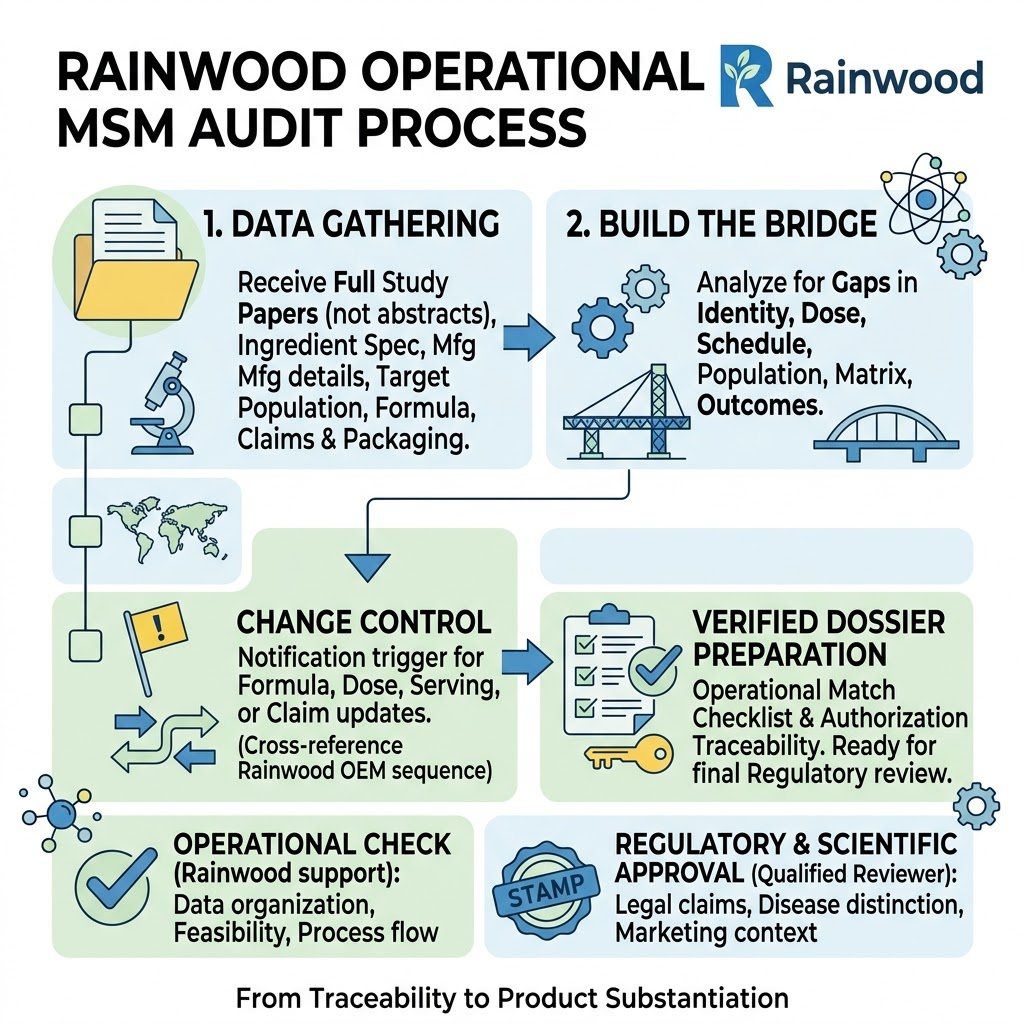
Formula teams frequently change source, dose, serving, flavor system, capsule count, or co-ingredients after the first prototype. Every change should trigger an evidence-impact check.
Create red-line conditions:
- MSM manufacturer or material changes;
- daily amount changes;
- serving instructions change;
- dosage form changes materially;
- active co-ingredients are added or removed;
- target consumer or destination changes;
- marketing wording or visual context changes.
Quality change control should notify regulatory and marketing, not only production. Otherwise an approved citation can remain attached to a product that no longer matches it.
Review RainwoodBio's published OEM sequence and place evidence re-checks after formula confirmation and again before artwork release.
How RainwoodBio can support an evidence-fit project
RainwoodBio describes requirement confirmation, formulation, sample confirmation, production, testing, and documentation in its public OEM materials. Those statements do not establish that a particular MSM ingredient is clinically studied or that a proposed formula may use a specific claim.
Ask RainwoodBio to help organize the operational side of the review:
- exact proposed MSM manufacturer, specification, and lot chain;
- daily amount and serving feasibility;
- full formula and dosage-form comparison with the cited study;
- available branded-ingredient authorization or traceability documents;
- sample formula and manufacturing constraints;
- raw and finished-product test plan;
- a list of claim questions requiring qualified regulatory approval.
Scientific and regulatory substantiation must still be approved by appropriately qualified reviewers for the exact product and market.
The claim ladder
Use the least aggressive statement that the evidence and law can support:
1. Contains MSM — primarily an accurate composition statement.
2. Made with a defined MSM material — requires identity and traceability.
3. MSM has been studied in [accurate context] — requires faithful, non-misleading description.
4. Made with clinically studied MSM — requires a strong ingredient match and authorization where relevant.
5. This formula is clinically studied — normally requires evidence on the exact finished formula.
6. Disease treatment or prevention statement — can move outside permitted supplement positioning and should not be used without a lawful basis.
The distance between levels three, four, and five is where many brands create risk.
Request an MSM study-to-formula match review. Send RainwoodBio the full papers—not only abstracts or supplier slides—plus the ingredient specification, manufacturer, daily amount, serving, formula, target consumer, proposed wording, destination, dosage form, pack, and volume. The team can build the operational comparison while your scientific and regulatory reviewers decide what may be claimed.
Frequently asked questions
1.Does one human trial make an MSM ingredient “clinically proven”?
That phrase can overstate the evidence. Assess the trial's quality, totality, replication, exact material, outcome, and market rules before selecting wording.
2.Can I say “clinically studied ingredients” if the finished blend was never studied?
Only if the statement is accurate, adequately qualified, not misleading in context, and approved for the destination. It must not imply that the finished formula itself was tested.
3.Is the same daily amount enough to establish equivalence?
No. Identity, manufacturer, specification, regimen, population, formula matrix, duration, endpoint, and product use also matter.
4.Can an abstract support the claim file?
Use the full paper and, when possible, protocol, registry, supplementary information, and material details. Abstracts omit information essential to match assessment.
5.What if the evidence match is only partial?
Record every mismatch, narrow or remove the statement, seek additional evidence, or reformulate. Do not let a sales deadline turn uncertainty into a certainty claim.
References
- NCCIH, Things to Know About Complementary Health Approaches for Osteoarthritis: https://www.nccih.nih.gov/health/tips/things-to-know-about-complementary-health-approaches-for-osteoarthritis
- Kim et al., MSM pilot randomized trial: https://pubmed.ncbi.nlm.nih.gov/16309928/
- Brien et al., systematic review of DMSO and MSM: https://pubmed.ncbi.nlm.nih.gov/18417375/
- FTC, Health Products Compliance Guidance: https://www.ftc.gov/business-guidance/resources/health-products-compliance-guidance
- FDA, Structure/Function Claims: https://www.fda.gov/food/nutrition-food-labeling-and-critical-foods/structurefunction-claims
- RainwoodBio OEM service: https://www.rainwoodbio.com/oem
This article is for international B2B evidence-planning and educational purposes. Ingredient identity, traceability, study relevance, dose, totality of evidence, substantiation, labels, claims, advertising, and regulatory requirements must be assessed for the exact raw material, formula, finished product, audience, and destination market.