 EN
EN

Meta title: Add-On Ingredients in Creatine Electrolyte Powders
Meta description: Caffeine, taurine, and amino acids change dose, stability, claims, and target users. Choose add-ons that your creatine electrolyte formula can defend.
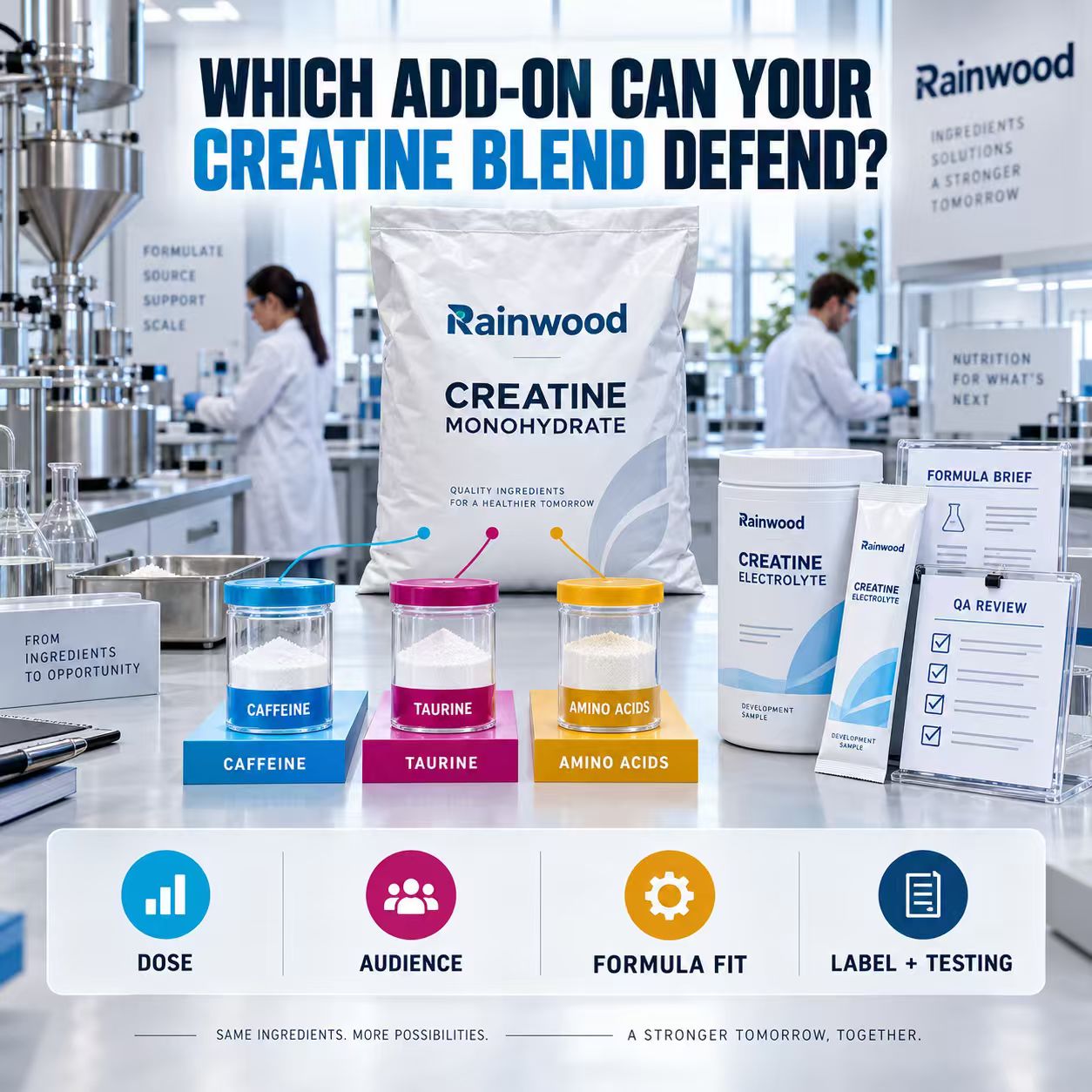
The product brief keeps growing: creatine for performance, electrolytes for hydration, caffeine for energy, taurine for focus, and amino acids for recovery. The ingredient list looks impressive until procurement asks for the exact dose, formulation purpose, evidence, warning language, and market status of each addition.
A creatine electrolyte powder can become a crowded performance blend very quickly. Each add-on changes the serving mass, taste, solubility, stability, package, cost, and claim file. The risk is not that caffeine, taurine, or amino acids are automatically unsuitable. The risk is that the formula carries more promises than the evidence and label can support.
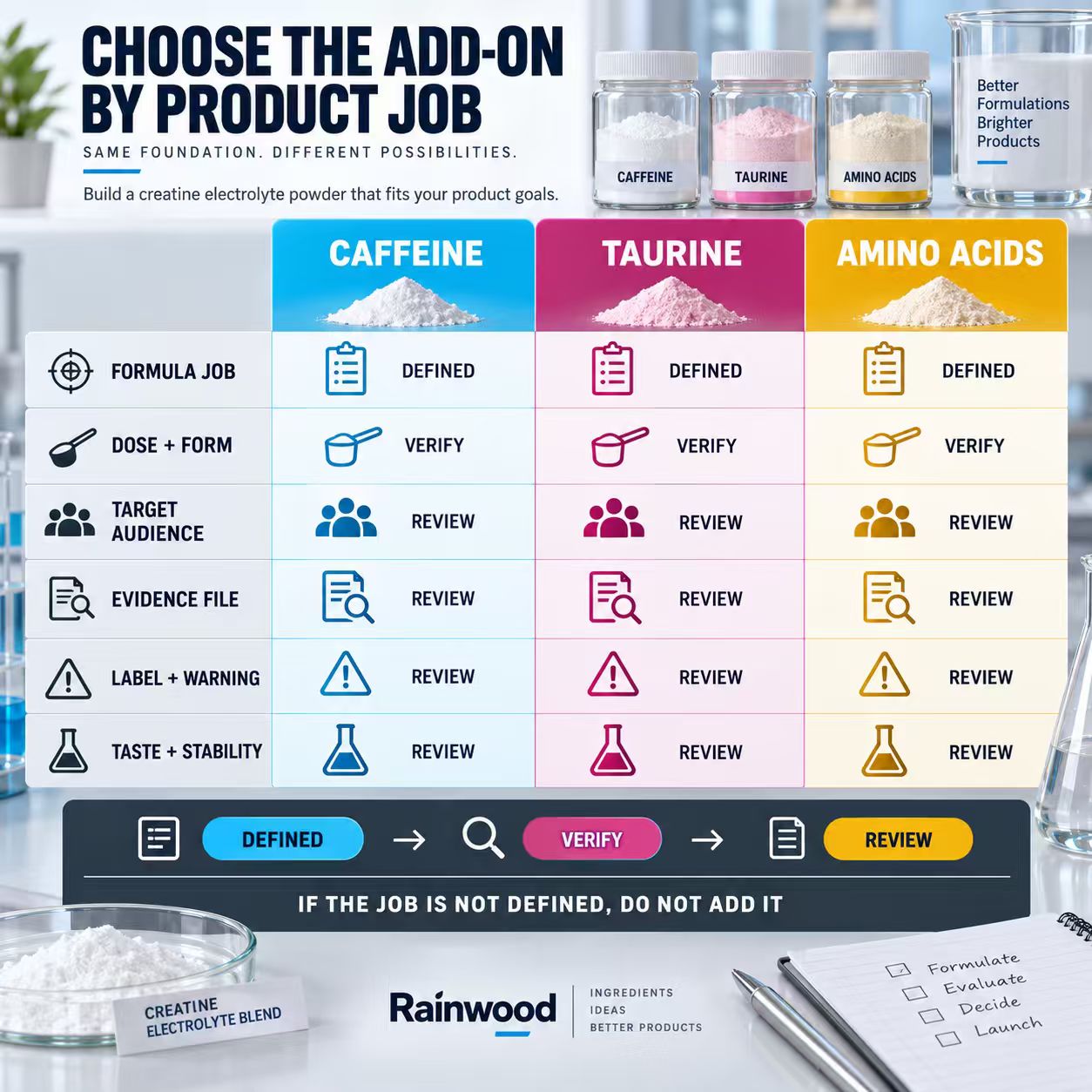
Choose the add-on by product job
Write one sentence for each ingredient:
- What role does it play in the formula?
- What dose is required for that role?
- Which customer is expected to use it?
- Which evidence matches the exact form and dose?
- What new safety, label, or stability issue does it create?
Use our creatine electrolyte add-on evaluation matrix before adding another active to the formula.
If the sentence only says “makes the product more powerful,” the ingredient is not ready for procurement.
Caffeine: a clear dose and audience boundary
Caffeine can change the positioning from hydration powder to stimulant performance product. The label needs a precise amount per serving, serving directions, and market-specific warnings or restrictions where applicable. The product team should also decide whether the formula is intended for daily use, pre-workout use, or occasional use.
The buyer loss is an audience mismatch. A customer seeking a daily creatine and hydration powder may not want a stimulant. A user who consumes multiple caffeinated products may unintentionally stack intake. Do not hide caffeine inside a proprietary blend or let a “natural energy” phrase obscure the quantity.
Taurine: familiar name, separate evidence file
Taurine is common in energy and performance products, but its presence does not automatically prove a benefit in your specific creatine electrolyte formula. Check identity, dose, purity, stability, and the exact claim. If the ingredient is sensitive to heat, pH, or storage, include it in the finished-product stability plan.
The formula may also contain taurine-related flavor or solubility interactions. Test the complete blend, not an isolated taurine solution.
Read the use-case guide for pre-workout and hydration powders before using the same directions for a stimulant and a daily formula.
Amino acids: dose, taste, and label space
Branched-chain amino acids, essential amino acids, citrulline, beta-alanine, and other amino acids each bring different dose and sensory realities. A gram-level amino acid dose can dominate the serving and make a small creatine sachet difficult to fill. Bitterness can require more flavoring or sweetener, and the combination can change osmolality.
Do not imply that the amino acid supports the same outcome as creatine or electrolytes. Keep each ingredient’s role distinct in the evidence file and product page.
Add-ons can change the mineral and carbohydrate calculations
Acidic ingredients, salts, and buffered systems may contribute sodium, potassium, or other ions. Flavor carriers can add sugar, polyols, or calories. A stimulant premix may contain flow aids or excipients that alter the serving mass. Count everything before publishing electrolyte or calorie claims.
Use an ingredient contribution table:
| Component | Intended role | Dose per serving | New formula effect |
|---|---|---:|---|
| Creatine | Daily performance support | Defined amount | Powder mass and identity |
| Electrolytes | Scenario-specific mineral profile | Elemental amounts | Taste and osmolality |
| Caffeine | Stimulant positioning | Exact amount | Warning and audience |
| Taurine | Formula-specific support | Exact amount | Stability and claim review |
| Amino acid | Formula-specific support | Exact amount | Bitterness and fill weight |
If the add-on does not have a defined role or acceptance criterion, remove it from the first commercial version.
Stability and sampling become more demanding
More ingredients mean more possible interactions and more analytical questions. A finished powder should be checked for appearance, moisture, flow, active content, microbial quality, heavy metals where relevant, and blend uniformity. If caffeine or another potent ingredient is present at a low dose, the sampling plan must be able to detect segregation and local concentration differences.
Keep raw-material identity tests separate from finished-blend release. A supplier COA for caffeine does not prove uniform caffeine delivery in a creatine electrolyte sachet.
How RainwoodBio can keep an expanding formula controlled
RainwoodBio publishes formula development, multi-format OEM support, supplier management, testing and release documentation, packaging, logistics, and traceability. For a multi-active blend, the relevant capability is a controlled formula brief that records dose, purpose, evidence, and release tests for each ingredient.
Request a creatine electrolyte add-on and formula-complexity review with the full ingredient list, target users, serving, claims, package, and market.
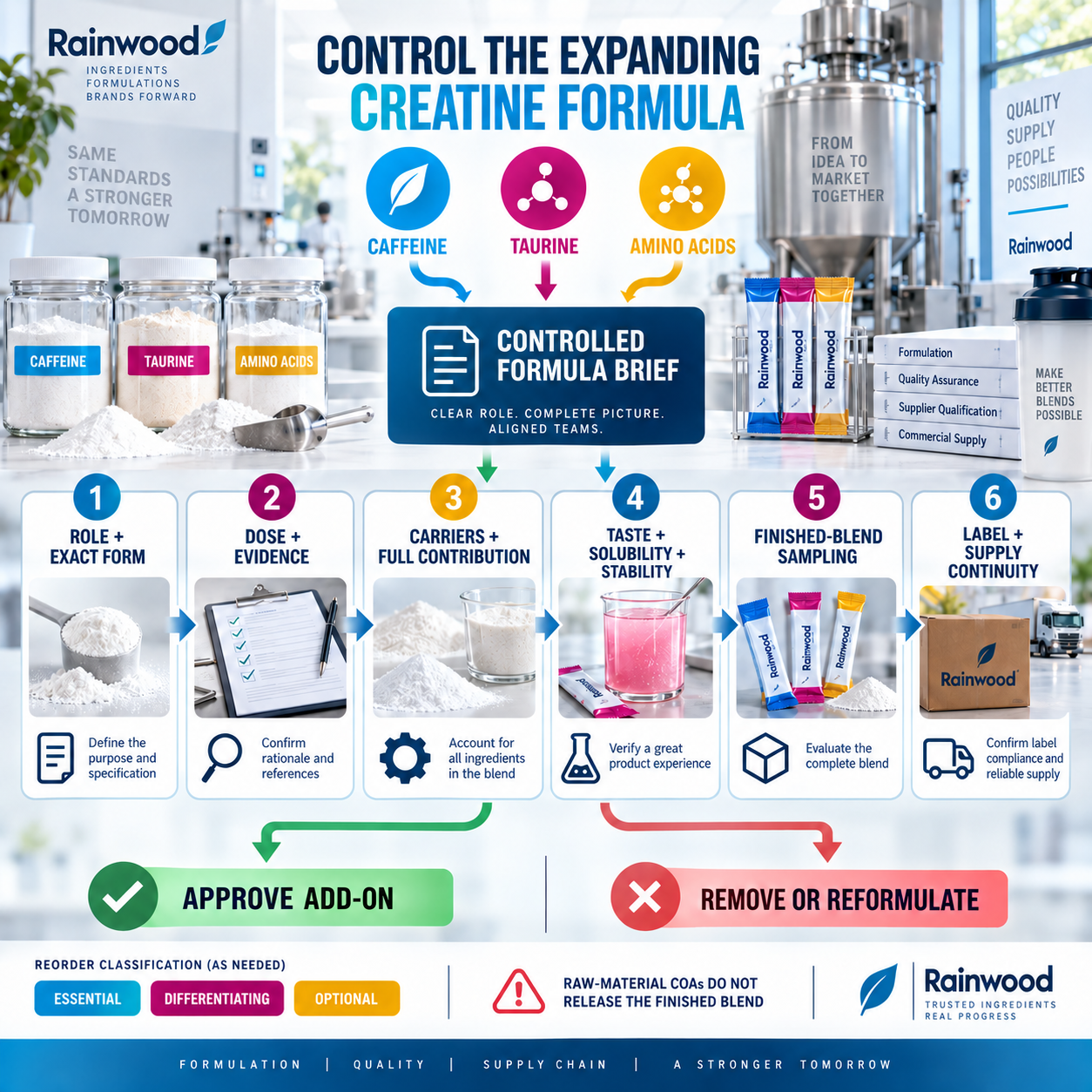
The add-on approval gate
Before launch, confirm:
- every added active has one defined formula job;
- dose and evidence match the exact form;
- caffeine and other potent ingredients have clear amount and warning review;
- mineral, sugar, calorie, and serving calculations include all carriers;
- taste, solubility, and stability are tested in the complete blend;
- finished-product sampling can detect low-dose segregation;
- the product page does not merge separate ingredients into one unsupported promise.
Send your draft formula, target audience, claims, supplier COAs, and market list for a creatine electrolyte add-on review. RainwoodBio can help decide which ingredient strengthens the product and which one merely increases the dossier burden.
Complexity has a reorder cost
Every extra active creates another possible supplier change, lead-time issue, minimum order, and analytical method. A formula with five different active systems can be harder to replenish than a focused creatine and electrolyte powder. Before launch, classify each add-on as essential, differentiating, or optional. If an optional ingredient becomes unavailable, define whether the product can be reformulated, paused, or sold under a different name. This decision should be made before the marketing team builds a product story around a component that cannot be guaranteed for every commercial lot.
Also calculate the smallest practical batch for each low-dose ingredient. A technically elegant formula can be commercially inefficient if the active requires a separate premix and a dedicated testing schedule.
Frequently asked questions
1.Does caffeine make a creatine electrolyte powder more marketable?
It may attract a pre-workout audience, but it also narrows the target user and adds dose, warning, and claim requirements. Treat it as a separate product decision.
2.Can I hide small-dose ingredients in a proprietary blend?
That depends on the market, but hiding amounts can weaken transparency and complicate safety and quality review. Use the required declaration and a clear internal specification.
3.Are amino acids automatically compatible with creatine and electrolytes?
No. Check taste, dose, solubility, osmolality, stability, and finished-product uniformity.
References
- FDA, Label Claims for Food and Dietary Supplements: https://www.fda.gov/food/nutrition-food-labeling-and-critical-foods/label-claims-food-dietary-supplements
- NIH Office of Dietary Supplements, Exercise and Athletic Performance: https://ods.od.nih.gov/factsheets/ExerciseAndAthleticPerformance-HealthProfessional/
- ISSN position stand on energy drinks and electrolytes: https://pmc.ncbi.nlm.nih.gov/articles/PMC9987737/
- RainwoodBio OEM information: https://www.rainwoodbio.com/oem
This article is for B2B procurement and educational purposes. Ingredient dose, safety, stability, analytical, labeling, and regulatory requirements must be confirmed for the exact blend, target audience, and destination market.