 EN
EN

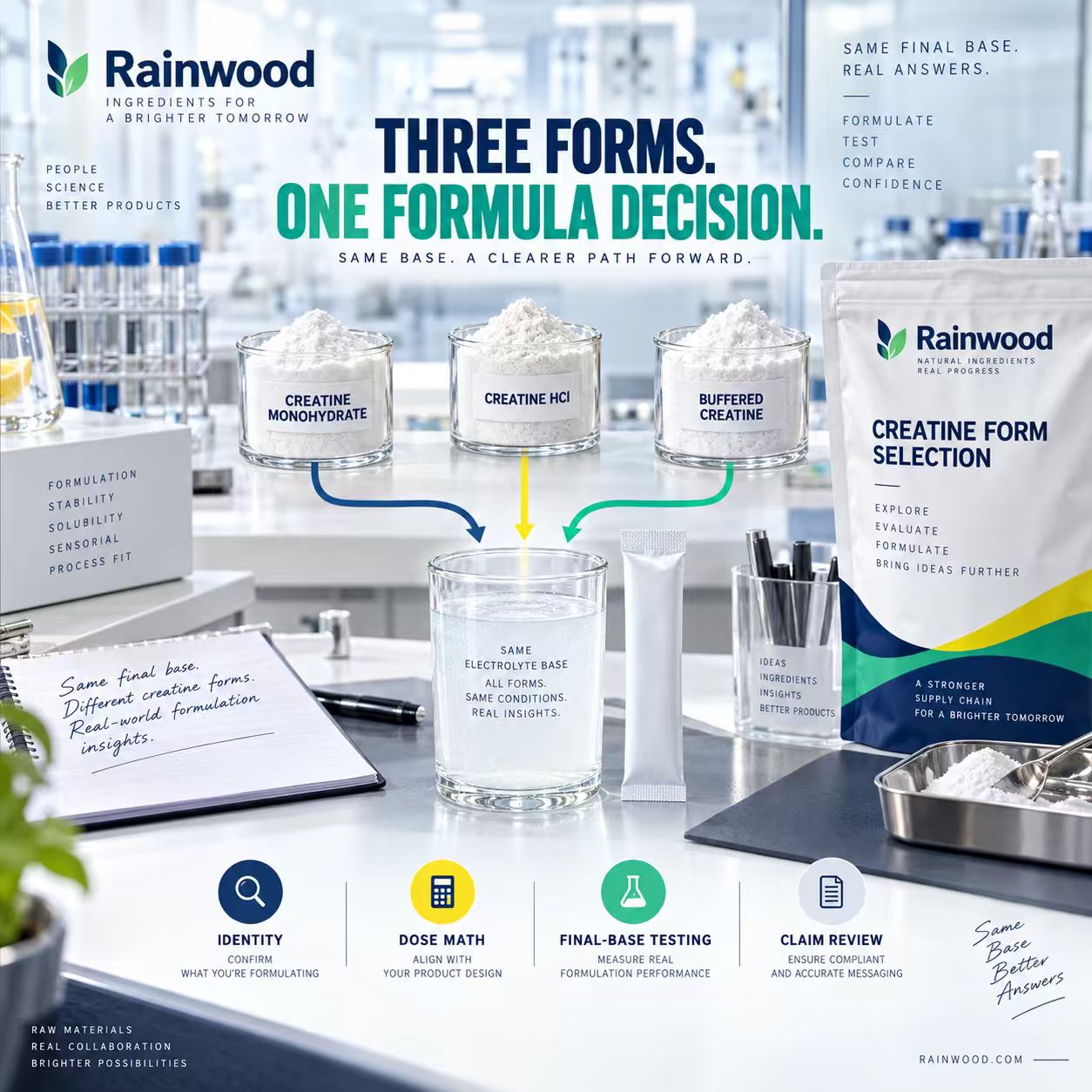
Meta title: Creatine Form Selection for Electrolyte Powders
Meta description: Creatine monohydrate, creatine HCl, and buffered creatine create different dose, solubility, cost, and evidence decisions in electrolyte powders.
The sales deck says one form of creatine is “more soluble,” another is “more advanced,” and a third is the proven standard. Purchasing asks for the lowest cost per kilogram. Marketing asks for the strongest headline. The formulator needs a powder that actually works in water and fits the label.
This is not a simple premium-versus-basic decision. Creatine monohydrate, creatine hydrochloride, and buffered or pH-adjusted forms are different raw materials with different molecular weights, dose calculations, evidence histories, price structures, and formulation behavior. Adding electrolytes makes the comparison harder because salts, acids, sweeteners, and flavors change the final drink.
The wrong form can create a familiar commercial failure: a formula is built around a claimed serving, the powder does not dissolve or taste as expected, and the team changes the process without checking whether the product still matches the evidence. Select the form by the buyer promise and the actual formula, not by a single supplier adjective.
Start with the product identity
Write the candidate form exactly:
- creatine monohydrate;
- creatine hydrochloride;
- buffered or pH-adjusted creatine system;
- a branded form with its own authorization and evidence;
- a blend that contains more than one creatine form.
Then define whether the label communicates the compound mass, the creatine equivalent, or another market-specific quantity. Use our creatine form comparison worksheet before collecting quotations.
Creatine monohydrate: familiar evidence, real powder constraints
Creatine monohydrate has the most familiar evidence base in sports nutrition and is often used at gram-level servings. Its commercial advantage is not that it solves every formulation issue. It may require attention to particle size, suspension, sediment, and the practical amount of powder in a scoop or sachet.
The buyer loss appears when a brand promises a clear, instant drink but selects a grade that behaves like a suspension. If the team adds acid, heat, or extra salts to improve the drinking experience, the finished formula needs its own stability and sensory review. The form remains recognizable, but the delivery system is no longer a simple raw-material decision.
Creatine HCl: lower mass claim, different evidence question
Creatine HCl is often marketed around solubility or smaller serving mass. That may be attractive in a compact stick pack or a flavor system where sediment is unacceptable. But a lower gram number is not automatically equivalent to the standard monohydrate dose, and a solubility advantage does not independently prove superior performance.
Ask the supplier to show the calculation basis, identity, assay, chloride contribution, impurity limits, and evidence for the exact form. If a product page compares “one gram” of HCl with “five grams” of monohydrate, confirm what outcome and dose the comparison actually represents.
Read the label math behind creatine servings before using a small scoop as a performance headline.
Buffered creatine: the word “buffered” is not a complete specification
Buffered systems can mean different things: a defined salt, a blend with alkalizing agents, or a product positioned around pH control. Ask what the buffer contains, how much of each component is present, and whether those components change the electrolyte totals or sensory profile.
The buyer risk is hidden complexity. A buffer can add sodium, potassium, calcium, carbonate, or other ingredients that must appear in the formula and may affect taste, osmolality, claims, and target users. Do not accept “buffered creatine” as an identity statement without a full composition and method.
Compare form fit using five decision gates
| Gate | Question |
|---|---|
| Identity | Can the form be verified with a fit-for-purpose method? |
| Dose | What amount is needed for the intended positioning and evidence? |
| Formula | Does it dissolve, disperse, and taste acceptable with the selected salts? |
| Cost | What is the cost per usable serving, not only per kilogram? |
| Claims | Can the market wording be supported for this exact form? |
Run the same formula comparison for each candidate form. Include sodium, potassium, magnesium, acidulants, sweeteners, flavors, carriers, and package. A form that looks cheaper alone may become more expensive after masking, extra excipients, or a larger serving.
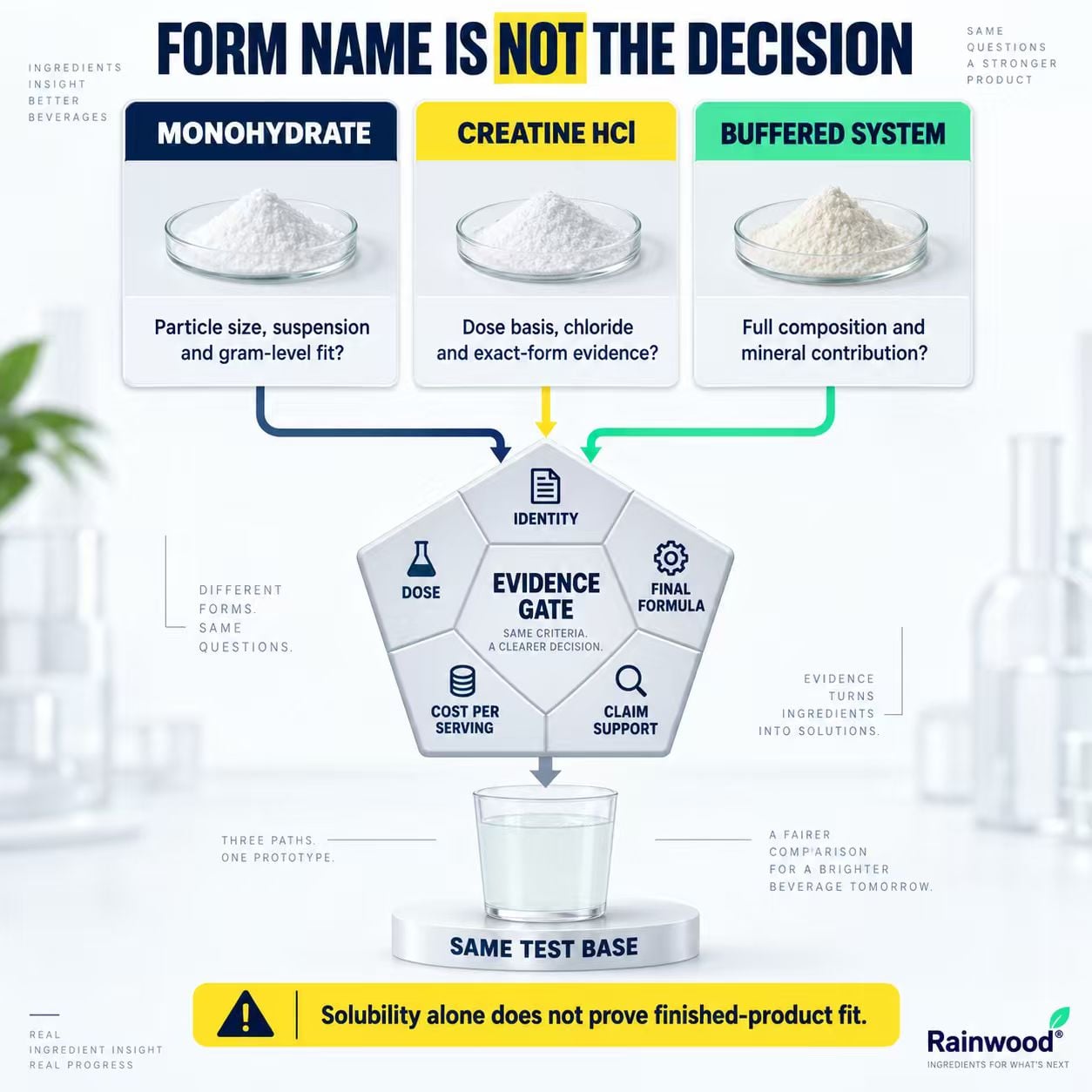
Solubility does not equal finished-product performance
Measure solubility or dispersion in the actual volume and temperature your customer will use. A raw-material test in warm laboratory water may not predict a cold bottle mixed after training. Check sediment after five, ten, and thirty minutes. Record pH, flavor, foam, and visual appearance. If the formula is acidic, evaluate the stability of creatine in the liquid state and establish a realistic time between mixing and consumption.
The correct acceptance criterion depends on the product promise. A cloudy recovery drink may be acceptable; a clear hydration powder may not be. Write the expectation before the pilot so the result is not judged by whoever tastes it first.
How RainwoodBio can compare forms without borrowing claims
RainwoodBio publishes requirement confirmation, supplier management, sample development, multi-format OEM support, testing and release documentation, packaging, and traceability. For a creatine electrolyte powder, the useful capability is a side-by-side formulation trial that keeps raw-material identity, serving math, and claim language connected.
Request a creatine form and electrolyte-format feasibility review with your target market, serving size, package, price target, and draft claim.
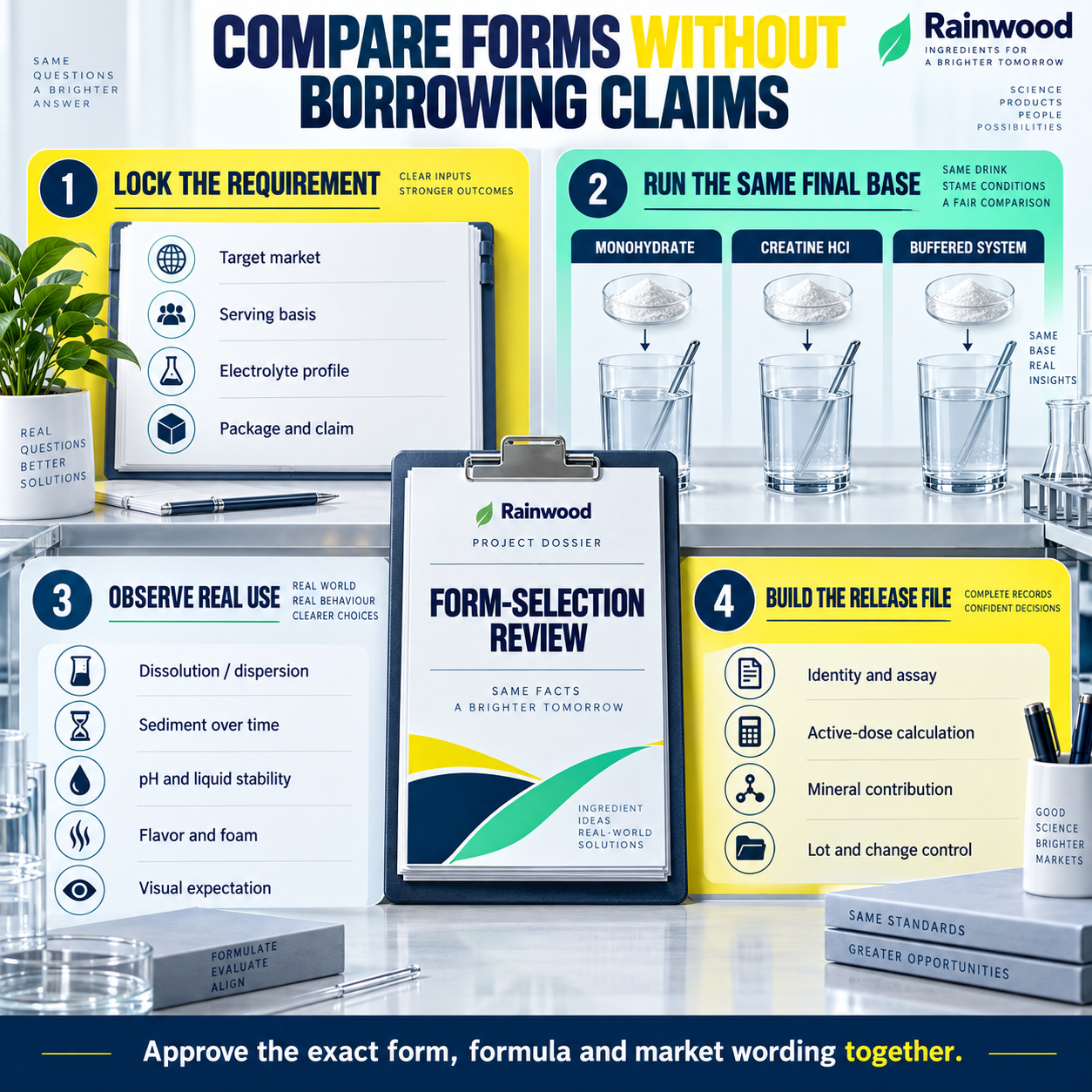
Form-selection approval gate
Before approving a supplier, require:
- exact chemical form and full composition;
- method and specification for identity and assay;
- active-dose calculation and evidence match;
- solubility, sediment, pH, and sensory data in the final base;
- elemental mineral contribution after adding the chosen form;
- lot-to-lot and change-control plan;
- target-market review for the selected wording.
Send your competing COAs, formula concepts, target dose, electrolyte profile, and package plan for a creatine-form quotation and formula review. RainwoodBio can help identify whether the “advanced” form solves a real buyer problem or simply adds a new claim burden.
Frequently asked questions
1.Is creatine HCl always better for a drink powder?
No. It may fit some solubility or serving-size requirements, but the comparison must include dose, evidence, taste, stability, cost, and the exact product promise.
2.Can I combine monohydrate and HCl in one formula?
Possibly, but the purpose and dose of each form must be clear. Combining forms can complicate label identity, calculation, testing, and consumer education.
3.Does buffered creatine automatically add electrolytes?
Not necessarily. It depends on the buffer composition. Request a complete formula and calculate elemental minerals separately.
References
- NIH Office of Dietary Supplements, Exercise and Athletic Performance: https://ods.od.nih.gov/factsheets/ExerciseAndAthleticPerformance-HealthProfessional/
- International Society of Sports Nutrition creatine position stand: https://jissn.biomedcentral.com/counter/pdf/10.1186/s12970-021-00412-w.pdf
- FDA GRAS Notice 931, Creatine Monohydrate: https://www.fda.gov/media/144598/download?attachment=
- RainwoodBio OEM information: https://www.rainwoodbio.com/oem
This article is for B2B procurement and educational purposes. Ingredient form, dose, evidence, stability, safety, labeling, and regulatory requirements must be confirmed for the exact formula and destination market.