 EN
EN


Meta title: Creatine Electrolyte Drink Solubility and Osmolality
Meta description: Creatine and mineral salts can change sediment, taste, and osmolality in one drink. Learn how to test a mixed powder before commercial scale.
The powder disappears in a warm laboratory beaker. A customer mixes it in cold water after training and sees crystals at the bottom. The drink tastes aggressively salty, the sweetness feels heavy, and the brand team calls it a hydration failure. The raw materials did not necessarily fail. The formula was never tested as the customer uses it.
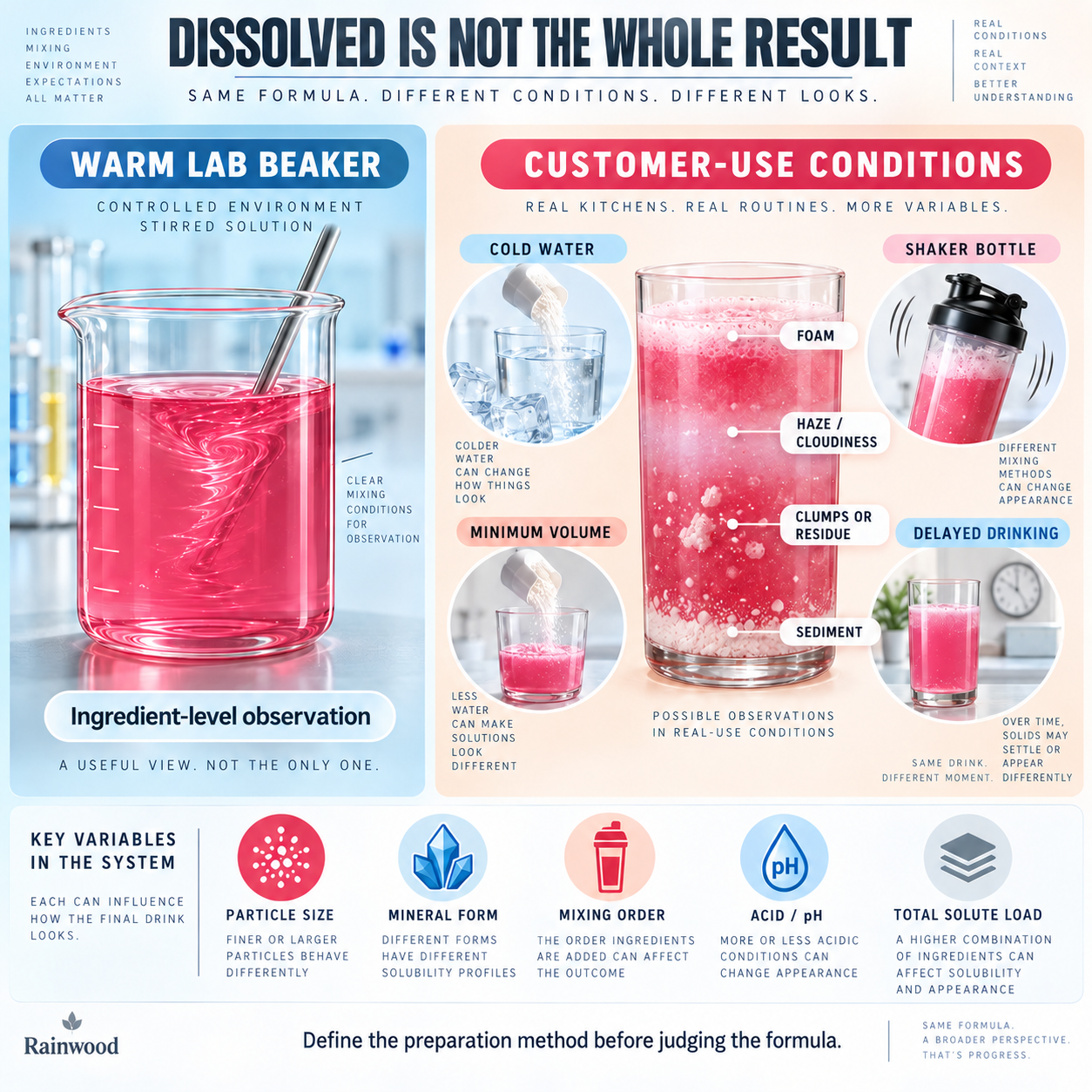
A creatine electrolyte powder is a multi-variable drink system. Creatine solubility, salt selection, particle size, acidulants, sweeteners, carbohydrate, water volume, temperature, and mixing time all interact. A raw-material COA can confirm identity while the prepared drink still fails the commercial promise.
Solubility is a preparation condition, not a yes-or-no adjective
Define what “dissolves” means for your product. Specify water volume, temperature, shaking or stirring method, hydration time, acceptable sediment, foam, and visual appearance. A cloudy drink may be acceptable for one product and unacceptable for another. A small amount of settled creatine after thirty minutes may be normal for a suspension but a serious issue for a clear hydration concept.
Use our creatine electrolyte solubility and drink specification to turn a vague sensory goal into a testable product requirement.
Creatine and salts do not behave independently
Creatine monohydrate has limited cold-water solubility compared with many soluble salts. Sodium and potassium salts can dissolve quickly but change ionic strength and taste. Magnesium forms may remain cloudy or contribute to a chalky mouthfeel. Acidulants and sweeteners alter pH, density, and the perceived intensity of every ingredient.
If the formula is acidic, the team must also define how long the powder may sit after mixing before consumption. Stability in a dry sachet is not the same as stability in a prepared drink. Heat, pH, and time can change the chemical environment and the consumer experience.
Read the acidic flavor and creatine stability guide before you approve lemon or citrus concepts based only on a first sip.
Osmolality is not the same as “more minerals”
Every dissolved solute contributes to the drink’s total osmotic load. Creatine, mineral salts, sugars, polyols, acids, and other solids all matter. Increasing every ingredient to create a “stronger” label can make the drink heavier, less palatable, and less aligned with the intended hydration scenario.
Use a prepared-drink calculation and measurement plan. Test at the labeled water volume and at a realistic user dilution. Record pH, conductivity or another suitable proxy, osmolality where relevant, taste, sediment, and time to drink. Do not claim that a measured number guarantees faster hydration without appropriate evidence and market review.
The four formulation choices that change the result
Water volume
The same powder can be balanced in 500 ml and unpleasant in 250 ml. Put a clear volume on the directions and test both the minimum and the target volume.
Mineral form
Citrate, chloride, oxide, glycinate, and other forms differ in taste, elemental contribution, solubility, and bulk. Choose for the complete formula, not the ingredient label alone.
Particle size and mixing order
Fine powders can disperse quickly but may create dust or agglomerates. Larger crystals can settle. Adding a small amount of one ingredient too early or too late can create local clumps or segregation.
Flavor and acid system
Acidulants can improve taste while changing pH and stability. High-intensity sweeteners can mask salt but reveal bitterness or aftertaste when the drink warms.
A customer-use matrix for the pilot
| Test condition | Record |
|---|---|
| Cold water | Time to disperse, sediment, flavor |
| Room-temperature water | Same checks and foam |
| Shaker bottle | Lumps, residue, and user effort |
| Stirred glass | Visual appearance and settle time |
| Minimum water volume | Taste and concentration risk |
| Target water volume | Label-relevant result |
| Delayed consumption | Stability and sediment after 15–60 minutes |
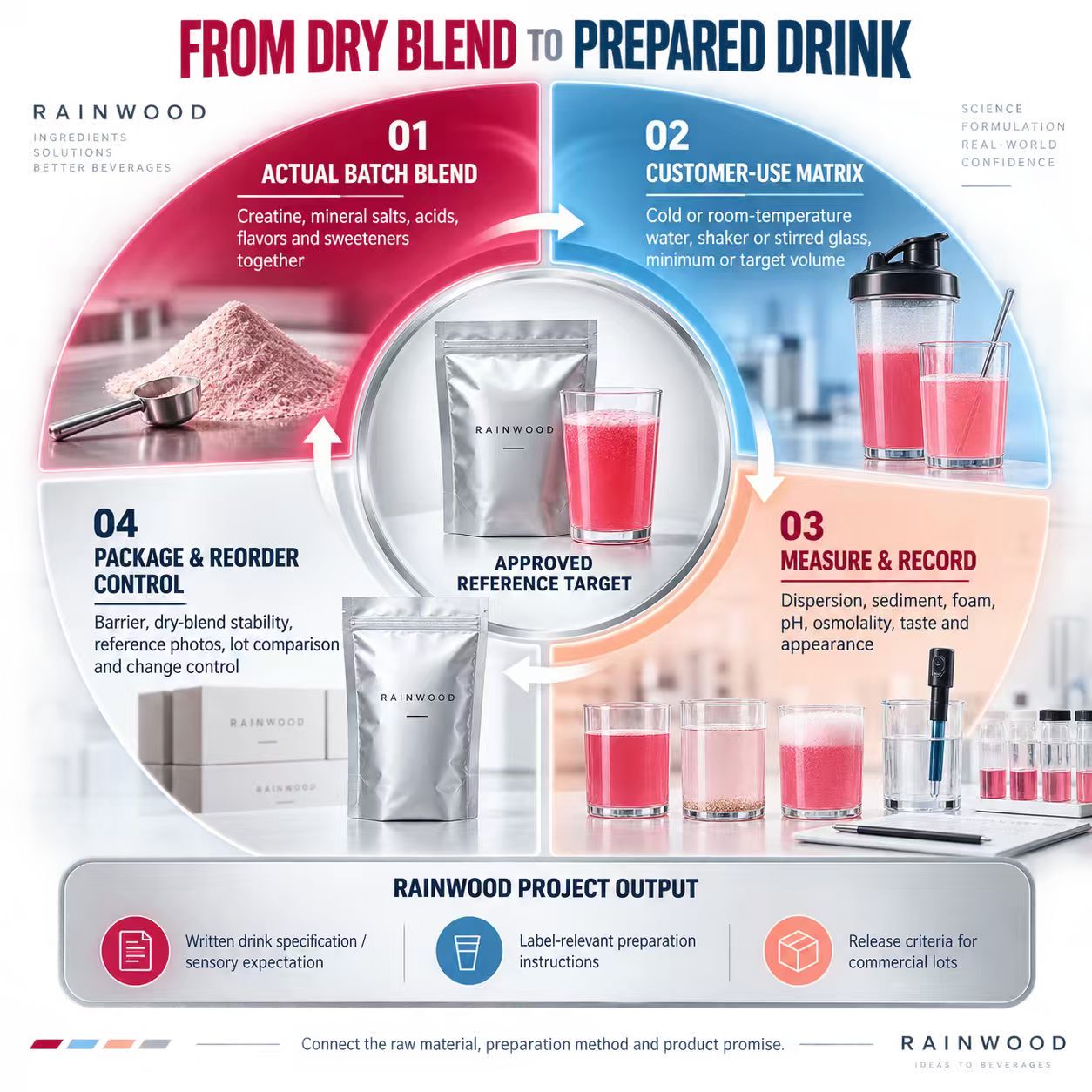
Use the actual batch blend, not an idealized ingredient mixture. Retain photos or short videos as development evidence and compare commercial lots against the approved reference.
How RainwoodBio can carry the formula from powder to prepared drink
RainwoodBio publishes powder drink and sachet formats, requirement confirmation, sample development, production control, testing and release documentation, packaging, and traceability. For a creatine electrolyte drink, the relevant capability is connecting the raw-material choice with the preparation instructions and sensory release gate.
Request a prepared-drink solubility and osmolality feasibility review with your water volume, creatine form, mineral salts, flavor concept, package, and target market.
The drink approval gate
Before approving the formula, confirm:
- solubility is defined at the labeled temperature and water volume;
- sediment and foam limits are written;
- pH and osmolality targets are appropriate to the use case;
- mineral and creatine calculations match the prepared serving;
- taste is acceptable after standing, not only immediately after mixing;
- the dry blend remains stable in the selected package;
- the claim language does not outrun the measured or clinical evidence.
Send your formula, pilot photos, water-volume directions, COAs, and draft claims for a creatine electrolyte drink performance review. RainwoodBio can help identify whether the failure is caused by the raw materials, mixing conditions, formula density, or package.
A failed drink needs a root-cause path
When sediment appears, do not immediately add a solubilizer or reduce the creatine dose. First identify whether the cause is particle size, water temperature, mixing energy, mineral interaction, pH, storage, or a formula calculation. Prepare the same lot under controlled conditions and change one variable at a time. Photograph the result and retain the liquid for the planned test window. This approach prevents a cosmetic fix from creating a new taste, label, or stability problem. It also gives the supplier a useful technical question instead of a vague complaint that the powder “does not dissolve.”
If the final product is intentionally a suspension, write that expectation into the directions and visual specification rather than allowing customers to assume the drink should be perfectly clear.
Frequently asked questions
1.Is sediment always a quality failure?
No. It depends on the product promise. A suspension may be acceptable if it is described and tested consistently; a clear hydration drink needs a different visual standard.
2.Does higher water temperature solve creatine solubility?
It may change dissolution, but it can also change flavor, stability, and the customer experience. Test the labeled preparation condition rather than relying on warm-water behavior.
3.Can more sodium improve a creatine drink?
Not automatically. Sodium affects taste, mineral delivery, osmolality, and the intended use case. Set the amount from the scenario and evidence.
References
- Solution thermodynamics of creatine monohydrate: https://www.sciencedirect.com/science/article/pii/S002196141500333X
- ISSN position stand on energy drinks and electrolytes: https://pmc.ncbi.nlm.nih.gov/articles/PMC9987737/
- Compositional aspects of hydration beverages: https://pmc.ncbi.nlm.nih.gov/articles/PMC10781183/
- RainwoodBio OEM information: https://www.rainwoodbio.com/oem
This article is for B2B procurement and educational purposes. Solubility, stability, osmolality, safety, labeling, analytical, and regulatory requirements must be confirmed for the exact formula, preparation method, and destination market.