 EN
EN


Meta title: Elemental Electrolyte Amounts in Creatine Powders
Meta description: Salt weight is not elemental electrolyte content. Learn how buyers calculate sodium, potassium, and magnesium accurately in creatine blends.
The quote lists 1,000 mg sodium citrate, 500 mg potassium chloride, and 300 mg magnesium citrate. The marketer wants to write “high electrolytes.” The formulator asks how much sodium, potassium, and magnesium those amounts actually deliver. The label team waits for a number that can be defended.
This is where many electrolyte powders lose technical credibility. Mineral salts are the delivery materials; elemental minerals are the quantities relevant to most nutrient declarations. Because each salt contains a different proportion of the target mineral, a large raw-material weight does not automatically mean a large electrolyte dose.
In a creatine blend, the problem is amplified by scoop size and taste. Sodium changes palatability and market positioning. Potassium can contribute bitterness. Magnesium salts can add chalkiness or gastrointestinal concerns at higher amounts. If the team compares salt weights instead of elemental quantities, the formula may be over-salted, under-delivered, or impossible to explain.
Start with the salt identity
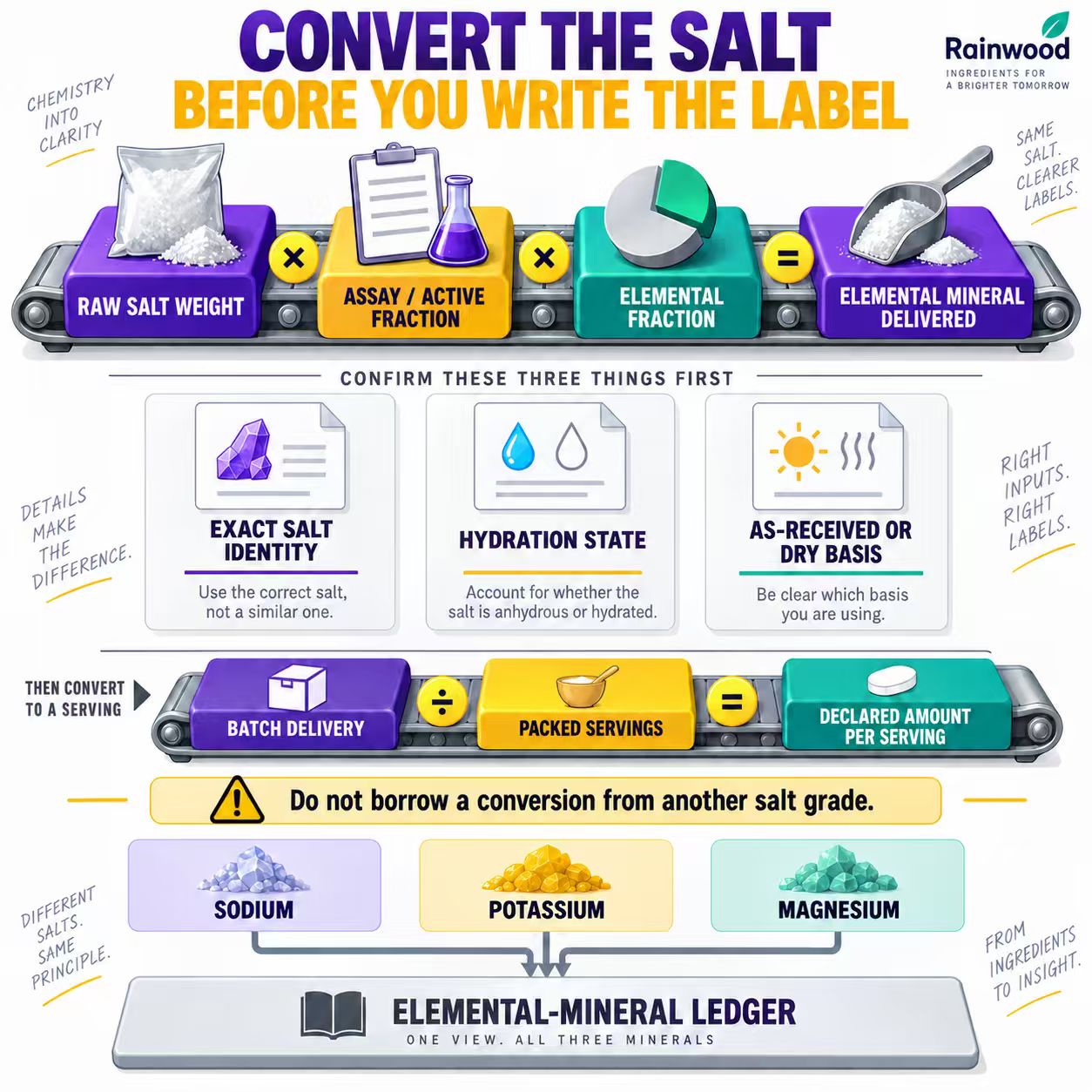
Name the exact source: sodium chloride, sodium citrate, potassium chloride, potassium citrate, magnesium citrate, magnesium glycinate, magnesium oxide, or another permitted form. Then record the elemental mineral percentage or supplier calculation basis.
Use our elemental electrolyte calculation guide to separate raw-material procurement from customer-facing mineral amounts.
The supplier COA may show assay for the salt, but it may not show the elemental conversion in the same line. Ask for the specification, molecular formula or validated conversion, hydration state where relevant, and whether the amount is reported as received or on a dry basis.
The simple calculation that prevents the biggest mistake
Use this internal formula:
Elemental mineral delivered = raw salt weight × assay or active fraction × elemental fraction.
The exact calculation depends on the material form and supplier specification. Do not copy a conversion from a different grade or assume an anhydrous value applies to a hydrated salt. Have QA verify the basis and units.
Then multiply by the batch amount and divide by the expected packed servings. If the final blend has an overage or processing loss, document how it affects the label calculation and release criterion.
Read the five-gram creatine serving math guide because the same raw-material-versus-declared-amount problem exists for creatine.
Why sodium, potassium, and magnesium behave differently in the blend
Sodium
Sodium salts often determine the hydration profile and taste. A product designed for heavy sweat loss may use more sodium than a daily wellness powder, but the acceptable amount depends on the use case, serving volume, target user, and market. Sodium also contributes to total osmolality and should be calculated with the other dissolved solids.
Potassium
Potassium can support a broader electrolyte story, but it is not interchangeable with sodium for every hydration objective. Potassium salts can be bitter or metallic, and the amount must be reviewed with the target population and label rules.
Magnesium
Magnesium forms vary widely in elemental content and sensory behavior. A marketing panel may highlight “magnesium,” while the formulation team must decide whether the chosen salt can deliver the target amount without excessive bulk, chalkiness, or taste masking.
The formulation mistake: chasing impressive salt numbers
A supplier quote may look attractive because it lists large milligram amounts of mineral salts. The finished product can still deliver modest elemental amounts. Alternatively, a formula can overshoot the desired mineral level when multiple salts, buffers, flavors, and other ingredients contribute the same ion.
The buyer loss is a label correction or a product that tastes like a salty mineral drink. If the brand makes a “high in magnesium” or similar nutrient-content claim, the amount and market threshold must be reviewed. FDA guidance explains that nutrient-content claims have defined requirements and that the Supplement Facts panel must support the statement. The rule of thumb is simple: marketing words must follow the calculation, not replace it.
Create an elemental-mineral ledger
| Ingredient | Salt form | Raw amount | Elemental fraction | Delivered mineral | Label treatment |
|---|---|---:|---:|---:|---|
| Sodium source | Defined salt | Batch value | Supplier-verified | Sodium per serving | Market-specific |
| Potassium source | Defined salt | Batch value | Supplier-verified | Potassium per serving | Market-specific |
| Magnesium source | Defined salt | Batch value | Supplier-verified | Magnesium per serving | Market-specific |
Add a contribution column for buffers, preservatives, flavor systems, and other salts. Review the ledger at formulation approval, after supplier changes, and before printing each market version.
Test the blend for taste and calculated delivery
The correct mineral profile is not only a spreadsheet result. Prepare the product in the intended water volume and test taste, pH, cloudiness, sediment, and aftertaste. Then verify the finished blend or serving unit with a method suitable for the minerals and product matrix. A raw salt assay does not prove finished-sachet delivery.
If the formula is sold as a high-electrolyte product, test multiple locations or units for uniformity. A product that is chemically correct on average but segregates during filling creates a customer-facing risk.
How RainwoodBio can connect mineral calculation with finished production
RainwoodBio publishes formula requirement confirmation, raw-material supplier management, production control, testing and release, packaging, logistics, and traceability. For this product, the useful capability is reconciling salt weights, elemental quantities, taste targets, and finished serving tests before scale-up.
Request an elemental-electrolyte and label calculation review with your supplier specifications, target sodium-potassium-magnesium profile, creatine dose, water volume, and destination market.

Approval gate for the electrolyte panel
Before approving the product, confirm:
- every salt form and hydration state is identified;
- elemental conversion is documented and reviewed;
- all hidden mineral contributions are included;
- the label amount matches the finished-serving calculation;
- taste and osmolality are tested in the intended water volume;
- blend uniformity and lot release are defined;
- nutrient-content and structure/function claims are market-reviewed.
Send your mineral quotation, COAs, formula, draft panel, target market, and taste target for an elemental-electrolyte specification review. RainwoodBio can help convert an impressive raw-material list into a defensible finished-product declaration.
Frequently asked questions
1.Is 1,000 mg sodium citrate equal to 1,000 mg sodium?
No. Sodium citrate includes citrate and only part of its weight is elemental sodium. Use the supplier-verified elemental fraction and the correct assay basis.
2.Which electrolyte is most important in every sports powder?
There is no universal ratio for every use case. Sodium often plays a central role in sweat-replacement formulations, but duration, climate, sweat loss, serving volume, and target market matter.
3.Can I list both salt weight and elemental mineral weight?
That depends on the market and panel rules. Internally, keep both values; externally, use the required declaration and make the product name consistent with it.
References
- FDA, Dietary Supplement Labeling Guide: https://www.fda.gov/food/dietary-supplements-guidance-documents-regulatory-information/dietary-supplement-labeling-guide
- ISSN position stand on energy drinks and electrolytes: https://pmc.ncbi.nlm.nih.gov/articles/PMC9987737/
- Compositional aspects of hydration beverages: https://pmc.ncbi.nlm.nih.gov/articles/PMC10781183/
- RainwoodBio Quality and company information: https://www.rainwoodbio.com/about-us
This article is for B2B procurement and educational purposes. Mineral calculations, dose, safety, labeling, analytical methods, and regulatory requirements must be confirmed for the exact salts, formula, finished product, and destination market.