 EN
EN

Meta title: High Sodium Creatine Electrolyte Powder Guide
Meta description: High-sodium positioning can fit some training scenarios but create taste, audience, safety, and label risks. Build the formula around the use case.
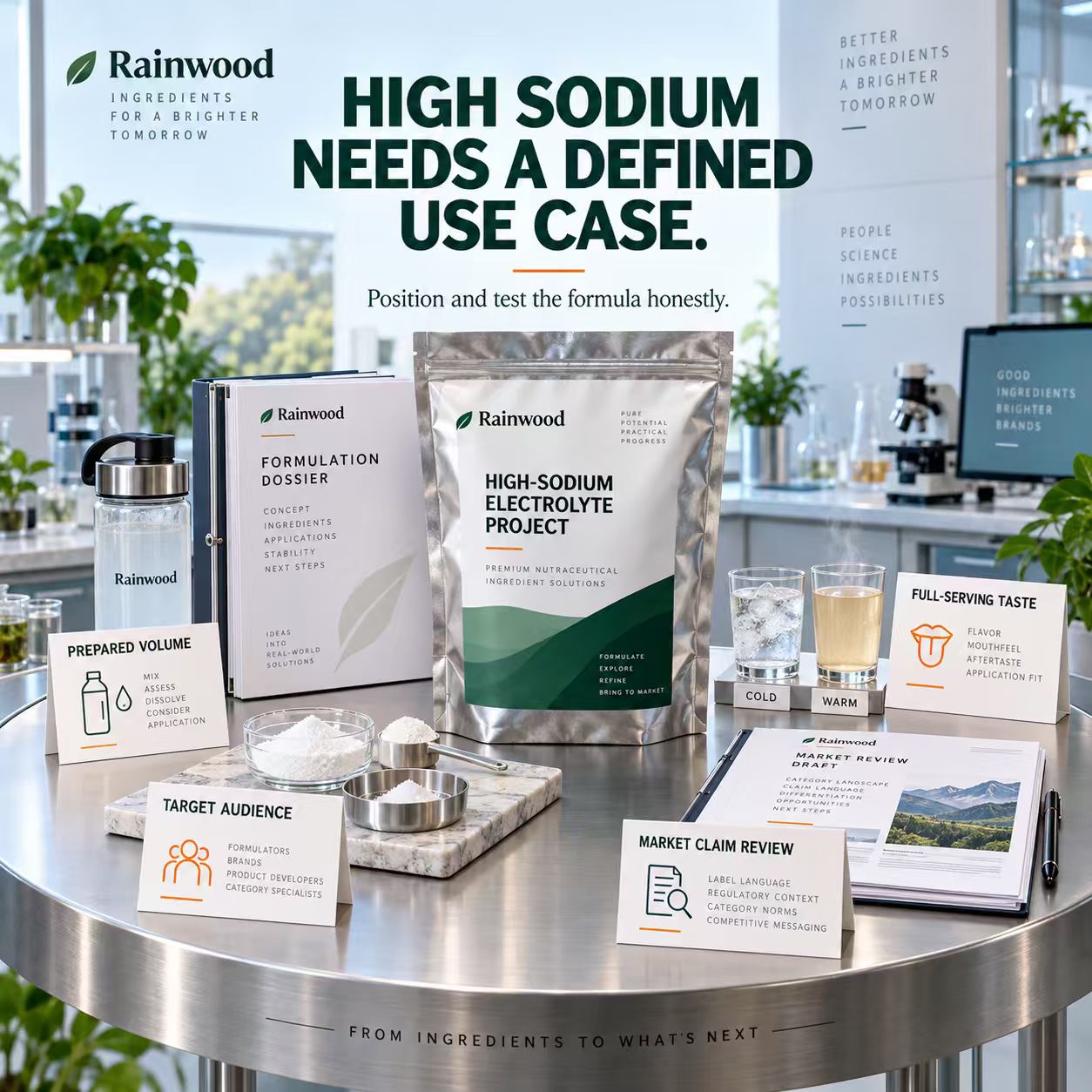
The front panel says “high sodium hydration.” The product is also sold as a daily creatine drink for office workers, travelers, and casual gym users. That is a difficult promise to reconcile. A high-sodium formula may make sense for certain exercise and climate conditions, but it is not automatically the right everyday beverage for every customer.
In a creatine electrolyte powder, sodium affects taste, fluid-volume instructions, osmolality, mineral claims, and audience definition. A product can be technically correct and still be commercially wrong if it does not tell the buyer when to use it or how much water to add. The solution is not to hide sodium. It is to position and test the formula honestly.
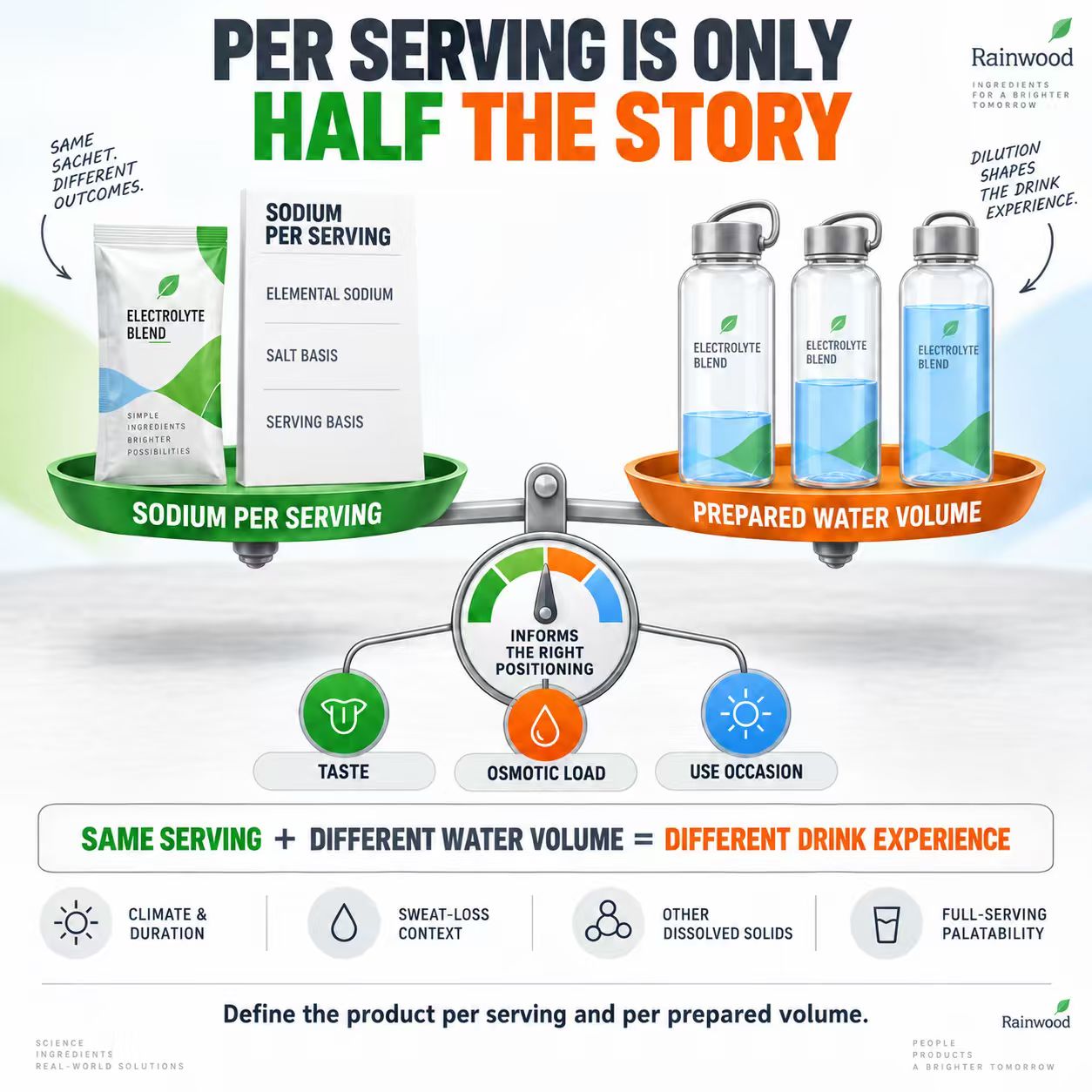
High sodium must be defined per serving and per prepared volume
“High sodium” can mean a large number per sachet, a high concentration in a small bottle, or a meaningful replacement amount in a larger training bottle. These are different experiences. Always record sodium per serving and sodium per liter or per labeled water volume.
Use our high-sodium creatine electrolyte specification guide to connect mineral delivery with the actual preparation direction.
The ISSN position stand discusses sodium concentrations in sports drinks in relation to fluid and electrolyte losses, but that context does not authorize one universal formula. Duration, climate, sweat rate, serving volume, carbohydrate, and individual use all matter.
Taste is the first commercial test
Sodium can improve palatability at one concentration and become harsh at another. Acidity, sweetness, flavor, potassium, magnesium, and creatine sediment change the perception. A high-sodium formula often needs a larger water volume or a more deliberate flavor system.
Test the drink in the exact bottle size printed on the label. Ask users to consume the full serving at a realistic pace rather than taking one sip. If the product is intended for long sessions, test it warm and cold. If it is intended for daily use, test it alongside ordinary meals and beverages.
Read the sodium-led sweat-loss formulation guide before adding a high-sodium claim to a broad daily-hydration product.
The audience must know when high sodium is useful
An endurance athlete training in heat may have different needs from a casual user who drinks the formula at a desk. A distributor may place the product next to low-sodium wellness powders even when the formula is built for heavy sweating. That channel mismatch can lead to poor reviews, consumer confusion, or inappropriate use.
Write directions that identify the intended scenario without making medical claims. The product page can explain that electrolyte needs vary with exercise, climate, diet, and sweat loss. It should not imply that every user needs a high sodium intake or that the product prevents a medical condition.
The label and claim review
Nutrient-content claims have market-specific rules. FDA guidance explains that claims characterizing nutrient levels require the correct amount and panel declaration. The product team should review sodium wording, serving size, disclosure requirements, and any comparison claim with a qualified regulatory reviewer.
Do not use “maximum hydration,” “replaces all lost electrolytes,” or similar absolute language unless the evidence and market allow it. A disclaimer cannot repair a claim that promises a universal physiological outcome.
A high-sodium product decision table
| Decision point | Question |
|---|---|
| Use occasion | Long, hot, or high-sweat training, or daily use? |
| Water volume | Does the labeled bottle size make the drink palatable? |
| Sodium amount | What is delivered per serving and per liter? |
| Other minerals | Are potassium and magnesium necessary, and at what amount? |
| Creatine | Is the daily dose compatible with the use moment? |
| Audience | Can a customer understand when to use it? |
| Claim | Is the wording supported in the target market? |
Use the table before finalizing the front panel. A strong product is specific about its job.
How RainwoodBio can develop a high-sodium formula with a clear market position
RainwoodBio publishes requirement confirmation, formula development, powder and sachet formats, testing and release documentation, packaging, and traceability. For a high-sodium creatine product, the relevant capability is connecting the mineral profile to water volume, flavor, audience, and market copy.
Request a high-sodium creatine electrolyte formula and label review with target users, exercise duration, climate, water volume, creatine dose, and proposed claims.
Approval gate for a high-sodium launch
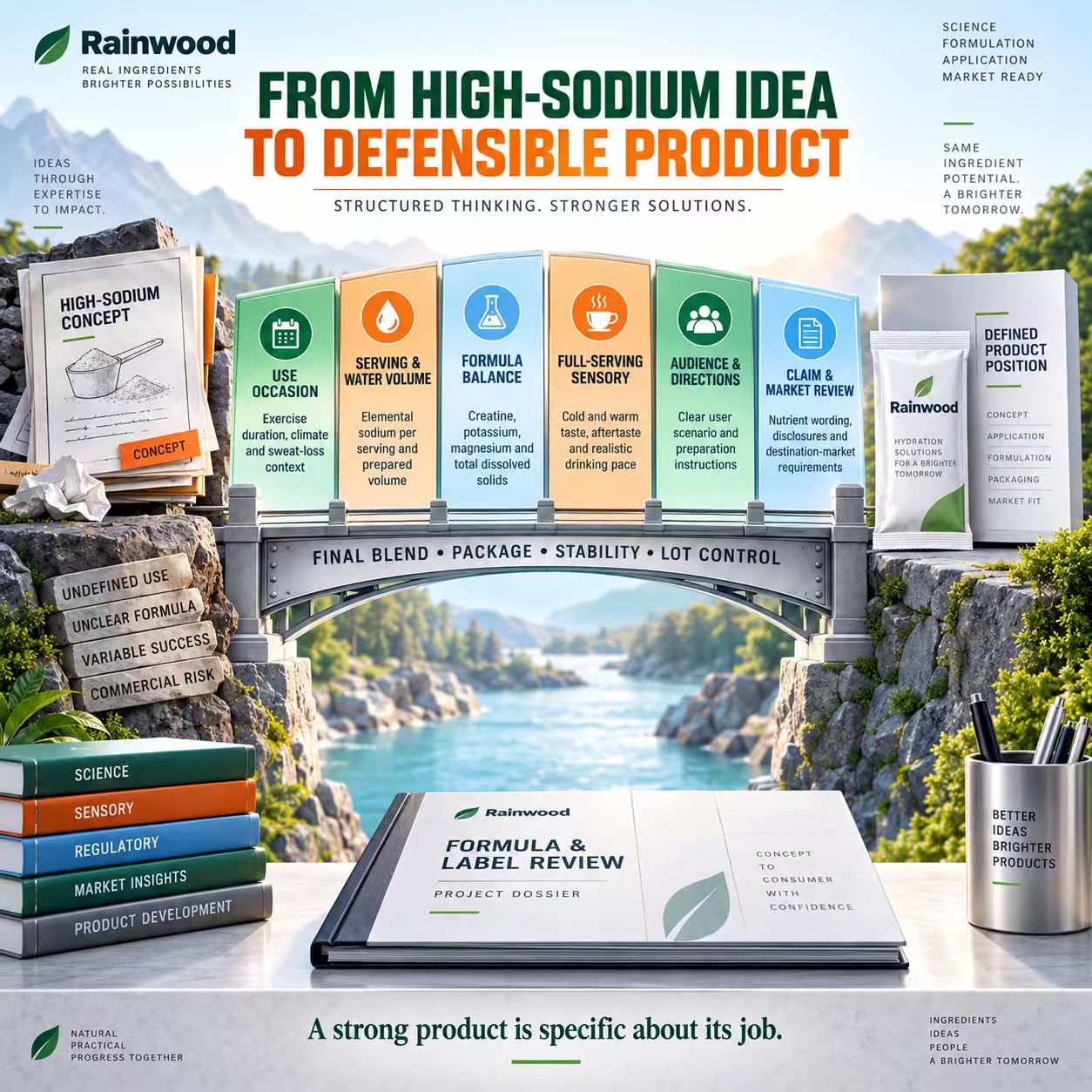
Before production, confirm:
- sodium is defined per serving and prepared volume;
- water-volume directions are clear;
- taste is acceptable over the full serving;
- potassium, magnesium, and creatine amounts are separately justified;
- target users and use moments are stated;
- nutrient-content and structure/function claims are reviewed;
- warnings and market-specific requirements are addressed;
- package and stability testing use the final blend.
Send your mineral proposal, formula, draft label, flavor samples, target markets, and product-page copy for a high-sodium formula-risk review. RainwoodBio can help determine whether the sodium level is a defensible product feature or a source of avoidable label and customer risk.
High sodium also changes the reorder conversation
When the formula is sold for a specific training scenario, distributors need a clear explanation of the serving and water volume. Otherwise they may compare the product with low-sodium daily hydration powders on price per sachet and conclude that it is expensive or too salty. Give distributors a short technical sheet showing sodium per serving, sodium per liter, creatine amount, intended exercise duration, and preparation direction. This turns a large number on the panel into a reasoned use case. It also reduces the chance that a partner will dilute the powder incorrectly or rewrite the product page as a universal everyday drink.
Keep the sodium value consistent between the quotation, formula, COA, Supplement Facts panel, product page, and distributor sheet. A small unit or basis difference can make a technically sound formula appear inconsistent.
Frequently asked questions
1.Is high sodium appropriate for every athlete?
No. Needs vary with exercise duration, climate, sweat loss, diet, fluid intake, and individual circumstances. Position the product for a defined use case.
2.Can I call a product “high electrolyte” because it has sodium, potassium, and magnesium?
Not automatically. The amounts, market definitions, panel, and surrounding claims must be reviewed.
3.Should high-sodium products include more water in the directions?
Often the formula should be tested at a water volume that makes the drink usable, but the correct direction depends on the complete formulation and use case.
References
- ISSN position stand on energy drinks and electrolytes: https://pmc.ncbi.nlm.nih.gov/articles/PMC9987737/
- FDA, Label Claims for Food and Dietary Supplements: https://www.fda.gov/food/nutrition-food-labeling-and-critical-foods/label-claims-food-dietary-supplements
- American College of Sports Medicine fluid replacement position stand: https://pubmed.ncbi.nlm.nih.gov/9303999/
- RainwoodBio OEM information: https://www.rainwoodbio.com/oem
This article is for B2B procurement and educational purposes. Sodium amount, safety, hydration, labeling, analytical, and regulatory requirements must be confirmed for the exact formula, user scenario, and destination market.