 EN
EN


Meta title: Magnesium L-Threonate Compliance Risks for Retail
Meta description: A retail-buyer guide to magnesium L-threonate market access, labels, claims, supplier documents, traceability and change control in the US and EU.
“Sold online already” is not a market-access argument
Magnesium L-threonate sits in a regulatory patchwork that exposes retail buyers to copy-and-paste mistakes. In the EU, the monohydrate was authorised as a novel food under defined adult-use, dose, specification and labeling conditions, with protected data for the named applicant through 7 November 2029. It was subsequently added to the EU list of permitted magnesium sources. Great Britain authorised the material on 5 March 2026 for adults, excluding pregnant and lactating women, with a maximum 250 mg of magnesium per day and its own protected-data conditions.
The US follows a different framework. FDA’s “no questions” response to GRAS Notice 499 concerns specified uses in conventional foods; it is not FDA approval of a dietary supplement, a manufacturer or a cognitive claim. A UNII or facility registration is also not product approval. Retail files should state the actual legal route for the exact source and market instead of collecting regulatory-sounding screenshots.
Claims create a second exposure. FDA has already cited disease claims for a Magtein product—including dementia and “repairs damaged synapses”—as evidence of an unapproved and misbranded drug. A retailer can inherit risk through its product page, search copy, staff scripts, reviews it republishes or supplier-provided education. Approval should therefore cover both the physical label and every controlled digital claim.
A retailer can remove a noncompliant product from the shelf, but it cannot recover lost buyer trust as easily. Magnesium L-threonate creates a particular challenge because the ingredient, evidence, labeling and permitted route to market differ by jurisdiction.
Retail buyers do not need to become regulatory lawyers. They do need a gatekeeping process that catches obvious gaps before a launch reaches stores, pharmacies or a retail website.
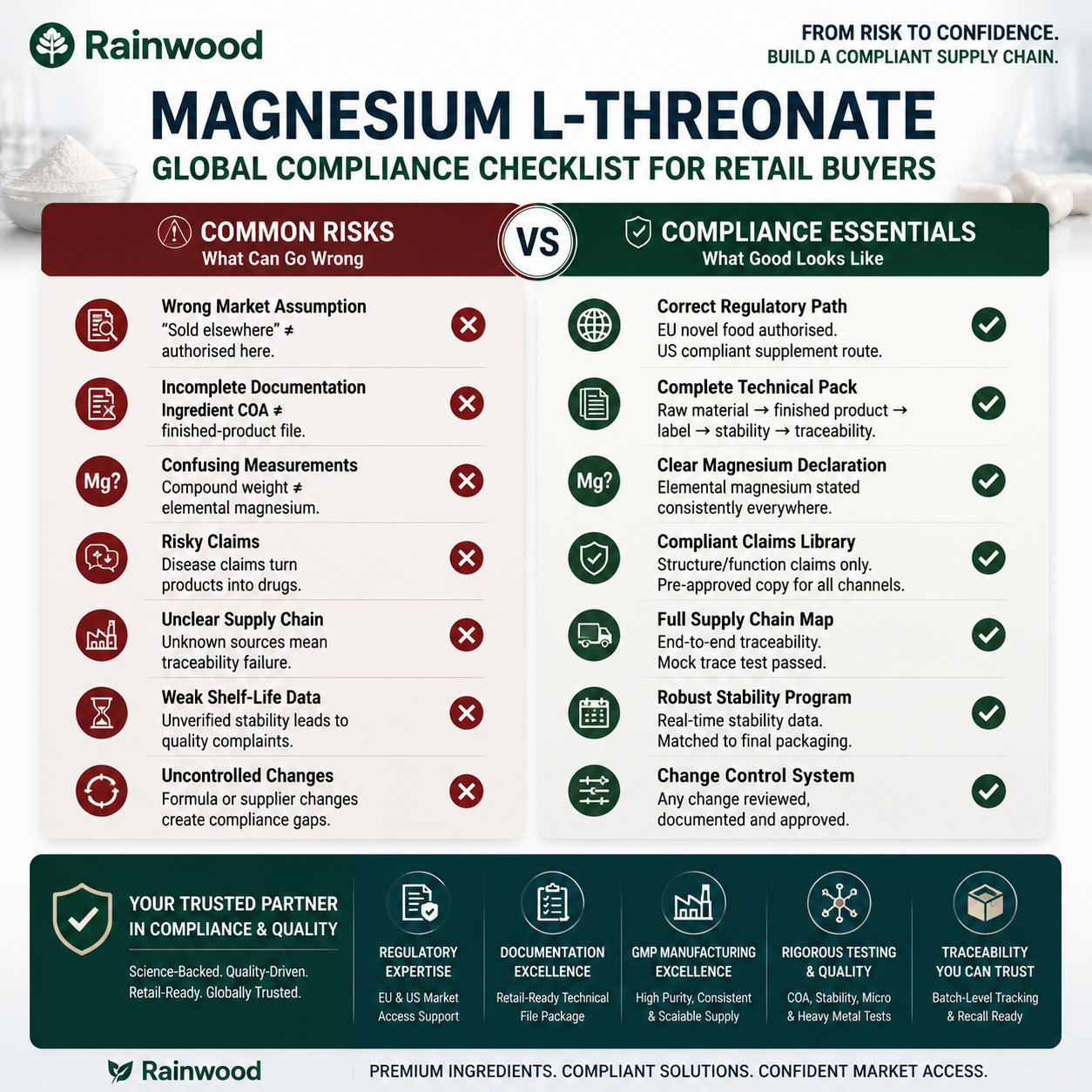
Risk 1: assuming “sold elsewhere” means authorised here
The same product cannot automatically move between the United States, European Union, United Kingdom, Canada, Australia or the Middle East.
In the EU, Commission Implementing Regulation (EU) 2024/2694 authorises magnesium L-threonate as a novel food for food supplements for adults, excluding pregnant and lactating women. Commission Regulation (EU) 2025/2225 also added it to the permitted list of magnesium sources in Annex II to Directive 2002/46/EC. The novel-food authorisation table sets a maximum level of 250 mg/day; EFSA’s underlying assessment describes up to 3,000 mg/day of the novel food as providing approximately 250 mg magnesium. The regulation also requires the ingredient name “Magnesium L-threonate,” an adults-only statement excluding pregnant and lactating women, and includes data-protection terms through 7 November 2029.
A retailer should verify that the actual supply chain is lawfully covered, not merely that the formula matches a chemical description.
The United States has a different dietary supplement framework. Review ingredient status, manufacturing compliance, the Supplement Facts panel, claims and any applicable new dietary ingredient analysis rather than applying the EU route.
Use our market-access review for magnesium L-threonate before accepting a cross-border product.
Risk 2: treating an ingredient document as a finished-product file
An ingredient COA does not establish that the finished capsules:
- contain the declared amount;
- meet microbiological and contaminant limits;
- were made under appropriate controls;
- use the approved label;
- remain stable in the commercial package; or
- can be traced and recalled.
Request a retail technical pack that clearly separates:
1. raw-material documents;
2. manufacturing-site documents;
3. finished-product specifications and results;
4. label and claims review;
5. shelf-life support; and
6. distribution traceability.
Our retail-ready supplement documentation checklist provides a useful document index.
Risk 3: confusing compound weight with elemental magnesium
Magnesium L-threonate is the source compound; magnesium is the mineral declared according to applicable labeling rules. A front label, product page and shelf card can create a misleading impression if they present a large compound number as though it were elemental magnesium.
Review all consumer touchpoints:
- principal display panel;
- Supplement Facts or nutrition declaration;
- product title;
- shelf tag;
- online specifications;
- comparison charts;
- retailer search filters; and
- staff training.
The same numerical statement should mean the same thing everywhere.
See Why Magnesium L-Threonate Quotes Vary So Much for the sourcing implications.
Risk 4: disease claims hidden in “educational” copy
Retail pages often repeat supplier descriptions. A product listing that claims to treat insomnia, prevent dementia or reverse cognitive decline can create regulatory exposure even if the bottle uses softer wording.
The US FTC looks at express and implied messages in health-product advertising and expects objective claims to have competent and reliable scientific evidence. FDA distinguishes permissible categories of dietary supplement labeling claims from disease claims and has requirements for structure/function claim notifications and disclaimers.
The existence of a study does not establish that:
- every magnesium L-threonate source is equivalent;
- the finished retail product matches the studied formula;
- the population matches the shopper;
- every measured outcome improved;
- the effect is clinically meaningful; or
- disease language is permitted.
Create an approved-copy library for product pages, email, shelf cards and staff scripts. Remove unreviewed supplier copy from automatic data feeds.
Review our responsible supplement claims guide.
Risk 5: misunderstanding branded ingredients and authorisations
Trademark permission, patented-use rights, novel-food authorisation and technical equivalence are different questions. A supplier may offer chemically similar material without the right to use a branded name. Conversely, trademark permission alone does not prove that the finished product satisfies every regulatory requirement.
The retailer’s file should show:
- exact ingredient manufacturer;
- distributor chain;
- right to use any trademark;
- relevant authorisation or market-access basis;
- formula and dose consistency;
- label statements; and
- change-notification route.
Do not permit a brand to add a logo after product approval without documentation.
Risk 6: weak supplier and site traceability
The label may name a brand or distributor, while manufacturing, packaging and testing occur at several sites. Map:
- ingredient manufacturer;
- importer;
- finished-product manufacturer;
- contract packer;
- testing laboratories;
- brand owner;
- retailer distribution centre; and
- complaint contact.
Require lot coding that connects the retail unit to manufacturing and distribution records. Test the system with a mock trace: choose a bottle lot and ask the supplier to identify key ingredient and packaging lots.
Risk 7: shelf life borrowed from another product
A two-year expiry may be based on the ingredient, a different bottle, a different capsule count or a “similar” magnesium formula. Retail buyers should ask what evidence supports the commercial product in its actual package.
At minimum, understand:
- stability protocol or scientific rationale;
- formula and package tested;
- storage condition;
- attributes monitored;
- available time points;
- handling of ongoing data; and
- action if a trend threatens shelf life.
Expiry coding must also leave sufficient remaining life at receipt under the retailer’s policy.
Risk 8: changes after listing approval
A product can pass onboarding and then change ingredient source, facility, formula, capsule shell, label, laboratory or package.
Your supplier agreement should define changes requiring prior approval. Use version control for:
- formula;
- specifications;
- label;
- claims;
- packaging bill of materials;
- facility list; and
- regulatory documents.
Reapprove material changes before accepting the next lot.
A retail onboarding gate
Require sign-off from the relevant functions:
| Gate | Key question |
|---|---|
| Commercial | Does the product fit the category and margin plan? |
| Regulatory | Is the ingredient, label and claim set suitable for the market? |
| Quality | Are specifications, testing and manufacturing controls adequate? |
| Supply | Can lots be traced and replenished reliably? |
| Legal | Are rights, responsibilities and remedies documented? |
| Content | Do every retail and digital claim match the approved copy? |
Do not let a promotional launch date override a failed critical gate.
Frequently asked questions
### Can a retailer rely on the brand’s compliance warranty?
A warranty is useful but does not replace proportionate due diligence. Retailers should define required evidence and audit rights.
### Does an FDA facility registration make the product approved?
No. FDA states that dietary supplements are not approved for safety and effectiveness before sale. Registration and product approval are not the same.
### Is EU magnesium L-threonate suitable for pregnant consumers?
The current EU authorisation is for adults excluding pregnant and lactating women and requires corresponding label wording.
### How often should the technical file be refreshed?
Set a periodic review and require immediate notification of relevant changes, complaints, recalls or regulatory developments.
Make the retail file as strong as the shelf presentation
Send us the destination market, proposed label, ingredient documents and retail requirements. We can help organise a pre-listing gap review and document request.
Request a retail magnesium L-threonate compliance review.
References
- Commission Implementing Regulation (EU) 2024/2694.
- Commission Regulation (EU) 2025/2225.
- European Commission, *EU Register of Nutrition and Health Claims*.
- US Food and Drug Administration, *Dietary Supplement Labeling Guide*.
- US Food and Drug Administration, *Notifications for Structure/Function Claims*.
- US Federal Trade Commission, *Health Products Compliance Guidance*.
- UK Food Standards Agency register, [GB authorisation for magnesium L-threonate](https://data.food.gov.uk/regulated-products/id/novel-foods/authorisation/novel-166.html).
- US Food and Drug Administration, [warning letter citing disease claims for a Magtein product](https://www.fda.gov/inspections-compliance-enforcement-and-criminal-investigations/warning-letters/spartan-enterprises-inc-dba-watershed-wellness-center-642030-03082023).
- US Food and Drug Administration, [GRAS Notice 499 for specified conventional-food uses](https://hfpappexternal.fda.gov/scripts/fdcc/index.cfm?id=499&set=grasnotices).
*This article is general information, not legal advice. Retail requirements and laws vary and should be confirmed for the destination and sales channel.*