 EN
EN
Meta title: How to Verify a Magnesium L-Threonate Supplier
Meta description: An importer’s guide to verifying magnesium L-threonate supplier identity, manufacturing sites, market access, testing, traceability and trial orders.
Three documents that can look convincing and prove almost nothing
The first is a COA recreated on the seller’s own letterhead. It may contain real-looking limits but fail to identify the original ingredient manufacturer or laboratory. The second is a factory certificate whose scope covers food powders or capsules generally, not the site and activity being offered. The third is a branded-ingredient declaration that cannot be traced to an authorised distributor or licence. None should be accepted in isolation.
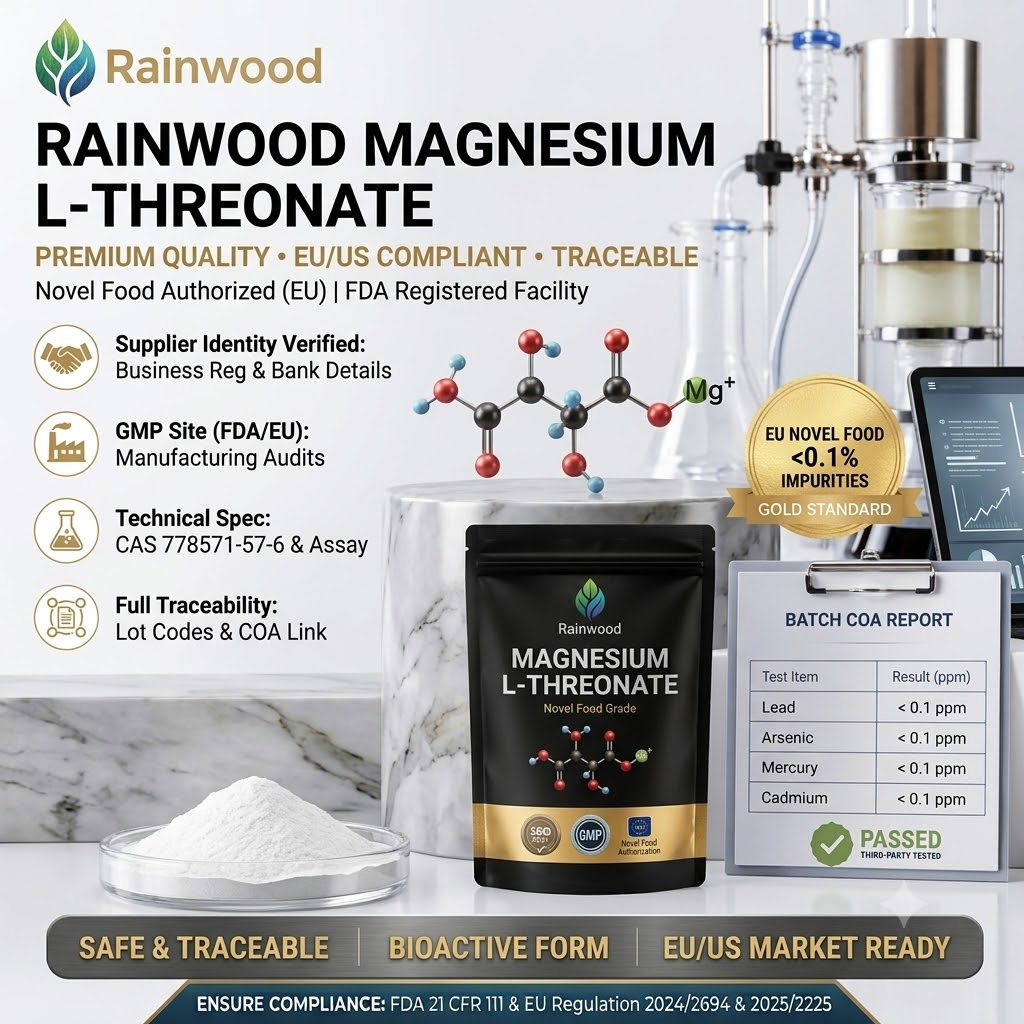
For magnesium L-threonate, cross-check the chemistry as well as the company. CAS 778571-57-6 refers to the anhydrous substance in FDA records; CAS 500304-76-7 identifies the monohydrate used in the EU-authorised novel food. Confirm which form the supplier makes, which formula weight its assay uses and whether the stated magnesium percentage is internally consistent. A mismatch is a reason to investigate, not automatic proof of counterfeiting.
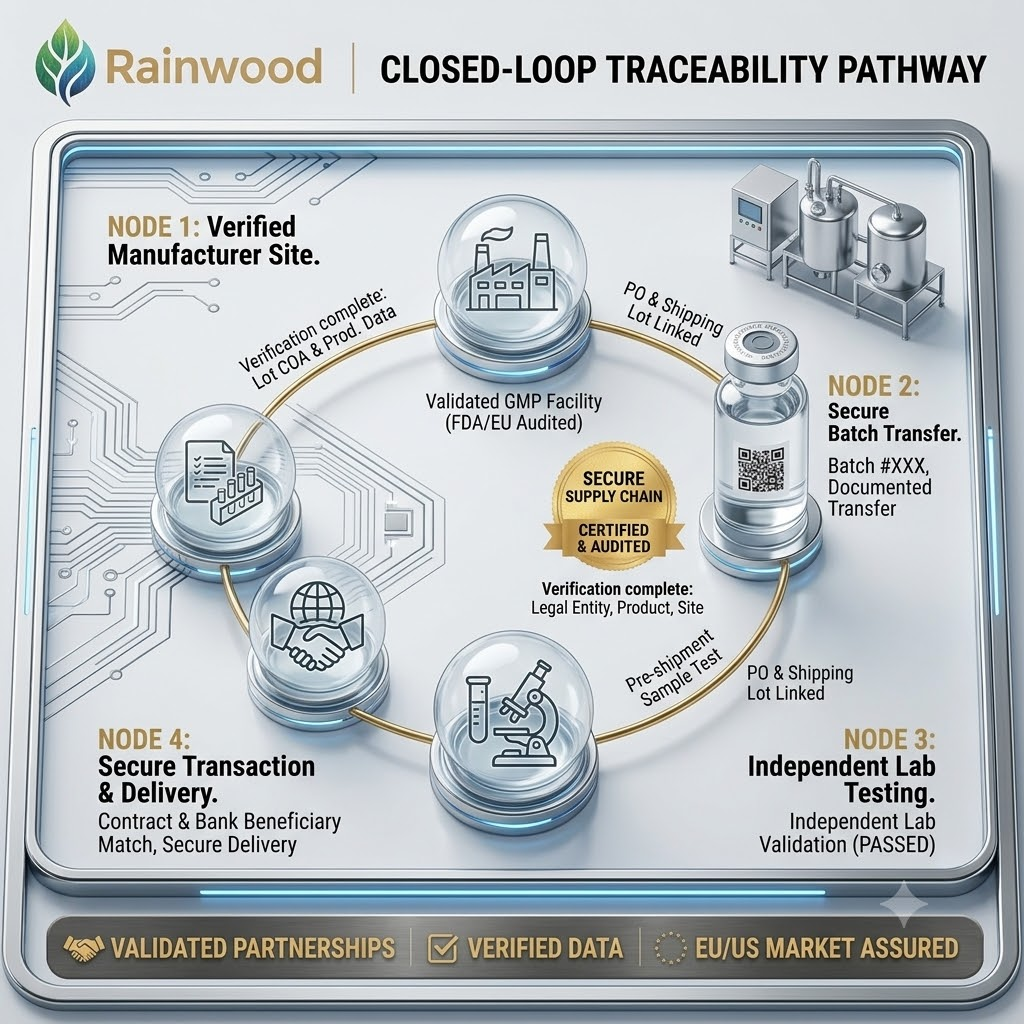
Then close the traceability loop. Ask for the original manufacturer’s product code, specification and lot COA; distributor authorisation if applicable; purchase-order and shipping-lot linkage; recent product-specific production or testing evidence; and a small independently tested trial lot. Verify bank changes and important documents through a separately sourced contact. A supplier that cannot explain who made the material should not be rescued by a beautiful website.
A professional website, a polished COA and a video of stainless-steel equipment can all be real—and still fail to prove that the company quoting you controls the magnesium L-threonate supply it claims to sell.
Supplier verification is not about deciding whether a company is “good” or “bad.” It is about confirming the legal entity, product, site, quality system and transaction path before your risk becomes inventory.
Verify the legal and commercial identity
Start with facts that should agree across documents:
- registered company name;
- business registration number;
- registered address;
- manufacturing and warehouse addresses;
- website domain and company email;
- bank beneficiary;
- export entity;
- contract seller; and
- invoice issuer.
A manufacturer may legitimately use an affiliated export company or distributor. The risk is not the structure; it is an unexplained structure. Ask for a simple supply-chain diagram showing who manufactures, tests, sells, stores and exports the material.
The bank beneficiary should match the contracted party or be supported by a documented, verified explanation. Confirm changes through a known contact using an independent communication channel.
Use our supplier onboarding and traceability checklist to record the result.
Establish whether the site is a manufacturer, packer or trader
Ask the supplier to state its role in writing. Then request evidence appropriate to that role:
### If it claims to manufacture the ingredient
Request the site address, process overview, production scope, capacity range, quality certifications, recent audit evidence where available and product-specific records.
### If it manufactures finished supplements
Request evidence covering the dosage form, applicable dietary supplement or food controls, production and packaging capabilities, quality-unit authority and testing arrangements.
### If it is a distributor or trader
Request manufacturer authorisation, traceability, storage conditions, change-notification route and confirmation of whether original manufacturer documents can be reviewed.
Trading companies can add valuable export, financing and communication services. Problems arise when the role is hidden or traceability stops at the trader.
Verify the exact material, not a generic capability
The supplier should provide a controlled product specification including:
- chemical name and form;
- composition or assay;
- elemental magnesium;
- L-threonate;
- relevant impurities;
- moisture or loss on drying;
- heavy-metal limits;
- microbiological criteria;
- physical characteristics;
- test methods or references; and
- storage and shelf-life conditions.
Compare the specification with the target market. For the EU, review Commission Implementing Regulation (EU) 2024/2694, including the authorised conditions, specifications, labeling statements and data-protection terms, plus Regulation (EU) 2025/2225 on its use as a magnesium source. Do not assume a material is covered because its English name looks identical.
Our magnesium L-threonate product documentation guide lists the technical file elements to request.
Read the COA for evidence, not decoration
Check whether the COA:
- names the manufacturer;
- identifies a real lot and production date;
- references the approved specification;
- reports actual numerical results where appropriate;
- identifies methods;
- includes review or approval;
- is internally consistent; and
- can be traced to the offered goods.
Watch for the word “conforms” across every field without numerical data, impossible dates, inconsistent fonts, mismatched addresses or methods that do not fit the analyte. None proves fraud alone, but each deserves clarification.
Independently verify a pre-shipment sample from the commercial lot when risk justifies it. Control sampling: a perfect sample selected by the seller does not necessarily represent the shipment.
Read How to Verify Magnesium L-Threonate Quality Beyond the COA for test-plan details.
Evaluate the quality system with product-specific questions
Certificates are useful, but a discussion about actual controls is more revealing. Ask:
- How is incoming ingredient identity verified?
- Who approves suppliers and specifications?
- How are deviations investigated?
- How are out-of-specification results handled?
- What changes require customer notification?
- How are labels and packaging reconciled?
- How long are batch and distribution records retained?
- How are complaints and recalls managed?
- Can the facility trace one finished lot back to ingredient lots?
For US dietary supplement manufacturing, FDA’s 21 CFR Part 111 framework provides a useful reference for identity, specifications, master records, batch records, quality control, complaints and recordkeeping.
Ask the supplier to demonstrate one traceability example with sensitive commercial data redacted.
Conduct a remote or on-site audit intelligently
A live video call can confirm location and basic capability when travel is impractical. Ask the host to move through a pre-agreed route and show:
- exterior and site identification;
- receiving and quarantine areas;
- material labels;
- production equipment;
- cleaning status;
- in-process controls;
- packaging lines;
- laboratory or sample-control area;
- retained samples; and
- finished-goods quarantine.
An on-site audit allows deeper record review, but it is still a sample in time. Use an auditor qualified for the product and market. Avoid treating a photo tour as a quality-system audit.
Explore our contract manufacturer audit support.
Check regulatory documents at the source
Whenever possible, verify certificates through the issuing body, certification database or regulator. Confirm:
- legal name and site;
- scope;
- standard and version;
- certificate number;
- issue and expiry dates;
- accreditation status; and
- whether the dosage form or product falls within scope.
“FDA registered” does not mean FDA approved. FDA explains that dietary supplements and their labels are generally not approved for safety and effectiveness before sale. Treat claims of government “approval” carefully.
Use a controlled trial order
A trial order should test the system, not only the material. Define:
- approved specification;
- commercial-lot sampling;
- pre-shipment test plan;
- packaging and sealing;
- shipment documents;
- temperature or humidity controls where needed;
- deviation communication;
- delivery timing; and
- acceptance and remedy terms.
Retain samples and compare received goods with the independently tested pre-shipment sample. Evaluate documentation accuracy, responsiveness and change handling.
Protect the contract
Include provisions for:
- product and specification;
- authorised manufacturing site;
- no unapproved substitution;
- audit and inspection;
- change notification;
- records and traceability;
- confidentiality and intellectual property;
- nonconformance investigation;
- rejection, replacement or refund;
- recall cooperation;
- governing law; and
- Incoterms.
Legal counsel should adapt terms to the transaction and jurisdictions. A purchase order referring only to “magnesium L-threonate powder” leaves too much unresolved.
A supplier verification scorecard
Score evidence, not presentation:
| Area | Evidence to review |
|---|---|
| Legal identity | Registration, address and bank match |
| Supply role | Manufacturer, distributor or exporter defined |
| Product | Controlled specification and methods |
| Market access | Destination-specific support |
| Quality | Procedures, audit and records |
| Testing | Lot-specific and independent verification |
| Traceability | One-step-back and one-step-forward example |
| Change control | Written notification commitment |
| Commercial | Clear price, Incoterm, lead time and remedy |
Any critical gap should be resolved before price becomes the deciding factor.
Frequently asked questions
### Is a video factory tour enough?
No. It supports identity and capability checks but does not replace document review, product-specific verification or a qualified audit.
### Is buying through a trader always riskier?
No. A transparent, qualified distributor can reduce risk. Hidden manufacturer identity and weak traceability are the concern.
### Who should select the independent laboratory?
The buyer should approve a competent laboratory and suitable methods. Sampling control is as important as the lab name.
### How often should suppliers be requalified?
Use a risk-based schedule and re-evaluate after significant changes, quality issues, regulatory changes or long periods without orders.
Verify before you wire the deposit
Send us the supplier’s specification, redacted COA, target market and proposed order terms. We can help identify gaps and organise the questions for a technical and commercial review.
Request a magnesium L-threonate supplier review.
References
- US Food and Drug Administration, *Current Good Manufacturing Practice for Dietary Supplements*.
- US Food and Drug Administration, *FDA 101: Dietary Supplements*.
- Commission Implementing Regulation (EU) 2024/2694.
- Commission Regulation (EU) 2025/2225.
- European Food Safety Authority, *Safety of magnesium L-threonate as a novel food* (2024).
- US FDA Global Substance Registration System, [anhydrous magnesium L-threonate identity and CAS](https://precision.fda.gov/uniisearch/srs/unii/1y26zz0otm).
- ThreoTech, [Magtein supply and authenticity statement](https://magtein.com/about-us/) (brand-owner source).
*This article provides general due-diligence information and is not legal advice. Verification should be proportionate to the product, order and destination.*