 EN
EN

Meta title: Launch Magnesium L-Threonate with a Practical MOQ
Meta description: A step-by-step magnesium L-threonate launch plan for startup and DTC brands, covering positioning, dosage, format, testing, packaging, MOQ and reordering.
The low-MOQ trap nobody puts in the quotation
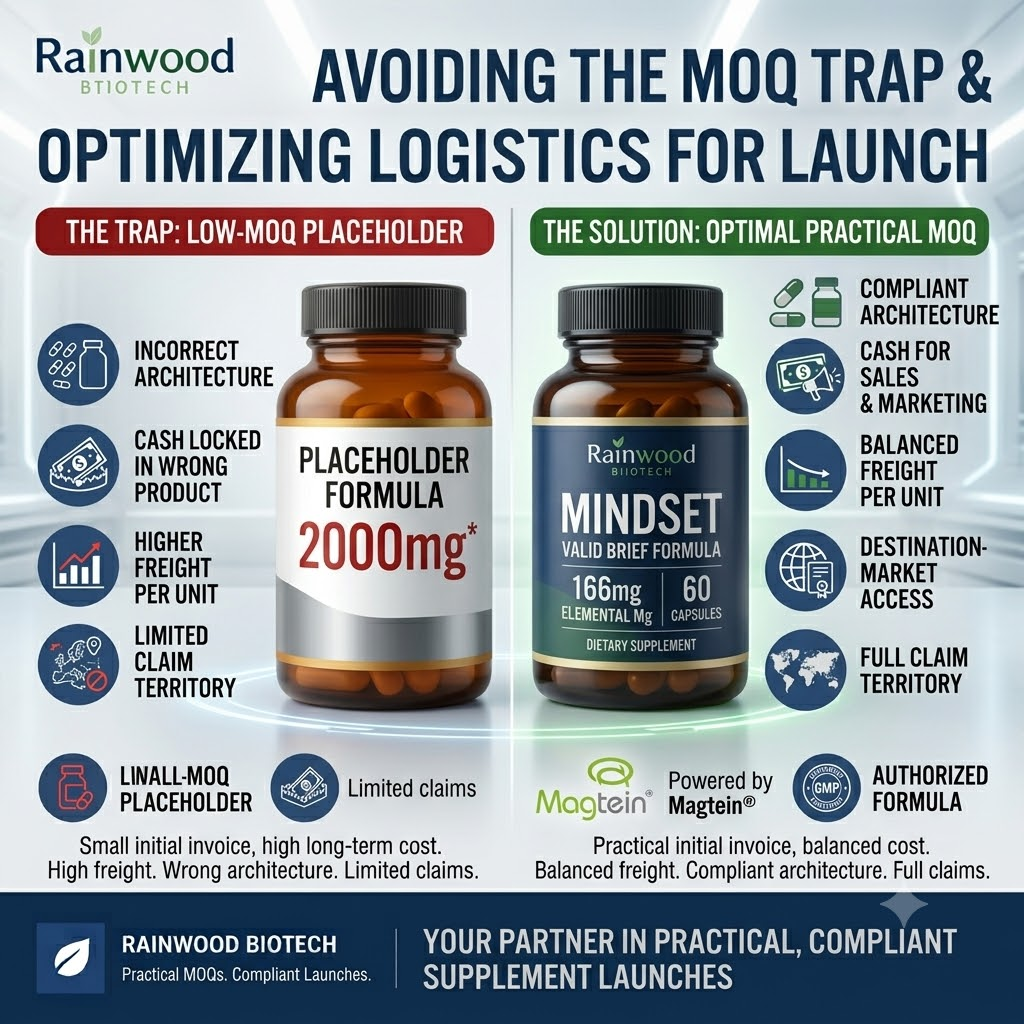
A low minimum order can reduce the first invoice while locking a brand into the wrong product architecture. The common trap begins with a large front-panel number such as “2,000 mg.” For the EU monohydrate specification, magnesium represents only 7.2%–8.3% of the compound. Two thousand milligrams therefore corresponds to roughly 144–166 mg of elemental magnesium before finished-product tolerances are considered. Delivering that compound amount commonly needs several capsules, a larger bottle and more freight than a founder first models.
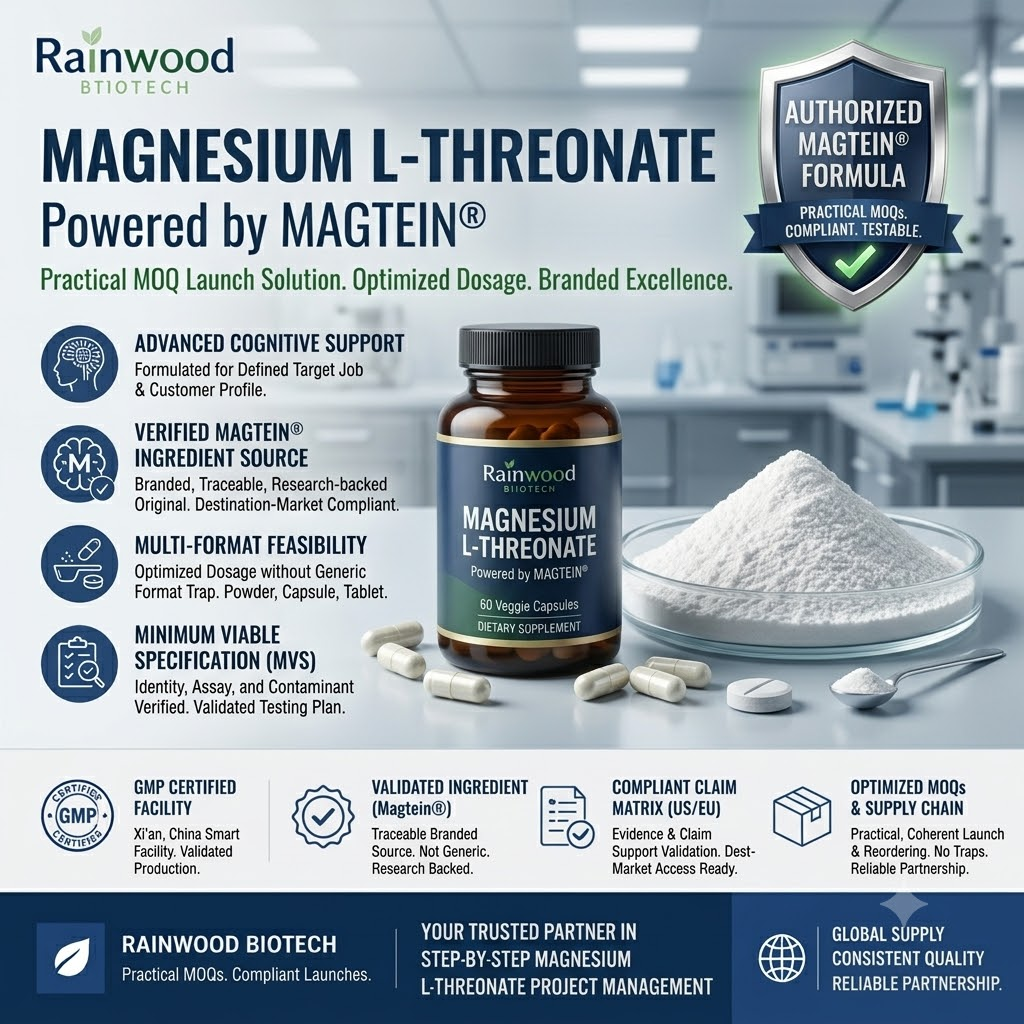
There is a second decision hidden inside the MOQ: branded Magtein® or a generic magnesium L-threonate source. Generic material is not automatically fake, but it cannot automatically use the Magtein name, logo, supply story, research or a protected market authorisation. A small test order made before trademark permissions, source traceability and destination-market access are settled can become inventory that cannot be advertised as planned.
For a sensible trial launch, freeze five points before paying a deposit: exact chemical form and source; compound and elemental amounts; realistic commercial fill; permitted claim territory; and the documents or rights needed in the country of sale. Negotiate a small first run around that validated brief, not around a placeholder formula designed only to reach a low MOQ.
The smallest manufacturing minimum is not necessarily the safest first order. A “low MOQ” launch can still lock cash into the wrong serving size, an inefficient package or claims that cannot be used in the target market.
For a startup supplement brand, a practical MOQ is the smallest production run that can deliver a compliant, testable and commercially coherent product at a landed cost the business model can support. Finding that point requires decisions in the right order.
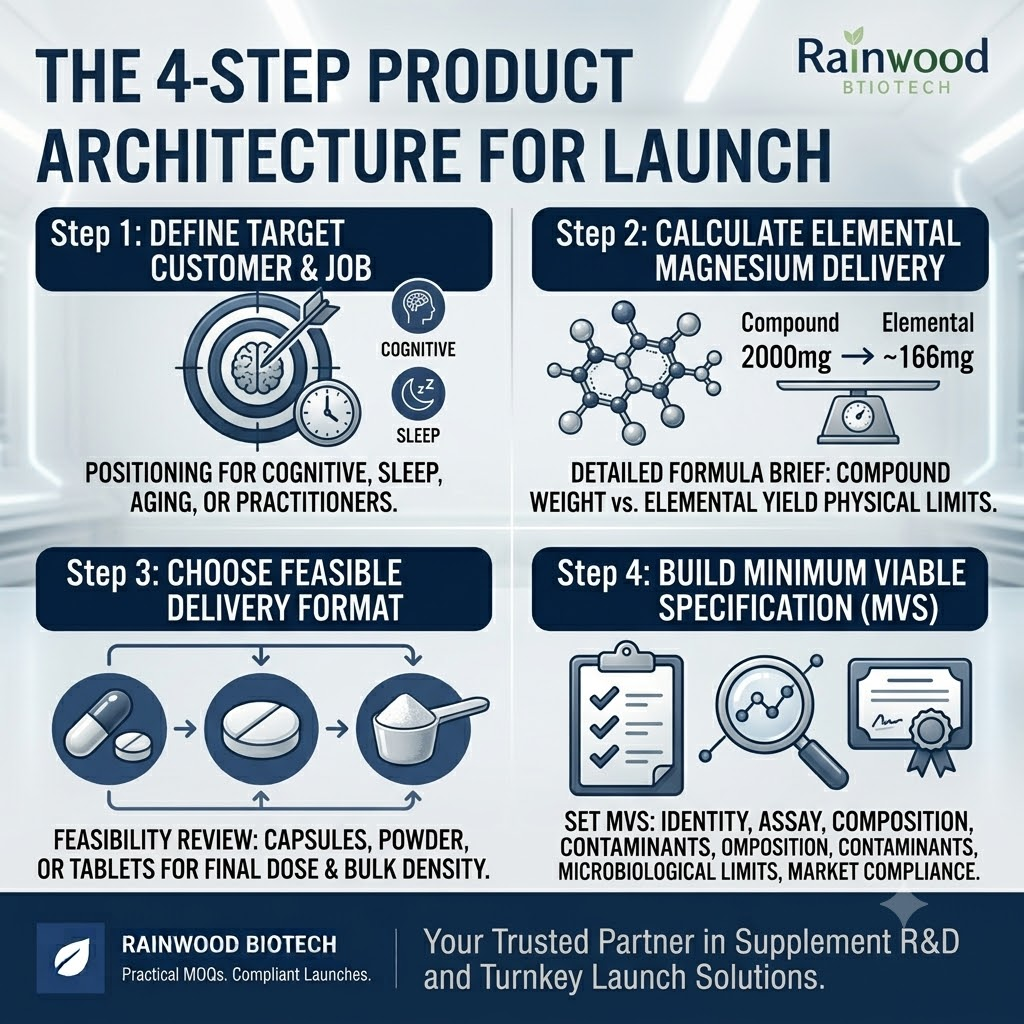
Step 1: Define one customer and one job
Do not begin with “a premium magnesium product for everyone.” Decide who the first buyer is and why the product belongs in that person’s routine.
Possible starting positions include:
- a premium cognitive-wellness product for knowledge workers;
- an evening routine product for consumers interested in sleep quality;
- a healthy-ageing mineral formula;
- a practitioner-positioned magnesium product; or
- a transparent single-ingredient product for experienced supplement buyers.
This is a commercial positioning decision, not permission to make disease claims. The intended benefit language must later be reviewed against the available evidence and the rules in the country of sale.
Our private-label magnesium L-threonate development process starts with the customer, channel and target market because those choices control nearly everything that follows.
Step 2: Separate ingredient weight from magnesium delivery
Magnesium L-threonate contains only a fraction of its weight as elemental magnesium. The exact value must come from the accepted raw-material specification and be reflected correctly in the finished-product calculation.
Write a formula brief containing:
1. magnesium L-threonate compound weight per daily serving;
2. calculated elemental magnesium per serving;
3. target capsule or scoop count;
4. other active ingredients, if any;
5. target consumer and market; and
6. any ingredient or label restrictions.
This prevents a common launch error: choosing an attractive front-label number before confirming what can physically fit in the selected format.
Step 3: Choose a format the dose can support
Capsules are familiar, portable and easy to position, but gram-level serving weights can increase the daily capsule count. Tablets may reduce unit count in some formulas, yet compression behaviour, tablet size, disintegration and tooling need evaluation. Powders can accommodate larger servings, but taste, moisture control, scoop accuracy and packaging become more important.
Do not choose based on trend alone. Ask for a preliminary feasibility review covering:
- raw-material bulk density and flow;
- estimated capsule or tablet dimensions;
- excipient requirements;
- serving count;
- package size;
- consumer convenience; and
- production and testing implications.
Compare the options in Capsules, Tablets or Powder for Magnesium L-Threonate.
Step 4: Build a minimum viable specification
A startup does not need unnecessary tests, but it does need enough control to know what it is selling.
The specification should address:
- identity;
- elemental magnesium or other appropriate strength measure;
- composition;
- relevant chemical contaminants;
- microbiological limits;
- appearance and physical characteristics;
- capsule or tablet weight variation, where applicable;
- packaging and label controls; and
- shelf-life basis.
The exact program should be set by qualified quality and regulatory professionals for the market. “Supplier COA available” is not a finished-product quality plan.
Read how to verify magnesium L-threonate beyond the COA before approving the specification.
Step 5: Design the evidence and claims together
Scientific interest in magnesium L-threonate has grown, but a promising paper is not a blank cheque for marketing language.
The FTC advises US health-product marketers to assess the totality and quality of evidence and generally regards randomised, controlled human clinical testing as the most reliable support for health-benefit claims. Product, dose, population and outcome all affect whether a study supports the exact claim being considered.
Recent human trials have reported outcomes related to sleep and cognition, but limitations and funding relationships should be considered, and results should not be translated into disease-treatment promises. Build a claim matrix with:
- proposed wording;
- implied consumer message;
- supporting evidence;
- study ingredient and dose;
- target population;
- required qualification; and
- market-specific approval status.
This disciplined approach is more valuable than filling a label with aggressive claims that may later need to be removed.
Step 6: Use stock components strategically
Custom bottles, closures and cartons can make a product distinctive, but they often carry higher component minimums than the supplement itself. For a first run, differentiation can come from:
- a well-designed pressure-sensitive label;
- a carefully selected stock bottle;
- a distinctive but available closure;
- clear benefit hierarchy;
- strong unboxing copy; and
- transparent quality information.
Reserve custom moulds and uncommon components for a later run unless they are essential to the business model. Confirm whether unused labels, cartons or bottles remain your property and how long the manufacturer will store them.
Our supplement packaging options for emerging brands can help separate launch essentials from upgrades.
Step 7: Calculate MOQ from cash and sales velocity
Use a simple model:
> First-order units ÷ realistic monthly unit sales = months of inventory
Then add sampling, damaged units, influencer seeding, customer replacements and channel reserves. Compare the result with the product’s supported shelf life and your reorder lead time.
The first order should leave enough cash for:
- freight and import charges;
- marketplace or fulfilment fees;
- advertising;
- samples;
- customer acquisition;
- a second production deposit; and
- unexpected artwork or component corrections.
If buying the “best” unit price leaves no money to sell or reorder the product, it is not the best MOQ.
Step 8: Build the reorder before the launch
A first batch is only successful if the second batch is easier.
Before production, agree on:
- forecast update frequency;
- reorder minimum;
- ingredient and packaging lead times;
- retained samples;
- approved master documentation;
- change notification;
- batch-release documents; and
- a reorder decision date.
Set a reorder trigger based on weeks of stock, not intuition. If total replenishment takes 12 weeks, waiting until only four weeks of inventory remain creates an avoidable stockout.
A practical launch sequence
For many emerging brands, the lowest-risk order of work is:
1. target customer and positioning brief;
2. market and ingredient feasibility review;
3. formula and serving calculation;
4. format trial;
5. preliminary specification and testing plan;
6. packaging selection;
7. compliant label copy;
8. final quotation;
9. pre-production approval;
10. manufacturing and batch release; and
11. launch and reorder monitoring.
Changing this sequence—especially printing packaging before formula and regulatory review—can create waste.
Frequently asked questions
### What is a normal MOQ for magnesium L-threonate?
There is no universal number. MOQ depends on format, ingredient availability, packaging, testing, facility scheduling and whether components are stock or custom. Ask for both the manufacturing minimum and the minimum total project spend.
### Should a first product contain only magnesium L-threonate?
A single-ingredient formula is easier to explain and control, but it still needs a clear commercial reason to exist. A blend may create stronger differentiation but adds dose, compatibility, evidence and label complexity.
### How early should packaging design begin?
Visual exploration can begin early, but final dielines and print-ready artwork should wait until serving size, count, mandatory copy and package dimensions are confirmed.
### Can the same launch plan be used in the US and EU?
No. Ingredient authorisation, required statements and claims differ. EU magnesium L-threonate has specific novel-food conditions, while the US uses a different dietary supplement framework. Review each market separately.
Plan a first run that can become a second run
Send us your target market, customer profile, desired format, expected retail price and first six-month sales forecast. We can turn those inputs into a practical development brief and a quotation with the main cost assumptions visible.
Discuss a low-MOQ magnesium L-threonate project.
References
- US Food and Drug Administration, *FDA 101: Dietary Supplements*.
- US Food and Drug Administration, *Dietary Supplement Labeling Guide*.
- US Federal Trade Commission, *Health Products Compliance Guidance*.
- European Commission, Implementing Regulation (EU) 2024/2694.
- Hausenblas et al., *Sleep Medicine X* (2024), randomised controlled trial of magnesium L-threonate in adults with self-reported sleep problems.
- UK Advisory Committee on Novel Foods and Processes, [identity, composition and use conditions for the assessed monohydrate](https://acnfp.food.gov.uk/ACNFPAdviceonthesafetyofMagnesiumL-threonateasanovelfoodforuseinfoodsupplements).
- ThreoTech, [Magtein ingredient-source and authenticity statement](https://magtein.com/about-us/) (brand-owner source).
*This article is intended for business planning and education. It is not medical or legal advice, and product requirements must be assessed for the intended market.*