 EN
EN

Meta title: Magnesium L-Threonate vs Glycinate for Brands
Meta description: Compare magnesium L-threonate and glycinate for supplement brands across positioning, evidence, elemental magnesium, format, cost and compliance.
The comparison most brands get wrong
“L-threonate goes to the brain; glycinate is for sleep” is an attractive sales script, not an adequate product comparison. It collapses preclinical mechanisms, ingredient-specific human trials, consumer associations and legal claims into two slogans. The right question is not which salt is universally better; it is which exact material, dose, format, evidence package and market position fit the customer’s job.
The numbers are also easy to manipulate. Magnesium L-threonate products may headline a gram-level compound weight while providing a much smaller elemental-magnesium amount. A glycinate product may be fully reacted, buffered with magnesium oxide or described through a proprietary blend, producing different elemental content and tolerance considerations. Compare verified elemental magnesium, exact compound input, other magnesium sources, capsule count and cost per day—not the front-panel milligrams alone.
Evidence must remain product-specific. Human magnesium L-threonate trials do not prove superiority over every glycinate product, and the absence of head-to-head evidence should not be filled with certainty. Conversely, generic magnesium research does not automatically prove a unique L-threonate benefit. A credible comparison identifies what is directly demonstrated, what is extrapolated and what remains a formulation or positioning choice.
Magnesium L-threonate and magnesium glycinate are often placed in the same “premium magnesium” category. That does not make them interchangeable.
For supplement brands, the important comparison is not which ingredient wins a universal “best magnesium” contest. It is which form fits the intended customer, evidence strategy, daily serving, delivery format, target price and destination market.
This guide compares the two from a product-development and sourcing perspective. It does not recommend either ingredient for an individual medical need.
The short answer
Magnesium L-threonate is usually positioned around cognitive wellness, healthy ageing and increasingly sleep-related routines. Its commercial advantages are a distinctive story and ingredient-specific research. Its challenges include relatively low elemental magnesium by weight, higher ingredient cost, a potentially larger daily serving and market-specific intellectual-property or novel-food questions.
Magnesium glycinate is commonly positioned around everyday magnesium supplementation, relaxation and gentle use. It can provide more elemental magnesium per gram than L-threonate, depending on its exact chemical form and whether it is buffered. Its challenges include crowded competition, inconsistent naming and the risk that “glycinate” products contain magnesium oxide or other forms that are not obvious from front-label marketing.
Neither description is a substitute for reviewing the exact raw material.
1. Chemistry and naming
Magnesium L-threonate is a magnesium salt of L-threonic acid. The EU authorised novel-food specification identifies the material as magnesium L-threonate monohydrate and defines composition, magnesium, L-threonate, impurities and microbiological limits.
Magnesium glycinate is a broad commercial name commonly used for magnesium bisglycinate or related glycine complexes. Suppliers may use terms such as:
- magnesium bisglycinate;
- magnesium diglycinate;
- magnesium glycinate chelate;
- fully reacted magnesium bisglycinate; or
- buffered magnesium glycinate.
Those names do not always describe the same material. “Buffered” products may include magnesium oxide to raise elemental magnesium or alter cost. A brand should request the formula, chemical description, elemental magnesium, manufacturing process and suitable analytical evidence rather than buying a name.
For both forms, the first sourcing question is:
> What exactly is the ingredient, and can the supplier’s methods distinguish it from a cheaper magnesium-containing blend?
Use our magnesium raw-material specification checklist before requesting finished-product quotes.
2. Elemental magnesium and serving size
Consumers often compare the largest number on the label. Brands must compare like with like.
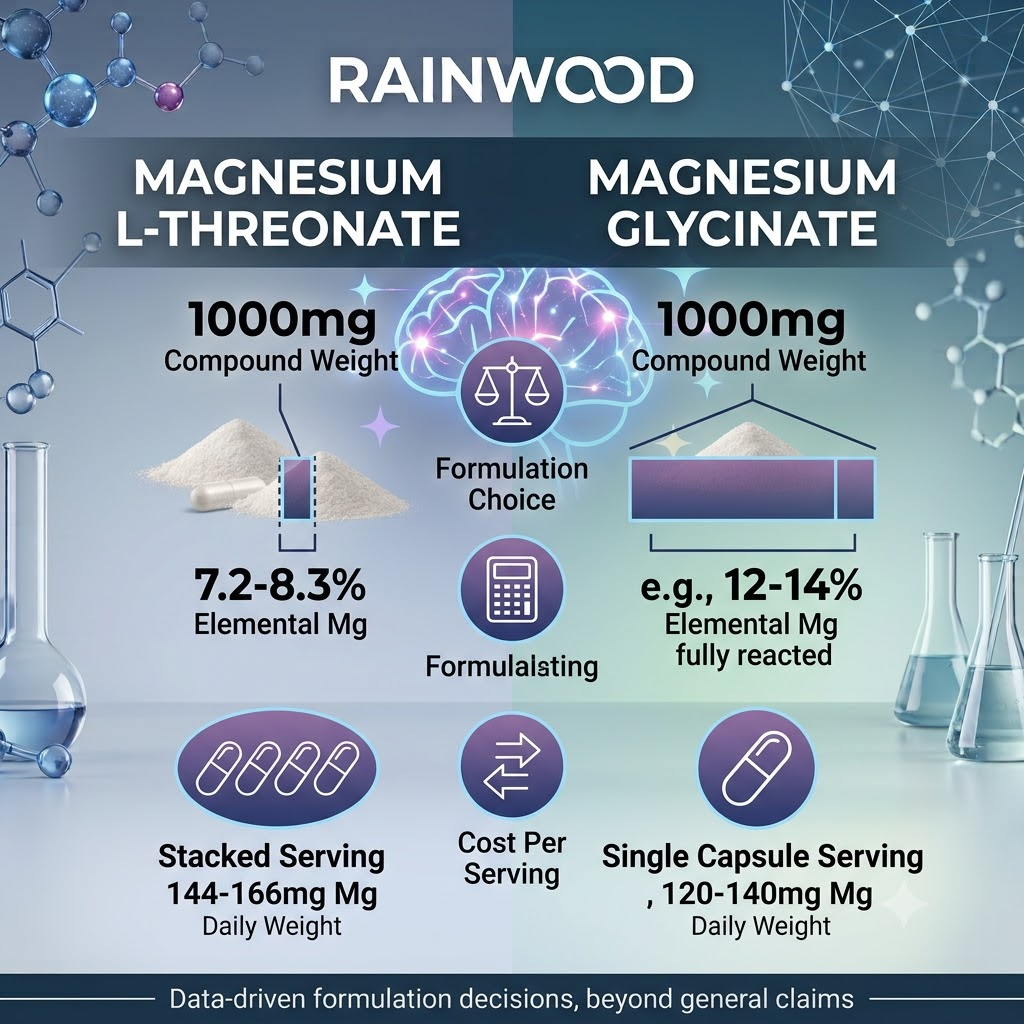
The EU specification for magnesium L-threonate lists magnesium at 7.2%–8.3%. At that range, 2,000 mg of the compound would theoretically provide about 144–166 mg of magnesium before final formulation and label considerations. The exact calculation must use the approved lot and specification.
Magnesium glycinate materials often have a higher theoretical or specified magnesium percentage, but the value varies with composition, hydration, manufacturing and buffering. Do not use a generic internet percentage for a commercial formula.
The practical result is that an L-threonate product may require:
- a larger total powder weight;
- more capsules;
- a larger scoop;
- more packaging; and
- a higher cost per daily serving.
This does not make it inferior. It means the form is usually sold on differentiation rather than on delivering the highest elemental magnesium in the smallest capsule.
Our magnesium L-threonate serving and format guide helps model the actual daily unit count.
3. Consumer positioning
Magnesium L-threonate
Common commercial territories include:
- cognitive wellness;
- focus and memory support;
- healthy ageing;
- premium brain-health routines; and
- sleep or evening wellness.
These territories attract consumers willing to pay for a specialised form, but they also create a higher claim-substantiation burden. Disease claims related to dementia, Alzheimer’s disease or insomnia are not appropriate shortcuts.
Magnesium glycinate
Common commercial territories include:
- general magnesium support;
- relaxation;
- evening routines;
- muscle and nerve function; and
- digestive gentleness compared with some other forms.
The category is familiar and broad, which can support higher volume but makes differentiation harder.
The best position depends on whether the brand wants to sell a specialised premium product or a more accessible daily magnesium.
4. What the human evidence can and cannot say
Magnesium L-threonate has ingredient-specific human trials exploring cognition and sleep-related outcomes. For example:
- a 2024 randomised controlled trial in 80 adults aged 35–55 with self-reported sleep problems evaluated 1 g/day for 21 days and reported differences in selected subjective and wearable outcomes;
- a 2026 randomised controlled trial in 100 adults aged 18–45 dissatisfied with sleep evaluated 2 g/day for six weeks and reported improvements in some cognitive and physiological outcomes, but no group differences in several sleep outcomes.
The papers disclosed industry relationships or funding. Study populations, doses and outcomes matter, and the results should be presented with limitations.
Research on magnesium glycinate is less tied to one proprietary cognitive story. A 2025 randomised placebo-controlled trial in 155 adults with poor sleep reported a small improvement in insomnia-severity scores with 250 mg/day elemental magnesium from bisglycinate over four weeks. That result does not prove that every glycinate formula treats insomnia.
Most importantly, a direct high-quality head-to-head trial establishing that one form is universally superior for sleep or cognition is not available from these sources. Comparing separate trials is scientifically weaker because study designs differ.
The FTC advises health-product marketers to rely on competent and reliable scientific evidence, consider the totality of evidence and ensure that studies match the product and claim. Animal findings can support research context but generally do not substantiate human benefit claims alone.
Review the claim traps magnesium L-threonate brands face before turning the comparison into marketing copy.
5. Format feasibility
Capsules
Both forms can be encapsulated, but L-threonate’s larger compound weight may increase capsule count. Glycinate formulas can also become bulky when delivering higher elemental magnesium.
Confirm:
- raw-material bulk density;
- capsule size;
- target fill;
- excipients;
- capsules per serving; and
- bottle count.
Tablets
Tablets can carry more material but require assessment of compressibility, tooling, disintegration, swallowability and coating. A technically feasible tablet may still be too large for the target customer.
Powders
Powders accommodate higher gram weights and flexible serving, but taste, solubility, moisture, scoop accuracy and pack protection matter. Flavoured formulas introduce sweeteners, flavours and stability questions.
Gummies
Mineral load, taste, water activity, process loss and unit count can make a meaningful dose difficult. Do not promise a gummy before a pilot feasibility review.
6. Cost structure
Compare cost per finished daily serving, not price per kilogram.
Include:
- raw-material cost;
- required compound weight;
- capsule, tablet or scoop count;
- manufacturing speed;
- excipients;
- testing;
- packaging size;
- branded-ingredient or licensing costs;
- regulatory support;
- freight; and
- expected retail margin.
Magnesium L-threonate may justify a higher retail price through a specialised story. Magnesium glycinate may deliver a more accessible price but face stronger competition and advertising costs.
Read What Determines the True Cost of a Magnesium L-Threonate Supplement for a complete model.
7. Quality risks are different
Magnesium L-threonate risks
- generic material presented as equivalent to a branded source;
- unclear target-market authorisation;
- compound assay without adequate identity;
- elemental magnesium calculation errors;
- sample-to-batch source changes;
- overextended brain or sleep claims; and
- low-density powder causing unexpected capsule counts.
Magnesium glycinate risks
- buffered material not disclosed clearly;
- magnesium oxide contributing to a high elemental value;
- ambiguous chemical naming;
- “chelated” claims without suitable evidence;
- methods that measure total magnesium but not the complex; and
- crowded labels using unsupported superiority claims.
Both ingredients require an identity strategy that goes beyond total magnesium. A result showing magnesium is present does not establish the form.
8. Regulatory considerations
United States
Dietary supplement brands are responsible for safety, manufacturing, labeling and claims. FDA does not approve supplements for safety and effectiveness before sale. Labels must follow Supplement Facts and ingredient requirements. Structure/function claims require substantiation, the statutory disclaimer and FDA notification after first marketing; disease claims are prohibited for products marketed as supplements.
Ingredient-specific NDI analysis may be necessary depending on the ingredient and history. Qualified regulatory review should determine the route.
European Union
Magnesium L-threonate is authorised under Regulation (EU) 2024/2694 with specific conditions, specifications, label statements and protected-data terms. Regulation (EU) 2025/2225 added it to Annex II of Directive 2002/46/EC as a source of magnesium used in food supplements. Health claims must still be evaluated under the EU authorised-claims framework.
Magnesium glycinate’s status and permitted use should be checked separately under applicable EU rules. Do not transfer a US label or claim strategy.
Other markets
Canada, the UK, Australia and other destinations have separate positive lists, licensing or notification systems. Ingredient acceptance in one market is not proof of acceptance elsewhere.
Our market-specific supplement compliance service can help organise a destination review.

9. Product strategy options
Choose magnesium L-threonate when:
- the brand wants a specialised premium position;
- the customer accepts a higher price and possibly more capsules;
- the evidence story is reviewed responsibly;
- the authorised source fits the market; and
- the supply chain can support consistent documentation.
Choose magnesium glycinate when:
- the brand wants broader daily magnesium positioning;
- elemental magnesium density and price matter more;
- the market is highly familiar with glycinate;
- the exact material and buffering are transparent; and
- the brand has another way to differentiate.
Consider a combination only when:
- there is a clear formulation rationale;
- each ingredient amount is meaningful;
- the combined elemental magnesium is calculated correctly;
- format and unit count remain practical;
- claims are supported for the actual formula; and
- the target market permits the ingredients and dose.
A blend should not be used to capture two keyword trends while hiding token amounts.
A brand decision scorecard
Score each form from 1 to 5:
| Decision factor | L-threonate | Glycinate |
|---|---:|---:|
| Fit with target customer | | |
| Evidence relevance | | |
| Market access | | |
| Elemental magnesium target | | |
| Capsule or format feasibility | | |
| Target retail price | | |
| Competitive differentiation | | |
| Supplier documentation | | |
| Supply continuity | | |
| Claims risk | | |
Weight the factors according to the business. A practitioner brand and a value-focused mass retailer should not reach the same answer.
Frequently asked questions
1.Is magnesium L-threonate more bioavailable than glycinate?
The answer depends on what “bioavailable” means, the endpoint, material and evidence. Avoid a universal superiority claim without direct, relevant comparative human data.
2.Which form is better for sleep?
Both have sleep-related marketing and some human research, but the available studies differ and do not establish a universal winner. Product choice should not replace medical advice.
3.Why does L-threonate often provide less elemental magnesium per serving?
Most of the compound’s mass is the L-threonate portion rather than magnesium. The accepted specification determines the calculation.
4.Can a brand call generic material by a branded ingredient name?
Only with appropriate rights and verification. Trademark, evidence and regulatory position should be confirmed.
5.Which form is cheaper to manufacture?
Glycinate is often less expensive per serving, but exact cost depends on material specification, dose, format, testing, packaging, volume and market requirements.
Choose the form that fits the business case
Send us your target customer, market, retail price, desired benefit territory, elemental magnesium goal and preferred format. We can help organise a side-by-side development brief before you request samples.
Compare magnesium L-threonate and glycinate for your brand.
References
- National Institutes of Health Office of Dietary Supplements, *Magnesium Fact Sheet for Health Professionals*.
- US Food and Drug Administration, *Dietary Supplement Labeling Guide*.
- US Federal Trade Commission, *Health Products Compliance Guidance*.
- Commission Implementing Regulation (EU) 2024/2694.
- Commission Regulation (EU) 2025/2225.
- Hausenblas et al., *Sleep Medicine X* (2024).
- Lopresti and Smith, *Frontiers in Nutrition* (2026).
- *Magnesium Bisglycinate Supplementation in Healthy Adults Reporting Poor Sleep: A Randomized, Placebo-Controlled Trial* (2025), indexed by the US National Library of Medicine.
- Wirth et al., [systematic review of magnesium supplementation and cognitive health](https://pubmed.ncbi.nlm.nih.gov/39009081/).
- Liu et al., [2016 randomised magnesium L-threonate trial](https://pubmed.ncbi.nlm.nih.gov/26519439/).
*This article is intended for product-development education and does not provide medical advice or claim that either ingredient treats a disease.*