 EN
EN

Meta title: How to Choose a Magnesium L-Threonate Manufacturer
Meta description: Choose a magnesium L-threonate manufacturer using verified evidence on source, testing, compliance, scale-up, packaging, contracts and trial runs.
The choice is not simply “factory or trader”
A real capsule factory may still buy poorly documented magnesium L-threonate. A knowledgeable distributor may offer better ingredient traceability than a manufacturer that hides its source. The decisive question is who controls each critical step: ingredient manufacture, authorised distribution, incoming release, formulation, finished testing, packaging, export and complaint investigation.
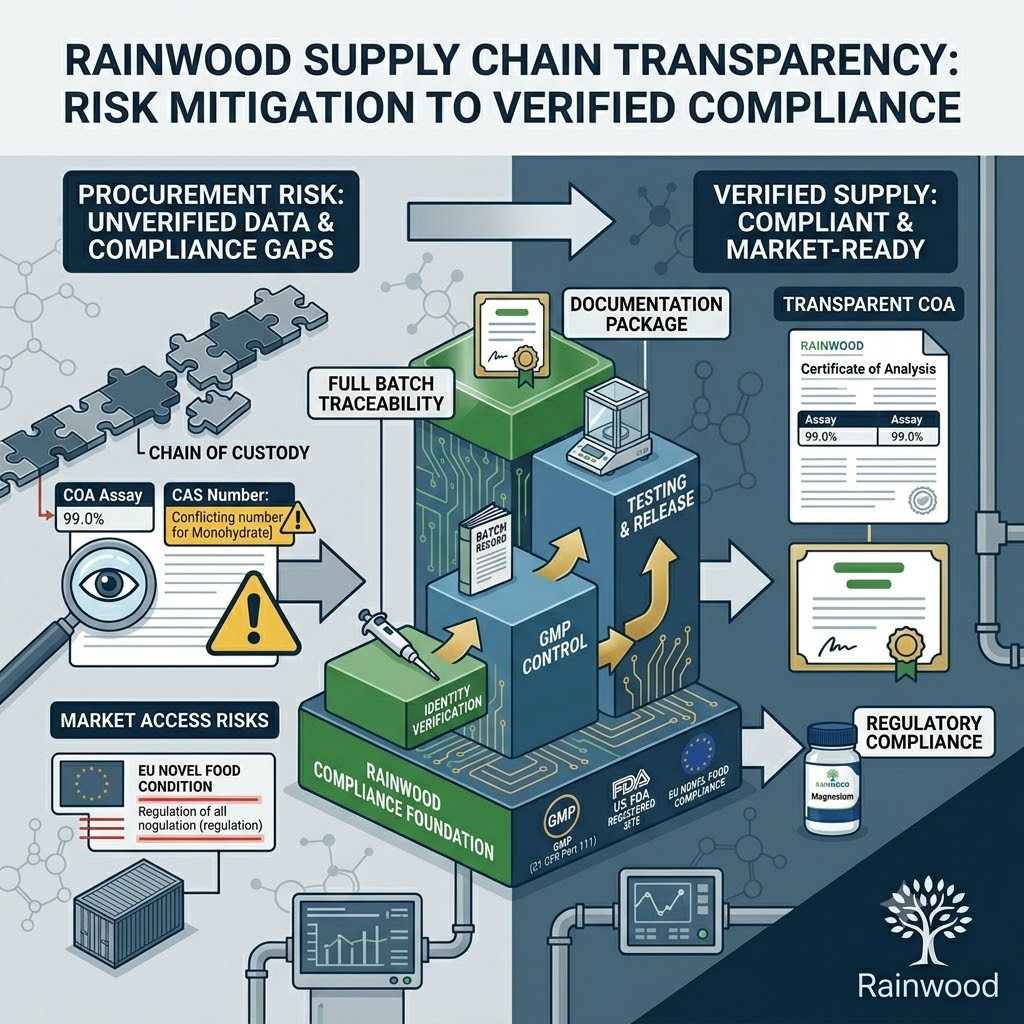
Start with the product identity. Require the original ingredient manufacturer and product code, monohydrate or anhydrous form, CAS identifier, formula or assay basis, magnesium and L-threonate limits, relevant process impurities and test methods. Cross-check whether the COA’s numbers can coexist. A “99%” assay, an anhydrous CAS number and a monohydrate magnesium range assembled from different templates should trigger a technical investigation.
Then separate three commercial positions. Authentic Magtein® requires a verifiable authorised source and trademark permission. Generic magnesium L-threonate can be legitimate, but it needs its own identity, evidence, IP and market-access assessment. Material presented as generic while quietly using Magtein studies, logo or protected regulatory status is a misrepresentation risk even if the powder is chemically related.
Ask the shortlisted manufacturer to prove the chain on one actual trial lot: purchase and receiving records, original lot COA, incoming identity verification, batch record, yields, finished results, retained sample and shipping traceability. That evidence is more predictive than another certificate wall.
The wrong manufacturer is not always the one with the worst factory. It may be a competent supplier whose ingredient source, dosage-form capability, documentation or minimum order does not fit your product.
Choosing well requires more than collecting certificates and comparing bottle prices. You need a repeatable process that separates verified evidence from sales presentation.
Step 1: write the project brief before contacting suppliers
A manufacturer cannot quote accurately from “Magnesium L-threonate capsules, best price.”
Provide:
- target country;
- target customer;
- product position;
- ingredient preference or source restrictions;
- compound weight and elemental-magnesium goal;
- single ingredient or blend;
- capsule, tablet, powder or other format;
- servings and units per container;
- packaging concept;
- testing expectations;
- initial and annual volume;
- target launch date;
- desired Incoterm; and
- target cost or retail price.
Separate requirements from preferences. “Must be suitable for EU sale” is a requirement; “black bottle preferred” may be flexible.
Our magnesium L-threonate OEM project brief gives suppliers the same information for comparable proposals.
Step 2: decide which manufacturing model you need
Full-service contract manufacturer
Handles formulation, sourcing, production, testing, packaging and sometimes label support. Convenient for growing brands but verify which activities are internal and which are subcontracted.
Toll or conversion manufacturer
Processes buyer-supplied ingredient or packaging. Gives the brand more source control but increases coordination, ownership and release responsibilities.
Private-label stock product
Offers an existing formula with a custom label. Fast and lower complexity, but differentiation, source choice and formula control may be limited.
Overseas finished-product manufacturer
Can offer integrated sourcing and competitive costs but adds freight, customs, importer, communication and destination-compliance questions.
Ingredient supplier plus local manufacturer
Separates ingredient expertise from finished-dosage capability. It can improve control but requires strong quality agreements between parties.
Choose the model before comparing prices.
Step 3: verify the legal entity and site
Confirm:
- registered legal name;
- business and manufacturing addresses;
- contract and invoice entity;
- bank beneficiary;
- facility registrations or licences;
- certification scope;
- dosage-form capability;
- ownership or group relationships; and
- subcontractors.
A sales office can represent a real factory. Ask for the relationship in writing and verify documents at the issuing source.
“FDA registered” does not mean FDA approved. FDA states that dietary supplements are generally not approved for safety and effectiveness before sale.
Read How Importers Can Verify a Magnesium L-Threonate Supplier for deeper due diligence.
Step 4: verify the magnesium L-threonate source
Ask:
- Who manufactures the raw material?
- At which site?
- Is it branded or generic?
- What is the exact specification?
- What evidence verifies identity?
- What is the magnesium range?
- Which market-access documents apply?
- Can the source change without approval?
- What is the normal lead time and capacity?
- Is a backup source qualified?
For EU projects, review the authorised novel-food conditions and protected-data terms in Regulation (EU) 2024/2694, together with Regulation (EU) 2025/2225 adding magnesium L-threonate as a permitted magnesium source under Directive 2002/46/EC. Do not accept “EU compliant” as a complete answer.
For US projects, request the supplier’s regulatory rationale and have qualified professionals assess ingredient status, any applicable NDI considerations, labeling and claims.
Our magnesium L-threonate source documentation checklist identifies the core documents.

Step 5: assess dosage-form competence
A manufacturer may be excellent at herbal capsules and inexperienced with a high-load mineral powder.
For capsules, ask about:
- representative bulk density;
- flow;
- capsule sizes;
- target fill;
- weight controls;
- excipient strategy;
- rejection rates;
- bottle-count fit; and
- pilot capability.
For tablets:
- direct compression or granulation;
- tooling;
- target tablet dimensions;
- hardness and friability;
- disintegration;
- coating; and
- pilot scale.
For powder:
- blend uniformity;
- flavour capability;
- hygroscopicity;
- scoop or stick-pack fill;
- seal integrity; and
- sensory testing.
Request examples of technically similar products with confidential information removed. Do not ask for another brand’s private formula.
Evaluate capsules, tablets and powder against the target dose before committing to one format.
Step 6: review the quality system through records
Certificates summarise a system. Records show it working.
Review or audit:
- quality-unit responsibilities;
- supplier qualification;
- incoming identity verification;
- specifications and methods;
- master manufacturing records;
- batch production records;
- in-process controls;
- deviations;
- out-of-specification investigations;
- change control;
- cleaning and line clearance;
- complaint handling;
- retained samples;
- recalls; and
- document retention.
US FDA dietary supplement CGMP in 21 CFR Part 111 provides a detailed reference for manufacturers serving that market. Other destinations have their own requirements.
Ask the manufacturer to walk through one redacted batch from receipt to release.
Step 7: define the testing package
Clarify for every test:
- raw material or finished product;
- analyte;
- method;
- specification;
- frequency;
- internal or external laboratory;
- turnaround;
- result format; and
- action for failure.
Do not accept “full testing” as a scope.
A magnesium L-threonate program may need to address identity, elemental magnesium, composition, relevant impurities, heavy metals, microbiology and finished dosage-form attributes. The exact plan is risk- and market-specific.
Explore How to Verify Magnesium L-Threonate Quality Beyond the COA.
Step 8: evaluate regulatory and claims support
Ask what the manufacturer provides:
- formula review;
- ingredient-status documents;
- Supplement Facts or nutrition panel;
- warning review;
- structure/function claim support;
- FDA notification support;
- EU novel-food and health-claim review;
- translation;
- trademark review; and
- retailer technical documentation.
Then define what remains the brand’s responsibility.
A manufacturer may review label mechanics without acting as legal counsel or substantiating marketing claims. Obtain qualified independent review when risk warrants it.
See Magnesium L-Threonate Labeling Mistakes That Can Delay a Launch.
Step 9: investigate sample-to-scale controls
Ask:
- Is the sample hand-filled or machine-produced?
- Which raw-material lot is used?
- Will commercial production use the same approved source?
- Which attributes does the sample demonstrate?
- Is a pilot required?
- How is the sample approved?
- Are retained units kept?
- What changes require reapproval?
A beautiful sample does not prove commercial blend uniformity, line performance or shelf life.
Treat the sample as one part of scale-up evidence, not proof that mass production will match automatically.
Step 10: inspect packaging capability
Confirm:
- stock and custom options;
- component suppliers;
- bottle-to-count fit;
- closure and induction seal;
- desiccant;
- label application;
- variable-data coding;
- carton and case pack;
- packaging-component MOQs;
- storage and ownership; and
- stability implications.
Ask for an actual finished pack prototype and dimensions. If the product will use FBA or another fulfilment network, check current channel thresholds directly.
Map stock and custom packaging options before components are placed on order.
Step 11: compare total commercial terms
Your quotation should state:
- formula and revision;
- ingredient source;
- batch and unit quantity;
- allowed overrun or underrun;
- tests;
- packaging;
- setup and tooling;
- unit price;
- taxes and freight;
- Incoterm;
- payment milestones;
- quote validity;
- lead time assumptions;
- storage;
- ownership of unused components;
- nonconformance remedy; and
- cancellation terms.
Compare total landed released cost per serving.
Compare the true landed cost per released serving rather than the headline bottle price.
Step 12: put quality and change control in the agreement
The manufacturing or quality agreement should address:
- approved sites and sources;
- specifications;
- testing and release;
- record access;
- audit;
- change notification;
- deviations and investigations;
- complaints and adverse-event routing;
- recalls;
- confidentiality;
- intellectual property;
- rejected product;
- destruction or replacement; and
- termination support.
Legal counsel should adapt terms. A supplier handbook is not automatically a negotiated quality agreement.
Step 13: run a controlled trial project
Use the first project to test:
- communication;
- document accuracy;
- sample control;
- schedule realism;
- production records;
- testing turnaround;
- packaging;
- shipment;
- complaint responsiveness; and
- invoice accuracy.
Define acceptance criteria before paying the balance. Retain commercial-lot samples and record lessons for reorder.
Step 14: score suppliers with weighted evidence
| Area | Suggested weight |
|---|---:|
| Product and market fit | 15% |
| Ingredient source and documents | 15% |
| Quality system | 20% |
| Dosage-form competence | 10% |
| Testing and methods | 10% |
| Regulatory support | 10% |
| Supply continuity | 10% |
| Commercial terms | 5% |
| Communication | 5% |
Adjust weights to the project. Score evidence from 1 to 5 and record the reason.
A critical market-access or identity gap should be disqualifying even if the weighted score looks acceptable.
Questions that expose weak answers
Ask:
1. Which test proves the ingredient is L-threonate rather than another magnesium material?
2. How do you calculate elemental magnesium for the label?
3. What would make you change the ingredient source?
4. Which EU authorisation covers this exact source?
5. What does the sample fail to demonstrate?
6. Which tests are on the finished batch?
7. What happens if our independent result disagrees?
8. Who approves a deviation?
9. How quickly can you trace a bottle lot?
10. Which packaging component has the longest lead time?
Strong suppliers may not answer instantly, but they should investigate transparently.
Red flags
- refuses to identify the manufacturing site;
- uses “FDA approved” inaccurately;
- cannot explain elemental magnesium;
- offers EU supply without authorisation evidence;
- COA lacks methods or lot trace;
- promises any capsule count without a fill trial;
- changes source without notice;
- guarantees marketplace approval;
- requires payment to an unrelated beneficiary;
- will not define defect remedy; or
- attacks competitors instead of explaining specifications.
One red flag calls for investigation. Several unresolved critical gaps call for another supplier.
Frequently asked questions
1.Should price be part of initial screening?
Yes, but after defining scope. An unaffordable supplier is not a fit; a cheap but noncomparable quote is not evidence of value.
2.Is a domestic manufacturer always safer?
No. Location changes logistics and oversight but does not replace product-specific verification. Assess every site.
3.How many suppliers should a brand audit?
Screen documents first, then invest in deeper review for the strongest candidates. The number depends on risk, volume and alternatives.
4.Should the ingredient supplier and finished manufacturer be the same company?
Not necessarily. Integrated supply can simplify coordination; separation can improve specialised expertise. Traceability and agreements matter.
5.Can a manufacturer formulate the claims?
It can propose language, but the brand remains responsible for marketing. Claims need qualified, market-specific substantiation and review.
Choose with a documented reason
Send us your market, format, serving concept, volume, test requirements and current supplier questions. We can help organise a comparable request for quotation and due-diligence checklist.
Request a magnesium L-threonate manufacturing review.
References
- US Food and Drug Administration, *Current Good Manufacturing Practice for Dietary Supplements*.
- US Food and Drug Administration, *Dietary Supplement Labeling Guide*.
- US Food and Drug Administration, *New Dietary Ingredient Notification Process*.
- US Federal Trade Commission, *Health Products Compliance Guidance*.
- Commission Implementing Regulation (EU) 2024/2694.
- Commission Regulation (EU) 2025/2225.
- European Food Safety Authority, *Safety of magnesium L-threonate as a novel food* (2024).
- UK Advisory Committee on Novel Foods and Processes, [identity, process and specification assessment](https://acnfp.food.gov.uk/ACNFPAdviceonthesafetyofMagnesiumL-threonateasanovelfoodforuseinfoodsupplements).
- US FDA Global Substance Registration System, [anhydrous magnesium L-threonate identity](https://precision.fda.gov/uniisearch/srs/unii/1y26zz0otm).
- ThreoTech, [Magtein ingredient-source and authenticity statement](https://magtein.com/about-us/) (brand-owner source).
*This article provides general sourcing, quality and regulatory information and is not legal advice. Supplier approval should be conducted by qualified professionals for the project and destination.*