 EN
EN


Meta title: Build a Reliable Magnesium L-Threonate Supply
Meta description: Build a reliable retail magnesium L-threonate supply program with better forecasting, source approval, batch release, change control and traceability.
The backup-source paradox
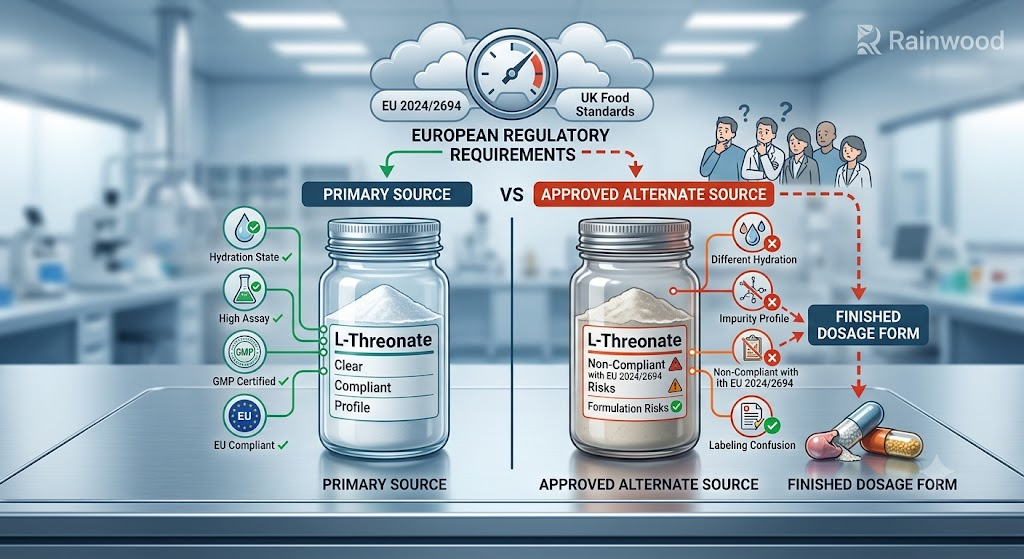
A buyer may believe two magnesium L-threonate suppliers create resilience. In reality, the second powder may use a different hydration state, assay basis, manufacturer, trademark status or legal market-access route. It may require a new label value, different tests, a changed capsule fill and a separate regulatory conclusion. A name-level “approved alternate” can therefore create more risk precisely when the primary source fails.
Qualify backups at three levels. First, confirm legal substitutability in every destination, including any protected-data or authorised-source conditions. Second, demonstrate technical comparability through identity, magnesium, L-threonate, water, relevant process impurities and physical properties. Third, run the finished dosage form using the alternate material and confirm fill, weight variation, disintegration, appearance, packaging fit and shelf-life implications.
Retail contracts should also distinguish an emergency source from an approved interchangeable source. Require advance written notification, documentary traceability and buyer approval before a change. Reserve strategic ingredient or finished-goods stock where concentration risk cannot be removed. A silent substitution made to protect an on-time delivery can be more damaging than a transparent short delay.
A successful magnesium L-threonate listing creates a new risk: demand grows faster than the documentation, ingredient supply or packaging plan.
Retail and pharmacy buyers need more than a supplier that can fill the first purchase order. They need a program that protects continuity, batch quality, shelf life and consumer trust through promotions, seasonal demand and regulatory change.
Define the program before selecting the supplier
Begin with a written supply brief:
- country or countries of sale;
- sales channels and store count;
- launch date;
- expected weekly baseline;
- promotional peaks;
- desired weeks of stock;
- minimum remaining shelf life at receipt;
- packaging and case-pack requirements;
- batch-document requirements; and
- service-level expectations.
This gives suppliers a fair basis for capacity and cost planning. “Best price for 10,000 bottles” does not show whether the buyer may need 30,000 bottles six weeks after launch.
Our retail magnesium L-threonate program brief helps turn a range decision into operational requirements.
Approve the ingredient supply chain
Document the magnesium L-threonate manufacturer, distributor and any importer. Review:
- product specification;
- market-access basis;
- lead time;
- normal batch size;
- supply capacity;
- testing and release;
- change notification;
- backup strategy; and
- allocation policy during shortages.
For the EU, verify the supply chain against the conditions and data-protection terms in Commission Implementing Regulation (EU) 2024/2694 and the magnesium-source framework updated by Regulation (EU) 2025/2225. A backup source cannot be added only because its chemistry looks similar; legal market access must also be established.
For each market, qualified regulatory professionals should confirm whether the source, dose and label remain suitable.
Separate the demand forecast from the purchase order
Share a rolling forecast even when it is not binding. Use three horizons:
1. Firm window: production and components are committed.
2. Planning window: supplier reserves capacity and materials.
3. Visibility window: longer-term demand helps identify supply constraints.
Update forecasts after promotions, distribution gains, category resets and major media exposure. Track forecast accuracy so both parties can improve safety-stock decisions.
A reliable supplier should explain which inputs are constrained: ingredient, capsules, bottles, labels, cartons, laboratory capacity or production slots.
Set inventory buffers at the right points
Holding all safety stock as finished bottles can create expiry risk. Holding none creates stockouts. Consider buffers for:
- qualified ingredient;
- standard packaging components;
- printed components;
- released finished goods; and
- retailer distribution inventory.
The right mix depends on lead time and obsolescence. Unprinted stock bottles are flexible; market-specific printed cartons are less flexible. Ingredient reserves may help continuity but require storage, ownership and retest-date agreements.
Review the true cost of magnesium L-threonate inventory before assigning buffers.
Use a retailer-approved product specification
Do not rely solely on the manufacturer’s standard release sheet. The approved finished-product specification should connect:
- ingredient identity;
- elemental magnesium declaration;
- composition;
- relevant contaminants;
- dosage-form attributes;
- packaging;
- label;
- lot coding;
- storage; and
- shelf life.
The technical agreement should state which document wins if the purchase order, supplier specification and retailer manual conflict.
Our finished-product quality control process provides a framework for specifications and batch documents.
Create a batch-release document pack
Agree on documents before launch:
- finished-product COA;
- ingredient lot traceability;
- production and expiry dates;
- lot number;
- packaging and artwork revision;
- deviation summary;
- required independent test results;
- release authorisation; and
- shipment documentation.
Set the review timeline. If the retailer needs five business days for document approval, that time belongs in the supply lead time.
For pharmacy or professional channels, the buyer may require additional evidence. Requirements should be proportionate and defined before quotation.

Control changes through the commercial relationship
The supplier must notify the buyer before changes to:
- ingredient manufacturer or specification;
- manufacturing or packing site;
- formula or excipients;
- capsule shell;
- test method or laboratory;
- bottle, closure, seal or desiccant;
- label or claim;
- shelf life; and
- legal or regulatory status.
Define which changes require prior written approval, notification only or revalidation. Include enough notice to use existing packaging responsibly.
See how established brands control magnesium L-threonate batch consistency.
Measure service with a balanced scorecard
Price and on-time delivery are not enough. Track:
- on-time, in-full delivery;
- document right-first-time rate;
- batch-release cycle;
- deviation rate;
- complaint rate;
- forecast accuracy;
- change-notification compliance;
- corrective-action closure;
- remaining shelf life; and
- responsiveness during incidents.
Review trends quarterly or at a justified frequency. A slightly higher-cost supplier may produce a lower total program cost through better documents and fewer disruptions.
Prepare for complaints and recalls
Before the first sale, define:
- consumer-contact owner;
- serious-adverse-event escalation where applicable;
- complaint sample collection;
- lot trace process;
- investigation timelines;
- retailer notification;
- withdrawal and recall roles;
- public communication approval; and
- cost allocation.
Run a mock trace or recall exercise. Select one lot and verify how quickly the parties can identify ingredient lots, production records, shipment destinations and remaining stock.
Manage shelf life as a moving control
Shelf life is not only an expiry date printed on a bottle. Monitor:
- stability commitments;
- ongoing results;
- shipping and storage conditions;
- warehouse dwell time;
- minimum life at retailer receipt;
- FEFO rotation;
- returns; and
- consumer complaints.
If distribution moves into a hotter or more humid region, reassess whether the existing package and stability rationale remain appropriate.
Our packaging and shelf-life planning service can support this review.
A 90-day launch operating plan
Before launch
Approve the technical file, forecast, safety stock, batch-release process, product content and escalation contacts.
First 30 days
Track sell-through, returns, customer questions, listing accuracy and fulfilment damage.
Days 31–60
Update the forecast, place the reorder if the trigger is reached and review any complaint patterns.
Days 61–90
Conduct the first supplier performance review, confirm stability commitments and adjust inventory by channel.
This early discipline helps prevent a strong launch from becoming a stockout or rushed second batch.
Frequently asked questions
1.Should retailers require two approved sources?
Not automatically. A second source can improve resilience but adds qualification, regulatory and consistency work. In some markets, switching may be legally constrained.
2.Who should own printed packaging inventory?
Agree in writing. Ownership, storage, obsolescence, artwork changes and destruction should be clear.
3.How much safety stock is appropriate?
Use demand variability, total replenishment lead time, service target and shelf life. Avoid a universal percentage.
4.Can the retailer release a batch based only on the COA?
That depends on its quality agreement and risk assessment. At minimum, confirm the correct lot, product, specification, label revision and required documents.
Build supply before demand exposes the gaps
Send us your destination market, annual forecast, channel plan, required shelf life and technical manual. We can organise the information needed for a supply and manufacturing feasibility review.
Discuss a retail magnesium L-threonate supply program.
References
- US Food and Drug Administration, *Current Good Manufacturing Practice for Dietary Supplements*.
- Commission Implementing Regulation (EU) 2024/2694.
- Commission Regulation (EU) 2025/2225.
- European Food Safety Authority, *Safety of magnesium L-threonate as a novel food* (2024).
- UK Food Standards Agency register, [GB authorisation for magnesium L-threonate](https://data.food.gov.uk/regulated-products/id/novel-foods/authorisation/novel-166.html).
- UK Advisory Committee on Novel Foods and Processes, [assessed specification and physical-property controls](https://acnfp.food.gov.uk/ACNFPAdviceonthesafetyofMagnesiumL-threonateasanovelfoodforuseinfoodsupplements).
*This article provides general supply and quality information. Retail, pharmacy and regulatory requirements should be confirmed for each market.*