 EN
EN

Meta title: Why Magnesium L-Threonate Samples Fail at Scale
Meta description: Learn why a magnesium L-threonate sample may fail at scale and how brands can control formula, source, fill, testing and packaging changes.
The uncomfortable possibility: the bulk lot is not the sample
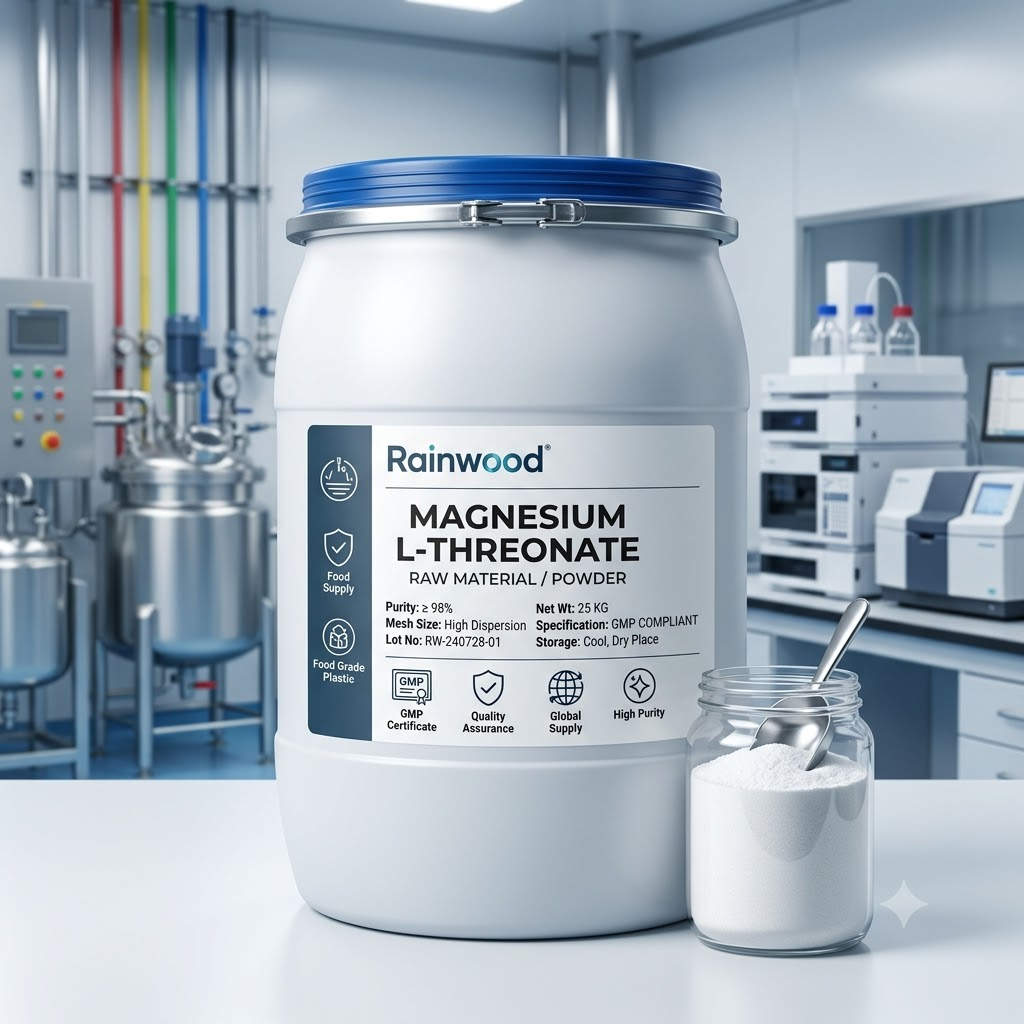
Most sample-to-bulk failures are process-control failures, but buyers should also design against substitution. A development sample can be made with a branded or well-documented lot, while the production batch is purchased from a cheaper source. The replacement may still be called magnesium L-threonate yet differ in manufacturer, hydration state, assay basis, particle size, impurity profile, trademark status or market rights. Appearance alone cannot reveal that switch.
Close the gap contractually and analytically. Put the raw-material manufacturer, product code, chemical form, agreed specification revision and approved distributor in the master record. Require written approval before any source change. At commercial production, reconcile the incoming lot number with the purchase and receiving records, obtain the original manufacturer’s lot COA, conduct risk-based identity verification and retain sealed samples of both the approved development material and released bulk product.
When Magtein® is specified, confirm the authorised supply route and trademark permission directly through reliable source documentation; a typed brand name on a trader’s COA is not proof. When generic material is specified, prohibit unauthorised branded references and require an evidence file that stands on its own. The goal is not to accuse every supplier of bait-and-switch. It is to make an undisclosed switch difficult to perform and easy to detect.
The sample arrives on time. The capsules look clean, the bottle feels premium and the paperwork appears complete. Three months later, the commercial batch has a different powder colour, variable capsule weights or a changed excipient.
This does not always mean deliberate substitution. Samples and production batches are often created under different conditions. The risk begins when those differences are not documented, approved or tested.
For an established supplement brand, a sample should be treated as one piece of the technical transfer—not as the complete manufacturing standard.
The sample may come from a different raw-material lot
A development sample can be made from material held in a laboratory or pilot area. By the time the purchase order is released, the original lot may be depleted. The commercial batch may use another lot, another shipment or, in poorly controlled situations, another source.
Natural variation is not the main issue here; magnesium L-threonate is a defined compound. The issue is whether each lot meets the same approved identity, composition, contaminant and physical specifications.
Ask the manufacturer to record:
- raw-material manufacturer and supply-chain path;
- lot number used for the sample;
- approved specification revision;
- identity and strength results;
- physical properties relevant to production; and
- rules for changing the source.
If source continuity matters to your positioning or regulatory status, put it in the quality agreement rather than relying on an email.
See our magnesium L-threonate raw-material qualification checklist for the questions that should be resolved before scale-up.
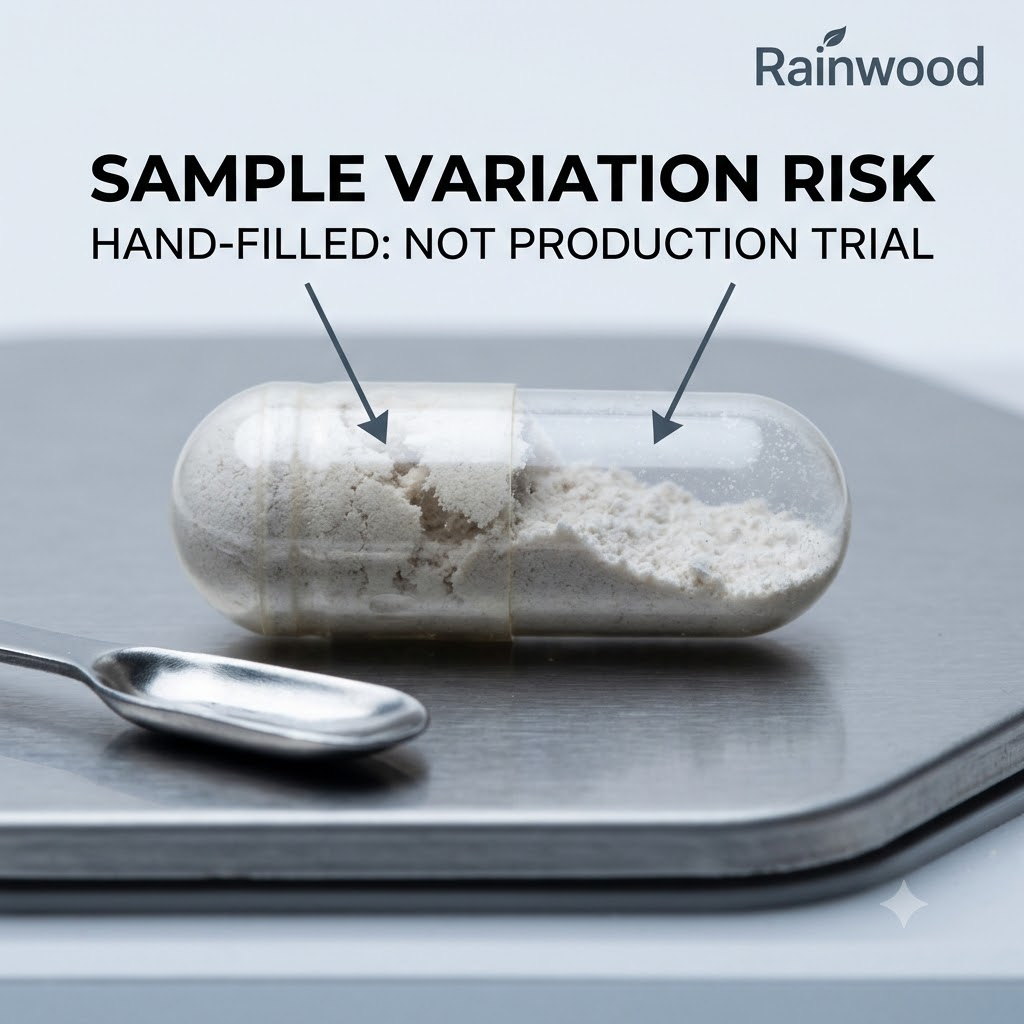
A hand-filled capsule is not a production trial
Laboratory samples may be hand-filled or produced on small equipment. Commercial production introduces hopper time, vibration, speed, tooling, environmental exposure and thousands of repeated fills.
Powder that behaves well for 50 capsules may bridge, segregate or change flow during a long run. This can affect:
- capsule weight variation;
- active distribution in a blend;
- rejected units;
- machine downtime;
- required flow agents; and
- final cost.
The higher the proportion of low-dose companion ingredients in a formula, the more carefully blend uniformity should be considered. A visually perfect sample cannot demonstrate commercial-batch uniformity.
Before committing to scale, request a documented feasibility or pilot run when the formula, capsule count or powder behaviour creates uncertainty.
“Equivalent excipient” changes can alter the product
Manufacturers sometimes treat excipients as interchangeable processing aids. From the brand’s perspective, a switch may affect:
- label copy;
- allergen or dietary-positioning statements;
- capsule appearance;
- dissolution or disintegration;
- flow and fill weight;
- consumer expectations; and
- market acceptance.
The master formula should name each component and its acceptable specification. Any proposed substitution should pass through written change control and regulatory review.
This is especially important when the brand promises a short ingredient list, vegan capsule, no silicon dioxide or another formulation attribute.
Compound weight and label value can drift apart
The ingredient input is magnesium L-threonate; the Supplement Facts declaration for magnesium is based on elemental magnesium. If the assumed magnesium percentage differs from the accepted lot specification, the theoretical label calculation can drift.
FDA’s dietary supplement CGMP framework requires specifications for identity, purity, strength, composition and relevant contamination limits, along with verification that production and process controls are delivering the required product. A mature brand should decide how incoming data, formulation overage if any, finished-product testing and label tolerance fit together.
Do not solve a calculation discrepancy by quietly changing the front label or serving size after the sample is approved. Reconcile:
1. raw-material assay basis;
2. formula input;
3. manufacturing loss assumptions;
4. finished-product result;
5. label declaration; and
6. shelf-life target.
Our finished-product magnesium testing guide provides a fuller review framework.
Packaging can change product performance
A sample bottle is often assembled shortly before shipment and evaluated immediately. A commercial product may spend months in a warehouse, parcel network or humid climate.
Packaging selection should consider:
- moisture sensitivity of the formula;
- bottle and closure compatibility;
- induction sealing;
- desiccant type and placement;
- headspace;
- capsule shell behaviour;
- label adhesion; and
- distribution conditions.
A short-term sample does not establish shelf life. The stability rationale should match the actual commercial formula and packaging configuration. If the bottle, count or closure changes, assess whether existing evidence still applies.
Review supplement packaging and stability planning before approving a new presentation.
The approved sample needs an approval record
“Looks good” is not a transferable specification. Use a sample approval form that captures:
- formula and revision;
- raw-material source or source restrictions;
- capsule size, shell and colour;
- target fill weight;
- appearance;
- odour and other relevant sensory attributes;
- packaging components;
- label version;
- test requirements;
- deviations accepted for the sample; and
- signatures and date.
Retain enough approved units for comparison, stored under controlled conditions. A retained sample is useful during an investigation, but it should support—not replace—objective specifications.
Five warning signs before mass production
Pause the project if:
1. the sample lot cannot be identified;
2. the commercial formula differs from the approved sample without a revision record;
3. the supplier will not define its change-notification process;
4. the final test plan remains “COA provided” with no agreed specification; or
5. packaging is ordered before fill feasibility and label content are confirmed.
None of these proves that a supplier is unreliable. Each indicates that the brand is being asked to accept avoidable uncertainty.
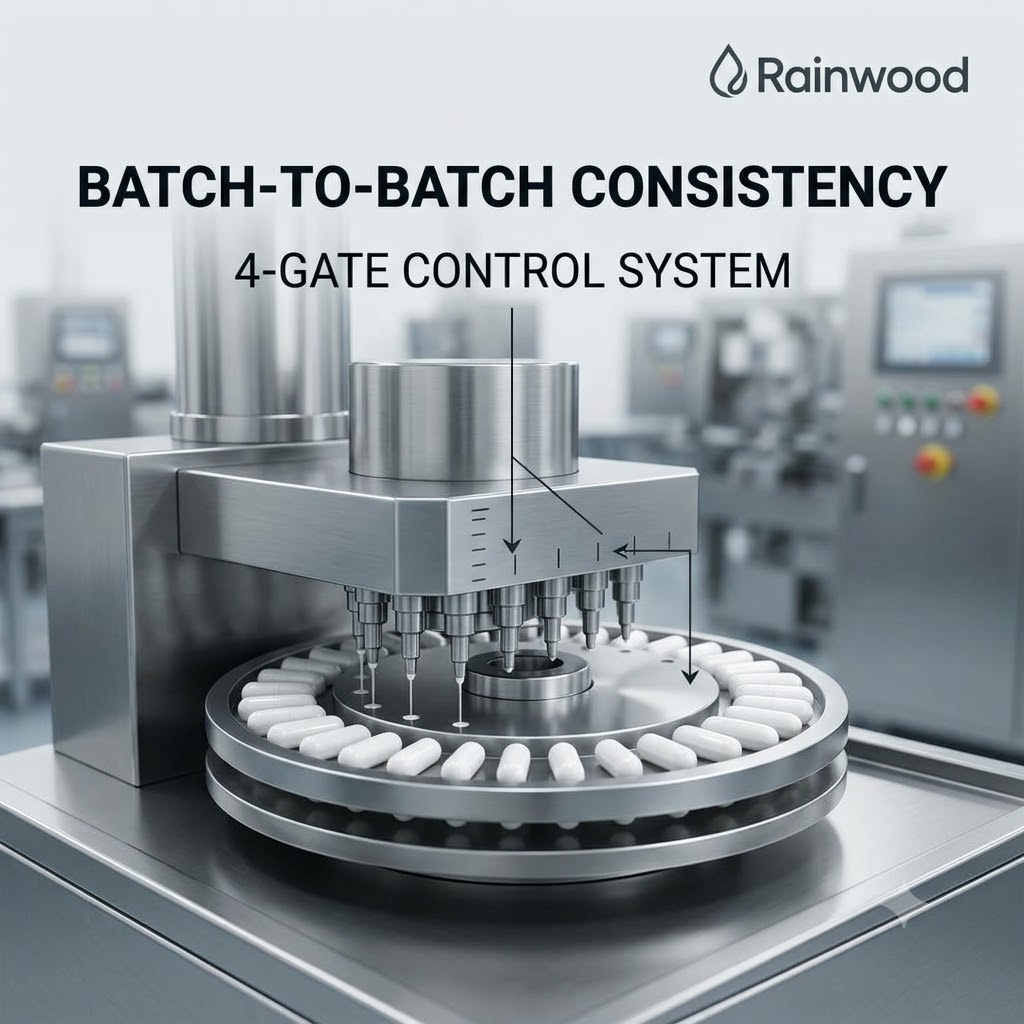
A stronger sample-to-batch control plan
Use four control gates:
Gate 1: Technical brief
Approve the target market, formula, ingredient source requirements, format and key quality attributes.
Gate 2: Feasibility sample
Evaluate manufacturability, serving count, appearance and packaging fit. Record what was and was not demonstrated.
Gate 3: Pre-production approval
Freeze the master formula, specifications, methods, packaging bill of materials and label artwork.
Gate 4: Batch release
Review executed production records, deviations, finished-product results and packaging reconciliation before distribution.
This process takes more discipline than approving a couriered sample, but it protects the brand when production volume and market exposure grow.
Frequently asked questions
1.Should the commercial batch use the exact same raw-material lot as the sample?
Not necessarily. That may be impractical. It should use material from an approved source that meets the same accepted specification, with any relevant physical differences assessed.
2.Can a pre-production sample prove shelf life?
No. Shelf life requires an appropriate stability basis. A recently made sample can show immediate appearance and fit, but not long-term performance.
3.What if a manufacturer needs to change an excipient?
The manufacturer should provide the reason and proposed change for brand review. Quality, regulatory, label and performance impacts should be assessed before approval.
4.Is finished-product testing enough to control consistency?
Testing is essential, but it cannot inspect quality into a poorly controlled process. Source qualification, master records, in-process controls, change control and batch documentation work together.
Make the approved sample reproducible
Send us your current formula, sample specification, target market and known production concerns. We can help convert a visual sample approval into a documented scale-up brief that a production and quality team can execute.
Request a sample-to-production review.
References
- US Food and Drug Administration, *Current Good Manufacturing Practice in Manufacturing, Packaging, Labeling, or Holding Operations for Dietary Supplements*.
- US Food and Drug Administration, *Dietary Supplement Labeling Guide*.
- European Food Safety Authority, *Safety of magnesium L-threonate as a novel food and bioavailability of magnesium from this source* (2024).
- ThreoTech, [Magtein ingredient-source and authenticity statement](https://magtein.com/about-us/) (brand-owner source).
- US FDA Global Substance Registration System, [magnesium L-threonate anhydrous identity](https://precision.fda.gov/uniisearch/srs/unii/1y26zz0otm).
*This article provides general quality and business information. Product-specific controls should be established by qualified manufacturing, quality and regulatory professionals.*