 EN
EN

Meta title: Build Credible Magnesium L-Threonate Products
Meta description: A development guide for practitioner and professional magnesium L-threonate brands covering formula logic, evidence, quality files, packaging and education.
The professional-channel dossier has to survive one hard question
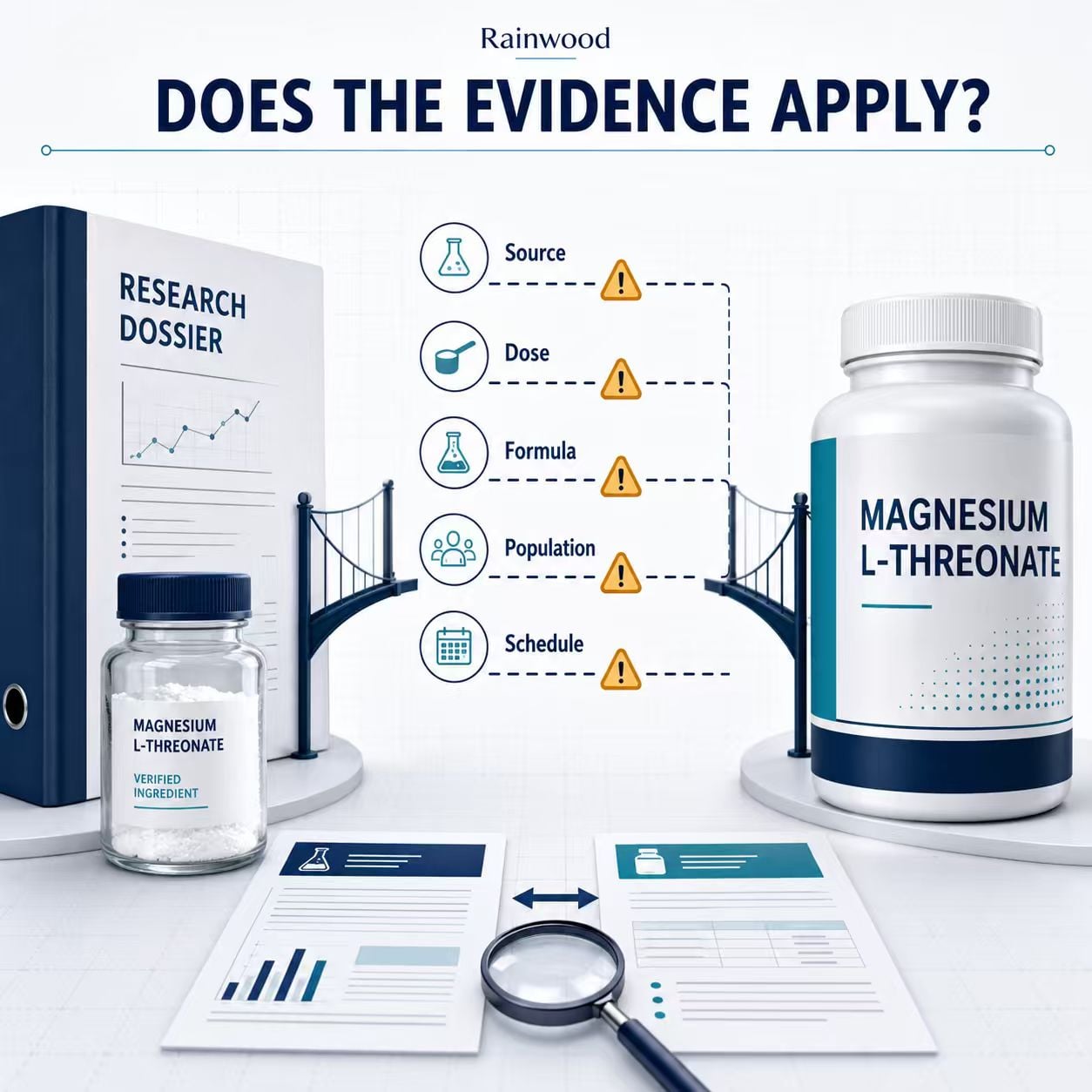
That question is: “Does the evidence actually apply to this bottle?” A product can copy a studied compound amount yet use a different source, hydration basis, finished formula, population or dosing schedule. It can also cite a combination-product study as though magnesium L-threonate alone produced every outcome. Professional buyers will notice those gaps even when consumers do not.
Create an evidence bridge for every important statement. Record the cited study, exact test material, brand or formulation, daily amount, duration, participant profile, measured outcome, null results, funding and the reason the result is relevant to the commercial product. If equivalence between a generic ingredient and a studied branded material is claimed, support identity, composition, impurity and performance comparability rather than relying on the shared common name.
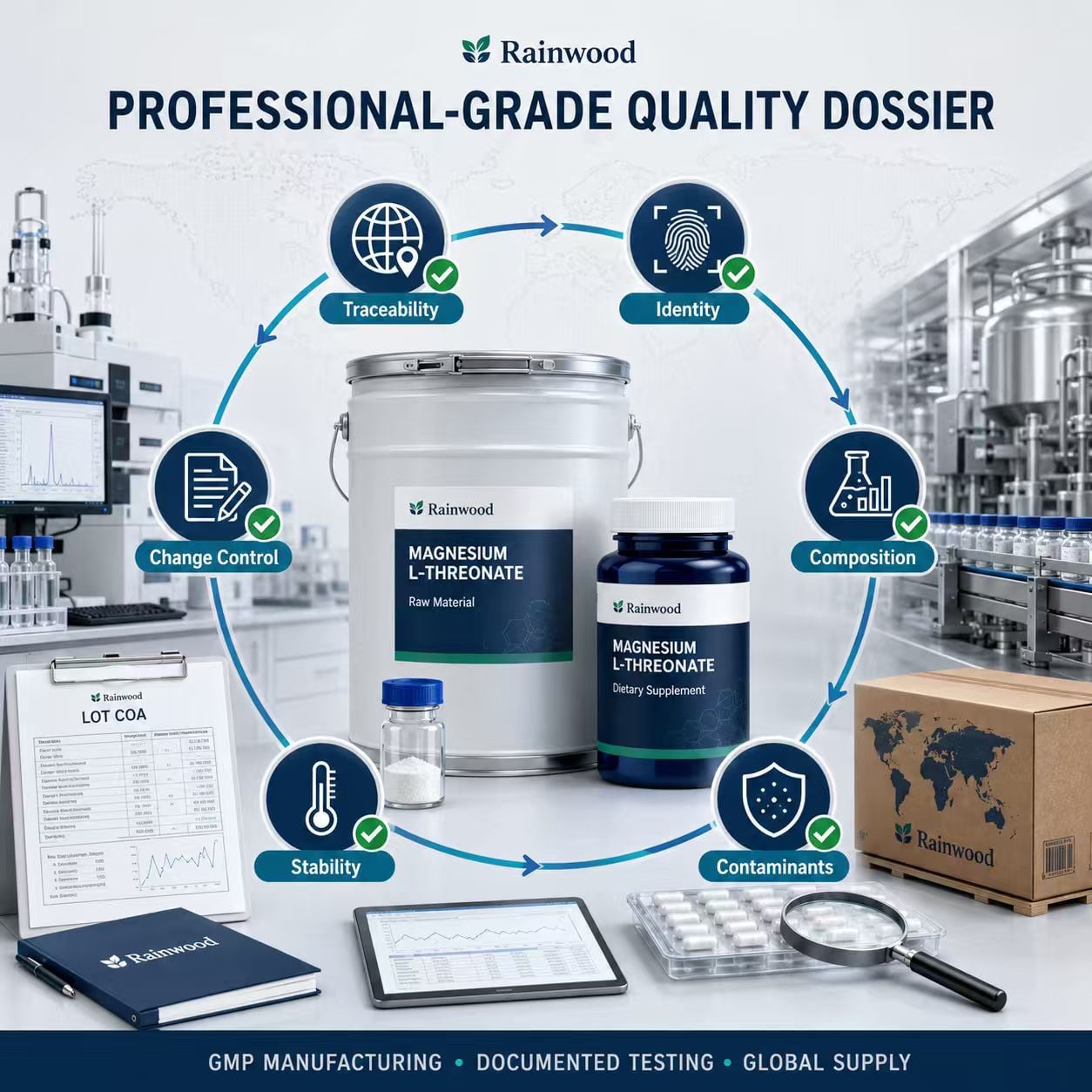
The quality dossier should match that precision. Include source traceability; monohydrate or anhydrous identity; magnesium and L-threonate results; water or loss on drying; relevant oxalic-acid and ethanol controls where the process makes them applicable; finished-product composition; stability; label calculations; and change control. This turns “professional grade” from a design style into an auditable product position.
Practitioners and professional-wellness retailers tend to ask harder questions than “Is it premium?” They want to know what the material is, why the dose was chosen, how the finished batch was verified and whether the marketing accurately reflects the evidence.
Credibility is therefore built into the product before it is added to the label.
Start with a clinical-use context, not a disease promise
Define the intended place in a wellness routine:
- customer profile;
- professional channel;
- use occasion;
- product format;
- practical serving;
- relevant precautions;
- evidence-supported communication territory; and
- questions that require clinician judgment.
The brief should not claim to diagnose, treat, cure or prevent disease. It should help the development team understand why a practitioner or professional retailer would select this formula over another magnesium option.
Our professional magnesium L-threonate product brief organises these inputs before formulation.
Choose the ingredient with market and evidence fit
Ingredient selection should consider:
- identity and composition;
- manufacturer and supply-chain traceability;
- target-market authorisation;
- relevance to published research;
- trademark and intellectual-property permissions;
- specification and test methods;
- supply continuity; and
- cost.
Do not assume generic material can use a branded ingredient’s research, logo or regulatory position. For the EU, examine the specific authorisation and protected-data conditions in Regulation (EU) 2024/2694 and the source-list amendment in Regulation (EU) 2025/2225. For the US, conduct the appropriate dietary-ingredient and labeling analysis.
See our magnesium L-threonate sourcing and documentation guide.
Make dose logic transparent
Show both magnesium L-threonate compound weight and elemental magnesium in development documents. Confirm what must appear in the consumer label for the intended market.
Dose selection should consider:
- studied ingredient and amount;
- legal limits or conditions of use;
- elemental magnesium contribution;
- other magnesium sources in the formula;
- daily capsule or scoop count;
- target consumer;
- tolerability and warnings;
- evidence boundaries; and
- qualified professional advice.
Do not choose a dose only because a competitor uses it. Document the rationale and re-evaluate when the ingredient source or market changes.
Avoid formula decoration
Professional formulas sometimes accumulate small amounts of trendy ingredients so the label appears comprehensive. This can weaken credibility if the quantities are not meaningful or the combination lacks a coherent rationale.
For every companion ingredient, ask:
1. What role does it serve?
2. Is the amount justified?
3. Does it fit the format?
4. Is it lawful in the target market?
5. Does it create new warnings or interactions?
6. Does it complicate claims or stability?
7. Can it be tested appropriately?
A focused single-ingredient formula may be more credible than an underdosed blend.
Build a professional-grade technical file
The file should be organised so a qualified buyer can review it efficiently:
Ingredient section
Manufacturer, supply chain, specification, representative and lot COAs, regulatory statements, allergen and other relevant declarations.
Formula section
Master formula, elemental-magnesium calculation, excipients, capsule or powder details, and revision history.
Manufacturing section
Site and quality documentation, process summary, master-record control, in-process checks and change control.
Testing section
Identity, strength or composition, contaminants, microbiology, methods, laboratory qualifications and finished-product COA.
Stability and packaging section
Commercial package, storage, shelf-life rationale and ongoing commitments.
Claims section
Approved copy, substantiation matrix, study relevance, disclaimers, restrictions and review history.
Our professional product quality dossier service helps structure this information without replacing independent professional review.
Use a testing strategy that answers real questions
“Third-party tested” is incomplete. State what is tested, in which lot, by which type of method and against which specification.
A risk-based program may address:
- raw-material identity;
- magnesium L-threonate characterisation;
- elemental magnesium;
- relevant process impurities;
- heavy metals;
- microbiological criteria;
- finished dosage-form attributes;
- packaging integrity; and
- stability.
FDA dietary supplement CGMP provides a useful US framework for identity testing and specifications. Other markets have their own legal requirements.
Read How to Verify Magnesium L-Threonate Quality Beyond the COA for a deeper testing discussion.
Translate research without overclaiming
Use a structured evidence summary:
- research question;
- study design;
- number and type of participants;
- ingredient and dose;
- duration;
- primary and secondary outcomes;
- positive, null and adverse findings;
- limitations;
- funding and conflicts; and
- relevance to the commercial product.
The scientific landscape includes animal research and a limited number of human trials. Some human studies have reported sleep- or cognition-related outcomes, but formulations, populations and results vary. Professional communication should show this nuance.
Avoid implying that an ingredient study proves the finished formula treats insomnia, dementia or cognitive impairment.
Review The Claim Traps Practitioner Brands Face with Magnesium L-Threonate before writing educational materials.
Design packaging for professional use
Professional presentation should make practical information easy to find:
- ingredient source and amount;
- elemental magnesium;
- serving size;
- capsule count or scoop;
- storage;
- lot and expiry;
- warnings;
- customer-service contact; and
- QR code to a controlled document page, if used.
If a QR code links to a COA, confirm that lot selection is accurate and that the page does not expose confidential or unrelated records. Maintain links when packaging remains in circulation.
Create education that supports conversations
A professional launch kit can include:
- one-page product specification;
- balanced research summary;
- quality-control overview;
- label and serving explanation;
- FAQ;
- approved claim language;
- objection-handling guide;
- storage and complaint instructions; and
- contact for technical questions.
Train sales teams not to improvise disease claims. Record and review questions from practitioners; they can reveal where the product file or education is unclear.
Use a controlled magnesium L-threonate education library so every channel works from the same evidence and approved language.
Maintain credibility after launch
Review:
- batch trends;
- complaints and adverse-event reports;
- new studies;
- regulatory updates;
- supplier changes;
- claim performance;
- sales-team feedback; and
- practitioner questions.
Update the evidence and technical file on a defined schedule. A credible product is maintained, not merely launched.
Frequently asked questions
1.Does a practitioner brand need a branded ingredient?
Not always. The decision depends on evidence, market access, rights, documentation, supply and positioning. Generic equivalence should not be assumed.
2.Should the product provide a full Daily Value of magnesium?
Not necessarily. The formula, source, serving and legal conditions should drive the decision. Do not confuse magnesium L-threonate compound weight with elemental magnesium.
3.Can professional education cite clinical trials?
Yes, if presented accurately and in context, with relevance and limitations reviewed. Commercial use of literature can still convey advertising claims.
4.What creates the most trust with professional buyers?
Traceable materials, clear dose logic, specific testing, balanced evidence, controlled claims and responsive technical support.
Build a dossier a professional buyer can question
Send us your market, formula concept, preferred source, channel and evidence goals. We can organise a development brief and technical-document request for review by your qualified team.
Discuss a professional magnesium L-threonate product.
References
- US Food and Drug Administration, *Current Good Manufacturing Practice for Dietary Supplements*.
- US Federal Trade Commission, *Health Products Compliance Guidance*.
- Commission Implementing Regulation (EU) 2024/2694.
- Commission Regulation (EU) 2025/2225.
- Relevant magnesium L-threonate human trials indexed by the US National Library of Medicine.
- UK Advisory Committee on Novel Foods and Processes, [identity, specification and stability assessment](https://acnfp.food.gov.uk/ACNFPAdviceonthesafetyofMagnesiumL-threonateasanovelfoodforuseinfoodsupplements).
- Liu et al., [2016 randomised trial in older adults](https://pubmed.ncbi.nlm.nih.gov/26519439/).
- Hausenblas et al., [2024 randomised sleep trial](https://pubmed.ncbi.nlm.nih.gov/39252819/).
*This article provides general product-development information. It is not medical or legal advice and does not replace professional judgment.*