 EN
EN

Meta title: True Magnesium L-Threonate Supplement Cost
Meta description: Calculate the true magnesium L-threonate supplement cost across source, dose, format, testing, packaging, compliance, freight and inventory.
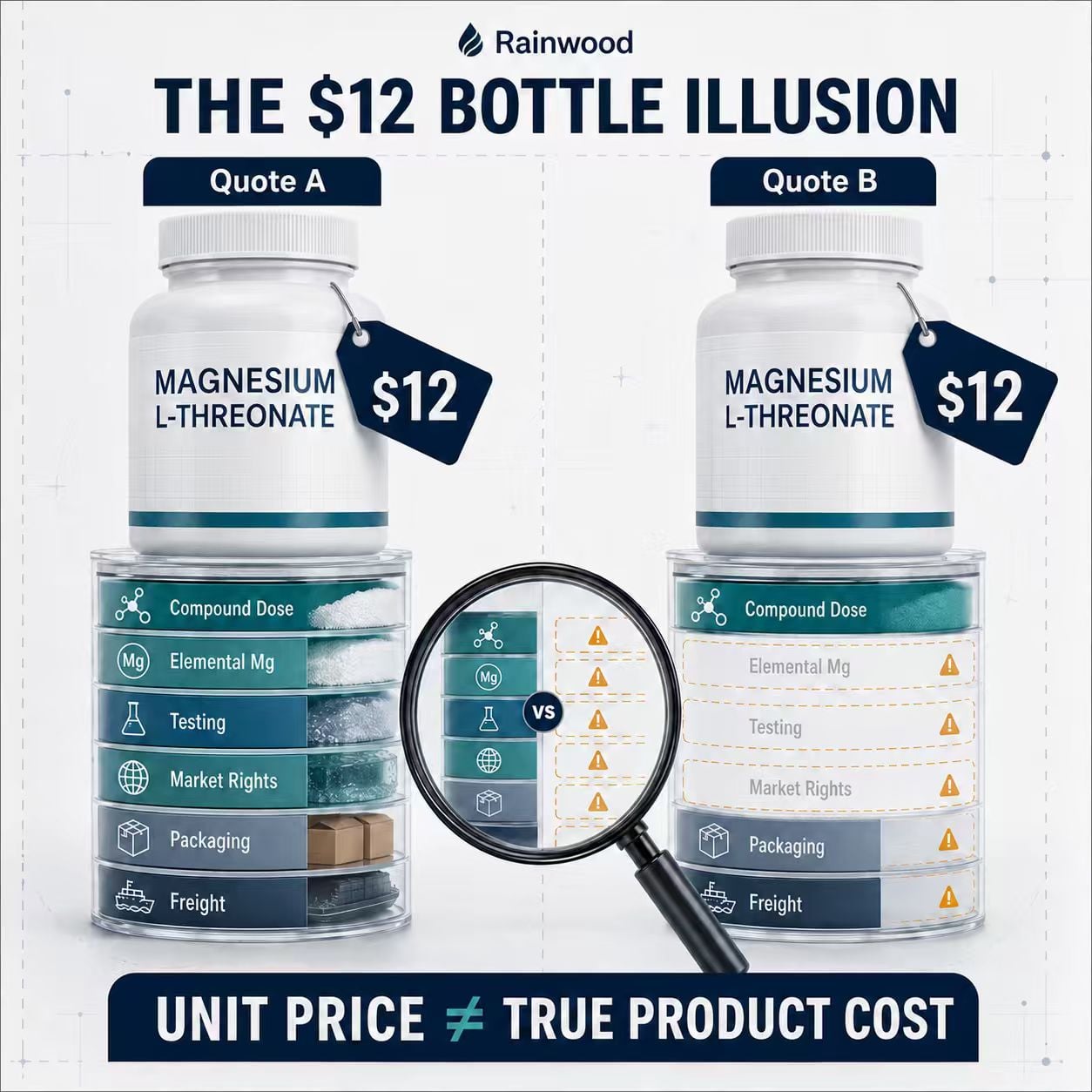
The $12-bottle illusion
Two bottles can share the words “magnesium L-threonate” and have radically different economics. One may provide a disclosed 2 g compound serving in three capsules. Another may use a multi-magnesium proprietary blend in which L-threonate is only one contributor and its exact amount is hidden. A third may use generic material while the commercial plan assumes Magtein® trademark use or access to a protected market dossier. Unit price alone cannot reveal these differences.
Normalise offers into cost per disclosed daily amount of the exact compound, cost per elemental-magnesium serving and cost per consumer month. Then add the price of proof: source rights, identity and compositional testing, process-related impurity controls, finished-product release, stability, label review and substantiation. Cheap material that forces a second laboratory investigation, reformulation or rejected artwork is not cheap.
The serving drives the physical cost stack. At 7.2%–8.3% magnesium, 2 g of the EU-specification monohydrate corresponds to about 144–166 mg elemental magnesium and may require three or more capsules depending on bulk density and formulation. That changes shell count, filling time, bottle size, freight, fulfilment fees and bottle-days. Calculate margin after the product is chemically, legally and physically defined.
The price of magnesium L-threonate powder is not the cost of a magnesium L-threonate product.
A finished supplement’s economics are shaped by how much compound is used, how much elemental magnesium it provides, how many capsules fit the serving, what evidence and market rights support the source, which tests are performed and how the bottle moves through the supply chain.
This guide gives brands and importers a cost model that reveals what a cheap quotation may exclude.
Begin with the unit you are actually selling
Compare cost at four levels:
1. Per kilogram of raw material
2. Per finished capsule, tablet or scoop
3. Per daily serving
4. Per customer month
The fourth number often matters most. A bottle that costs less but lasts 20 days may have worse customer economics than a higher-priced 30-day bottle.
Define:
- magnesium L-threonate compound weight per serving;
- elemental magnesium per serving;
- daily units;
- servings per container;
- target retail price;
- wholesale price;
- channel fees; and
- expected repeat interval.
Use our magnesium L-threonate product planning worksheet before requesting unit pricing.
Cost driver 1: ingredient identity and source
Prices vary because materials differ in:
- manufacturer;
- country and site;
- specification;
- hydration or assay basis;
- magnesium and L-threonate ranges;
- impurity controls;
- analytical methods;
- branded status;
- evidence access;
- regulatory documentation;
- order size; and
- supply agreement.
A lower-priced generic material may be suitable for one market and unsuitable for another. For the EU, Regulation (EU) 2024/2694 includes specific authorisation and protected-data conditions through 7 November 2029, while Regulation (EU) 2025/2225 adds magnesium L-threonate to the permitted source list for magnesium. Legal access to the EU market cannot be valued by chemistry alone.
Branded ingredient costs may include trademark use, documentation, marketing support and a controlled supply chain. Verify what is included rather than assuming a premium is either justified or unnecessary.
See How Importers Can Verify a Magnesium L-Threonate Supplier.
Cost driver 2: compound amount versus elemental magnesium
The EU specification lists magnesium at 7.2%–8.3% in magnesium L-threonate monohydrate. This illustrates why the compound weight is much larger than its elemental magnesium contribution.
If a formula uses 2,000 mg of material at 7.2% magnesium, the theoretical contribution is 144 mg elemental magnesium. At 8.3%, it is 166 mg. The approved formula and lot specification—not a general example—must drive the label calculation.
A quotation based on 1,000 mg compound and one based on 2,000 mg are not comparable even if both bottles say “Magnesium L-Threonate.”
Ask for:
- compound input;
- specified magnesium percentage;
- elemental calculation;
- process-loss assumptions;
- finished-product target;
- label value; and
- tolerance.
Cost driver 3: dosage form and daily unit count
Capsules
Costs include shell, filling, inspection and bottle space. A high gram weight may need multiple capsules. Powder density and flow determine actual fill, so a theoretical quote can change after trial.
Tablets
Tablets may carry more material but add granulation or direct-compression considerations, tooling, compression, dedusting, possible coating and disintegration testing.
Powder
Powder can reduce capsule count but adds blending, flavour development if used, scoop or stick-pack filling, moisture control and larger containers.
Gummies
Gummies can be expensive because of mineral load, taste masking, process constraints, unit count, stability and specialised manufacturing. A low-dose “pixie dust” concept may be cheaper but can undermine the product proposition.
Read Capsules, Tablets or Powder for Magnesium L-Threonate before choosing the cheapest operation.
Cost driver 4: excipients and formulation
Even a single-ingredient concept may require capsule shell and processing aids. The formula may include:
- flow agents;
- fillers;
- anti-caking agents;
- flavours;
- sweeteners;
- acids;
- colours;
- companion actives; and
- capsule materials.
Each affects cost, label claims, sourcing minimums, testing and production. “No excipients” can also increase manufacturing difficulty or rejection rate.
Choose components for a defined function and document whether alternatives are allowed. A late request to remove a flow agent can trigger a new feasibility run.
Cost driver 5: testing
Testing may include:
- incoming identity;
- elemental magnesium;
- L-threonate or compound characterisation;
- process impurities;
- residual solvents;
- heavy metals;
- microbiology;
- finished-product verification;
- dosage-form performance; and
- stability.
The cost depends on laboratory, method complexity, number of lots, turnaround and whether reference materials or method development are needed.
A quotation stating “COA included” should show exactly which tests are performed on the commercial lot and whether the document belongs to raw material or finished product.
Explore How to Verify Magnesium L-Threonate Quality Beyond the COA.
Cost driver 6: compliance and claim development
Market-ready work may include:
- ingredient-status review;
- NDI or novel-food analysis;
- formula and dose review;
- Supplement Facts or nutrition panel;
- required warnings;
- structure/function notification;
- claims substantiation;
- translation;
- responsible-person or importer requirements;
- trademark permission; and
- retailer technical files.
The US and EU should be budgeted separately. In the US, FDA labeling and manufacturing rules intersect with FTC advertising substantiation. In the EU, the novel-food authorisation and authorised health-claims framework create a different route.
Cheap artwork that must be destroyed is more expensive than qualified review before printing.
Our market-specific supplement compliance workflow helps define the scope.
Cost driver 7: packaging
Break packaging into:
- bottle or pouch;
- closure;
- induction seal;
- desiccant;
- label;
- printing finish;
- carton;
- insert;
- lot and expiry coding;
- case;
- pallet; and
- protective shipping material.
Stock components reduce minimums and lead time. Custom colours, moulds or printed closures create differentiation but can require larger commitments and obsolescence reserves.
Packaging size also affects freight, storage and e-commerce fulfilment. Measure the finished unit after filling.
Cost driver 8: batch size and MOQ
Manufacturing costs include setup, line clearance, documentation, cleaning, in-process checks and testing that do not scale directly with unit count. A small batch carries more fixed cost per bottle.
But a large batch creates:
- more cash tied up;
- higher expiry risk;
- more storage;
- larger exposure to label changes;
- slower learning; and
- possible markdowns.
Calculate the economic order quantity with realistic sales velocity and shelf life, not the lowest quoted unit price.
Cost driver 9: yield, overrun and rejected units
Ask how the supplier handles:
- raw-material overage;
- line loss;
- capsule or tablet rejects;
- testing samples;
- retained samples;
- packaging overrun;
- finished-quantity tolerance; and
- billing.
A purchase order for 5,000 bottles may permit shipment and billing of 4,750–5,250 or another agreed range. That affects cash and inventory.
Unusually low yield may signal poor flow, inappropriate tooling or process problems. Track yield across batches.
Cost driver 10: freight, duties and Incoterms
Compare the same delivery point.
Include:
- domestic transport to port;
- export handling;
- ocean or air freight;
- insurance;
- customs broker;
- duty and tax;
- examination or storage;
- destination delivery;
- pallet exchange; and
- temperature or humidity precautions.
An Ex Works raw-material quote and a delivered finished-product quote are not competing numbers.
For capsules, transporting finished bottles may move more air than importing bulk and manufacturing locally. Local versus overseas manufacturing should be modelled, not decided by headline unit price.
Cost driver 11: working capital and lead time
The cash cycle may include:
1. formula deposit;
2. raw-material purchase;
3. custom-packaging payment;
4. manufacturing balance;
5. freight and duties;
6. marketplace or retailer payment delay; and
7. reorder deposit before the first batch is fully sold.
Longer lead times require more safety stock and capital. A supplier offering a slightly higher price but shorter, reliable lead time can reduce inventory and stockout risk.
Cost driver 12: quality failures and rework
Risk-adjusted cost should include the probability and impact of:
- failed identity;
- potency discrepancy;
- microbiological or heavy-metal issue;
- label error;
- bottle leakage;
- missing seal;
- late delivery;
- platform rejection;
- complaint trend;
- withdrawal; and
- recall.
Quality investment is not automatically economical, but omitted controls can create asymmetric losses. Define specifications and remedies before production.
Build the landed-cost model
Use this formula:
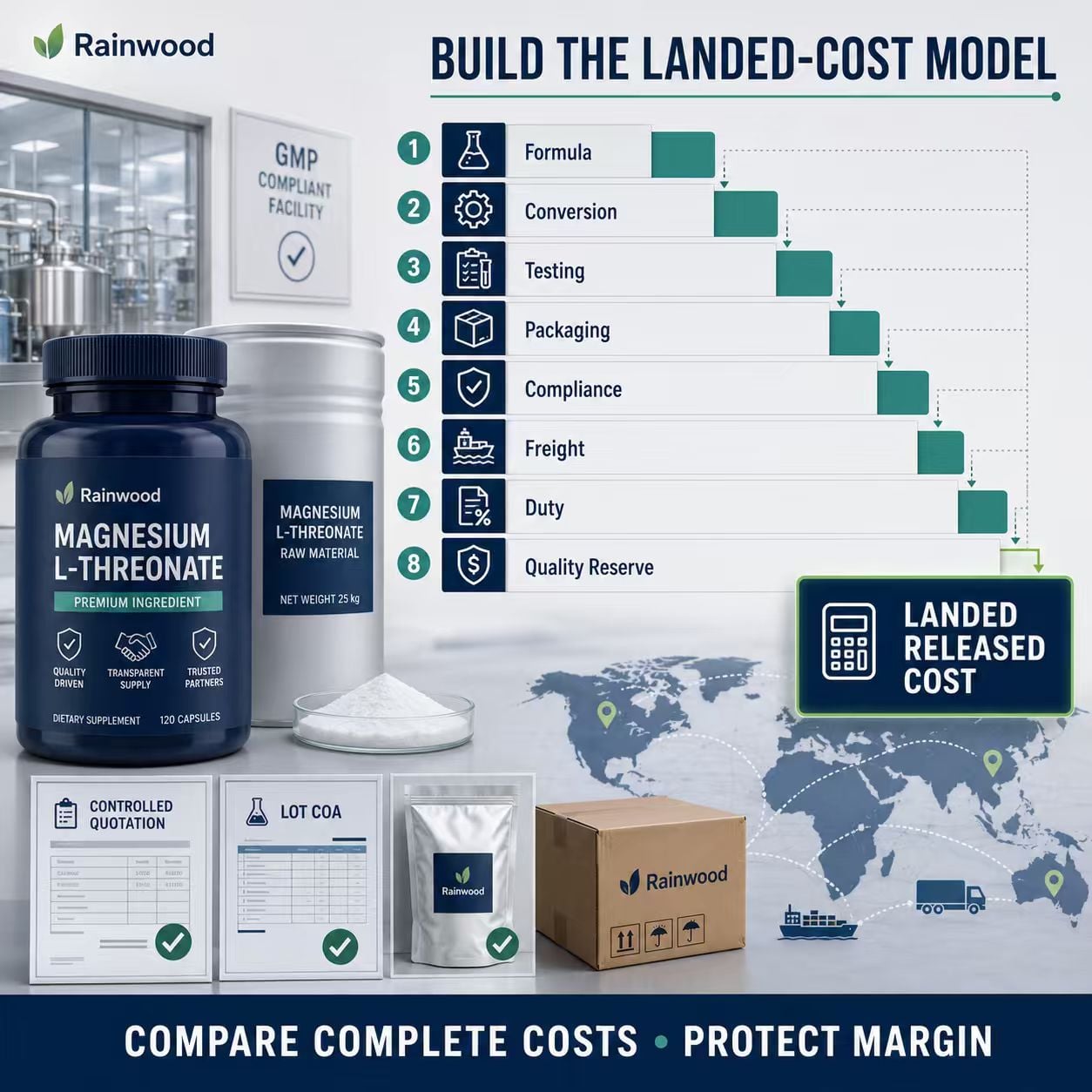
> Landed released product cost = formula + conversion + testing + packaging + compliance + freight + duty + quality reserve
Then calculate:
> Contribution margin = net sales − landed cost − fulfilment − channel fees − promotion − returns − customer service
And:
> Cash required before breakeven = deposits + inventory + launch costs + reorder commitment − collected receipts
Model conservative, base and optimistic sales cases.
Compare quotations with a cost waterfall
| Cost layer | Quote A | Quote B |
|---|---:|---:|
| Magnesium L-threonate | | |
| Other ingredients | | |
| Conversion | | |
| Testing | | |
| Packaging | | |
| Regulatory and artwork | | |
| Setup and tooling | | |
| Freight and duty | | |
| Storage and fulfilment | | |
| Risk reserve | | |
| Cost per daily serving | | |
If a supplier cannot fill a row, mark it “excluded” rather than zero.
Frequently asked questions
1.Why is magnesium L-threonate more expensive than some magnesium forms?
Ingredient production, lower elemental-magnesium density, larger serving weight, branded or regulatory considerations, testing and specialised positioning can all contribute.
2.Is the lowest cost per milligram of magnesium the best metric?
Not for every product. L-threonate is usually selected for a specialised product story. Use cost per daily serving and fit with the target customer.
3.How much should testing add?
There is no universal percentage. Cost depends on methods, markets, lots, turnaround and quality risk. Define the test plan before comparing quotes.
4.Does a larger MOQ always reduce total cost?
It reduces some unit costs but can increase working capital, expiry, storage and obsolescence. Model total business cost.
5.Can one formula be manufactured for all markets?
Sometimes, but ingredient status, dose, warnings, labels and claims may differ. Market-specific review is required.
Get a cost you can actually use
Send us your market, formula, serving, format, packaging, annual forecast, desired Incoterm and target retail price. We can help build a transparent quotation brief and identify excluded cost layers.
Request a magnesium L-threonate landed-cost review.
References
- Commission Implementing Regulation (EU) 2024/2694.
- Commission Regulation (EU) 2025/2225.
- US Food and Drug Administration, *Current Good Manufacturing Practice for Dietary Supplements*.
- US Food and Drug Administration, *Dietary Supplement Labeling Guide*.
- US Federal Trade Commission, *Health Products Compliance Guidance*.
- NIH Dietary Supplement Label Database, [2 g Magtein and 147 mg elemental-magnesium label example](https://dsld.od.nih.gov/label/274903).
- NIH Dietary Supplement Label Database, [multi-form proprietary-magnesium-blend example](https://dsld.od.nih.gov/label/288533).
*This article provides general commercial information and is not legal, tax, customs or medical advice.*