 EN
EN

Meta title: Hidden FBA Costs in Magnesium L-Threonate
Meta description: Learn how serving size, capsule count, bottle dimensions, testing, claims, returns and stockouts can change the real FBA cost of magnesium L-threonate.
The 2,000 mg number can wreck the margin model
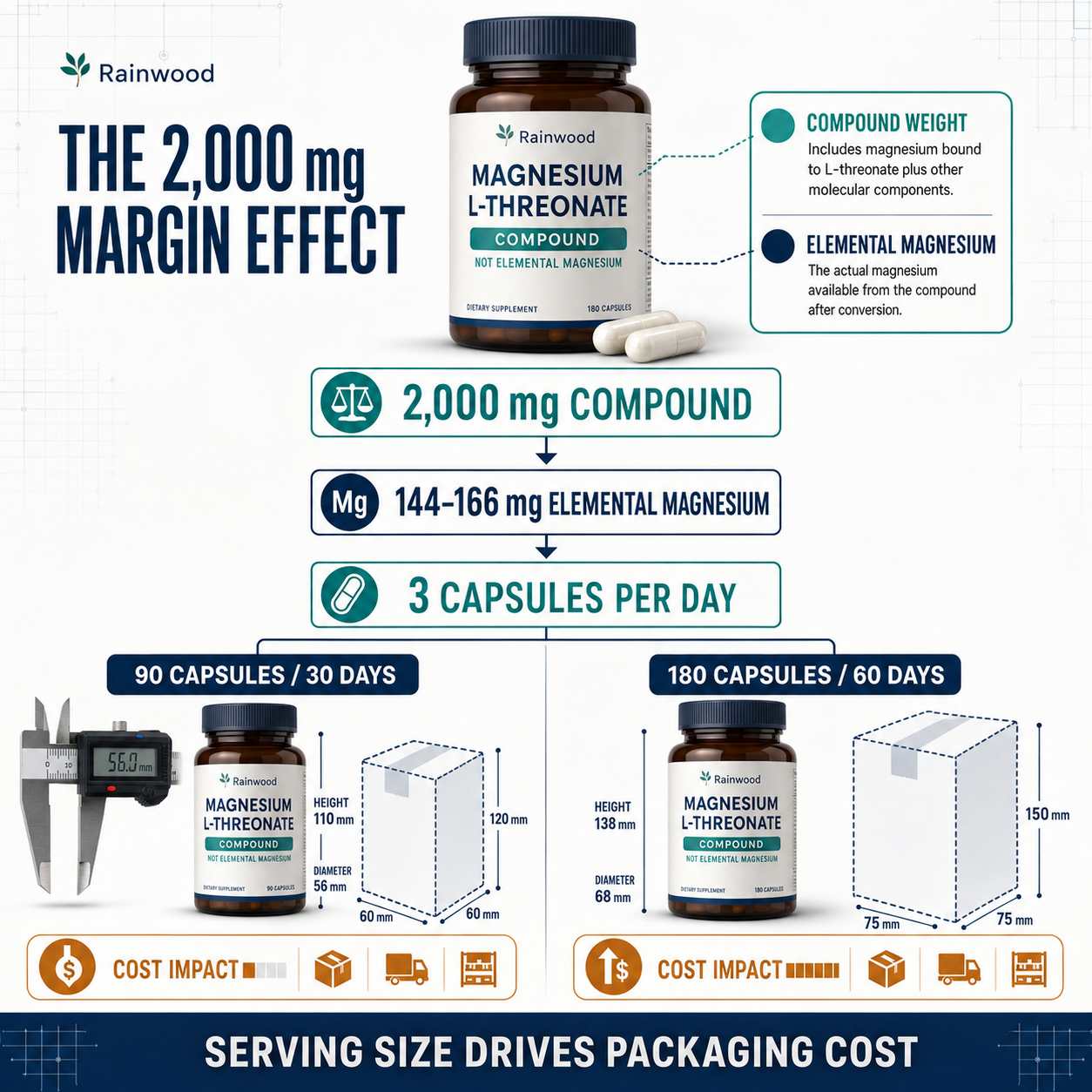
Marketplace shoppers often see a large magnesium L-threonate compound number and assume it is elemental magnesium. It is not. Under the EU monohydrate range, 2,000 mg of compound corresponds to about 144–166 mg of magnesium. A public US label in NIH’s Dietary Supplement Label Database likewise lists 2 g of Magtein® compound but 147 mg of elemental magnesium in a three-capsule serving. That gap is normal chemistry, but it has expensive packaging consequences.
The deeper label trap appears in multi-magnesium “L-threonate complex” products. A blend may combine Magtein or generic L-threonate with cheaper oxide, glycinate, malate or other forms while declaring only the total blend and total magnesium. If the exact L-threonate amount is not disclosed, a shopper—and sometimes an inexperienced sourcing team—may assume the headline form contributes most of the dose. Build comparisons around disclosed milligrams of the exact compound, elemental magnesium, capsules per day and bottle-days, not around the largest number on the front.
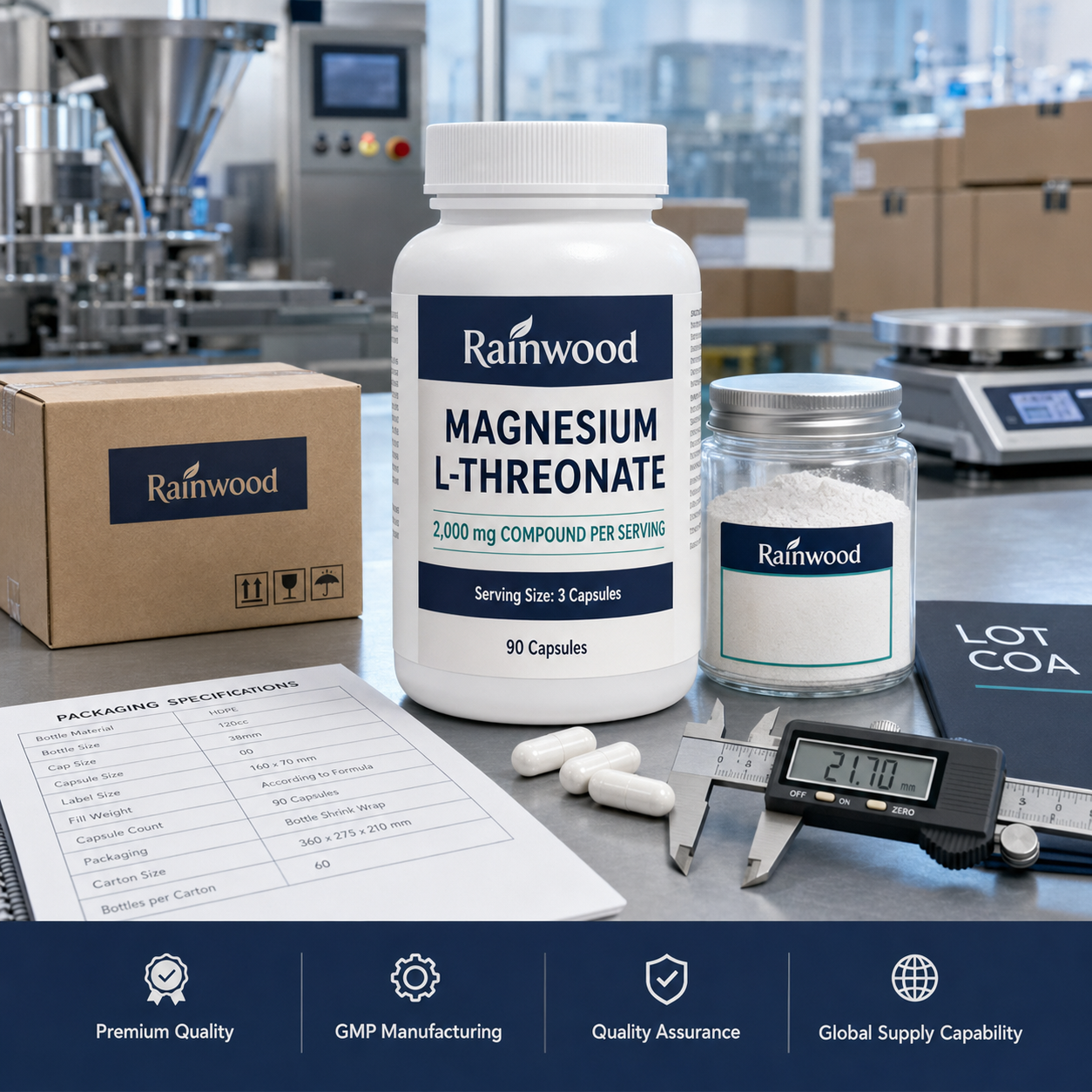
These distinctions affect more than trust. A three-capsule 30-day product needs 90 capsules; the same serving in a 60-day subscription needs 180. Shells, filling time, bottle size, dimensional tiers, inbound freight and return expectations all move. Model the actual formula and a commercial fill trial before choosing the bottle or promising a daily unit count.
Two magnesium L-threonate products can have the same factory price and radically different e-commerce margins. The difference may be one extra capsule per serving, a bottle that crosses a fulfilment size threshold, a label that triggers rework or a stockout caused by a slow custom closure.
For Amazon and DTC sellers, product cost is not the quotation. It is the total cost of getting a compliant unit into a customer’s hands—and keeping it in stock.
Hidden cost 1: a gram-level serving creates more capsules
Magnesium L-threonate contains a relatively low proportion of elemental magnesium by weight. The EU novel-food specification, for example, defines a magnesium range of 7.2%–8.3%. A formula built around a meaningful compound weight may therefore require several capsules per day.
That affects:
- capsule-shell cost;
- encapsulation time;
- bottle count and size;
- servings per bottle;
- pick-and-pack economics;
- subscription interval; and
- consumer adherence.
Do not compare cost per bottle until the daily serving and number of servings are aligned. A 90-capsule bottle taken three per day is a 30-day product; a superficially cheaper bottle may provide fewer days.
Use our **magnesium L-threonate serving and format calculator** **[INTERNAL LINK -> Magnesium L-Threonate product page]** when building the first unit economics.
Hidden cost 2: the bottle is larger than the formula needs
Brands often choose a bottle from a visual mock-up before the production fill is confirmed. Too much headspace can make the product look underfilled; too little space can slow packaging or prevent the desiccant from fitting correctly.
Fulfilment fees, storage and shipping can be sensitive to packaged dimensions and weight. Platform fee structures change, so current thresholds must be checked directly before the packaging purchase order.
Ask for finished pack measurements, not nominal bottle capacity:
- overall length, width and height;
- gross unit weight;
- capsules and desiccant inside;
- closure and induction seal;
- applied label;
- protective wrap or carton; and
- ship-ready configuration.
A few millimetres can matter at scale. Prototype the actual pack and measure it before committing to thousands of units.
Explore **e-commerce supplement packaging options** **[INTERNAL LINK -> Packaging solutions page]** for bottle-count and presentation choices.
Hidden cost 3: a premium carton adds two fulfilment layers
A folding carton can improve shelf presence and protect a bottle, but it adds material, printing, assembly, inbound volume and possible dimensional weight. It may also require separate barcodes, lot-code placement and tamper-evidence decisions.
For a DTC-only launch, a high-quality bottle and label may provide enough differentiation. For retail expansion, a carton may become worthwhile. Model the channel rather than assuming “premium” always needs more packaging.
Hidden cost 4: claims create review and relabel risk
Magnesium L-threonate is commonly marketed around the brain, memory and sleep. Aggressive copy can create regulatory and platform risk.
In the US, objective health claims require adequate substantiation. The FTC advises marketers to consider express and implied messages and the totality of reliable evidence. A structure/function claim on dietary supplement labeling also brings FDA requirements, including the statutory disclaimer and notification after first marketing.
Words such as “treats insomnia,” “prevents dementia” or “reverses brain ageing” are not ordinary supplement positioning. Disclaimers do not convert disease claims into compliant structure/function claims.
The hidden costs of bad copy include:
- artwork redesign;
- destroyed labels or cartons;
- delayed inventory;
- suppressed listings;
- lost advertising spend;
- returns; and
- legal review under pressure.
Our **supplement claims and label review workflow** **[INTERNAL LINK -> Regulatory and labeling page]** should begin before print, not after a listing question.
Hidden cost 5: generic testing does not answer marketplace questions
A low-cost testing package may include only the ingredient supplier’s COA. A retailer, marketplace or brand quality team may later ask for lot-specific finished-product documents, contaminant testing, facility information or traceability.
Create a document map before production:
- ingredient specification and lot COA;
- identity verification;
- finished-product specification;
- finished-batch COA;
- heavy-metal and microbiological results as required;
- manufacturing facility documentation;
- label and formula consistency;
- stability or expiry basis; and
- traceability records.
Requirements vary by platform, market and product, and they can change. Confirm the current rules for the seller account and destination before manufacturing.
Read **how to verify magnesium L-threonate quality beyond a COA** **[INTERNAL LINK -> Article 14 on quality verification]**.
Hidden cost 6: slow-moving custom components
Custom-colour bottles, decorated closures and printed cartons may have longer lead times and higher minimums than the supplement run. If sales accelerate, a small missing component can hold back otherwise available product.
For each component, record:
- MOQ;
- lead time;
- production location;
- safety stock;
- ownership;
- storage charge;
- replacement option; and
- artwork or tooling control.
A stock bottle with a well-designed label often gives a young brand more supply flexibility than a fully custom pack.
Hidden cost 7: returns caused by expectation gaps
A product page may highlight “2,000 mg” while consumers assume that means 2,000 mg of elemental magnesium. Others may not expect three or four capsules per serving. Even a technically compliant presentation can produce negative reviews if the practical use is unclear.
State prominently:
- serving size;
- capsules per serving;
- servings per container;
- amount of magnesium L-threonate;
- elemental magnesium declaration as required; and
- who should consult a healthcare professional before use.
Clarity may reduce clicks from poorly matched shoppers, but it protects conversion quality and repeat purchase.
Hidden cost 8: stockouts and emergency freight
Ingredient qualification, production, testing, packaging and international freight create a longer replenishment cycle than a simple reorder button suggests.
Calculate:
> Reorder point = average weekly demand × total replenishment weeks + safety stock
Use a conservative demand range for promotions and subscriptions. Expedited freight can erase months of margin, while stockouts can reduce ranking, advertising efficiency and customer retention.
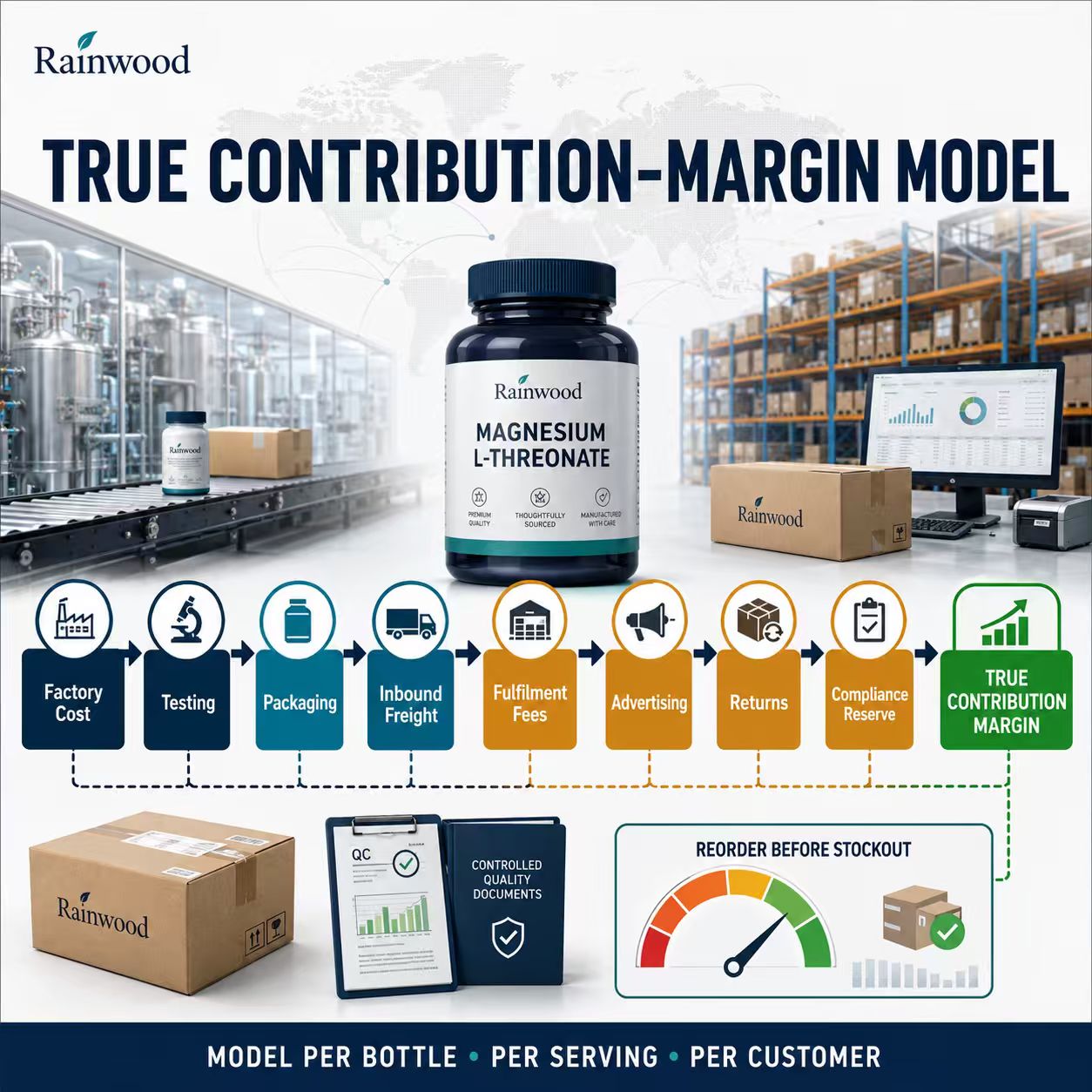
Build a true contribution-margin model
Include:
- finished product;
- testing;
- packaging components;
- inbound freight and duties;
- prep and labelling;
- platform referral and fulfilment fees;
- storage;
- advertising;
- discounts;
- returns and replacements;
- payment processing;
- customer support; and
- reserve for rework or compliance.
Run the model per bottle, per serving and per acquired customer. A product with a higher factory cost may win if it fits a better package, earns repeat orders and avoids rework.
Frequently asked questions
1.Should Amazon sellers always choose the smallest bottle?
No. The bottle must protect the product, fit the count, accommodate sealing and present the product honestly. Optimise the complete pack within current fulfilment rules.
2.Is powder cheaper than capsules for e-commerce?
It can reduce capsule and filling costs, but introduces scoop, taste, moisture, seal and container questions. Compare delivered cost and consumer fit, not one manufacturing step.
3.Can a contract manufacturer guarantee Amazon approval?
No responsible supplier should guarantee a third party’s decision. It can provide accurate documents and manufacture to agreed requirements; the seller remains responsible for its account and listing.
4.What information is needed for a realistic quotation?
Target market, formula, serving, unit count, package, projected volume, test plan, channel and desired launch date.
Calculate the cost Amazon customers actually create
Send us your target serving, bottle count, marketplace, sales forecast and desired retail price. We can help identify the manufacturing and packaging assumptions that should be tested before the order.
**Request an e-commerce magnesium L-threonate cost review** **[INTERNAL LINK -> Contact or quotation page]**.
References
- US Food and Drug Administration, *Dietary Supplement Labeling Guide*.
- US Federal Trade Commission, *Health Products Compliance Guidance*.
- Commission Implementing Regulation (EU) 2024/2694.
- NIH Dietary Supplement Label Database, [Magtein label showing 2 g compound, 147 mg magnesium and three capsules](https://dsld.od.nih.gov/label/274903).
- NIH Dietary Supplement Label Database, [multi-form magnesium proprietary-blend label](https://dsld.od.nih.gov/label/288533).
*Marketplace fees and policies change. Verify current platform requirements directly. This article is general business information, not legal, medical or tax advice.*