 EN
EN


Meta title: Low-Cost Magnesium L-Threonate Manufacturing Risks
Meta description: Learn what a low magnesium L-threonate quote may omit, from elemental magnesium and testing to capsule capacity, packaging and compliance.
The deep-water problem: a cheap powder can be a different technical product
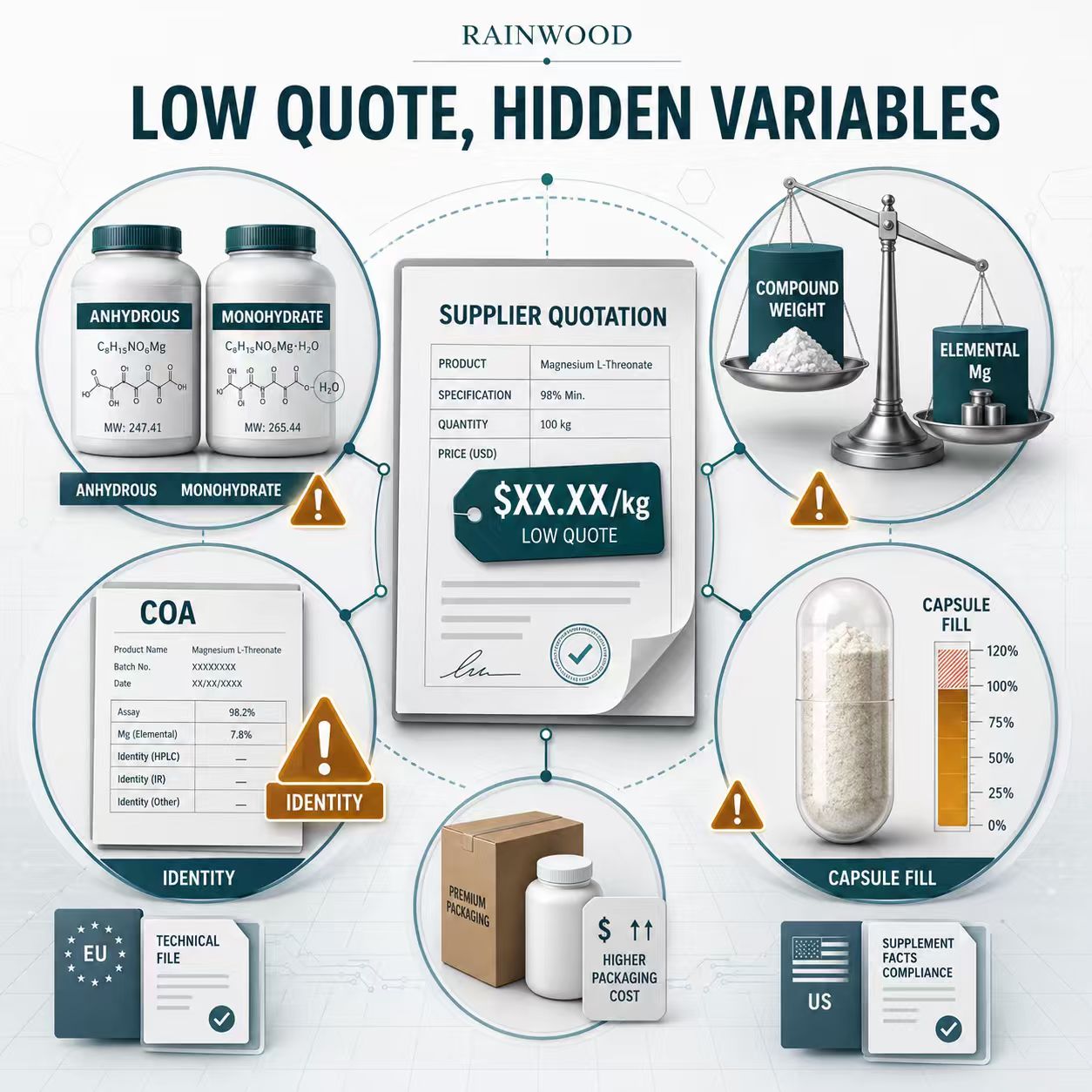
The most dangerous low quote is not necessarily counterfeit material. It is a material that carries the same English name while quietly changing the comparison basis. Magnesium L-threonate anhydrous and magnesium L-threonate monohydrate have different formula weights and CAS numbers. FDA substance records identify CAS 778571-57-6 for the anhydrous form, while the EU-authorised novel food is the monohydrate, CAS 500304-76-7. A supplier quoting one should not be allowed to borrow the other form’s specification or market-access file without evidence.
The “99%” line can also hide more than it reveals. In the UK safety assessment, the assay for the evaluated monohydrate is calculated from magnesium, threonate and water results rather than being a magic one-test proof of identity. Ask what the percentage measures, whether it is on an as-is or dry basis, and whether magnesium, L-threonate, water and identity were separately established. A broad titration, a company-standard calculation and a specific identity package do not have equal evidential value.
Manufacturing chemistry creates another layer of omissions. The assessed process oxidises ascorbic acid, forms calcium L-threonate, exchanges calcium for magnesium, removes calcium oxalate, decolourises, crystallises with ethanol and dries the material. That is why relevant controls can include oxalic acid, residual ethanol, water, calcium removal and stereochemical identity—not only lead, arsenic and total plate count. A bargain test panel that ignores the process may be cheap because it is looking for the wrong failures.
A magnesium L-threonate quote can look remarkably simple: a formula, a bottle count, a unit price and a lead time. The expensive surprises usually sit outside those four lines.
For a new supplement brand, the real question is not, “Who quoted the lowest price?” It is, “Are all suppliers quoting the same product, evidence package and launch scope?” A quote that excludes identity testing, compliant artwork review or realistic capsule capacity can become the most expensive option after reformulation, relabeling and delayed inventory are added.
This guide explains what may be missing and how to compare offers without assuming that every low quote is dishonest.
1. The quote may compare compound weight with elemental magnesium
Magnesium L-threonate is not 100% magnesium. The European Union specification for the authorised novel food, for example, defines magnesium L-threonate monohydrate with magnesium at 7.2%–8.3%. That means a large ingredient weight can provide a much smaller amount of elemental magnesium.
This distinction affects:
- the Supplement Facts calculation;
- the number and size of capsules;
- the cost per serving;
- the number of servings per bottle;
- front-label statements; and
- how consumers compare the product with other magnesium forms.
A quote stating “2,000 mg magnesium L-threonate” is not interchangeable with one stating “2,000 mg magnesium L-threonate providing X mg magnesium.” Ask every supplier to show both numbers and the calculation used.
Before approving a formula, review our magnesium L-threonate product specification checklist and require the final label value to be supported by the ingredient specification and finished-product controls.
2. A basic COA may not prove identity
A document titled “Certificate of Analysis” can be genuine and still be insufficient. Some certificates report only appearance, loss on drying and a broad assay result. They may not explain whether the method distinguishes magnesium L-threonate from other magnesium-containing material.
For a meaningful quality review, ask:
- Is the COA specific to the lot being supplied?
- Which method verifies identity?
- Which method measures magnesium?
- Is L-threonate or the complete compound characterised?
- Are heavy metals and microbiological limits appropriate for the target market?
- Is the laboratory internal, external or both?
- Can the supplier provide method references or representative chromatograms when justified?
US dietary supplement current good manufacturing practice requires an appropriate identity test or examination for dietary ingredients and specifications covering identity, purity, strength, composition and relevant contamination limits. A low quote that includes only a generic supplier COA may not include the verification work a responsible brand expects.
See our raw-material and finished-product quality control approach before comparing testing packages.
3. Capsule count may be based on an unrealistic fill assumption
Magnesium L-threonate formulas often involve a meaningful gram weight per daily serving. The required capsule count depends on the powder’s bulk density, flow, excipients, capsule material and manufacturing equipment—not just the theoretical capsule volume.
A paper calculation can therefore produce an attractive “two capsules per serving” concept that fails during a production trial. The correction may require:
- more capsules per serving;
- a larger capsule that consumers dislike;
- a lower compound weight;
- extra flow agents;
- a larger bottle; or
- a different delivery format.
Each change affects cost and positioning. A reliable quotation should state the assumed capsule size, target fill weight, estimated daily count and whether a bench or pilot fill has confirmed feasibility.
Our capsule, tablet and powder format guide explains the commercial trade-offs in more detail.
4. Packaging may be priced as a placeholder
“Bottle and label included” does not define a packaging system. Bottle resin, colour, count, neck finish, closure, induction seal, desiccant, label stock, print finish, carton and case pack all influence the final cost.
For e-commerce, package dimensions also affect fulfilment and freight economics. For retail, shelf impact and barcode placement matter. A supplier may quote a basic stock package and later add charges when the brand requests a matte label, custom colour, tamper-evident feature or retail carton.
Ask the supplier to separate:
1. stock packaging;
2. optional upgrades;
3. one-time setup charges;
4. custom-component minimums; and
5. freight and pallet assumptions.
The goal is not to reject low-cost packaging. It is to know exactly which version the unit price represents.
5. Artwork and claims review may not be included
Magnesium L-threonate is frequently positioned around cognition, sleep or healthy ageing. That positioning creates claim risk.
In the United States, structure/function claims used in dietary supplement labeling require substantiation, the statutory disclaimer and notification to FDA within 30 days after first marketing. Advertising is also subject to the FTC’s requirement that objective health claims be truthful, not misleading and supported by competent and reliable scientific evidence.
The EU follows a different framework. Magnesium L-threonate has specific novel-food conditions, and health claims must be assessed under the applicable EU rules and authorised-claims framework. A US label should never be copied into an EU launch without market-specific review.
A very low manufacturing quote may include printing the artwork exactly as supplied but exclude regulatory review. Clarify who is responsible for:
- Supplement Facts or nutrition declarations;
- ingredient naming;
- warnings and mandatory statements;
- claim substantiation;
- trademark review;
- barcode and net-content presentation; and
- final proofreading.
Explore our market-specific supplement labeling workflow before freezing artwork.
6. Small MOQ does not always mean low launch cost
A supplier may offer a low unit minimum while charging separately for setup, testing, label plates, cartons, stability work or expedited components. Another may quote a higher MOQ but include more of the launch package.
Compare the total cash required to release sellable inventory:
> Formula and ingredients + manufacturing + testing + packaging + artwork + setup + freight + duties + launch reserve
Also compare the cost per usable serving, not only the cost per bottle. If one offer provides fewer servings or requires an additional daily capsule, the bottle price alone is misleading.
A practical quote-comparison checklist
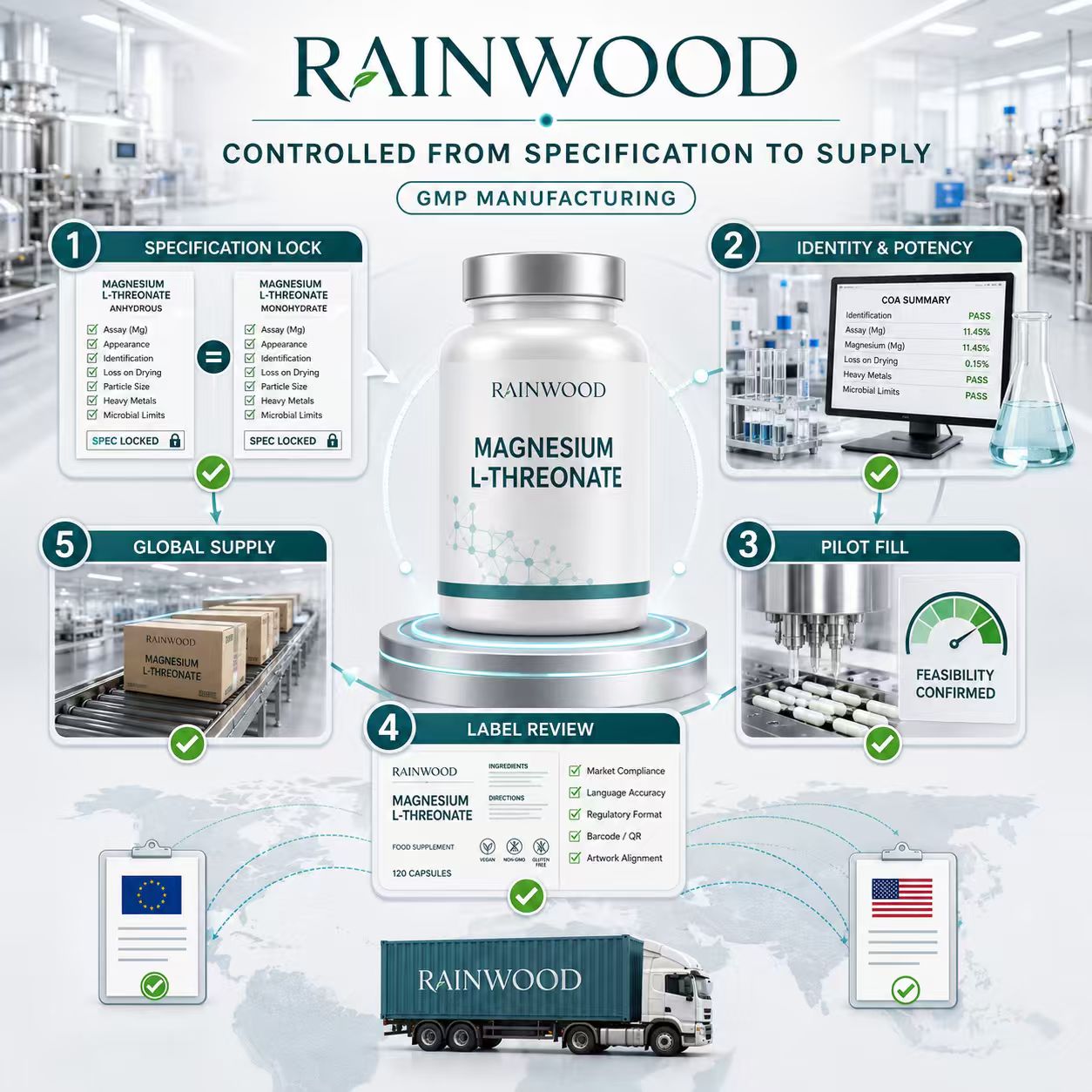
Before choosing a contract manufacturer, request a written answer for each item:
- exact ingredient identity and source;
- compound weight and elemental magnesium per serving;
- capsule size, count and fill feasibility;
- finished-product specifications;
- identity, potency and contaminant testing;
- packaging components and optional upgrades;
- market and label-review responsibility;
- one-time and recurring charges;
- realistic production lead time;
- ownership of artwork and custom components;
- change-control process; and
- complaint and nonconformance procedure.
If two quotes are still far apart after these items are aligned, ask each supplier to explain the cost drivers. Transparent suppliers should be able to discuss specifications without attacking competitors or hiding behind “premium quality.”
Frequently asked questions
1.Is a low magnesium L-threonate price automatically suspicious?
No. Scale, packaging simplicity, ingredient purchasing and production efficiency can create legitimate savings. The warning sign is a quote that cannot be mapped to a clear specification and scope.
2.Should a startup choose the smallest possible MOQ?
Not always. Choose a quantity that protects cash while keeping testing, packaging and freight economical. A slightly larger run may have a lower landed cost per serving, but only if the sales plan can move the inventory within its shelf life.
3.Can one COA support the finished label?
An ingredient COA is only one part of the evidence. The finished batch still needs specifications and appropriate verification under the rules and quality plan that apply to the product and market.
Turn a cheap quote into a comparable quote
Send us your target market, serving concept, preferred format, bottle count and any quotations you are already reviewing. We can help build a like-for-like specification and identify the questions that should be answered before you place an order.
Request a magnesium L-threonate quotation review.
References
- US Food and Drug Administration, *Current Good Manufacturing Practice in Manufacturing, Packaging, Labeling, or Holding Operations for Dietary Supplements*.
- US Food and Drug Administration, *Notifications for Structure/Function and Related Claims in Dietary Supplement Labeling*.
- US Federal Trade Commission, *Health Products Compliance Guidance*.
- Commission Implementing Regulation (EU) 2024/2694 on magnesium L-threonate.
- UK Advisory Committee on Novel Foods and Processes, [Advice on the safety of magnesium L-threonate](https://acnfp.food.gov.uk/ACNFPAdviceonthesafetyofMagnesiumL-threonateasanovelfoodforuseinfoodsupplements).
- US FDA Global Substance Registration System, [magnesium L-threonate anhydrous](https://precision.fda.gov/uniisearch/srs/unii/1y26zz0otm).
*This article provides general business and regulatory information, not legal or medical advice. Requirements should be confirmed for the product, claims and country of sale.*